2008 CHRYSLER 300 tire type
[x] Cancel search: tire typePage 382 of 519
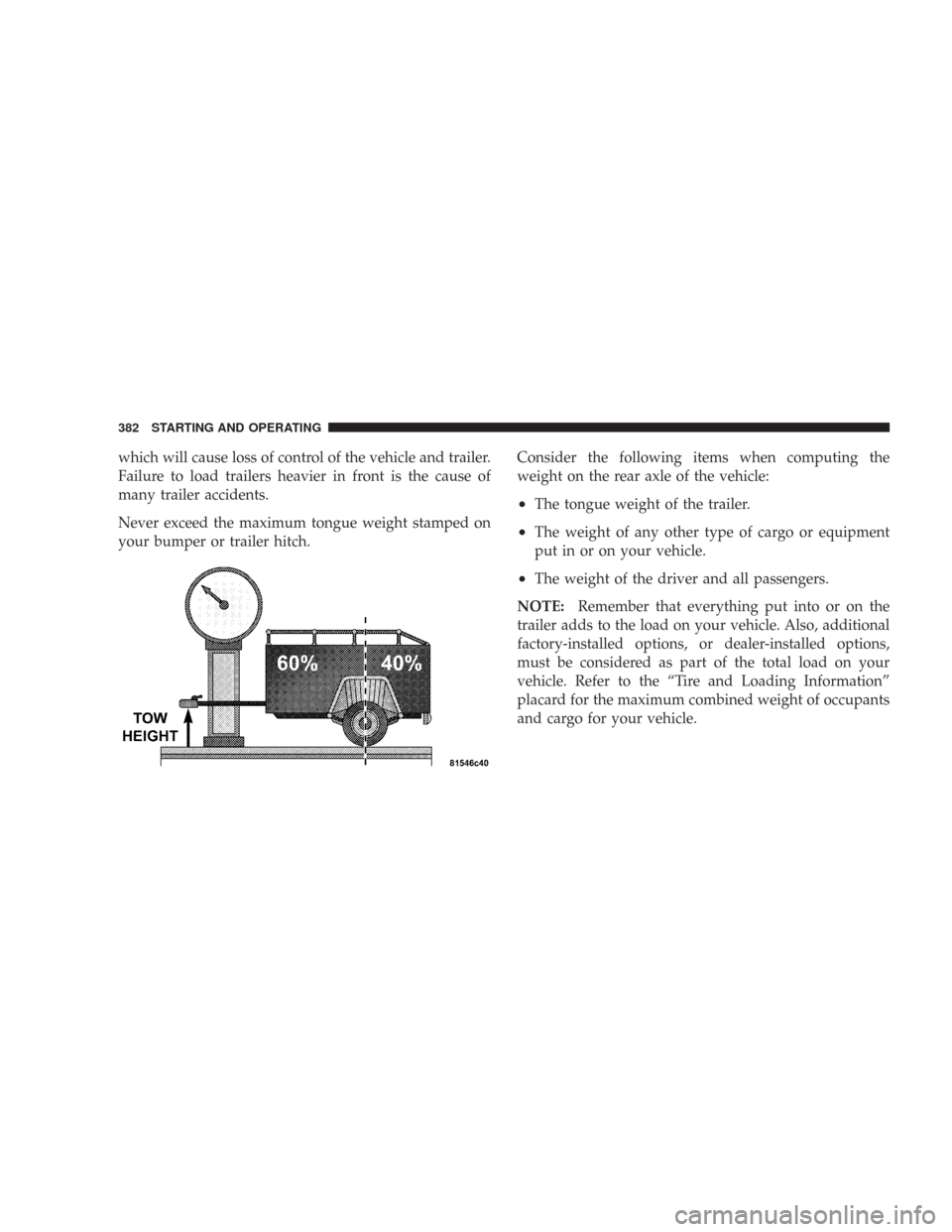
which will cause loss of control of the vehicle and trailer.
Failure to load trailers heavier in front is the cause of
many trailer accidents.
Never exceed the maximum tongue weight stamped on
your bumper or trailer hitch.Consider the following items when computing the
weight on the rear axle of the vehicle:
•The tongue weight of the trailer.
•The weight of any other type of cargo or equipment
put in or on your vehicle.
•The weight of the driver and all passengers.
NOTE:Remember that everything put into or on the
trailer adds to the load on your vehicle. Also, additional
factory-installed options, or dealer-installed options,
must be considered as part of the total load on your
vehicle. Refer to the “Tire and Loading Information”
placard for the maximum combined weight of occupants
and cargo for your vehicle.
382 STARTING AND OPERATING
Page 404 of 519

correct tightness of each lug nut is 100 ft/lb. (135 N. m).
If in doubt about the correct tightness, have them
checked with a torque wrench by your dealer or at a
service station.
7. For vehicles equipped with center caps, install the
center cap by hand. Do not use a hammer or excessive
force to install the center cap.
8. Stow the jack, tools, and spare tire. Make sure the base
of the jack faces the rear of the vehicle before tightening
down the fastener.
WARNING!
A loose tire or jack thrown forward in a collision or
hard stop could endanger the occupants of the ve-
hicle. Always stow the jack parts and the spare tire in
the places provided.
JUMP-STARTING PROCEDURES
WARNING!
•Take care to avoid the radiator cooling fan whenever the hood is
raised. It can start anytime the ignition switch is on. You can be hurt
by the fan.
•Do not attempt to push or tow your vehicle to get it started. Vehicles
equipped with an automatic transmission cannot be started this
way. Unburned fuel could enter the catalytic converter and once the
engine has started, ignite and damage the converter and vehicle. If
the vehicle has a discharged battery, booster cables may be used to
obtain a start from another vehicle. This type of start can be
dangerous if done improperly, so follow this procedure carefully.
•Battery fluid is a corrosive acid solution; do not allow battery fluid
to contact eyes, skin, or clothing. Don’t lean over battery when
attaching clamps or allow the clamps to touch each other. If acid
splashes in eyes or on skin, flush contaminated area immediately
with large quantities of water.
•A battery generates hydrogen gas, which is flammable and explo-
sive. Keep flame or spark away from the vent holes.
•Do not use a booster battery or any other booster source with an
output that exceeds 12 volts.
•The battery in this vehicle has a vent hose that should not be
disconnected and should only be replaced with a battery of the
same type (vented).
404 WHAT TO DO IN EMERGENCIES
Page 426 of 519

Spark Plugs
Spark plugs must fire properly to assure engine perfor-
mance and emission control. New plugs should be in-
stalled at the specified mileage. The entire set should be
replaced if there is any malfunction due to a faulty spark
plug. Malfunctioning spark plugs can damage the cata-
lytic converter. Refer to “Fluids, Lubricants, and Genuine
Parts” in this section for the proper type of spark plug for
use in your vehicle.
Engine Air Cleaner Filter
Refer to the “Maintenance Schedule” in Section 8 of this
manual for engine air cleaner filter maintenance inter-
vals.
NOTE:Be sure to follow the “dusty or off-road condi-
tions” maintenance interval if applicable.
WARNING!
The air induction system (air cleaner, hoses, etc) can
provide a measure of protection in the case of engine
backfire. Do not remove the air induction system (air
cleaner, hoses, etc) unless such removal is necessary
for repair or maintenance. Make sure that no one is
near the engine compartment before starting the
vehicle with the air induction system (air cleaner,
hoses, etc) removed. Failure to do so can result in
serious personal injury.
Fuel Filter
A plugged fuel filter can cause stalling, limit the speed at
which a vehicle can be driven or cause hard starting.
Should an excessive amount of dirt accumulate in the
fuel tank, filter replacement may be necessary. See your
authorized dealer for service.
426 MAINTAINING YOUR VEHICLE
Page 436 of 519

Coolant Checks
Check engine coolant (antifreeze) protection every 12
months (before the onset of freezing weather, where
applicable). If coolant is dirty or rusty in appearance, the
system should be drained, flushed, and refilled with
fresh coolant. Check the front of the A/C condenser for
any accumulation of bugs, leaves, etc. If dirty, clean by
gently spraying water from a garden hose vertically
down the face of the condenser.
Check the coolant recovery bottle tubing for brittle rub-
ber, cracking, tears, cuts, and tightness of the connection
at the bottle and radiator. Inspect the entire system for
leaks.
With the engine at normal operating temperature (but
not running), check the cooling system pressure cap for
proper vacuum sealing by draining a small amount of
coolant from the radiator drain cock. If the cap is sealing
properly, the engine coolant (antifreeze) will begin todrain from the coolant recovery bottle. DO NOT RE-
MOVE THE COOLANT PRESSURE CAP WHEN THE
COOLING SYSTEM IS HOT.
Cooling System — Drain, Flush, and Refill
The system should be drained, flushed, and refilled at the
intervals shown in the “Maintenance Schedule” in Sec-
tion 8 of this manual.
If the solution is dirty or contains a considerable amount
of sediment, clean and flush with a reliable cooling
system cleaner. Follow with a thorough rinsing to remove
all deposits and chemicals. Properly dispose of old
antifreeze solution.
Selection of Coolant
Use only the manufacturer’s recommended coolant. Re-
fer to “Fluids, Lubricants, and Genuine Parts” for the
correct coolant type.
436 MAINTAINING YOUR VEHICLE
Page 519 of 519

INTRODUCTION INTRODUCTION HOW TO USE THIS MANUAL WARNINGS AND CAUTIONS VEHICLE IDENTIFICATION NUMBER VEHICLE MODIFICATIONS / ALTERATIONS THINGS TO KNOW BEFORE STARTING YOUR VEHICLE A WORD ABOUT YOUR KEYS
Wireless Ignition Node (WIN)Fob with Integrated KeyTip Start FeatureIgnition Key RemovalKey-In-Ignition ReminderSENTRY KEY Replacement KeysCustomer Key (Fob) ProgrammingGeneral InformationSECURITY ALARM SYSTEM - IF EQUIPPED Rearming of the
SystemTo Arm the SystemTo Disarm the SystemILLUMINATED ENTRY SYSTEM REMOTE KEYLESS ENTRY To unlock the doorsTo lock the doorsTo unlatch the trunkUsing The Panic AlarmProgramming Additional TransmittersTransmitter Battery ServiceGeneral Information
REMOTE STARTING SYSTEM - IF EQUIPPED How To Use Remote StartDOOR LOCKS Manual Door LocksPower Door LocksChild Protection Door LockWINDOWS Power WindowsWind BuffetingTRUNK LOCK AND RELEASE TRUNK SAFETY WARNING Trunk
Emergency Release OCCUPANT RESTRAINTS Lap/Shoulder BeltsLap/Shoulder Belt Untwisting ProcedureSeat Belt PretensionersEnhanced Seat Belt Reminder System (BeltAlert) Automatic Locking Mode - If EquippedSeat Belts and Pregnant WomenSeat Belt Extender
Driver and Front Passenger Supplemental Restraint System (SRS) - AirbagEvent Data Recorder (EDR)Child RestraintENGINE BREAK-IN RECOMMENDATIONSSAFETY TIPS Transporting PassengersLock Your VehicleExhaust GasSafety Checks You Should Make Inside
The VehiclePeriodic Safety Checks You Should Make Outside The VehicleUNDERSTANDING THE FEATURES OF YOUR VEHICLE MIRRORS Inside Day/Night MirrorAutomatic Dimming Inside Mirror - If EquippedOutside MirrorsExterior Mirrors Folding Feature - If Equipped
Outside Mirror Auto Dimmer - If EquippedOutside Mirrors with Turn Signal and Approach Lighting - If EquippedTilt in Reverse Feature - If EquippedPower Remote Control MirrorsHeated Remote Control Mirrors - If EquippedIlluminated Vanity Mirrors - If EquippedHANDS-FREE
COMMUNICATION (UConnect) - IF EQUIPPED OperationPhone Call FeaturesUConnect System FeaturesAdvanced Phone ConnectivityThings You Should Know About Your UConnect SystemGeneral InformationSEATS Power SeatsPower Reclining SeatsLumbar Support
Head RestraintsHeated Seats - If EquippedFolding Rear Seat DRIVER MEMORY SEAT - IF EQUIPPED Programming The Memory FeatureLinking and Unlinking theRemote Keyless Transmitter to the Memory FeatureMemory Position RecallEasy Entry/Exit Seat (Available
with Memory Seat Only)TO OPEN AND CLOSE THE HOOD LIGHTS Headlight SwitchAutomatic Headlights - If EquippedHeadlights On with Wipers (Available withAuto Headlights Only)SmartBeams - If EquippedHeadlight Time DelayDaytime Running Lights - If Equipped
Lights-on ReminderFog Lights - If EquippedMulti-Function LeverOverhead Console Map/Reading LightsInterior LightsWINDSHIELD WIPERS AND WASHERS Intermittent Wiper SystemMist FeatureWindshield WashersHeadlights On with Wipers (Available with Auto
Headlights Only)Rain Sensing Wipers - If EquippedAdding Washer FluidHEADLIGHT WASHERS - IF EQUIPPED Adding Washer FluidTILT/TELESCOPING STEERING COLUMN POWER TILT/TELESCOPING STEERING COLUMN - IF EQUIPPED ADJUSTABLE PEDALS
- IF EQUIPPED ELECTRONIC SPEED CONTROL Electronic Speed Control OperationTo ActivateTo Set At A Desired SpeedTo DeactivateTo Resume SpeedTo Vary the Speed SettingTo Accelerate For PassingADAPTIVE CRUISE CONTROL (ACC) - IF EQUIPPED Adaptive
Cruise Control (ACC) OperationActivating Adaptive Cruise Control (ACC)To ActivateTo Set a Desired SpeedTo CancelTo Turn OffTo Resume SpeedTo Varythe Speed SettingSetting the Following Distance in ACCAdaptive Cruise Control (ACC) MenuDisplay Warnings and
MaintenancePrecautions While Driving with ACCGeneral InformationREAR PARK ASSIST SYSTEM - IF EQUIPPED OVERHEAD CONSOLE Courtesy/Reading LightsSunglasses StorageGARAGE DOOR OPENER - IF EQUIPPED Programming HomeLinkGate
Operator/Canadian ProgrammingUsing HomeLinkReprogramming a Single HomeLink ButtonSecurityTroubleshooting TipsGeneral InformationPOWER SUNROOF - IF EQUIPPED Opening Sunroof - ExpressClosing Sunroof - ExpressPinch Protect FeaturePinch Protect
OverrideVenting Sunroof - ExpressSunshade OperationWind BuffetingSunroof MaintenanceIgnition Off OperationSunroof Fully ClosedELECTRICAL POWER OUTLETS Electrical Outlet Use With Engine OffCUP HOLDERS Front Seat Cup HoldersRear Seat Cup Holders
STORAGE Console FeaturesCargo AreaLOAD LEVELING SYSTEM - IF EQUIPPED UNDERSTANDING YOUR INSTRUMENT PANEL INSTRUMENT PANEL AND CONTROLS BASE INSTRUMENT CLUSTER PREMIUM INSTRUMENT CLUSTER INSTRUMENT
CLUSTER DESCRIPTIONS ELECTRONIC VEHICLE INFORMATION CENTER (EVIC) - IF EQUIPPED Electronic Vehicle Information Center (EVIC) DisplaysOil ChangeRequiredTrip FunctionsCompass DisplayTelephone - If EquippedNavigation - If EquippedPersonal
Settings (Customer Programmable Features)SETTING THE ANALOG CLOCK RADIO GENERAL INFORMATION Radio Broadcast SignalsTwo Types of SignalsElectrical DisturbancesAM ReceptionFM ReceptionSALES CODE REN - MULTIMEDIA SYSTEM - IF EQUIPPED
Operating Instructions - Satellite Radio (If Equipped)Operating Instructions - Hands-Free Communication (UConnect) (If Equipped)Clock SettingProcedureSALES CODE REQ - AM/FM STEREO RADIO AND 6-DISC CD/DVD CHANGER (MP3/WMA AUX JACK) Operating
Instructions - Radio ModeOperation Instructions - (DISC MODE for CD and MP3/WMA Audio Play, DVD-VIDEO)Notes On Playing MP3/WMA FilesLIST Button (DISC Mode for MP3/WMA Play)INFO Button (DISC Mode for MP3/WMA Play)SALES CODE RER - MULTIMEDIA
SYSTEM - IF EQUIPPED Operating Instructions - Satellite RadioOperating Instructions - Hands-Free Communication (UConnect) (If Equipped)Clock Setting ProcedureSALES CODE RES - AM/FM STEREO RADIO WITH CD PLAYER (MP3 AUX JACK) Operating Instructions
- Radio ModeOperation Instructions - CD MODE for CD and MP3 Audio PlayNotes On Playing MP3 FilesLIST Button (CD Mode for MP3 Play)INFO Button (CD Mode for MP3 Play)SATELLITE RADIO (RSC) - IF EQUIPPED (REQ AND RES RADIOS ONLY) System Activation
Electronic Serial Number/Sirius Identification Number (ENS/SID)Selecting Satellite ModeSatellite AntennaReception QualityOperating Instructions - Satellite ModeOperating Instructions - Hands Free Phone (If Equipped)Operating Instructions - Video Entertainment System
(VES) (If Equipped)VIDEO ENTERTAINMENT SYSTEM - IF EQUIPPED UNIVERSAL CONSUMER INTERFACE (UCI) - IF EQUIPPED Connecting the iPodControlling the iPod using Radio ButtonsPlay ModeList or Browse ModeREMOTE SOUND SYSTEM CONTROLS
- IF EQUIPPED CD/DVD DISC MAINTENANCE RADIO OPERATION AND CELLULAR PHONES CLIMATE CONTROLS Manual Air Conditioning and Heating System Automatic Temperature Control - If Equipped Operating TipsREAR WINDOW FEATURES Electric Rear
Window DefrosterSTARTING AND OPERATING STARTING PROCEDURES Automatic TransmissionNormal Starting (Tip Start)Extremely Cold Weather (below -20degrees F or -29 degrees C)If Engine Fails To StartAfter StartingENGINE BLOCK HEATER - IF EQUIPPED
AUTOMATIC TRANSMISSION Automatic Transmission - General InformationBrake/Transmission Shift Interlock System4 Speed Automatic Transmission5Speed Automatic TransmissionAUTOSTICK - IF EQUIPPED Autostick OperationALL WHEEL DRIVE - IF EQUIPPED
DRIVING ON SLIPPERY SURFACES AccelerationTractionDRIVING THROUGH WATER Flowing/Rising WaterShallow Standing WaterPARKING BRAKE BRAKE SYSTEM Anti-Lock Brake System - If EquippedPOWER STEERING MULTI DISPLACEMENT SYSTEM (MDS)
- 5.7L Engine Only TRACTION CONTROL SYSTEM (TCS) - IF EQUIPPED BRAKE ASSIST SYSTEM (BAS) - IF EQUIPPED ELECTRONIC STABILITY PROGRAM (ESP) -
IF EQUIPPED Synchronizing ESPESP/BAS Malfunction Indicator and ESP/TCS Indicator LightsTIRE SAFETY INFORMATION Tire Markings Tire Identification Number (TIN)Tire Loading and Tire PressureTIRES - GENERAL INFORMATION Tire PressureTire Inflation
PressuresRadial-Ply TiresCompact Spare Tire - If EquippedLimited Use Spare - If EquippedTire SpinningTread Wear IndicatorsLife of TireReplacement TiresAlignment And BalanceSELF-SEALING TIRES - IF EQUIPPED TIRE CHAINS SNOW TIRES TIRE ROTATION
RECOMMENDATIONS TIRE PRESSURE MONITOR SYSTEM (TPMS) -
IF EQUIPPED Base System - If EquippedPremium System - If EquippedGeneral InformationFUEL REQUIREMENTS 2.7L Engine3.5L and 5.7L EnginesReformulated GasolineGasoline/Oxygenate BlendsMMT In GasolineMaterials Added to FuelFuel System CautionsCarbon
Monoxide WarningsADDING FUEL Fuel Filler Cap (Gas Cap)Loose Fuel Filler Cap MessageVEHICLE LOADING Vehicle Certification LabelGross Vehicle Weight Rating (GVWR)Gross Axle Weight Rating (GAWR)OverloadingLoadingTRAILER TOWING Common Towing
DefinitionsTrailer Hitch ClassificationTrailer Towing Weights (Maximum Trailer Weight Ratings)Trailer and Tongue WeightTowing RequirementsTowing TipsRECREATIONAL TOWING (BEHIND MOTORHOME, ETC.) TOWING THIS VEHICLE BEHIND ANOTHER VEHICLE
(Flat towing with all four wheels on the ground)WHAT TO DO IN EMERGENCIES HAZARD WARNING FLASHER IF YOUR ENGINE OVERHEATS JACKING AND TIRE CHANGING Preparations For JackingJack Location/Spare Tire StowageJacking and Changing a Tire
Compact Spare TireWheel Cover or Center Cap Installation (If Required)JUMP-STARTING PROCEDURES FREEING A STUCK VEHICLE TOWING A DISABLED VEHICLE WITHOUT THE IGNITION KEYTOWING THIS VEHICLE BEHIND ANOTHER VEHICLE (Flat towing
with all four wheels on the ground)TOWING THIS VEHICLE BEHIND ANOTHER VEHICLE WITH A TOW DOLLYMAINTAINING YOUR VEHICLE 2.7L ENGINE COMPARTMENT 3.5L ENGINE COMPARTMENT 5.7L ENGINE COMPARTMENT ONBOARD DIAGNOSTIC
SYSTEM - OBD II Loose Fuel Filler CapEMISSIONS INSPECTION AND MAINTENANCE PROGRAMS REPLACEMENT PARTS DEALER SERVICE MAINTENANCE PROCEDURES EngineOilEngine Oil FilterDrive Belts - Check Condition and TensionSpark PlugsEngine
Air Cleaner FilterFuel FilterCatalytic ConverterMaintenance-Free BatteryAir Conditioner MaintenanceA/C Air Filter - If EquippedPower Steering - Fluid CheckFront and Rear Suspension Ball JointsSteering LinkageBody LubricationWindshield Wiper BladesWindshield
Washers/Headlight Washers - If EquippedExhaust SystemCooling SystemHoses and Vacuum/Vapor HarnessesFuel SystemBrake SystemAutomatic TransmissionAll Wheel Drive (AWD) - If EquippedFront and Rear Wheel BearingsAppearance Care and Protection from
CorrosionCleaning the Center Console Cup HoldersFUSES (POWER DISTRIBUTION CENTERS) Fuses (Front Power Distribution Center)Fuses (Rear Power Distribution Center)VEHICLE STORAGE REPLACEMENT BULBS BULB REPLACEMENT Low Beam Headlight,
High Beam Headlight, Park/Turn Light, Inner Park Light, and Outer Park Light - 300 ModelsLow Beam Headlight, High Beam Headlight, and Park/Turn Light- 300CBackup Light, Side Marker Light, and Tail/Stop Turn Light - 300 ModelsTail/Stop, Tail, Turn Signal Light, and
Backup Light - 300C ModelsLicense LightFLUIDS AND CAPACITIES FLUIDS, LUBRICANTS, AND GENUINE PARTS EngineChassisMAINTENANCE SCHEDULES EMISSIONCONTROL SYSTEM MAINTENANCE MAINTENANCE SCHEDULE Required Maintenance
IntervalsIF YOU NEED CONSUMER ASSISTANCE SUGGESTIONS FOR OBTAINING SERVICE FOR YOUR VEHICLE Prepare For The AppointmentPrepare A ListBe Reasonable With RequestsIF YOU NEED ASSISTANCE WARRANTY INFORMATION (U.S. Vehicles
Only) MOPAR PARTS REPORTING SAFETY DEFECTS In CanadaPUBLICATION ORDER FORMS DEPARTMENT OF TRANSPORTATION UNIFORM TIRE QUALITY GRADES TreadwearTraction GradesTemperature GradesINDEX