2008 CHRYSLER 300 radiator
[x] Cancel search: radiatorPage 438 of 519

•Use only high purity water such as distilled or deion-
ized water when mixing the water/engine coolant
solution. The use of lower quality water will reduce
the amount of corrosion protection in the engine
cooling system.
Please note that it is the owner’s responsibility to main-
tain the proper level of protection against freezing ac-
cording to the temperatures occurring in the area where
the vehicle is operated.
NOTE:Mixing coolant types will decrease the life of the
engine coolant and will require more frequent coolant
changes.
Cooling System Pressure Cap
The cap must be fully tightened to prevent loss of
coolant, and to insure that coolant will return to the
radiator from the coolant recovery bottle.The cap should be inspected and cleaned if there is any
accumulation of foreign material on the sealing surfaces.
WARNING!
•The warning words “DO NOT OPEN HOT” on
the cooling system pressure cap are a safety pre-
caution. Never add coolant when the engine is
overheated. Do not loosen or remove the cap to
cool an overheated engine. Heat causes pressure to
build up in the cooling system. To prevent scald-
ing or injury, do not remove the pressure cap while
the system is hot or under pressure.
•Do not use a pressure cap other than the one
specified for your vehicle. Personal injury or en-
gine damage may result.
438 MAINTAINING YOUR VEHICLE
Page 439 of 519

Disposal of Used Coolant
Used ethylene glycol based engine coolant is a regulated
substance requiring proper disposal. Check with your
local authorities to determine the disposal rules for your
community. To prevent ingestion by animals or children,
do not store ethylene glycol based engine coolant in open
containers or allow it to remain in puddles on the
ground. If ingested by a child, contact a physician
immediately. Clean up any ground spills immediately.
Coolant Level
The coolant bottle provides a quick visual method for
determining that the coolant level is adequate. With the
engine off and cold, the level of the coolant in the bottle
should be between the ranges indicated on the bottle.
The radiator normally remains completely full, so there is
no need to remove the radiator cap unless checking for
coolant freeze point or replacing coolant. Advise yourservice attendant of this. As long as the engine operating
temperature is satisfactory, the coolant bottle need only
be checked once a month.
When additional coolant is needed to maintain the
proper level, it should be added to the coolant bottle. Do
not overfill.
Points To Remember
NOTE:When the vehicle is stopped after a few miles
(kilometers) of operation, you may observe vapor coming
from the front of the engine compartment. This is nor-
mally a result of moisture from rain, snow, or high
humidity accumulating on the radiator and being vapor-
ized when the thermostat opens, allowing hot coolant to
enter the radiator.
If an examination of your engine compartment shows no
evidence of radiator or hose leaks, the vehicle may be
safely driven. The vapor will soon dissipate.
MAINTAINING YOUR VEHICLE 439
7
Page 440 of 519

•Do not overfill the coolant recovery bottle.
•Check coolant freeze point in the radiator and in the
coolant recovery bottle. If antifreeze needs to be
added, contents of coolant recovery bottle must also be
protected against freezing.
•If frequent coolant additions are required, or if the
level in the coolant recovery bottle does not drop when
the engine cools, the cooling system should be pres-
sure tested for leaks.
•Maintain coolant concentration at 50% HOAT engine
coolant (minimum) and distilled water for proper
corrosion protection of your engine, which contains
aluminum components.
•Make sure that the radiator and coolant recovery
bottle overflow hoses are not kinked or obstructed.
•Keep the front of the radiator clean. If your vehicle is
equipped with air conditioning, keep the front of the
condenser clean, also.
•Do not change the thermostat for summer or winter
operation. If replacement is ever necessary, install
ONLY the correct type thermostat. Other designs may
result in unsatisfactory coolant performance, poor gas
mileage, and increased emissions.
Hoses and Vacuum/Vapor Harnesses
Inspect surfaces of hoses and nylon tubing for evidence
of heat and mechanical damage. Hard or soft spots,
brittle rubber, cracking, tears, cuts, abrasions, and exces-
sive swelling indicate deterioration of the rubber.
Pay particular attention to those hoses nearest to high
heat sources such as the exhaust manifold. Inspect hose
routing to be sure hoses do not come in contact with any
heat source or moving component, which may cause heat
damage or mechanical wear.
440 MAINTAINING YOUR VEHICLE
Page 452 of 519
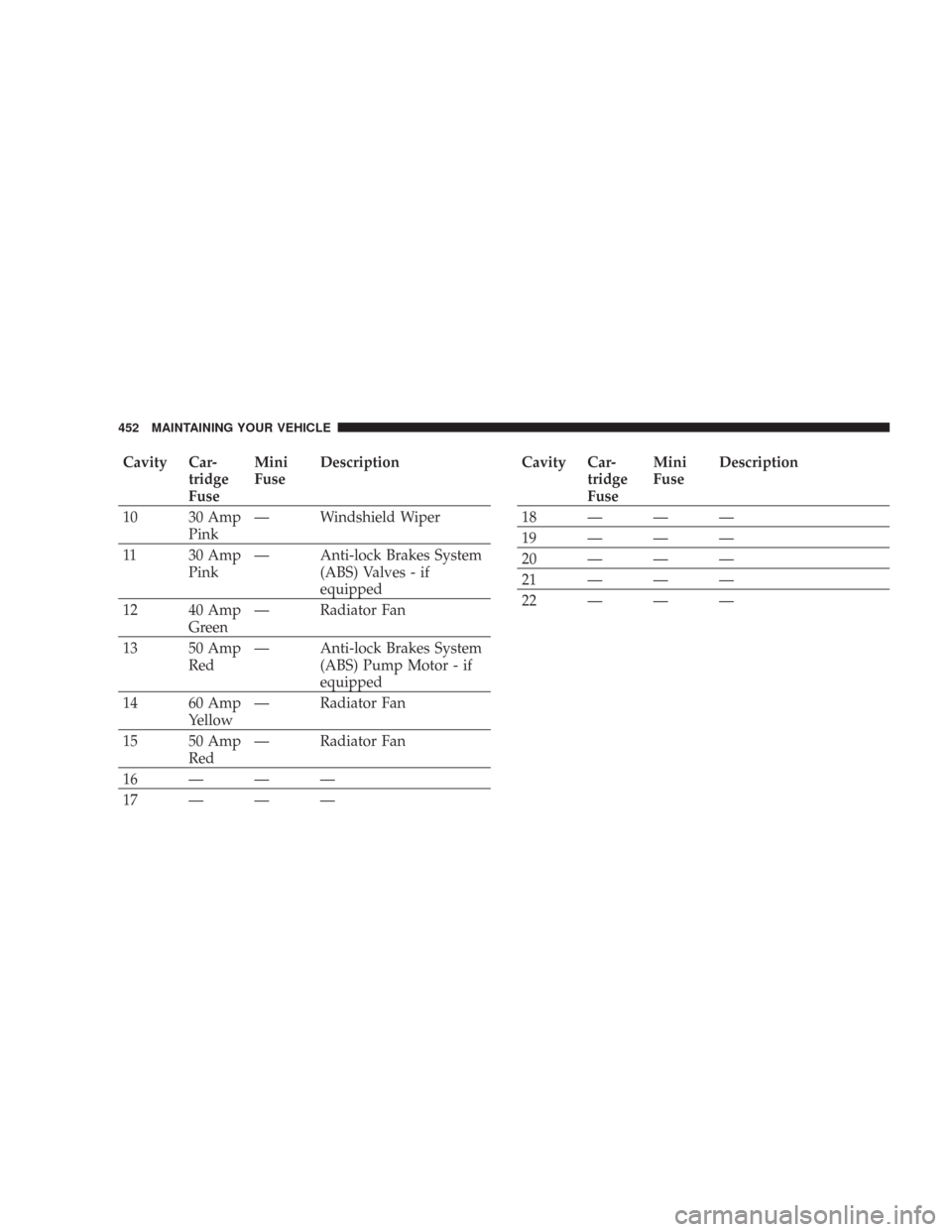
Cavity Car-
tridge
FuseMini
FuseDescription
10 30 Amp
Pink— Windshield Wiper
11 30 Amp
Pink— Anti-lock Brakes System
(ABS) Valves - if
equipped
12 40 Amp
Green— Radiator Fan
13 50 Amp
Red— Anti-lock Brakes System
(ABS) Pump Motor - if
equipped
14 60 Amp
Yellow— Radiator Fan
15 50 Amp
Red— Radiator Fan
16———
17———Cavity Car-
tridge
FuseMini
FuseDescription
18———
19———
20———
21———
22———
452 MAINTAINING YOUR VEHICLE
Page 498 of 519

Body Mechanism Lubrication............... 433
B-Pillar Location........................ 340
Brake Assist System...................... 330
Brake Control System, Electronic............. 330
Brake Fluid............................ 476
Brake, Parking.......................... 322
Brake System........................324,441
Anti-Lock (ABS)....................... 325
Fluid Check.......................443,476
Hoses.............................. 442
Master Cylinder....................... 443
Parking............................. 322
Warning Light.....................205,324
Brakes.............................324,441
Brake/Transmission Interlock............... 306
Break-In Recommendations, New Vehicle........ 76
Brightness, Interior Lights.................. 137
Bulb Replacement.....................459,460
Bulbs, Light..........................79,459Calibration, Compass..................... 222
Capacities, Fluid........................ 473
Caps, Filler
Fuel................................ 369
Oil (Engine).......................423,424
Radiator (Coolant Pressure)............... 438
Car Washes............................ 447
Carbon Monoxide Warning...............78,368
Cargo (Vehicle Loading)................... 372
Catalytic Converter...................... 427
CD (Compact Disc) Player...............234,252
Cellular Phone.....................91,252,253
Certification Label....................... 372
Chains, Tire............................ 353
Changing A Flat Tire..................... 394
Chart, Tire Sizing........................ 336
Check Engine Light
(Malfunction Indicator Light)............... 418
Checking Your Vehicle For Safety............. 77
498 INDEX
Page 499 of 519
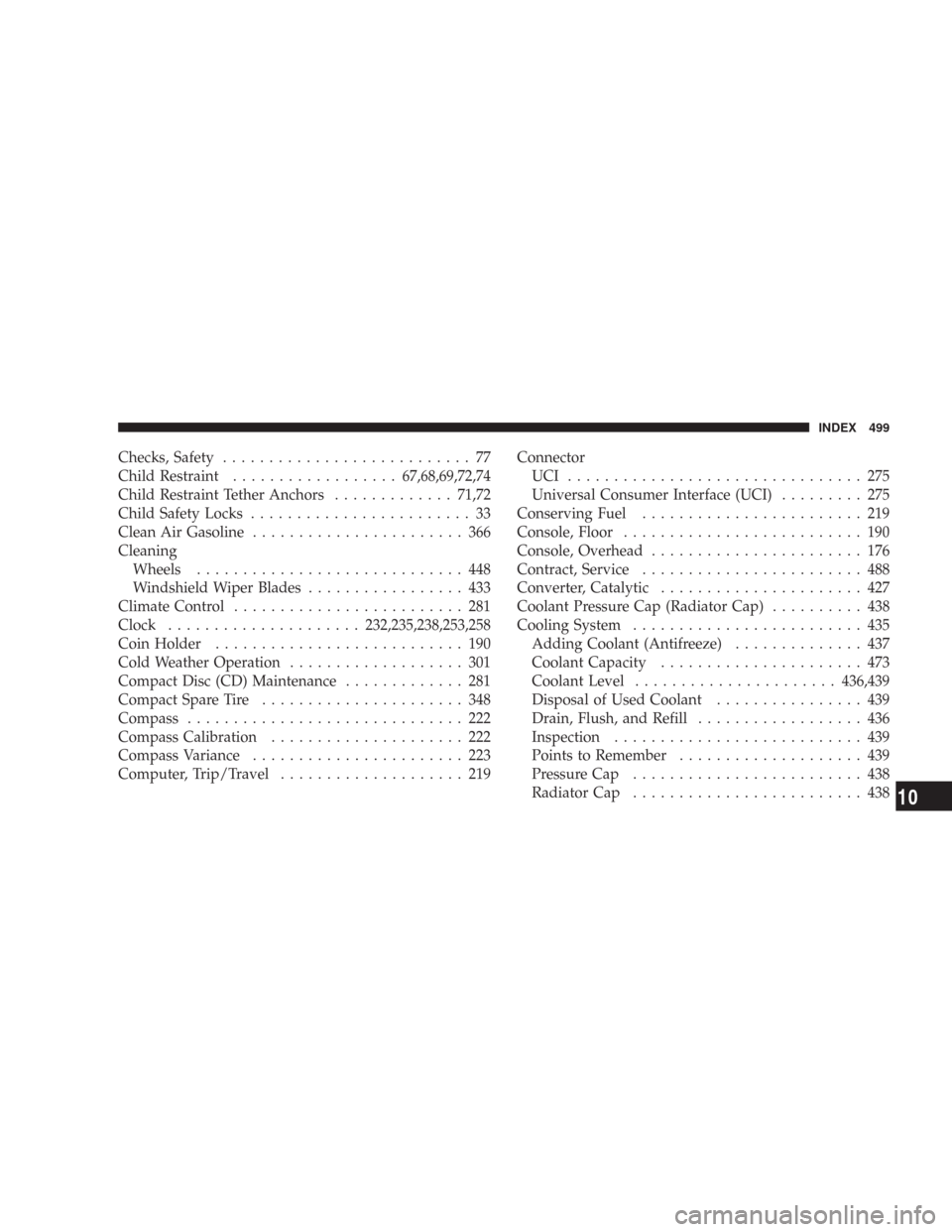
Checks, Safety........................... 77
Child Restraint..................67,68,69,72,74
Child Restraint Tether Anchors.............71,72
Child Safety Locks........................ 33
Clean Air Gasoline....................... 366
Cleaning
Wheels............................. 448
Windshield Wiper Blades................. 433
Climate Control......................... 281
Clock.....................232,235,238,253,258
Coin Holder........................... 190
Cold Weather Operation................... 301
Compact Disc (CD) Maintenance............. 281
Compact Spare Tire...................... 348
Compass.............................. 222
Compass Calibration..................... 222
Compass Variance....................... 223
Computer, Trip/Travel.................... 219Connector
UCI ................................ 275
Universal Consumer Interface (UCI)......... 275
Conserving Fuel........................ 219
Console, Floor.......................... 190
Console, Overhead....................... 176
Contract, Service........................ 488
Converter, Catalytic...................... 427
Coolant Pressure Cap (Radiator Cap).......... 438
Cooling System......................... 435
Adding Coolant (Antifreeze).............. 437
Coolant Capacity...................... 473
Coolant Level......................436,439
Disposal of Used Coolant................ 439
Drain, Flush, and Refill.................. 436
Inspection........................... 439
Points to Remember.................... 439
Pressure Cap......................... 438
Radiator Cap......................... 438
INDEX 499
10
Page 510 of 519

Parking On Hill......................... 322
Passing Light........................... 136
Pedals, Adjustable....................... 147
Personal Settings........................ 227
Pets.................................. 76
Phone, Cellular....................91,252,253
Phone, Hands-Free (UConnect™)........91,252,253
Placard, Tire and Loading Information......... 340
Port
Universal Serial Bus (USB).............234,252
USB .............................234,252
Power
Brakes.............................. 324
Deck Lid Release....................... 40
Distribution Center (Fuses)............... 451
Door Locks........................... 30
Mirrors.............................. 89
Outlet (Auxiliary Electrical Outlet).......... 187
Seats............................... 117Steering............................. 327
Steering, Checking..................... 432
Sunroof............................. 184
Tilt/Telescoping Steering Column........... 145
Windows............................. 36
Power Steering Fluid..................432,476
Pregnant Women and Seat Belts.............. 51
Preparation for Jacking.................... 395
Pretensioners
Seat Belts............................. 48
Programmable Electronic Features............ 227
Programming Transmitters
(Remote Keyless Entry).................... 20
Radial Ply Tires......................... 347
Radiator Cap (Coolant Pressure Cap).......... 438
Radio Broadcast Signals................... 232
Radio, Navigation....................... 252
Radio Operation...................234,253,281
510 INDEX