Page 297 of 520
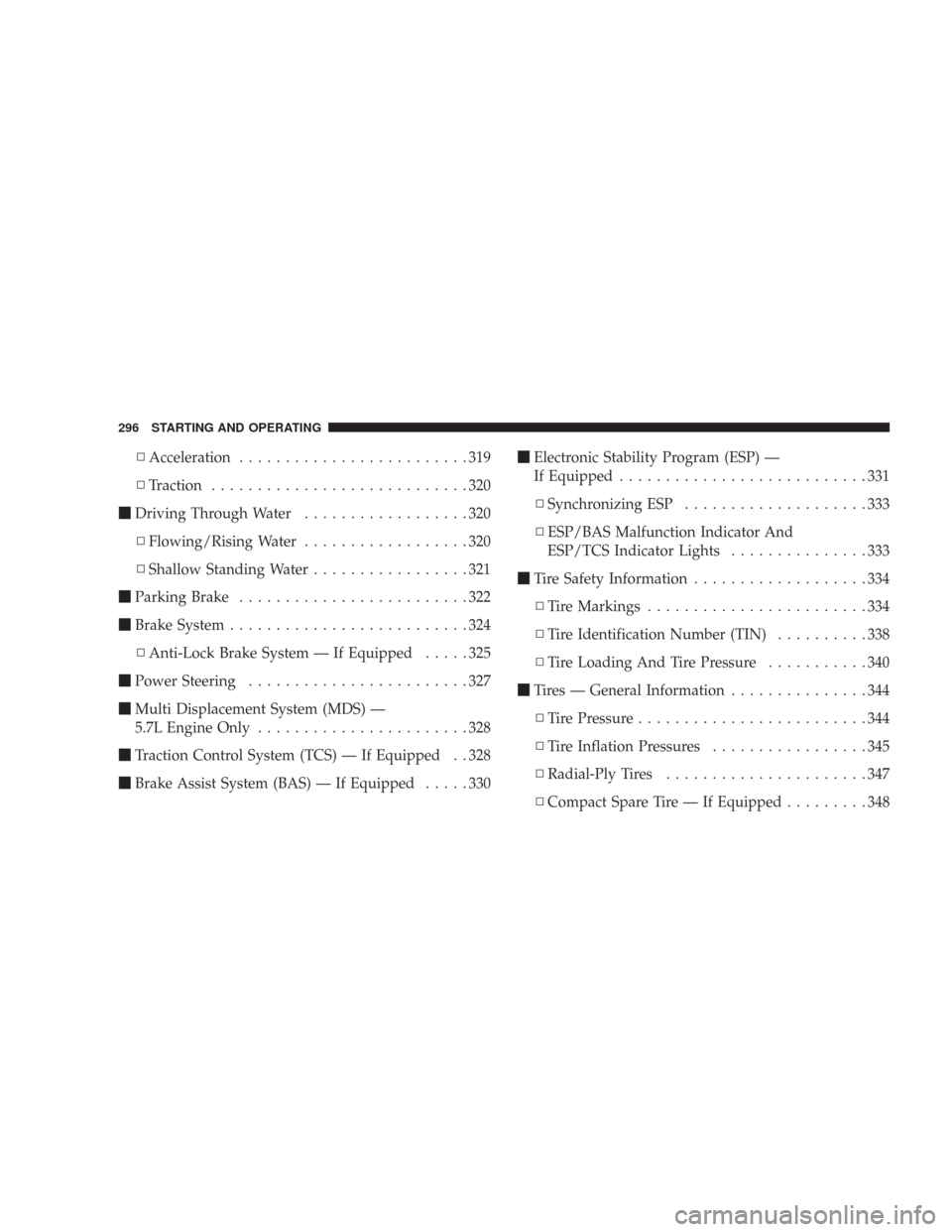
\3Acceleration.........................319
\3Traction............................320
\1Driving Through Water..................320
\3Flowing/Rising Water..................320
\3Shallow Standing Water.................321
\1Parking Brake.........................322
\1Brake System..........................324
\3Anti-Lock Brake System — If Equipped.....325
\1Power Steering........................327
\1Multi Displacement System (MDS) —
5.7L Engine Only.......................328
\1Traction Control System (TCS) — If Equipped . . 328
\1Brake Assist System (BAS) — If Equipped.....330\1Electronic Stability Program (ESP) —
If Equipped...........................331
\3Synchronizing ESP....................333
\3ESP/BAS Malfunction Indicator And
ESP/TCS Indicator Lights...............333
\1Tire Safety Information...................334
\3Tire Markings........................334
\3Tire Identification Number (TIN)..........338
\3Tire Loading And Tire Pressure...........340
\1Tires — General Information...............344
\3Tire Pressure.........................344
\3Tire Inflation Pressures.................345
\3Radial-Ply Tires......................347
\3Compact Spare Tire — If Equipped.........348
296 STARTING AND OPERATING
Page 306 of 520

•The electronically controlled transmission provides a
precise shift schedule. The transmission electronics are
self-calibrating. Therefore, the first few shifts on a new
vehicle may be somewhat abrupt or soft until after the
break-in period. This is a normal condition, and pre-
cision shifts will develop within a few shift cycles.
The selector lever is automatically locked while in the
“P” (Park) position. To move the selector lever out of the
“P” (Park) position, the brake pedal must be firmly
depressed before the shift lock will release.
Shift the selector lever to the desired position only when
the engine is idling normally and the brake pedal is
applied. Do not release the brake until ready to drive. The
vehicle may otherwise accelerate quickly when the selec-
tor lever is in “D” (Drive) or “R” (Reverse) position.WARNING!
Unintended movement of a vehicle could injure
those in and near the vehicle. As with all vehicles,
you should never exit a vehicle while the engine is
running. Before exiting a vehicle, you should always
shift the vehicle into “P” (Park), remove the key from
the ignition, and apply the parking brake. Once the
key is removed from the ignition, the transmission
selector lever is locked in the “P” (Park) position,
securing the vehicle against unwanted movement.
Furthermore, you should never leave children unat-
tended inside a vehicle.
STARTING AND OPERATING 305
5
Page 308 of 520
tab, which can be accessed through a hole inside the bin.
While the override is pressed, the shifter can be moved
out of the “P” (Park) position without pressing the brake.
After operation, return the rubber storage tray to its
original position.
4 Speed Automatic Transmission
Shifting from “D” (Drive) to “P” (Park) or “R” (Reverse)
(or from P or R to D) should be done only after the
accelerator pedal is released and the vehicle is stopped.
Be sure to keep your foot on the brake when moving the
selector lever between these gears.
Gear Ranges
“P” (Park)
“P” (Park) supplements the parking brake by locking the
transmission. The engine can be started in this range.
Selector Lever
STARTING AND OPERATING 307
5
Page 309 of 520

Never use “P” (Park) while the vehicle is in motion.
Apply the parking brake when leaving the vehicle in this
range.
When parking on a flat surface, place the gear selector in
the “P” (Park) position first, and then apply the parking
brake.
When parking on a hill, it is important to set the parking
brake before placing the gear selector in “P” (Park),
otherwise the load on the transmission locking mecha-
nism may make it difficult to move the selector out of
park. As an added precaution, turn the front wheels
toward the curb on a downhill grade and away from the
curb on an uphill grade.WARNING!
Never use “P” (Park) position on an automatic trans-
mission as a substitute for the parking brake. Always
apply parking brake fully when parked to guard
against vehicle movement and possible injury or
damage.
The following indicators should be used to ensure that
you have engaged the selector lever into the “P” (Park)
position:
•When shifting into “P’ (Park) move the lever all the
way forward until it stops, and is fully seated.
•Look at the shift indicator display on the instrument
panel to ensure it is in the “P” (Park) position.
308 STARTING AND OPERATING
Page 314 of 520
Gear Ranges
“P” (Park)
“P” (Park) supplements the parking brake by locking the
transmission. The engine can be started in this range.Never use “P” (Park) while the vehicle is in motion.
Apply the parking brake when leaving the vehicle in this
range.
When parking on a flat surface, place the gear selector in
the “P” (Park) position first, and then apply the parking
brake.
When parking on a hill, it is important to set the parking
brake before placing the gear selector in “P” (Park),
otherwise the load on the transmission locking mecha-
nism may make it difficult to move the selector out of
park. As an added precaution, turn the front wheels
toward the curb on a downhill grade and away from the
curb on an uphill grade.
Selector Lever
STARTING AND OPERATING 313
5
Page 315 of 520

WARNING!
Never use “P” (Park) position on an automatic trans-
mission as a substitute for the parking brake. Always
apply parking brake fully when parked to guard
against vehicle movement and possible injury or
damage.
The following indicators should be used to ensure that
you have engaged the selector lever into the “P” (Park)
position:
•When shifting into “P” (Park) move the lever all the
way forward until it stops, and is fully seated.
•Look at the shift indicator display on the instrument
panel to ensure it is in the “P” (Park) position.
CAUTION!
Damage to the shifter could result if the selector lever
is moved out of “P” (Park) before the ignition is
turned from the LOCK to ON position.
“R” (Reverse)
Shift into “R” (Reverse) gear only when the vehicle is
completely stopped.
“N” (Neutral)
No power is transmitted from the engine to the drive
axle. When the brakes are released, the vehicle can be
moved freely (pushed or towed). Do not engage “N”
(Neutral) position while driving except to coast when the
vehicle is in danger of skidding (e.g., on icy roads).
The engine may be started in this range. Use this range
for starting your vehicle if it is moving or being towed.
314 STARTING AND OPERATING
Page 323 of 520

WARNING!
•Driving through standing water limits your vehi-
cle’s traction capabilities. Do not exceed 5 mph (8
km/h) when driving through standing water.
•Driving through standing water limits your vehi-
cle’s braking capabilities, which increases stop-
ping distances. Therefore, after driving through
standing water, drive slowly and lightly press on
the brake pedal several times to dry the brakes.
•Getting water inside your vehicle’s engine can
cause it to lockup and stall out and leave you
stranded.
•Failure to follow these warnings may result in
injuries that are serious or fatal to you, your
passengers, and others around you.
PARKING BRAKE
The parking brake should always be applied when the
driver is not in the vehicle.
WARNING!
Never use “P” (Park) position on an automatic trans-
mission as a substitute for the parking brake. Always
apply parking brake fully when parked to guard
against vehicle movement and possible injury or
damage.
When parking on a flat surface, place the gear selector in
the “P” (Park) position first, and then apply the parking
brake.
When parking on a hill, it is important to apply the
parking brake before placing the gear selector in P (Park),
322 STARTING AND OPERATING
Page 324 of 520
otherwise the load on the transmission locking mecha-
nism may make it difficult to move the selector out of
park. As an added precaution, turn the front wheels
toward the curb on a downhill grade and away from the
curb on an uphill grade.
The foot operated parking brake is positioned below the
lower left corner of the instrument panel. To apply the
parking brake, push the parking brake pedal down and
then remove your foot from the pedal. To release the
parking brake, push down on the parking brake pedal
and then release.
The brake light in the instrument cluster will turn on
when the parking brake is applied and the ignition
switch is on.
NOTE:This light only shows that the parking brake is
applied. It does not show the degree of brake application.
Parking Brake
STARTING AND OPERATING 323
5


