2008 CHEVROLET SILVERADO belt
[x] Cancel search: beltPage 85 of 596

Passenger Sensing System
If your vehicle has one of the indicators pictured in the
following illustrations, then your vehicle has a passenger
sensing system for the right front passenger’s position,
unless there is an airbag off switch located in the glove
box. If there is an airbag off switch, your vehicle does not
have a passenger sensing system. SeeAirbag Off Switch
on page 1-78for more information.
The passenger airbag status indicator will be visible on
the overhead console when you start your vehicle.
The words ON and OFF, or the symbol for on and off,
will be visible during the system check. When the system
check is complete, either the word ON or the word OFF,
or the symbol for on or the symbol for off, will be visible.
SeePassenger Airbag Status Indicator on page 3-43.The passenger sensing system will turn off the right
front passenger’s frontal airbag under certain conditions.
The driver’s airbags are not part of the passenger
sensing system.
The passenger sensing system works with sensors that
are part of the right front passenger’s seat and safety
belt. The sensors are designed to detect the presence
of a properly-seated occupant and determine if the
right front passenger’s frontal airbag should be enabled
(may inate) or not.
Accident statistics show that children are safer if they
are restrained in the rear rather than the front seat.
We recommend that children be secured in a rear seat,
including: an infant or a child riding in a rear-facing
child restraint; a child riding in a forward-facing child
seat; an older child riding in a booster seat; and children,
who are large enough, using safety belts.
United States
Canada
1-81
Page 87 of 596
If a child restraint has been installed and the on
indicator is lit, turn the vehicle off. Remove the child
restraint from the vehicle and reinstall the child restraint
following the child restraint manufacturer’s directions
and refer toSecuring a Child Restraint in the Right Front
Seat Position (With Airbag Off Switch) on page 1-57
orSecuring a Child Restraint in the Right Front Seat
Position (With Passenger Sensing System) on page 1-62
orSecuring a Child Restraint in the Right Front Seat
Position (Heavy Duty Crew Cab Only) on page 1-66.
If, after reinstalling the child restraint and restarting the
vehicle, the on indicator is still lit, check to make sure that
the vehicle’s seatback is not pressing the child restraint
into the seat cushion. If this happens, slightly recline
the vehicle’s seatback and adjust the seat cushion if
possible. Also make sure the child restraint is not trapped
under the vehicle head restraint. If this happens, adjust
the head restraint. SeeHead Restraints on page 1-11.
Remove any additional material from the seat such as
blankets, cushions, seat covers, seat heaters, or seat
massagers before reinstalling or securing the child
restraint.If the on indicator is still lit, secure the child in the child
restraint in a rear seat position in the vehicle, and
check with your dealer/retailer. If no rear seat is
available, do not install a child restraint in this vehicle,
and check with your dealer/retailer.
The passenger sensing system is designed to enable
(may inate) the right front passenger’s frontal airbag
anytime the system senses that a person of adult size is
sitting properly in the right front passenger’s seat. When
the passenger sensing system has allowed the airbag to
be enabled, the on indicator will light and stay lit to remind
you that the airbag is active.
For some children who have outgrown child restraints
and for very small adults, the passenger sensing system
may or may not turn off the right front passenger’s frontal
airbag, depending upon the person’s seating posture
and body build. Everyone in your vehicle who has
outgrown child restraints should wear a safety belt
properly — whether or not there is an airbag for that
person.
1-83
Page 88 of 596
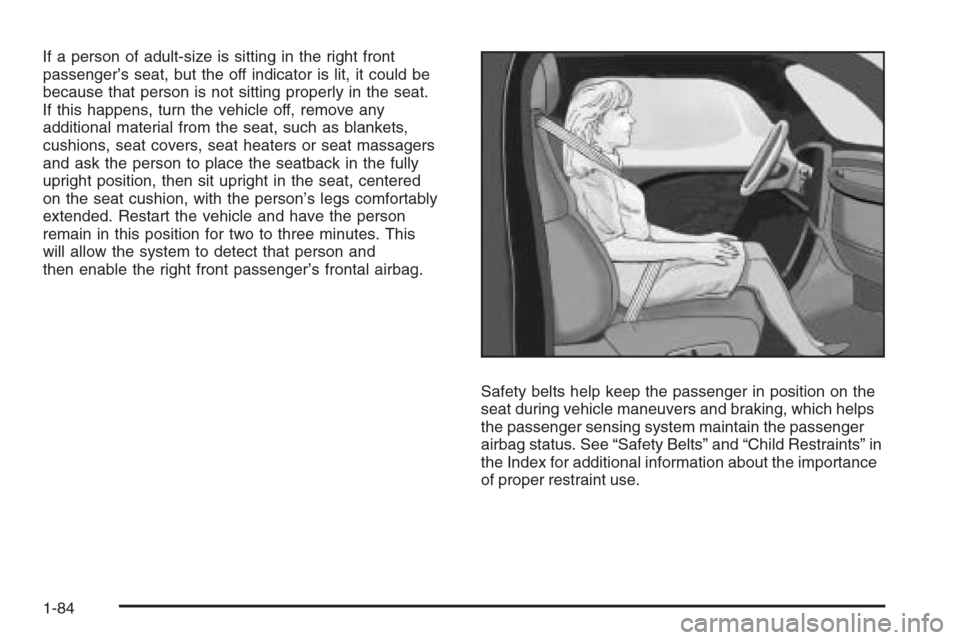
If a person of adult-size is sitting in the right front
passenger’s seat, but the off indicator is lit, it could be
because that person is not sitting properly in the seat.
If this happens, turn the vehicle off, remove any
additional material from the seat, such as blankets,
cushions, seat covers, seat heaters or seat massagers
and ask the person to place the seatback in the fully
upright position, then sit upright in the seat, centered
on the seat cushion, with the person’s legs comfortably
extended. Restart the vehicle and have the person
remain in this position for two to three minutes. This
will allow the system to detect that person and
then enable the right front passenger’s frontal airbag.
Safety belts help keep the passenger in position on the
seat during vehicle maneuvers and braking, which helps
the passenger sensing system maintain the passenger
airbag status. See “Safety Belts” and “Child Restraints” in
the Index for additional information about the importance
of proper restraint use.
1-84
Page 89 of 596
If you ever pull the shoulder portion of the belt out
all the way, you will engage the child restraint locking
feature. This may unintentionally cause the passenger
sensing system to turn the airbag(s) off for some adult
size occupants. If this happens, just let the belt go back
all the way and start again.
{CAUTION:
If the airbag readiness light in the instrument
panel cluster ever comes on and stays on,
it means that something may be wrong with
the airbag system. If this ever happens, have
the vehicle serviced promptly, because an
adult-size person sitting in the right front
passenger’s seat may not have the protection
of the airbag(s). SeeAirbag Readiness Light
on page 3-40for more on this, including
important safety information.A thick layer of additional material, such as a blanket or
cushion, or aftermarket equipment such as seat covers,
seat heaters, and seat massagers can affect how well the
passenger sensing system operates. We recommend
that you not use seat covers or other aftermarket
equipment other than any that GM has approved for
your specic vehicle. SeeAdding Equipment to Your
Airbag-Equipped Vehicle on page 1-86for more
information about modications that can affect how
the system operates.
{CAUTION:
Stowing of articles under the passenger’s
seat or between the passenger’s seat cushion
and seatback may interfere with the proper
operation of the passenger sensing system.
1-85
Page 90 of 596

Servicing Your Airbag-Equipped
Vehicle
Airbags affect how your vehicle should be serviced.
There are parts of the airbag system in several places
around your vehicle. Your dealer/retailer and the service
manual have information about servicing your vehicle
and the airbag system. To purchase a service manual,
seeService Publications Ordering Information on
page 7-15.
{CAUTION:
For up to 10 seconds after the ignition is
turned off and the battery is disconnected,
an airbag can still inate during improper
service. You can be injured if you are close
to an airbag when it inates. Avoid yellow
connectors. They are probably part of the
airbag system. Be sure to follow proper
service procedures, and make sure the person
performing work for you is qualied to do so.
Adding Equipment to Your
Airbag-Equipped Vehicle
Q:Is there anything I might add to or change
about the vehicle that could keep the airbags
from working properly?
A:Yes. If you add things that change your vehicle’s
frame, bumper system, height, front end or side
sheet metal, they may keep the airbag system from
working properly. Changing or moving any parts
of the front seats, safety belts, the airbag sensing
and diagnostic module, steering wheel, instrument
panel, roof-rail airbag modules, ceiling headliner
or pillar garnish trim, overhead console, front
sensors, rollover sensor module, or airbag wiring
can affect the operation of the airbag system.
1-86
Page 92 of 596
Restraint System Check
Checking the Restraint Systems
Safety Belts
Now and then, make sure the safety belt reminder light
and all your belts, buckles, latch plates, retractors
and anchorages are working properly.
Look for any other loose or damaged safety belt system
parts. If you see anything that might keep a safety belt
system from doing its job, have it repaired. Torn or frayed
safety belts may not protect you in a crash. They can rip
apart under impact forces. If a belt is torn or frayed, get a
new one right away.
Make sure the safety belt reminder light is working.
SeeSafety Belt Reminders on page 3-39for more
information.
Keep safety belts clean and dry. SeeCare of Safety
Belts on page 5-117.
Airbags
The airbag system does not need regularly scheduled
maintenance or replacement. Make sure the airbag
readiness light is working. SeeAirbag Readiness Light
on page 3-40for more information.
Notice:If an airbag covering is damaged, opened,
or broken, the airbag may not work properly.
Do not open or break the airbag coverings. If there
are any opened or broken airbag covers, have
the airbag covering and/or airbag module replaced.
For the location of the airbag modules, seeWhat
Makes an Airbag Inflate? on page 1-75. See your
dealer/retailer for service.
1-88
Page 93 of 596
Replacing Restraint System Parts
After a Crash
{CAUTION:
A crash can damage the restraint systems
in your vehicle. A damaged restraint system
may not properly protect the person using it,
resulting in serious injury or even death in
a crash. To help make sure your restraint
systems are working properly after a crash,
have them inspected and any necessary
replacements made as soon as possible.If you have had a crash, do you need new belts or
LATCH system (if equipped) parts?
After a very minor crash, nothing may be necessary.
But the belt assemblies that were used during any
crash may have been stressed or damaged. See your
dealer/retailer to have your safety belt assemblies
inspected or replaced.
If your vehicle has the LATCH system and it was being
used during a crash, you may need new LATCH
system parts.
New parts and repairs may be necessary even if the
belt or LATCH system (if equipped), was not being used
at the time of the crash.
If an airbag inates, you will need to replace airbag
system parts. See the part on the airbag system earlier
in this section.
Have your safety belt pretensioners checked if your
vehicle has been in a crash, if your airbag readiness
light stays on after you start your vehicle, or while you
are driving. SeeAirbag Readiness Light on page 3-40.
1-89
Page 104 of 596
Doors and Locks
Door Locks
{CAUTION:
Unlocked doors can be dangerous.
Passengers, especially children, can easily
open the doors and fall out of a moving
vehicle. When a door is locked, the handle
will not open it. You increase the chance
of being thrown out of the vehicle in a
crash if the doors are not locked. So, wear
safety belts properly and lock the doors
whenever you drive.
Young children who get into unlocked
vehicles may be unable to get out. A child
can be overcome by extreme heat and can
suffer permanent injuries or even death
from heat stroke. Always lock your vehicle
whenever you leave it.
Outsiders can easily enter through an
unlocked door when you slow down or
stop your vehicle. Locking your doors
can help prevent this from happening.There are several ways to lock and unlock your vehicle.
From the outside, use the Remote Keyless Entry (RKE)
transmitter or the key in the driver’s door.
From the inside, use the power door locks or manual
door locks. To lock or unlock the door with the manual
locks, push down or pull up on the manual lock knob.
Power Door Locks
The power door lock switches are located on the front
doors.
K(Unlock):Press to unlock the doors.
Q(Lock):Remove the key from the ignition and press
to lock the doors.
2-10