2008 CHEVROLET SILVERADO weight
[x] Cancel search: weightPage 356 of 596
Here are some guidelines for safely carrying a snow
plow on your vehicle:
Make sure the weight on the front and rear axles
does not exceed the axle rating for each.
For the front axle, if more cargo or passengers
must be carried, appropriate counter ballast must be
installed rear of the rear axle. Counter ballast
must be properly secured so it will not move during
driving.
Follow the snow plow manufacturer’s
recommendations regarding rear ballast. Rear
ballast may be required to ensure a proper front and
rear weight distribution ratio, even though the
actual weight at the front axle may be less than the
front axle rating.
The snow plow manufacturer or installer can assist
you in determining the amount of rear ballast
required, to help make sure your snowplow/vehicle
combination does not exceed the GVW rating,
the front and rear axle ratings, and the front and
rear weight distribution ratio.
The total vehicle must not exceed the GVW rating.Front axle reserve capacity is the difference between
your front Gross Axle Weight Rating (GAWR) and
the front axle weight of your vehicle with full fuel and
passengers. Basically, it is the amount of weight you can
add to your front axle before reaching your front GAWR.
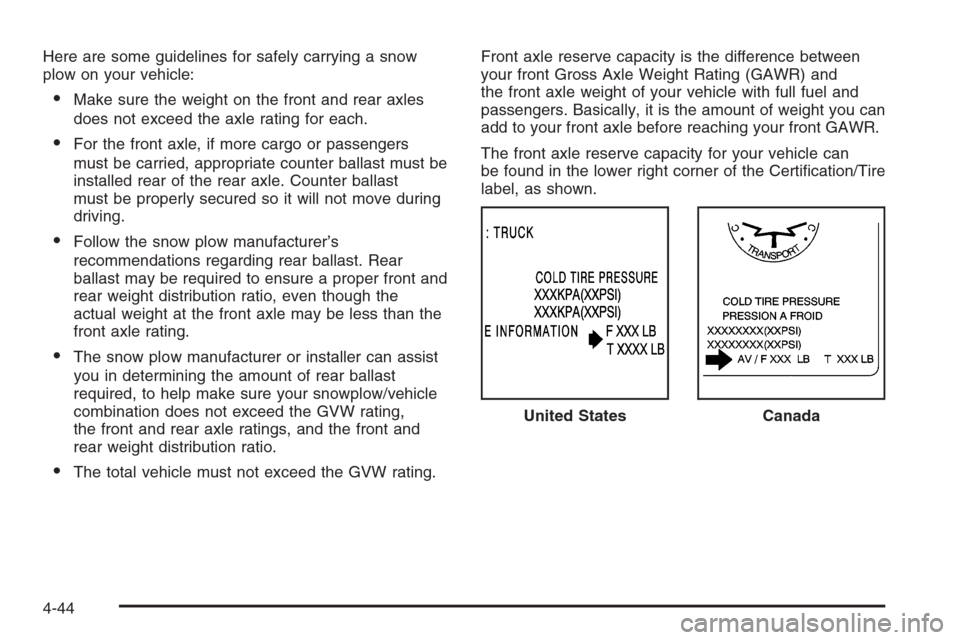
The front axle reserve capacity for your vehicle can
be found in the lower right corner of the Certication/Tire
label, as shown.
United States
Canada
4-44
Page 357 of 596
In order to calculate the amount of weight any front
accessory, such as a snow plow, is adding to the front
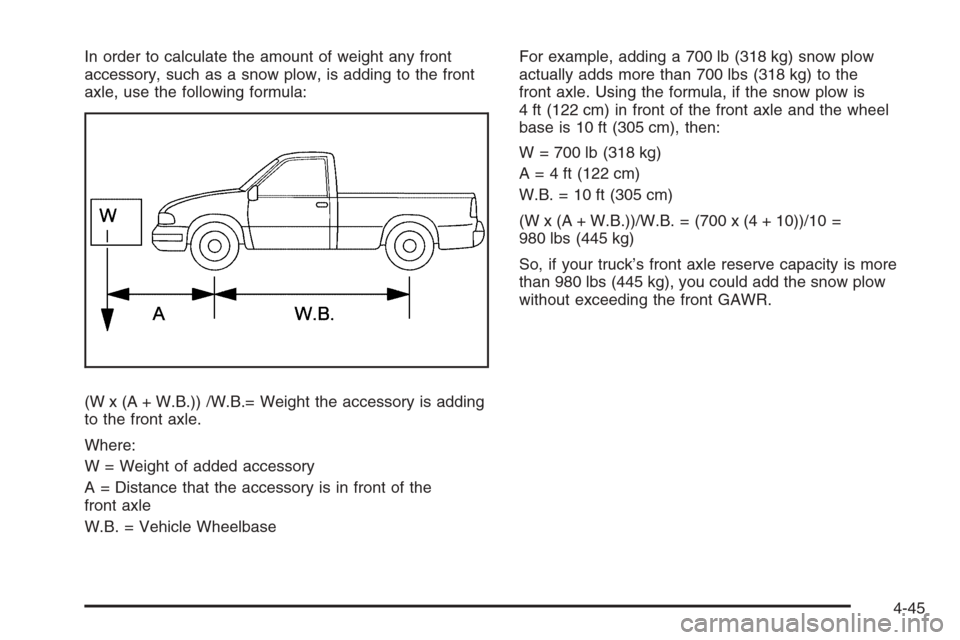
axle, use the following formula:
(W x (A + W.B.)) /W.B.= Weight the accessory is adding
to the front axle.
Where:
W = Weight of added accessory
A = Distance that the accessory is in front of the
front axle
W.B. = Vehicle WheelbaseFor example, adding a 700 lb (318 kg) snow plow
actually adds more than 700 lbs (318 kg) to the
front axle. Using the formula, if the snow plow is
4 ft (122 cm) in front of the front axle and the wheel
base is 10 ft (305 cm), then:
W = 700 lb (318 kg)
A = 4 ft (122 cm)
W.B. = 10 ft (305 cm)
(W x (A + W.B.))/W.B. = (700 x (4 + 10))/10 =
980 lbs (445 kg)
So, if your truck’s front axle reserve capacity is more
than 980 lbs (445 kg), you could add the snow plow
without exceeding the front GAWR.
4-45
Page 358 of 596
You can add heavier equipment on the front of the vehicle
if you compensate for it by carrying fewer passengers,
less cargo, or by positioning cargo towards the rear.
This has the effect of reducing the load on the front.
However, the front GAWR, rear GAWR, and the Gross
Vehicle Weight Rating (GVWR) must never be exceeded.
{CAUTION:
On some vehicles that have certain front
mounted equipment, such as a snow plow, it
may be possible to load the front axle to the
front gross axle weight rating (GAWR) but not
have enough weight on the rear axle to have
proper braking performance. If your brakes can
not work properly, you could have a crash.
CAUTION: (Continued)
CAUTION: (Continued)
To help your brakes work properly when a
snow plow is installed, always follow the
snow plow manufacturer or installer’s
recommendation for rear ballast to ensure a
proper front and rear weight distribution ratio,
even though the actual front weight may be
less than the front GAWR, and the total vehicle
weight is less than the gross vehicle weight
rating (GVWR). Maintaining a proper front and
rear weight distribution ratio is necessary to
provide proper braking performance.
Total vehicle reserve capacity is the difference between
your GVWR and the weight of your truck with full fuel
and passengers. It is the amount of weight you can
add to your vehicle before reaching your GVWR.
4-46
Page 359 of 596
Keep in mind that reserve capacity numbers are
intended as a guide when selecting the amount of
equipment or cargo your truck can carry. If you
are unsure of your vehicle’s front, rear, or total weight,
go to a weigh station and weigh your vehicle. Your
dealer/retailer can also help you with this.
The total vehicle reserve capacity for your vehicle can
be found in the lower right corner of the Certication/Tire
label as shown previously.
See your dealer/retailer for additional advice and
information about using a snow plow on your vehicle.
Also, seeLoading Your Vehicle on page 4-36.
Emergency Roof Lamp Provisions
Vehicles with the RPO VYU snow plow prep package
also have an emergency roof lamp provision package,
RPO TRW. Wiring for the emergency roof lamp is
provided above the overhead console. SeeAuxiliary
Roof Mounted Lamp on page 3-20for switch location.
Truck-Camper Loading Information
A vehicle specic Truck-Camper Loading
information label is attached to the inside of your
vehicle’s glove box. This label will tell you if
your vehicle can carry a slide-in camper, how
much of a load your vehicle can carry, and how to
correctly spread out the load. Also, it will help
you match the right slide-in camper to your vehicle.
When you carry a slide-in camper, the total
cargo load of your vehicle is the weight of the
camper, plus the following:
Everything else added to the camper after it
left the factory
Everything in the camper
All the people inside
The Cargo Weight Rating (CWR) is the maximum
weight of the load your vehicle can carry. It does not
include the weight of the people inside. But, you
can gure about 150 lbs (68 kg) for each seat.
The total cargo load must not be more than your
vehicle’s CWR.
4-47
Page 360 of 596
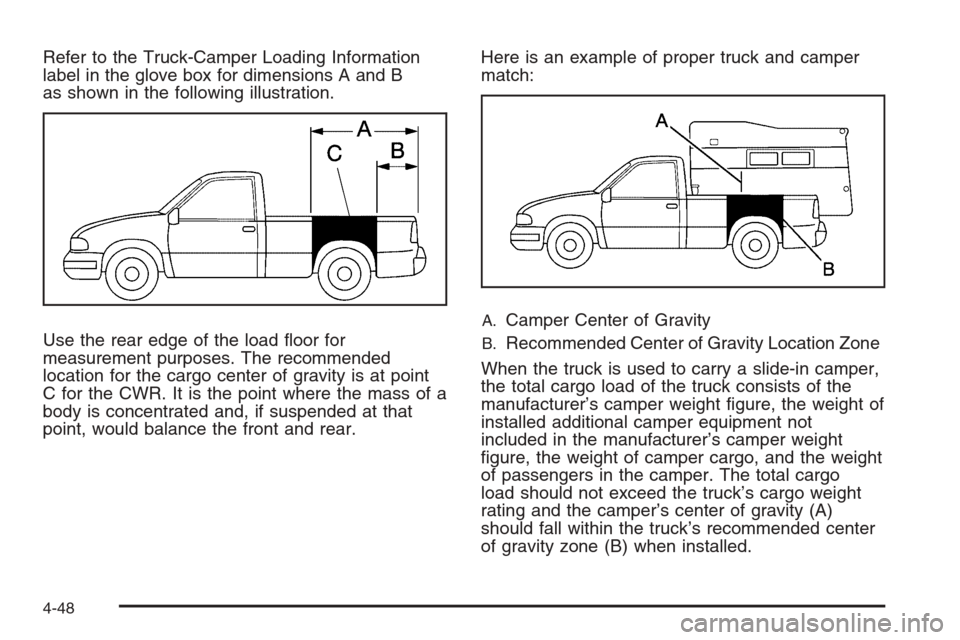
Refer to the Truck-Camper Loading Information
label in the glove box for dimensions A and B
as shown in the following illustration.
Use the rear edge of the load oor for
measurement purposes. The recommended
location for the cargo center of gravity is at point
C for the CWR. It is the point where the mass of a
body is concentrated and, if suspended at that
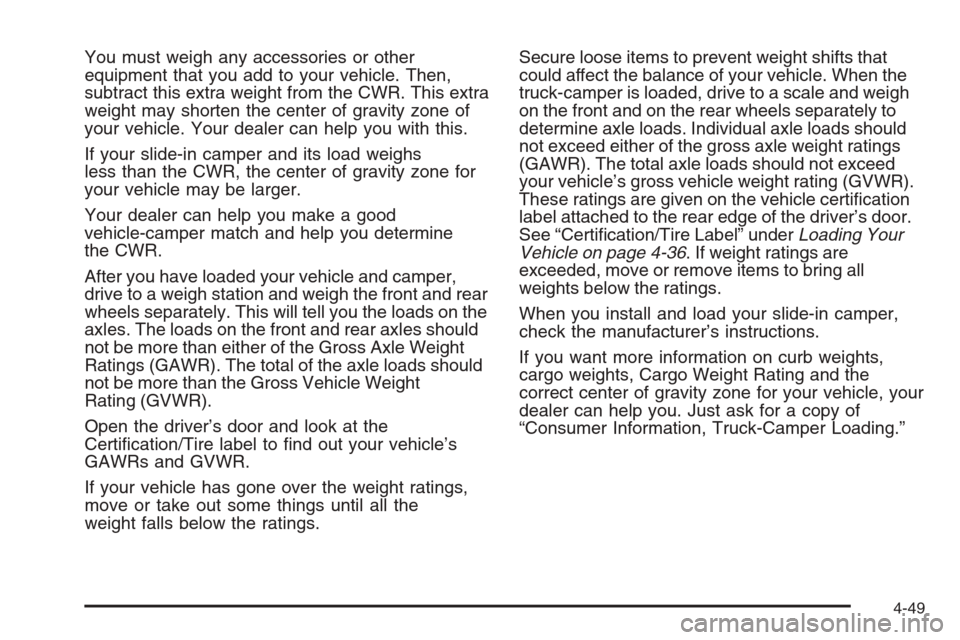
point, would balance the front and rear.Here is an example of proper truck and camper
match:
A.Camper Center of Gravity
B.Recommended Center of Gravity Location Zone
When the truck is used to carry a slide-in camper,
the total cargo load of the truck consists of the
manufacturer’s camper weight gure, the weight of
installed additional camper equipment not
included in the manufacturer’s camper weight
gure, the weight of camper cargo, and the weight
of passengers in the camper. The total cargo
load should not exceed the truck’s cargo weight
rating and the camper’s center of gravity (A)
should fall within the truck’s recommended center
of gravity zone (B) when installed.
4-48
Page 361 of 596
You must weigh any accessories or other
equipment that you add to your vehicle. Then,
subtract this extra weight from the CWR. This extra
weight may shorten the center of gravity zone of
your vehicle. Your dealer can help you with this.
If your slide-in camper and its load weighs
less than the CWR, the center of gravity zone for
your vehicle may be larger.
Your dealer can help you make a good
vehicle-camper match and help you determine
the CWR.
After you have loaded your vehicle and camper,
drive to a weigh station and weigh the front and rear
wheels separately. This will tell you the loads on the
axles. The loads on the front and rear axles should
not be more than either of the Gross Axle Weight
Ratings (GAWR). The total of the axle loads should
not be more than the Gross Vehicle Weight
Rating (GVWR).
Open the driver’s door and look at the
Certication/Tire label to nd out your vehicle’s
GAWRs and GVWR.
If your vehicle has gone over the weight ratings,
move or take out some things until all the
weight falls below the ratings.Secure loose items to prevent weight shifts that
could affect the balance of your vehicle. When the
truck-camper is loaded, drive to a scale and weigh
on the front and on the rear wheels separately to
determine axle loads. Individual axle loads should
not exceed either of the gross axle weight ratings
(GAWR). The total axle loads should not exceed
your vehicle’s gross vehicle weight rating (GVWR).
These ratings are given on the vehicle certication
label attached to the rear edge of the driver’s door.
See “Certication/Tire Label” underLoading Your
Vehicle on page 4-36. If weight ratings are
exceeded, move or remove items to bring all
weights below the ratings.
When you install and load your slide-in camper,
check the manufacturer’s instructions.
If you want more information on curb weights,
cargo weights, Cargo Weight Rating and the
correct center of gravity zone for your vehicle, your
dealer can help you. Just ask for a copy of
“Consumer Information, Truck-Camper Loading.”
4-49
Page 367 of 596
5. Shift the transfer case to NEUTRAL. See
Four-Wheel Drive on page 2-36.
6. Release the parking brake only after the vehicle
being towed is rmly attached to the tow vehicle.
7. Turn the ignition to LOCK/OFF.
Towing a Trailer
If your vehicle has a diesel engine, see the DURAMAX®
Diesel manual for more information.
Do not tow a trailer during break-in. SeeNew Vehicle
Break-In on page 2-22for more information.
{CAUTION:
If you do not use the correct equipment and
drive properly, you can lose control when you
pull a trailer. For example, if the trailer is too
heavy, the brakes may not work well — or even
at all. You and your passengers could be
seriously injured. Pull a trailer only if you have
followed all the steps in this section. Ask your
dealer for advice and information about towing
a trailer with your vehicle.Notice:Pulling a trailer improperly can damage
your vehicle and result in costly repairs not covered
by your warranty. To pull a trailer correctly, follow
the advice in this part, and see your dealer for
important information about towing a trailer with
your vehicle.
To identify the trailering capacity of your vehicle, you
should read the information in “Weight of the Trailer” that
appears later in this section.
Trailering is different than just driving your vehicle by
itself. Trailering means changes in acceleration, braking,
handling, durability and fuel economy. Successful,
safe trailering takes correct equipment, and it has to be
used properly.
That’s the reason for this part. In it are many time-tested,
important trailering tips and safety rules. Many of
these are important for your safety and that of your
passengers. So please read this section carefully before
you pull a trailer.
4-55
Page 368 of 596
If You Do Decide To Pull A Trailer
If you do, here are some important points:
There are many different laws, including speed limit
restrictions, having to do with trailering. Make sure
your rig will be legal, not only where you live
but also where you’ll be driving. A good source for
this information can be state or provincial police.
Consider using a sway control. See “Hitches” later
in this section.
Don’t tow a trailer at all during the rst 500 miles
(800 km) your new vehicle is driven. Your engine,
axle or other parts could be damaged.
Then, during the rst 500 miles (800 km) that you
tow a trailer, don’t drive over 50 mph (80 km/h)
and don’t make starts at full throttle. This helps your
engine and other parts of your vehicle wear in at
the heavier loads.
You can tow in DRIVE (D). You may want to shift
the transmission to THIRD (3), or FOURTH (4)
with the Allison or Hydra-matic 6-speed
transmissions, or if necessary, a lower gear
selection if the transmission shifts too often, such
as under heavy loads and/or hilly conditions.
See “Tow/Haul Mode” later in this section.Three important considerations have to do with weight:
The weight of the trailer
The weight of the trailer tongue
The weight on your vehicle’s tires
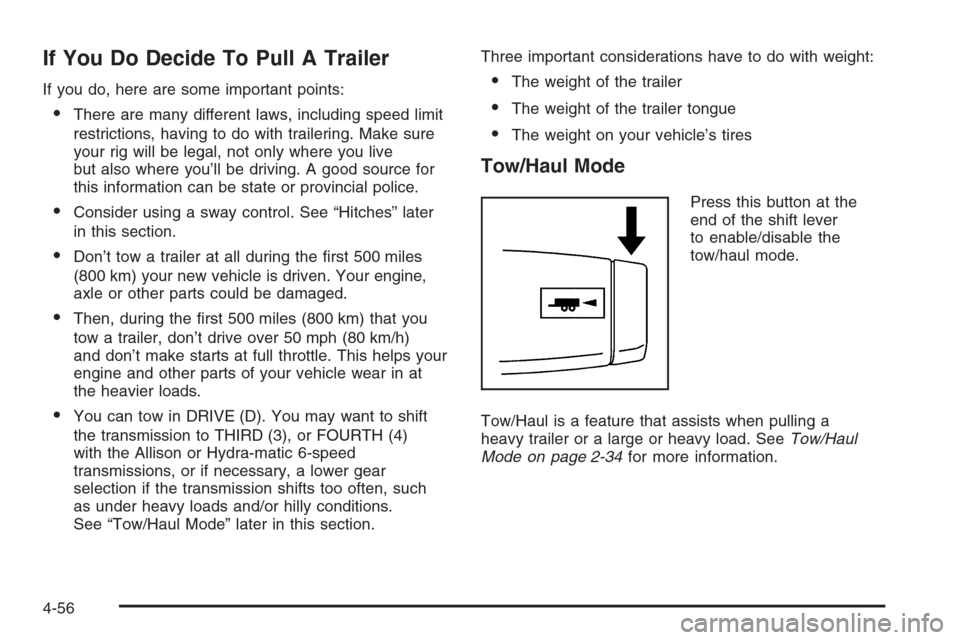
Tow/Haul Mode
Press this button at the
end of the shift lever
to enable/disable the
tow/haul mode.
Tow/Haul is a feature that assists when pulling a
heavy trailer or a large or heavy load. SeeTow/Haul
Mode on page 2-34for more information.
4-56