Page 281 of 412
If you get the overheat warning with no sign of steam,
try this for a minute or so:
1. In heavy traffic, let the engine idle in N (Neutral)
while stopped. If it is safe to do so, pull off the
road, shift to P (Park) or N (NEUTRAL) and let
the engine idle.
2. Turn on your heater to full hot at the highest fan
speed and open the windows as necessary.
If you no longer have the overheat warning, you can
drive. Just to be safe, drive slower for about 10 minutes.
If the warning does not come back on, you can drive
normally.
If the warning continues, pull over, stop, and park your
vehicle right away.
If there is still no sign of steam, idle the engine for
three minutes while you are parked. If you still have
the warning, turn off the engine and get everyone out
of the vehicle until it cools down.
You might decide not to lift the hood but to get service
help right away.Overheated Engine Protection
Operating Mode
This emergency operating mode allows your vehicle
to be driven to a safe place in an emergency situation.
If an overheated engine condition exists, an overheat
protection mode which alternates ring groups of
cylinders helps prevent engine damage. In this mode,
you will notice a signicant loss in power and engine
performance. The temperature gage will indicate an
overheat condition exists. Driving extended miles (km)
and/or towing a trailer in the overheat protection mode
should be avoided.
Notice:After driving in the overheated engine
protection operating mode, to avoid engine damage,
allow the engine to cool before attempting any
repair. The engine oil will be severely degraded.
Repair the cause of coolant loss, change the oil
and reset the oil life system. SeeEngine Oil
on page 5-19.
5-31
Page 282 of 412
Cooling System
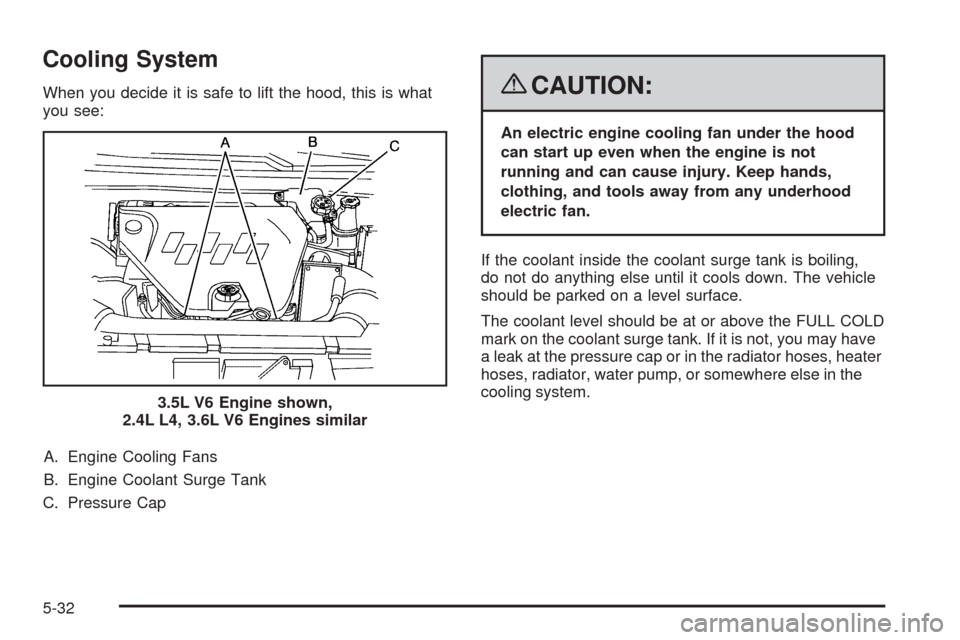
When you decide it is safe to lift the hood, this is what
you see:
A. Engine Cooling Fans
B. Engine Coolant Surge Tank
C. Pressure Cap{CAUTION:
An electric engine cooling fan under the hood
can start up even when the engine is not
running and can cause injury. Keep hands,
clothing, and tools away from any underhood
electric fan.
If the coolant inside the coolant surge tank is boiling,
do not do anything else until it cools down. The vehicle
should be parked on a level surface.
The coolant level should be at or above the FULL COLD
mark on the coolant surge tank. If it is not, you may have
a leak at the pressure cap or in the radiator hoses, heater
hoses, radiator, water pump, or somewhere else in the
cooling system.
3.5L V6 Engine shown,
2.4L L4, 3.6L V6 Engines similar
5-32
Page 285 of 412
{CAUTION:
Adding only plain water to the cooling system
can be dangerous. Plain water, or some other
liquid such as alcohol, can boil before the
proper coolant mixture will. The vehicle’s
coolant warning system is set for the proper
coolant mixture. With plain water or the wrong
mixture, the engine could get too hot but you
would not get the overheat warning. The engine
could catch re and you or others could be
burned. Use a 50/50 mixture of clean, drinkable
water and DEX-COOL
®coolant.
Notice:In cold weather, water can freeze and crack
the engine, radiator, heater core and other parts.
Use the recommended coolant and the proper
coolant mixture.
{CAUTION:
You can be burned if you spill coolant on hot
engine parts. Coolant contains ethylene glycol
and it will burn if the engine parts are hot
enough. Do not spill coolant on a hot engine.
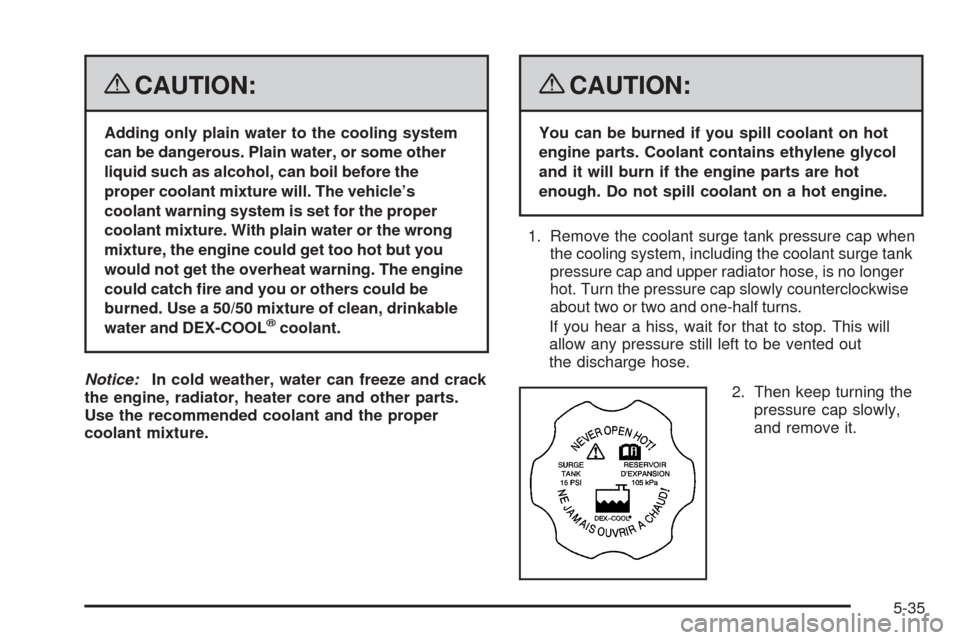
1. Remove the coolant surge tank pressure cap when
the cooling system, including the coolant surge tank
pressure cap and upper radiator hose, is no longer
hot. Turn the pressure cap slowly counterclockwise
about two or two and one-half turns.
If you hear a hiss, wait for that to stop. This will
allow any pressure still left to be vented out
the discharge hose.
2. Then keep turning the
pressure cap slowly,
and remove it.
5-35
Page 290 of 412
What to Add
When you need brake uid, use only DOT-3 brake
uid. Use new brake uid from a sealed container
only. SeeRecommended Fluids and Lubricants on
page 6-12.
Always clean the brake uid reservoir cap and the area
around the cap before removing it. This helps keep
dirt from entering the reservoir.
{CAUTION:
With the wrong kind of uid in the brake
hydraulic system, the brakes might not work
well. This could cause a crash. Always use the
proper brake uid.Notice:
Using the wrong uid can badly damage brake
hydraulic system parts. For example, just a
few drops of mineral-based oil, such as engine
oil, in the brake hydraulic system can damage
brake hydraulic system parts so badly that they
will have to be replaced. Do not let someone
put in the wrong kind of uid.
If you spill brake uid on your vehicle’s painted
surfaces, the paint nish can be damaged.
Be careful not to spill brake uid on your
vehicle. If you do, wash it off immediately.
SeeWashing Your Vehicle on page 5-92.
5-40
Page 354 of 412
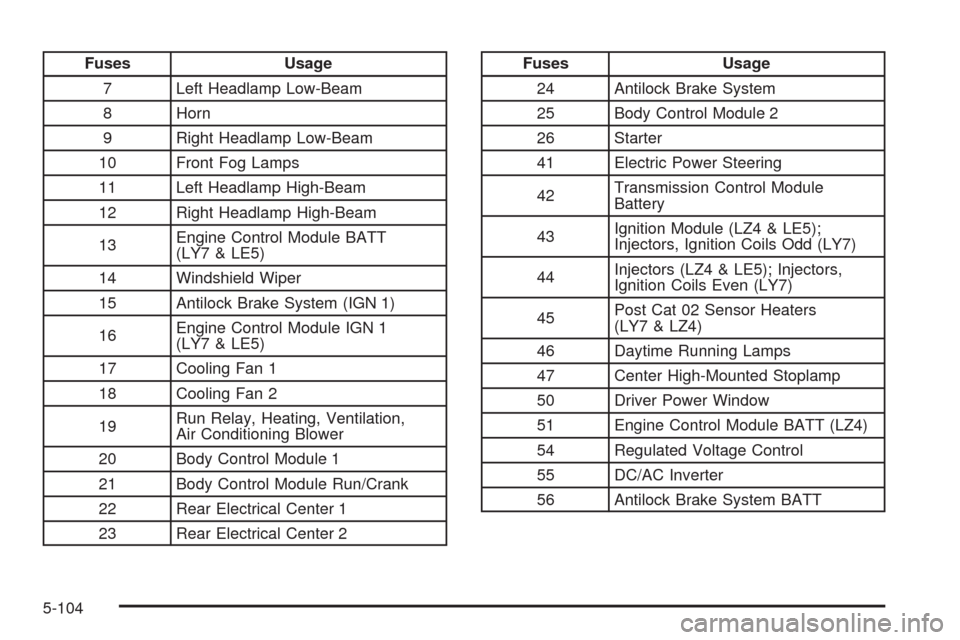
Fuses Usage
7 Left Headlamp Low-Beam
8 Horn
9 Right Headlamp Low-Beam
10 Front Fog Lamps
11 Left Headlamp High-Beam
12 Right Headlamp High-Beam
13Engine Control Module BATT
(LY7 & LE5)
14 Windshield Wiper
15 Antilock Brake System (IGN 1)
16Engine Control Module IGN 1
(LY7 & LE5)
17 Cooling Fan 1
18 Cooling Fan 2
19Run Relay, Heating, Ventilation,
Air Conditioning Blower
20 Body Control Module 1
21 Body Control Module Run/Crank
22 Rear Electrical Center 1
23 Rear Electrical Center 2Fuses Usage
24 Antilock Brake System
25 Body Control Module 2
26 Starter
41 Electric Power Steering
42Transmission Control Module
Battery
43Ignition Module (LZ4 & LE5);
Injectors, Ignition Coils Odd (LY7)
44Injectors (LZ4 & LE5); Injectors,
Ignition Coils Even (LY7)
45Post Cat 02 Sensor Heaters
(LY7 & LZ4)
46 Daytime Running Lamps
47 Center High-Mounted Stoplamp
50 Driver Power Window
51 Engine Control Module BATT (LZ4)
54 Regulated Voltage Control
55 DC/AC Inverter
56 Antilock Brake System BATT
5-104
Page 359 of 412
ApplicationCapacities
English Metric
Engine Oil with Filter
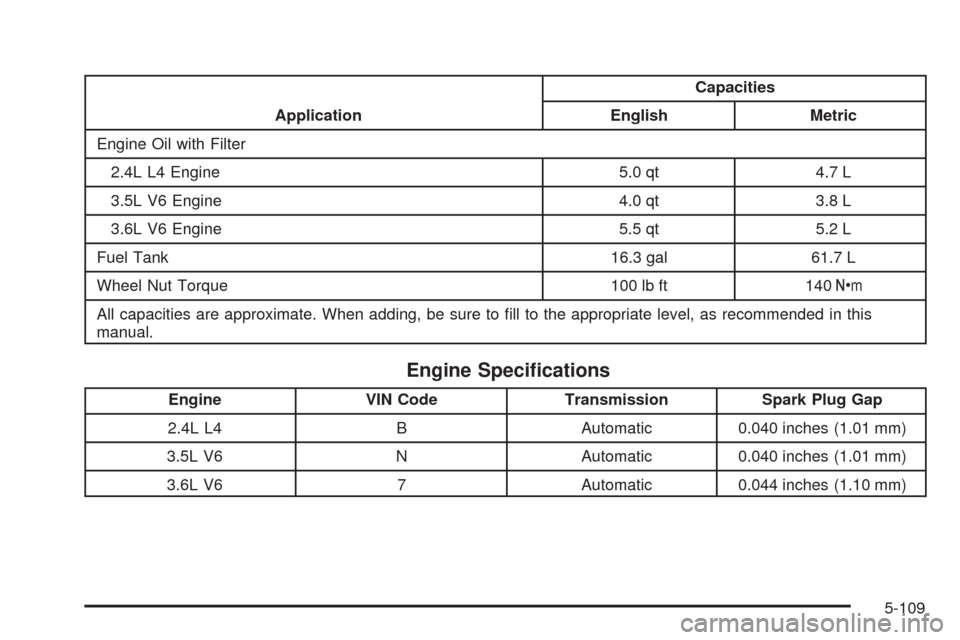
2.4L L4 Engine 5.0 qt 4.7 L
3.5L V6 Engine 4.0 qt 3.8 L
3.6L V6 Engine 5.5 qt 5.2 L
Fuel Tank 16.3 gal 61.7 L
Wheel Nut Torque 100 lb ft 140Y
All capacities are approximate. When adding, be sure to ll to the appropriate level, as recommended in this
manual.
Engine Specications
Engine VIN Code Transmission Spark Plug Gap
2.4L L4 B Automatic 0.040 inches (1.01 mm)
3.5L V6 N Automatic 0.040 inches (1.01 mm)
3.6L V6 7 Automatic 0.044 inches (1.10 mm)
5-109
Page 362 of 412
Maintenance Schedule
Introduction
Important: Keep engine oil at the proper level and
change as recommended.
Have you purchased the GM Protection Plan? The Plan
supplements your new vehicle warranties. See your
Warranty and Owner Assistance booklet or your
dealer/retailer for details.
Maintenance Requirements
Notice:Maintenance intervals, checks, inspections,
replacement parts, and recommended uids and
lubricants as prescribed in this manual are
necessary to keep your vehicle in good working
condition. Any damage caused by failure to follow
scheduled maintenance might not be covered
by warranty.
Your Vehicle and the Environment
Proper vehicle maintenance not only helps to keep your
vehicle in good working condition, but also helps the
environment. All recommended maintenance is
important. Improper vehicle maintenance can even
affect the quality of the air we breathe. Improper uid
levels or the wrong tire ination can increase the level of
emissions from your vehicle. To help protect our
environment, and to keep your vehicle in good condition,
be sure to maintain your vehicle properly.
6-2
Page 364 of 412
If you want to purchase service information, seeService
Publications Ordering Information on page 7-16.
Owner Checks and Services on page 6-8tells you what
should be checked, when to check it, and what you can
easily do to help keep your vehicle in good condition.
The proper replacement parts, uids, and lubricants to
use are listed inRecommended Fluids and Lubricants
on page 6-12andMaintenance Replacement Parts
on page 6-13. When your vehicle is serviced, make sure
these are used. All parts should be replaced and all
necessary repairs done before you or anyone else
drives the vehicle. We recommend the use of genuine
parts from your dealer/retailer.
Scheduled Maintenance
When the CHANGE OIL SOON message in the Driver
Information Center (DIC) comes on, it means that service
is required for your vehicle. Have your vehicle serviced as
soon as possible within the next 600 miles (1 000 km).
It is possible that, if you are driving under the best
conditions, the engine oil life system may not indicate that
vehicle service is necessary for over a year. However, the
engine oil and lter must be changed at least once a year
and at this time the system must be reset. Your dealer/
retailer has trained service technicians who will perform
this work using genuine parts and reset the system.If the engine oil life system is ever reset accidentally,
you must service your vehicle within 3,000 miles
(5 000 km) since your last service. Remember to reset
the oil life system whenever the oil is changed. See
Engine Oil Life System on page 5-22for information on
the Engine Oil Life System and resetting the system.
When the CHANGE OIL SOON message appears,
certain services, checks, and inspections are required.
Required services are described in the following for
“MaintenanceI” and “MaintenanceII.” Generally,
it is recommended that your rst service be
MaintenanceI, your second service be MaintenanceII,
and that you alternate MaintenanceIand MaintenanceII
thereafter. However, in some cases, MaintenanceII
may be required more often.
MaintenanceI— Use MaintenanceIif the message
comes on within 10 months since the vehicle was
purchased or MaintenanceIIwas performed.
MaintenanceII— Use MaintenanceIIif the previous
service performed was MaintenanceI. Always use
MaintenanceIIwhenever the message comes on
10 months or more since the last service or if the
message has not come on at all for one year.
6-4