Page 159 of 384

Engine Overspeed Warning Light
If your vehicle has this
light, it will come on if your
engine is operating at
too many revolutions per
minute (rpm).
It will also come on for a moment as a check when you
start your engine.
If it comes on when you’re driving, reduce your engine
speed immediately.
Engine Shutdown Warning Light
If your vehicle has the
engine shutdown feature,
this light will come on
when engine shutdown
is active.
SeeEngine Alarm and Automatic Shutdown on
page 2-18for more information.
Transmission Temperature Gage
If you have an automatic
transmission and this
gage, it is located
above the switchbank
in the center of the
instrument panel.
When your ignition is on, the gage shows the
temperature of the transmission oil. A reading in the
warning zone, the red area beginning at 300°F (150°C),
means you must stop driving and check into the cause.
One possible cause is a low oil level in the transmission.
Notice:If you drive your vehicle with the
transmission temperature gage above normal
operating range, you can damage the transmission.
This could lead to costly repairs that would not
be covered by your warranty. Do not drive your
vehicle while the transmission temperature gage
reading is above normal. See your dealer for service.
3-39
Page 162 of 384

Low Washer Fluid Warning Light
This light is located above
the climate controls in the
center of the instrument
panel.
This light will come on when your vehicle is low on
windshield washer fluid.
For more information, seeWindshield Washer Fluid on
page 5-55.
Power Take-Off Light
For vehicles with Power
Take-Off (PTO), this light
is located in the center
of the instrument panel.
This light will come on when the PTO switch is in the
ON position. SeePower Take-Off (PTO) on page 2-32
for more information.
Check Gages Warning Light
This light will come on
briefly when the engine is
started.
If this light comes on and stays on while you are driving.
It means that either the engine coolant temperature
gage or the engine oil pressure gage may be showing a
reading in the warning zone.
When the check gages light comes on, you will also
hear a warning tone. The tone and the light will
stay activated until the problem is corrected.
This light may also come on if your vehicle is has
automatic engine shutdown system and engine
shutdown has begun. SeeEngine Alarm and Automatic
Shutdown on page 2-18.
3-42
Page 214 of 384

In the United States, for best results use No. 2-D diesel
fuel year-round (above and below freezing conditions)
as oil companies blend No. 2-D fuel to address climate
differences. No. 1-D diesel fuel can be used in very
cold temperatures (when it stays below 0°F or−18°C);
however, it will produce a power and fuel economy loss.
Avoid the use of No. 1-D diesel fuel in warm or hot
climates. It can result in stalling, poor starting when the
engine is hot, and could damage the fuel injection
system.
It is acceptable to use diesel fuel containing up to
5% biodiesel (B5), but the final blended fuel must meet
the same specification, ASTM D 975 (Grades No. 2-D or
No. 1-D S15 commonly known as Ultra Low Sulfur
diesel), as other fuels used in your vehicle, and the
biodiesel used for making this fuel must meet the latest
version of ASTM specification D 6751. Biodiesel is
produced from vegetable oils or animal fat that have been
chemically modified to reduce the possibility of damage to
the fuel system and engine. Higher concentration (i.e.,
greater than B5) biodiesel-containing fuels or the use of
unmodified bio-oils blended into diesel fuel at any
concentration is not recommended and could damage the
fuel system and engine. Such damage would not be
covered by your warranty. If there are questions about
the biodiesel-containing fuels you are using, contact your
fuel supplier.Because of the cleansing properties of biodiesel,
switching from straight diesel to a biodiesel blend can
prematurely restrict the fuel filter with normal deposits in
the fuel system. A fuel filter replacement might be
required sooner than the recommended interval.
Diesel fuel can foam when you fill the tank. This can
cause the automatic pump nozzle to shut off, even
though the tank is not full. If this happens, just wait for
the foaming to stop and then try filling the tank more
slowly. SeeFilling the Tank on page 5-20.
{CAUTION:
Heat coming from the engine can cause the
fuel to expand and force the fuel out of the
tank. If something ignites the fuel, a re could
start and people could be burned. To help
avoid this, try lling the tank more slowly and
ll the fuel tank only until the automatic nozzle
shuts off. Do not try to top it off.
5-10
Page 215 of 384

What Fuel to Use in Canada
Notice:Use of diesel fuel other than Ultra Low
Sulfur Diesel (15 ppm sulfur maximum) or engine oil
other than low ash CJ-4 oil will cause permanent
damage to the DPF and related components.
This damage would not be covered by your
warranty.
The emission control system requires the use of diesel
fuel with ultra low-sulfur (0.0015% by weight, or 15 ppm,
maximum) content. Both Ultra Low Sulfur Diesel and Low
Sulfur Diesel fuels are available in the United States and
Ultra Low Sulfur Diesel fuel is available in Canada.
However, only higher sulfur diesel fuel is available
in Mexico.
At a minimum, the diesel fuel you use should meet the
latest version of specification CAN/CGSB-3.517 (ULS) in
Canada. In addition, the Engine Manufacturers
Association (EMA) has identified properties of an
improved diesel fuel for better engine performance and
durability (FQP-1A). Diesel fuels corresponding to the
EMA description could provide better starting, less noise,
and better vehicle performance. If there are questions
about the fuel you are using, contact your fuel supplier.Canadian fuels are blended for seasonal changes.
Diesel Type “A” fuel is blended for better cold weather
starting (below 0°F or−18°C); however, you might notice
some power and fuel economy loss. If Type “A” fuel is
used in warmer temperatures, stalling and hard
starting may occur. Diesel Type “B” fuel is blended for
temperatures above 0°F (−18°C).
It is acceptable to use diesel fuel containing up to
5% biodiesel (B5), but the final blended fuel must meet
the same specification, CAN/CGSB-3.517 (ULS) in
Canada, as other fuels used in your vehicle, and the
biodiesel used for making this fuel must meet the latest
version of ASTM specification D 6751. Biodiesel is
produced from vegetable oils or animal fat that have been
chemically modified to reduce the possibility of damage to
the fuel system and engine. Higher concentration (i.e.,
greater than B5) biodiesel-containing fuels or the use of
unmodified bio-oils blended into diesel fuel at any
concentration is not recommended and could damage the
fuel system and engine. Such damage would not be
covered by your warranty. If there are questions about
the biodiesel-containing fuels you are using, contact your
fuel supplier.
5-11
Page 227 of 384
Then take the hand hold and pull the hood forward.
When you tilt the hood far enough, there are cables that
will support it. When you close the hood, make sure
both latches are secured.
Engine Oil (Caterpillar®Diesel
Engine)
See your Caterpillar®Operation & Maintenance Manual
for information on oil quality and viscosities as well as
the temperature range chart.
5-23
Page 231 of 384
Look for this information on the oil container, and use
only those oils that are identified as meeting GM
Standard GM6094M and have the starburst symbol on
the front of the oil container.
Notice:Use only engine oil identied as meeting
GM Standard GM6094M and showing the American
Petroleum Institute Certied For Gasoline Engines
starburst symbol. Failure to use the recommended
oil can result in engine damage not covered by
your warranty.If you are in an area of extreme cold, where the
temperature falls below−20°F (−29°C), it is
recommended that you use either an SAE 5W-30
synthetic oil or an SAE 0W-30 oil. Both provide easier
cold starting and better protection for the engine at
extremely low temperatures.
Engine Oil Additives
Do not add anything to the oil. The recommended oils
with the API service symbol are all you need for
good performance and engine protection.
5-27
Page 232 of 384

Engine Oil (DURAMAX®Diesel
Engine)
Checking Engine Oil
It is a good idea to check the engine oil level every time
you get fuel.
The engine oil dipstick is
located in the engine
compartment on the driver
side of the vehicle.
In order to get an accurate reading, the engine should
be at normal operating temperature, so that the oil
is warm, and the vehicle must be on level ground.
1. If the engine is at normal operating temperature and
the oil is warm, turn off the engine and allow at
least five minutes for the oil to drain back into the
oil pan. If you do not do this, the oil dipstick
might not show the actual level.If the engine has not been run long enough to bring
it up to normal operating temperature and the oil
is cool, turn off the engine and allow 30 minutes for
the oil to drain back into the oil pan. If you do not do
this, the oil dipstick might not show the actual level.
2. Pull out the dipstick and clean it with a paper towel
or a cloth, then push it back in all the way.
3. Remove the dipstick again, keeping the tip down,
and check the oil level.
5-28
Page 236 of 384
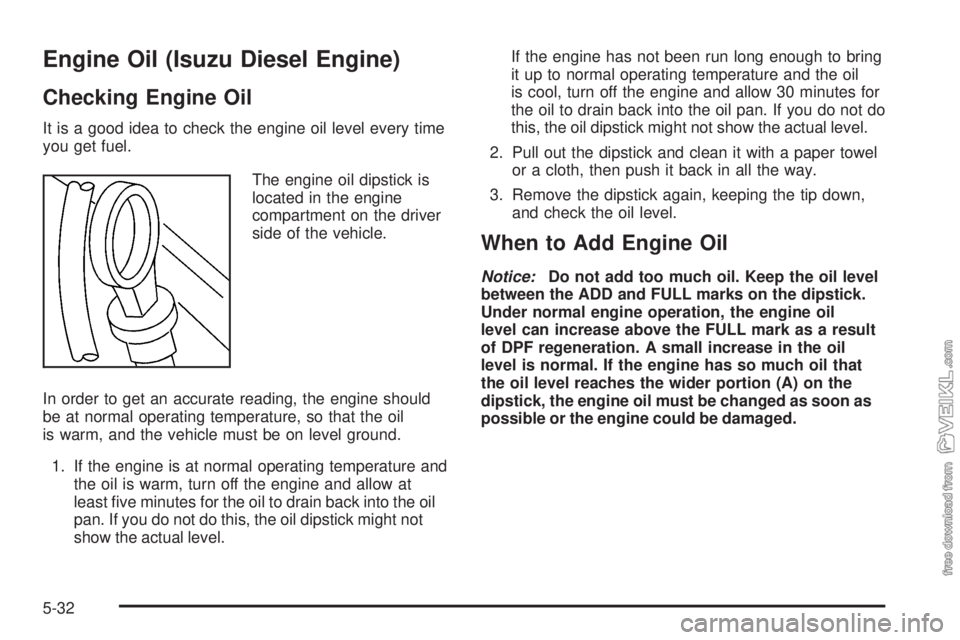
Engine Oil (Isuzu Diesel Engine)
Checking Engine Oil
It is a good idea to check the engine oil level every time
you get fuel.
The engine oil dipstick is
located in the engine
compartment on the driver
side of the vehicle.
In order to get an accurate reading, the engine should
be at normal operating temperature, so that the oil
is warm, and the vehicle must be on level ground.
1. If the engine is at normal operating temperature and
the oil is warm, turn off the engine and allow at
least five minutes for the oil to drain back into the oil
pan. If you do not do this, the oil dipstick might not
show the actual level.If the engine has not been run long enough to bring
it up to normal operating temperature and the oil
is cool, turn off the engine and allow 30 minutes for
the oil to drain back into the oil pan. If you do not do
this, the oil dipstick might not show the actual level.
2. Pull out the dipstick and clean it with a paper towel
or a cloth, then push it back in all the way.
3. Remove the dipstick again, keeping the tip down,
and check the oil level.
When to Add Engine Oil
Notice:Do not add too much oil. Keep the oil level
between the ADD and FULL marks on the dipstick.
Under normal engine operation, the engine oil
level can increase above the FULL mark as a result
of DPF regeneration. A small increase in the oil
level is normal. If the engine has so much oil that
the oil level reaches the wider portion (A) on the
dipstick, the engine oil must be changed as soon as
possible or the engine could be damaged.
5-32

