2008 CHEVROLET AVEO lock
[x] Cancel search: lockPage 203 of 384
Skidding
In a skid, a driver can lose control of the vehicle.
Defensive drivers avoid most skids by taking reasonable
care suited to existing conditions, and by not overdriving
those conditions. But skids are always possible.
The three types of skids correspond to your vehicle’s
three control systems. In the braking skid, the wheels
are not rolling. In the steering or cornering skid, too
much speed or steering in a curve causes tires to
slip and lose cornering force. And in the acceleration
skid, too much throttle causes the driving wheels
to spin.
A cornering skid and an acceleration skid are best
handled by easing your foot off the accelerator pedal.
If your vehicle starts to slide, ease your foot off the
accelerator pedal and quickly steer the way you want
the vehicle to go. If you start steering quickly enough,
your vehicle may straighten out. Always be ready
for a second skid if it occurs.Of course, traction is reduced when water, snow, ice,
gravel, or other material is on the road. For safety,
you will want to slow down and adjust your driving to
these conditions. It is important to slow down on slippery
surfaces because stopping distance will be longer and
vehicle control more limited.
While driving on a surface with reduced traction,
try your best to avoid sudden steering, acceleration,
or braking, including reducing vehicle speed by shifting
to a lower gear. Any sudden changes could cause
the tires to slide. You may not realize the surface
is slippery until your vehicle is skidding. Learn to
recognize warning clues — such as enough water,
ice, or packed snow on the road to make a mirrored
surface — and slow down when you have any doubt.
If you have the Antilock Brake System (ABS), remember:
It helps avoid only the braking skid. If you do not have
ABS, then in a braking skid, where the wheels are no
longer rolling, release enough pressure on the brakes to
get the wheels rolling again. This restores steering
control. Push the brake pedal down steadily when you
have to stop suddenly. As long as the wheels are rolling,
you will have steering control.
4-9
Page 208 of 384
Driving on Snow or Ice
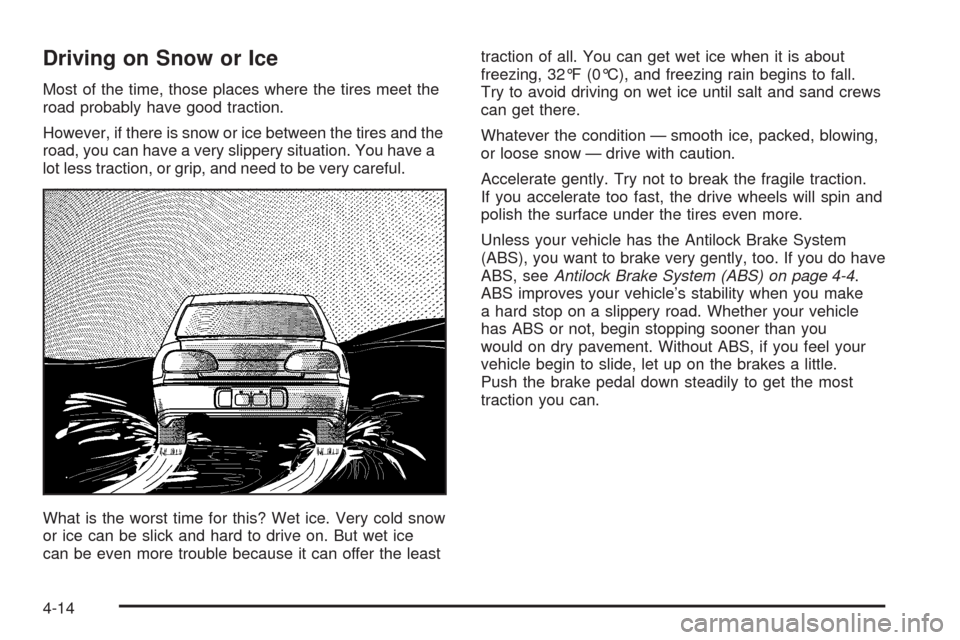
Most of the time, those places where the tires meet the
road probably have good traction.
However, if there is snow or ice between the tires and the
road, you can have a very slippery situation. You have a
lot less traction, or grip, and need to be very careful.
What is the worst time for this? Wet ice. Very cold snow
or ice can be slick and hard to drive on. But wet ice
can be even more trouble because it can offer the leasttraction of all. You can get wet ice when it is about
freezing, 32°F (0°C), and freezing rain begins to fall.
Try to avoid driving on wet ice until salt and sand crews
can get there.
Whatever the condition — smooth ice, packed, blowing,
or loose snow — drive with caution.
Accelerate gently. Try not to break the fragile traction.
If you accelerate too fast, the drive wheels will spin and
polish the surface under the tires even more.
Unless your vehicle has the Antilock Brake System
(ABS), you want to brake very gently, too. If you do have
ABS, seeAntilock Brake System (ABS) on page 4-4.
ABS improves your vehicle’s stability when you make
a hard stop on a slippery road. Whether your vehicle
has ABS or not, begin stopping sooner than you
would on dry pavement. Without ABS, if you feel your
vehicle begin to slide, let up on the brakes a little.
Push the brake pedal down steadily to get the most
traction you can.
4-14
Page 210 of 384
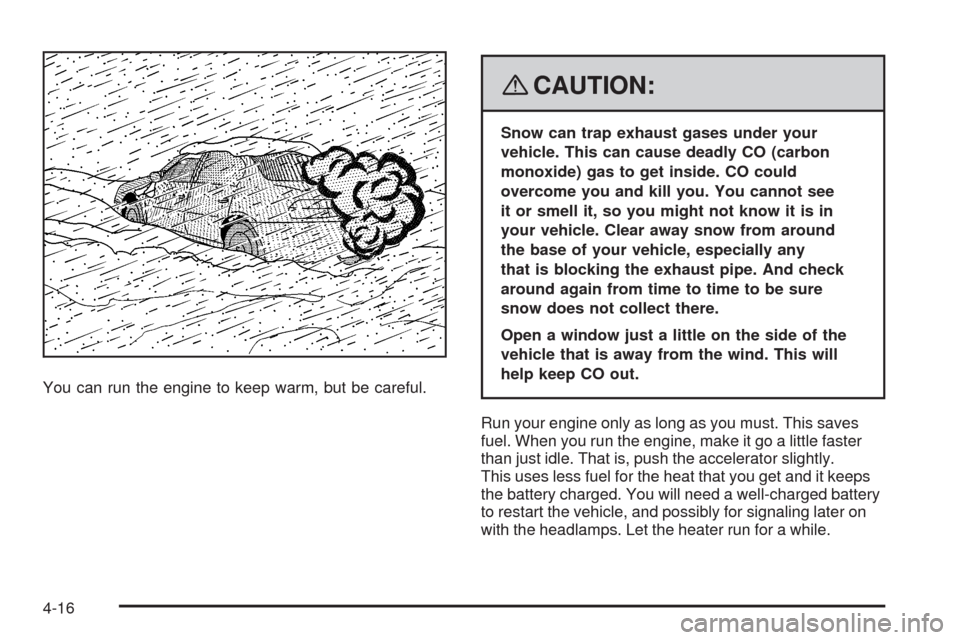
You can run the engine to keep warm, but be careful.
{CAUTION:
Snow can trap exhaust gases under your
vehicle. This can cause deadly CO (carbon
monoxide) gas to get inside. CO could
overcome you and kill you. You cannot see
it or smell it, so you might not know it is in
your vehicle. Clear away snow from around
the base of your vehicle, especially any
that is blocking the exhaust pipe. And check
around again from time to time to be sure
snow does not collect there.
Open a window just a little on the side of the
vehicle that is away from the wind. This will
help keep CO out.
Run your engine only as long as you must. This saves
fuel. When you run the engine, make it go a little faster
than just idle. That is, push the accelerator slightly.
This uses less fuel for the heat that you get and it keeps
the battery charged. You will need a well-charged battery
to restart the vehicle, and possibly for signaling later on
with the headlamps. Let the heater run for a while.
4-16
Page 212 of 384
Loading Your Vehicle
It is very important to know how much weight
your vehicle can carry. This weight is called the
vehicle capacity weight or maximum load amount
and includes the weight of all occupants, cargo,
and all nonfactory-installed options. Two labels
on your vehicle show how much weight it
may properly carry, the Tire and Loading
Information label and the Certification label.
{CAUTION:
Do not load your vehicle any heavier than
the Gross Vehicle Weight Rating (GVWR),
or either the maximum front or rear Gross
Axle Weight Rating (GAWR). If you do,
parts on your vehicle can break, and it
can change the way your vehicle handles.
These could cause you to lose control
and crash. Also, overloading can shorten
the life of your vehicle.
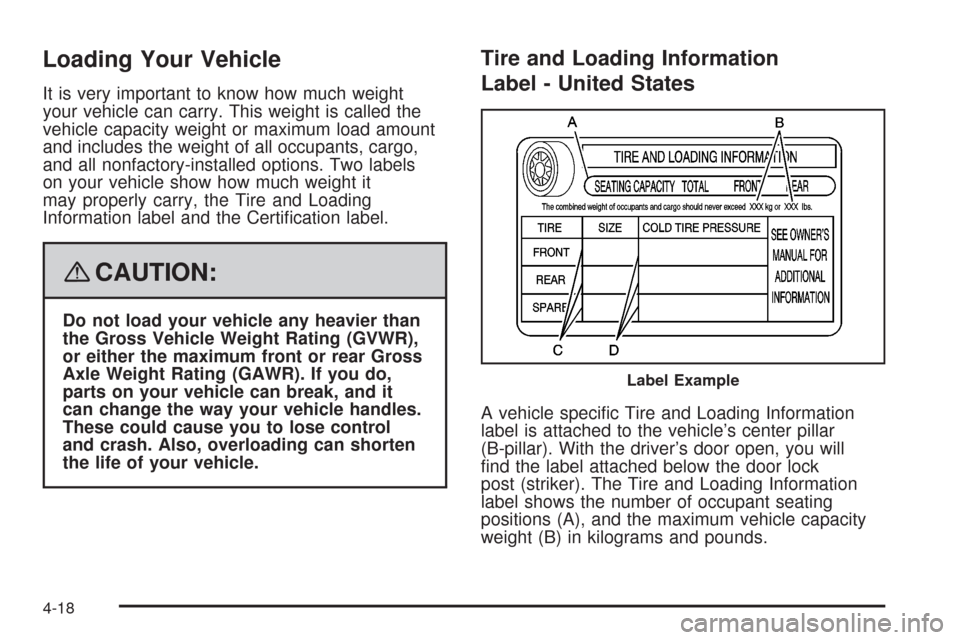
Tire and Loading Information
Label - United States
A vehicle specific Tire and Loading Information
label is attached to the vehicle’s center pillar
(B-pillar). With the driver’s door open, you will
find the label attached below the door lock
post (striker). The Tire and Loading Information
label shows the number of occupant seating
positions (A), and the maximum vehicle capacity
weight (B) in kilograms and pounds.
Label Example
4-18
Page 222 of 384
Dolly Towing
Notice:Towing your vehicle from the rear with the
front wheels on the ground could cause transmission
damage. Do not tow the vehicle from the rear with
the front wheels on the road.
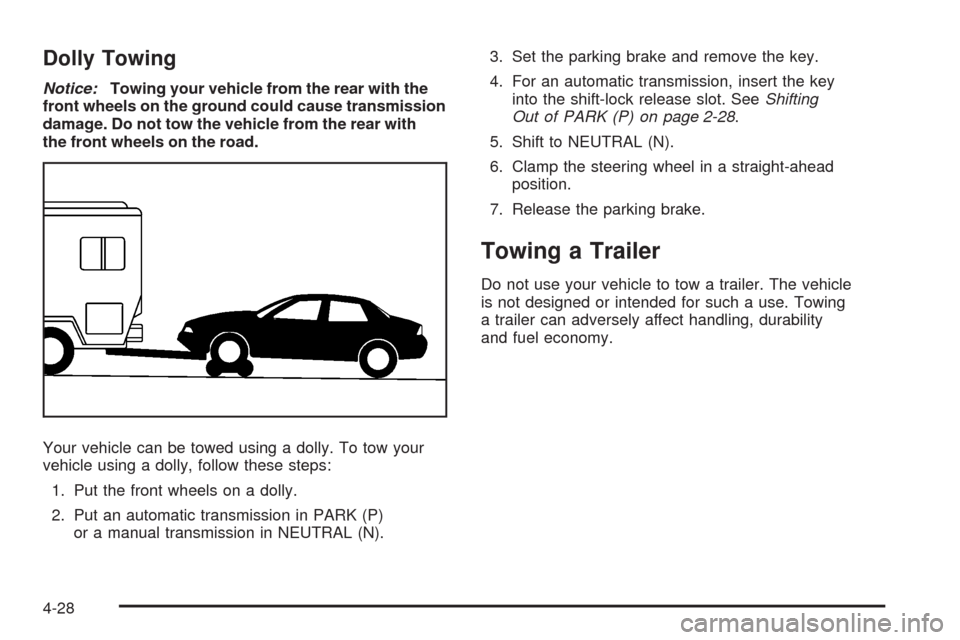
Your vehicle can be towed using a dolly. To tow your
vehicle using a dolly, follow these steps:
1. Put the front wheels on a dolly.
2. Put an automatic transmission in PARK (P)
or a manual transmission in NEUTRAL (N).3. Set the parking brake and remove the key.
4. For an automatic transmission, insert the key
into the shift-lock release slot. SeeShifting
Out of PARK (P) on page 2-28.
5. Shift to NEUTRAL (N).
6. Clamp the steering wheel in a straight-ahead
position.
7. Release the parking brake.
Towing a Trailer
Do not use your vehicle to tow a trailer. The vehicle
is not designed or intended for such a use. Towing
a trailer can adversely affect handling, durability
and fuel economy.
4-28
Page 224 of 384
Tire Inspection and Rotation...........................5-61
When It Is Time for New Tires.......................5-63
Buying New Tires.........................................5-64
Different Size Tires and Wheels......................5-65
Uniform Tire Quality Grading..........................5-66
Wheel Alignment and Tire Balance..................5-67
Wheel Replacement......................................5-67
Tire Chains..................................................5-69
If a Tire Goes Flat........................................5-69
Changing a Flat Tire.....................................5-70
Removing the Spare Tire and Tools................5-71
Removing the Flat Tire and Installing
the Spare Tire..........................................5-73
Storing a Flat or Spare Tire and Tools............5-78
Compact Spare Tire......................................5-78
Appearance Care............................................5-79
Interior Cleaning...........................................5-79
Fabric/Carpet...............................................5-80
Leather.......................................................5-81
Instrument Panel, Vinyl, and
Other Plastic Surfaces................................5-82
Care of Safety Belts......................................5-82
Weatherstrips...............................................5-82
Washing Your Vehicle...................................5-83
Cleaning Exterior Lamps/Lenses.....................5-83
Finish Care..................................................5-83Windshield and Wiper Blades.........................5-84
Aluminum Wheels.........................................5-85
Tires...........................................................5-85
Sheet Metal Damage.....................................5-85
Finish Damage.............................................5-86
Underbody Maintenance................................5-86
Chemical Paint Spotting.................................5-86
Vehicle Care/Appearance Materials..................5-87
Vehicle Identication......................................5-88
Vehicle Identification Number (VIN).................5-88
Service Parts Identification Label.....................5-88
Electrical System............................................5-88
Add-On Electrical Equipment..........................5-88
Headlamp Wiring..........................................5-89
Windshield Wiper Fuses................................5-89
Power Windows and Other
Power Options..........................................5-89
Fuses and Circuit Breakers............................5-89
Instrument Panel Fuse Block..........................5-90
Engine Compartment Fuse Block....................5-94
Capacities and Specications..........................5-99
Normal Maintenance Replacement Parts.........5-100
Normal Maintenance Replacement Parts.........5-100
Engine Drive Belt Routing............................5-101
Section 5 Service and Appearance Care
5-2
Page 225 of 384
Service
For service and parts needs, visit your dealer/retailer.
You will receive genuine GM parts and GM-trained and
supported service people.
Genuine GM parts have one of these marks:
Accessories and Modications
When non-dealer/non-retailer accessories are added to
your vehicle they can affect your vehicle’s performance
and safety, including such things as, airbags, braking,
stability, ride and handling, emissions systems,
aerodynamics, durability, and electronic systems like
antilock brakes, traction control and stability control.
Some of these accessories could even cause
malfunction or damage not covered by warranty.
GM Accessories are designed to complement and
function with other systems on your vehicle. Your
GM dealer/retailer can accessorize your vehicle using
genuine GM Accessories. When you go to your
GM dealer/retailer and ask for GM Accessories, you
will know that GM-trained and supported service
technicians will perform the work using genuine
GM Accessories.
Also, seeAdding Equipment to Your Airbag-Equipped
Vehicle on page 1-71.
5-3
Page 230 of 384
The tethered fuel cap is located behind a hinged fuel
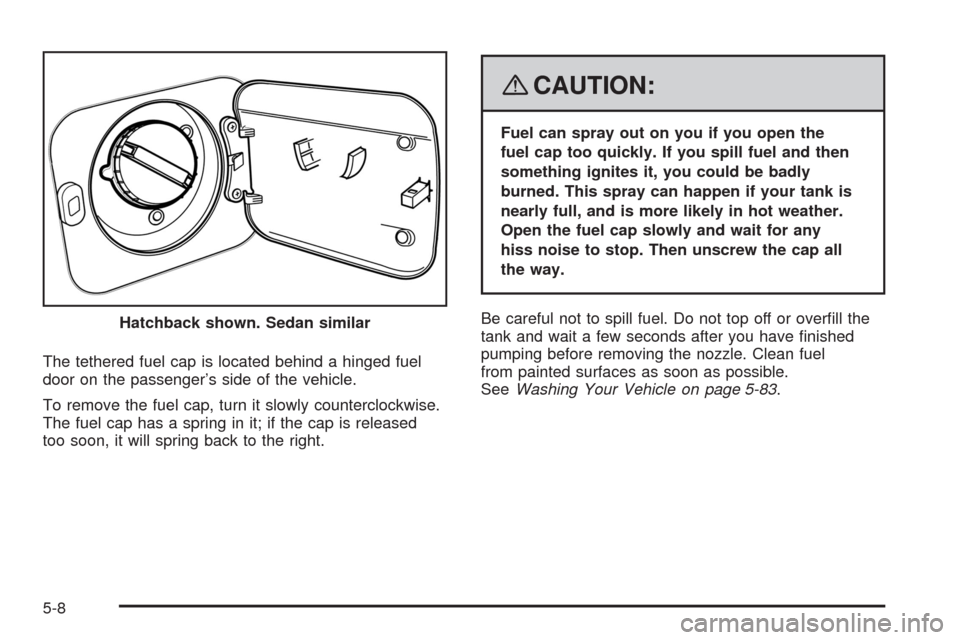
door on the passenger’s side of the vehicle.
To remove the fuel cap, turn it slowly counterclockwise.
The fuel cap has a spring in it; if the cap is released
too soon, it will spring back to the right.
{CAUTION:
Fuel can spray out on you if you open the
fuel cap too quickly. If you spill fuel and then
something ignites it, you could be badly
burned. This spray can happen if your tank is
nearly full, and is more likely in hot weather.
Open the fuel cap slowly and wait for any
hiss noise to stop. Then unscrew the cap all
the way.
Be careful not to spill fuel. Do not top off or overfill the
tank and wait a few seconds after you have finished
pumping before removing the nozzle. Clean fuel
from painted surfaces as soon as possible.
SeeWashing Your Vehicle on page 5-83. Hatchback shown. Sedan similar
5-8