2008 CHEVROLET AVEO brake
[x] Cancel search: brakePage 320 of 384

Fuses Usage
H/L LOW RHPassenger Side Low-Beam
Headlamp
FAN HI Cooling Fan High Speed
H/L LOW LH Driver Side Low-Beam Headlamp
FRT FOG Front Fog Lamps (Option)
FAN LOW Cooling Fan Low Speed
H/L HI High-Beam Headlamps
A/C COMPAir Conditioning Compressor
(Option)
FUEL PUMP Fuel Pump
SPARE Spare
ABS Antilock Brake System (Option)
EMS2LEGR Valve, HO2S, EVAP Canister
Purge Solenoid, CMP Sensor
P/WINDOW1 Power Window Switch (Option)
ECUEngine Control Module,
Transmission Control Module
SPARE Spare
EMS1Engine Control Module, Injector,
Cooling Fan, Air Conditioning
Compressor
SPARE SpareRelays Usage
H/L LOW
RELAYLow-Beam Headlamp Relay
FAN HI RELAY Cooling Fan High Speed Relay
FUEL PUMP
RELAYFuel Pump Relay
P/WINDOW
RELAYPower Window Relay
PARK LAMP
RELAYParking Lamp Relay
FRT FOG
RELAYFront Fog Lamps Relay
H/L HI RELAY High-Beam Headlamp Relay
FAN LOW
RELAYCooling Fan Low Speed Relay
A/C RELAY Air Conditioning Relay (Option)
MAIN RELAY Main Relay
Misc. Usage
FUSE PULLER Fuse Puller
5-98
Page 325 of 384
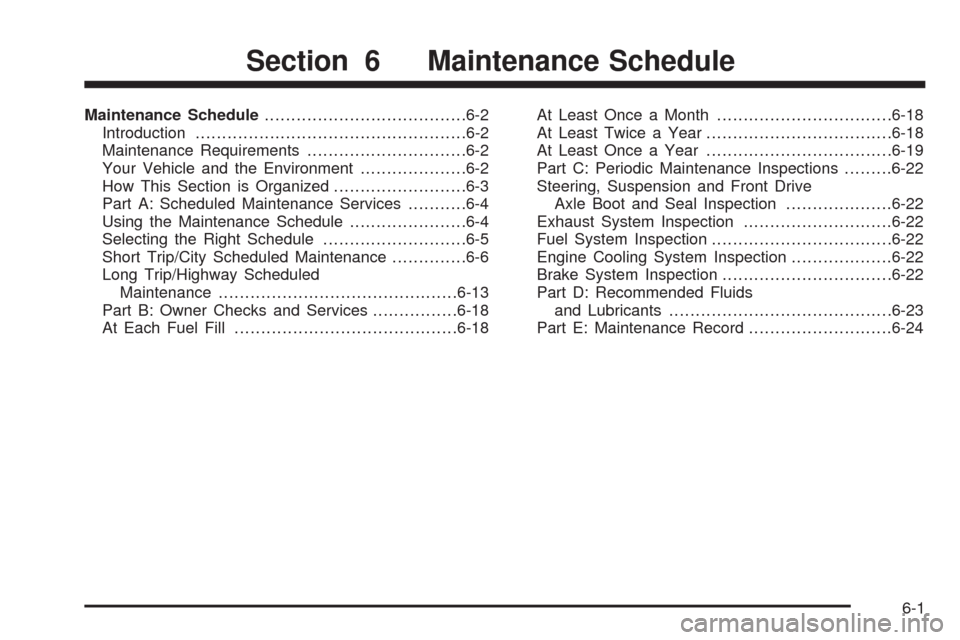
Maintenance Schedule......................................6-2
Introduction...................................................6-2
Maintenance Requirements..............................6-2
Your Vehicle and the Environment....................6-2
How This Section is Organized.........................6-3
Part A: Scheduled Maintenance Services...........6-4
Using the Maintenance Schedule......................6-4
Selecting the Right Schedule...........................6-5
Short Trip/City Scheduled Maintenance..............6-6
Long Trip/Highway Scheduled
Maintenance.............................................6-13
Part B: Owner Checks and Services................6-18
At Each Fuel Fill..........................................6-18At Least Once a Month.................................6-18
At Least Twice a Year...................................6-18
At Least Once a Year...................................6-19
Part C: Periodic Maintenance Inspections.........6-22
Steering, Suspension and Front Drive
Axle Boot and Seal Inspection....................6-22
Exhaust System Inspection............................6-22
Fuel System Inspection..................................6-22
Engine Cooling System Inspection...................6-22
Brake System Inspection................................6-22
Part D: Recommended Fluids
and Lubricants..........................................6-23
Part E: Maintenance Record...........................6-24
Section 6 Maintenance Schedule
6-1
Page 331 of 384
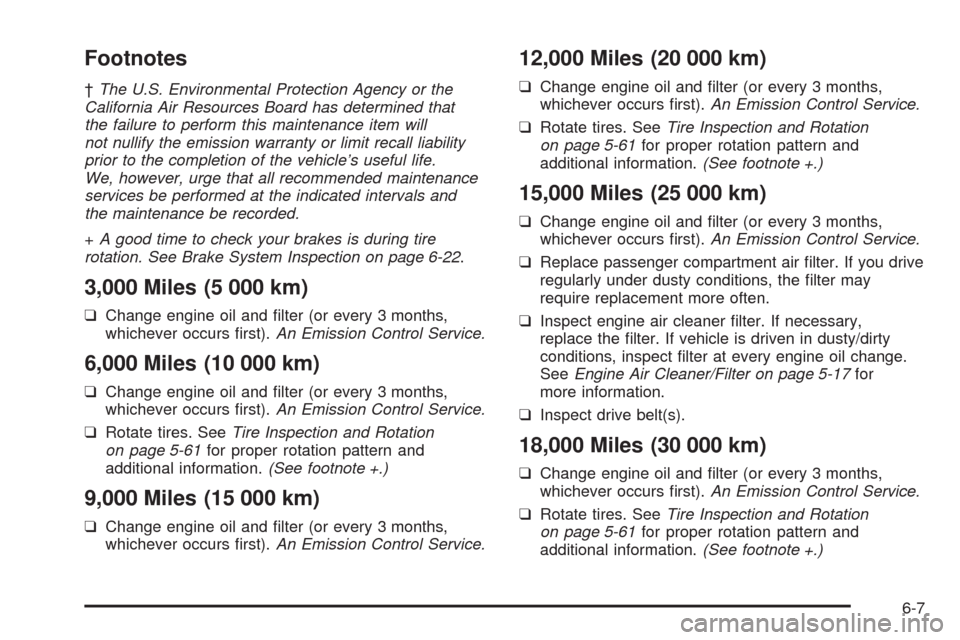
Footnotes
†The U.S. Environmental Protection Agency or the
California Air Resources Board has determined that
the failure to perform this maintenance item will
not nullify the emission warranty or limit recall liability
prior to the completion of the vehicle’s useful life.
We, however, urge that all recommended maintenance
services be performed at the indicated intervals and
the maintenance be recorded.
+A good time to check your brakes is during tire
rotation. See Brake System Inspection on page 6-22.
3,000 Miles (5 000 km)
❑Change engine oil and filter (or every 3 months,
whichever occurs first).An Emission Control Service.
6,000 Miles (10 000 km)
❑Change engine oil and filter (or every 3 months,
whichever occurs first).An Emission Control Service.
❑Rotate tires. SeeTire Inspection and Rotation
on page 5-61for proper rotation pattern and
additional information.(See footnote +.)
9,000 Miles (15 000 km)
❑Change engine oil and filter (or every 3 months,
whichever occurs first).An Emission Control Service.
12,000 Miles (20 000 km)
❑Change engine oil and filter (or every 3 months,
whichever occurs first).An Emission Control Service.
❑Rotate tires. SeeTire Inspection and Rotation
on page 5-61for proper rotation pattern and
additional information.(See footnote +.)
15,000 Miles (25 000 km)
❑Change engine oil and filter (or every 3 months,
whichever occurs first).An Emission Control Service.
❑Replace passenger compartment air filter. If you drive
regularly under dusty conditions, the filter may
require replacement more often.
❑Inspect engine air cleaner filter. If necessary,
replace the filter. If vehicle is driven in dusty/dirty
conditions, inspect filter at every engine oil change.
SeeEngine Air Cleaner/Filter on page 5-17for
more information.
❑Inspect drive belt(s).
18,000 Miles (30 000 km)
❑Change engine oil and filter (or every 3 months,
whichever occurs first).An Emission Control Service.
❑Rotate tires. SeeTire Inspection and Rotation
on page 5-61for proper rotation pattern and
additional information.(See footnote +.)
6-7
Page 337 of 384
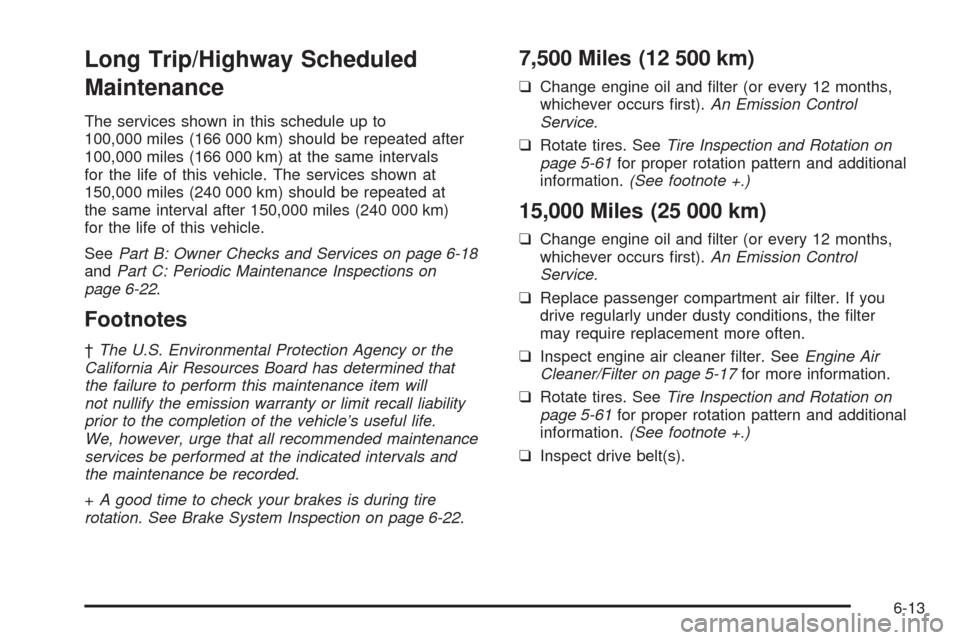
Long Trip/Highway Scheduled
Maintenance
The services shown in this schedule up to
100,000 miles (166 000 km) should be repeated after
100,000 miles (166 000 km) at the same intervals
for the life of this vehicle. The services shown at
150,000 miles (240 000 km) should be repeated at
the same interval after 150,000 miles (240 000 km)
for the life of this vehicle.
SeePart B: Owner Checks and Services on page 6-18
andPart C: Periodic Maintenance Inspections on
page 6-22.
Footnotes
†The U.S. Environmental Protection Agency or the
California Air Resources Board has determined that
the failure to perform this maintenance item will
not nullify the emission warranty or limit recall liability
prior to the completion of the vehicle’s useful life.
We, however, urge that all recommended maintenance
services be performed at the indicated intervals and
the maintenance be recorded.
+A good time to check your brakes is during tire
rotation. See Brake System Inspection on page 6-22.
7,500 Miles (12 500 km)
❑Change engine oil and filter (or every 12 months,
whichever occurs first).An Emission Control
Service.
❑Rotate tires. SeeTire Inspection and Rotation on
page 5-61for proper rotation pattern and additional
information.(See footnote +.)
15,000 Miles (25 000 km)
❑Change engine oil and filter (or every 12 months,
whichever occurs first).An Emission Control
Service.
❑Replace passenger compartment air filter. If you
drive regularly under dusty conditions, the filter
may require replacement more often.
❑Inspect engine air cleaner filter. SeeEngine Air
Cleaner/Filter on page 5-17for more information.
❑Rotate tires. SeeTire Inspection and Rotation on
page 5-61for proper rotation pattern and additional
information.(See footnote +.)
❑Inspect drive belt(s).
6-13
Page 343 of 384
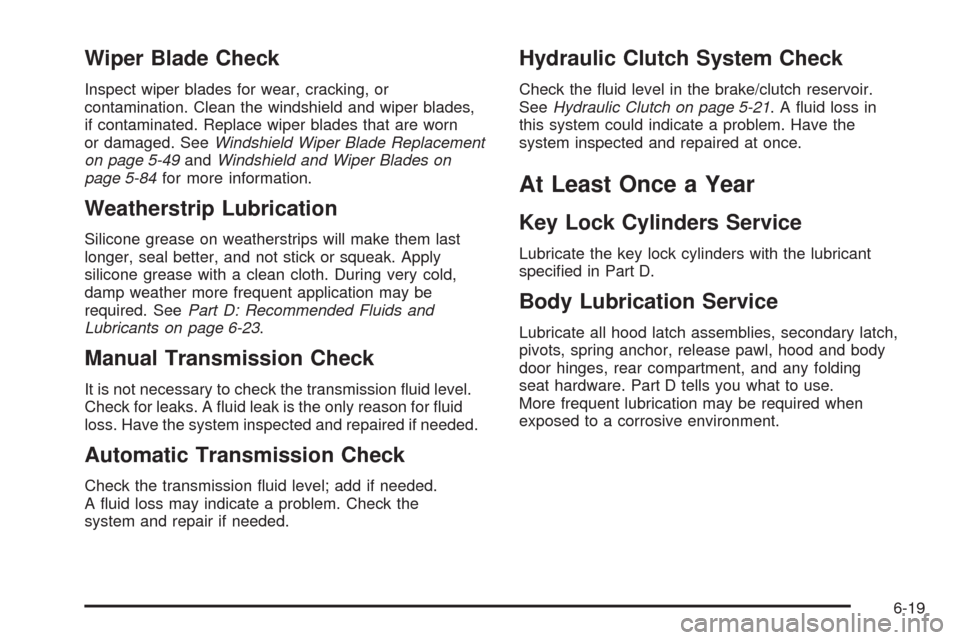
Wiper Blade Check
Inspect wiper blades for wear, cracking, or
contamination. Clean the windshield and wiper blades,
if contaminated. Replace wiper blades that are worn
or damaged. SeeWindshield Wiper Blade Replacement
on page 5-49andWindshield and Wiper Blades on
page 5-84for more information.
Weatherstrip Lubrication
Silicone grease on weatherstrips will make them last
longer, seal better, and not stick or squeak. Apply
silicone grease with a clean cloth. During very cold,
damp weather more frequent application may be
required. SeePart D: Recommended Fluids and
Lubricants on page 6-23.
Manual Transmission Check
It is not necessary to check the transmission fluid level.
Check for leaks. A fluid leak is the only reason for fluid
loss. Have the system inspected and repaired if needed.
Automatic Transmission Check
Check the transmission fluid level; add if needed.
A fluid loss may indicate a problem. Check the
system and repair if needed.
Hydraulic Clutch System Check
Check the fluid level in the brake/clutch reservoir.
SeeHydraulic Clutch on page 5-21. A fluid loss in
this system could indicate a problem. Have the
system inspected and repaired at once.
At Least Once a Year
Key Lock Cylinders Service
Lubricate the key lock cylinders with the lubricant
specified in Part D.
Body Lubrication Service
Lubricate all hood latch assemblies, secondary latch,
pivots, spring anchor, release pawl, hood and body
door hinges, rear compartment, and any folding
seat hardware. Part D tells you what to use.
More frequent lubrication may be required when
exposed to a corrosive environment.
6-19
Page 344 of 384
Starter Switch Check
{CAUTION:
When you are doing this inspection, the
vehicle could move suddenly. If the vehicle
moves, you or others could be injured.
1. Before you start, be sure you have enough room
around the vehicle.
2. Firmly apply both the parking brake and the regular
brake. SeeParking Brake on page 2-26if necessary.
Do not use the accelerator pedal, and be ready to
turn off the engine immediately if it starts.
3. On automatic transmission vehicles, try to start the
engine in each gear. The starter should work only
in PARK (P) or NEUTRAL (N). If the starter works in
any other position, your vehicle needs service.
On manual transmission vehicles, put the shift lever
in NEUTRAL, push the clutch pedal down halfway
and try to start the engine. The starter should
work only when the clutch pedal is pushed down
all the way to the floor. If the starter works when the
clutch pedal is not pushed all the way down, your
vehicle needs service.
Automatic Transmission Shift Lock
Control System Check
{CAUTION:
When you are doing this inspection, the
vehicle could move suddenly. If the vehicle
moves, you or others could be injured.
1. Before you start, be sure you have enough room
around the vehicle. It should be parked on a level
surface.
2. Firmly apply the parking brake. SeeParking Brake
on page 2-26if necessary.
Be ready to apply the regular brake immediately
if the vehicle begins to move.
3. With the engine off, turn the ignition to ON/RUN,
but do not start the engine. Without applying the
regular brake, try to move the shift lever out
of PARK (P) with normal effort. If the shift lever
moves out of PARK (P), your vehicle needs service.
6-20
Page 345 of 384
Ignition Transmission Lock Check
While parked, and with the parking brake set, try to turn
the ignition to LOCK/OFF in each shift lever position.
•With an automatic transmission, the ignition
should turn to LOCK/OFF only when the shift
lever is in PARK (P).
•With a manual transmission, the ignition should
turn to LOCK/OFF only when you press the key
release button.
On all vehicles, the ignition key should come out only
in LOCK/OFF.
Turn the steering wheel to the left and to the right.
It should only lock when turned to the right.
Parking Brake and Automatic
Transmission Park (P) Mechanism
Check
{CAUTION:
When you are doing this check, your vehicle
could begin to move. You or others could be
injured and property could be damaged. Make
CAUTION: (Continued)
CAUTION: (Continued)
sure there is room in front of your vehicle in case
it begins to roll. Be ready to apply the regular
brake at once should the vehicle begin to move.
Park on a fairly steep hill, with the vehicle facing downhill.
Keeping your foot on the regular brake, set the parking
brake.
•To check the parking brake’s holding ability: With the
engine running and transmission in NEUTRAL (N),
slowly remove foot pressure from the regular brake
pedal. Do this until the vehicle is held by the parking
brake only.
•To check the PARK (P) mechanism’s holding
ability: With the engine running, shift to PARK (P).
Then release the parking brake followed by the
regular brake.
Underbody Flushing Service
At least every spring, use plain water to flush any
corrosive materials from the underbody. Take care
to clean thoroughly any areas where mud and other
debris can collect.
6-21
Page 346 of 384
Part C: Periodic Maintenance
Inspections
Listed in this part are inspections and services which
should be performed at least twice a year, for instance,
each spring and fall.You should let your dealer/retailer
do these jobs. Make sure any necessary repairs
are completed at once.
Proper procedures to perform these services can be
found in a service manual. SeeService Publications
Ordering Information on page 7-17.
Steering, Suspension and Front
Drive Axle Boot and Seal Inspection
Inspect the front and rear suspension and steering system
for damaged, loose or missing parts, signs of wear or lack
of lubrication. Inspect the power steering lines and hoses
for proper hook-up, binding, leaks, cracks, chafing, etc.
Clean and then inspect the drive axle boot seals for
damage, tears or leakage. Replace seals if necessary.
Exhaust System Inspection
Inspect the complete exhaust system. Inspect the body
near the exhaust system. Look for broken, damaged,
missing, or out-of-position parts as well as open seams,
holes, loose connections, or other conditions which could
cause a heat build-up in the floor pan or could let exhaust
fumes into the vehicle. SeeEngine Exhaust on page 2-30.
Fuel System Inspection
Inspect the complete fuel system for damage or leaks.
Engine Cooling System Inspection
Inspect the hoses and have them replaced if they
are cracked, swollen or deteriorated. Inspect all pipes,
fittings and clamps; replace as needed. Clean the
outside of the radiator and air conditioning condenser.
To help ensure proper operation, a pressure test of
the cooling system and pressure cap is recommended
at least once a year.
Brake System Inspection
Inspect the complete system. Inspect brake lines and
hoses for proper hook-up, binding, leaks, cracks, chafing,
etc. Inspect disc brake pads for wear and rotors for
surface condition. Also inspect drum brake linings for
wear and cracks. Inspect other brake parts, including
drums, wheel cylinders, calipers, parking brake, etc.
Check parking brake adjustment. You may need to have
your brakes inspected more often if your driving habits or
conditions result in frequent braking.
6-22