2008 CHEVROLET AVEO seats
[x] Cancel search: seatsPage 104 of 384
Shift Speeds
{CAUTION:
If you skip a gear when you downshift, you could
lose control of your vehicle. You could injure
yourself or others. Do not shift down more than
one gear at a time when you downshift.
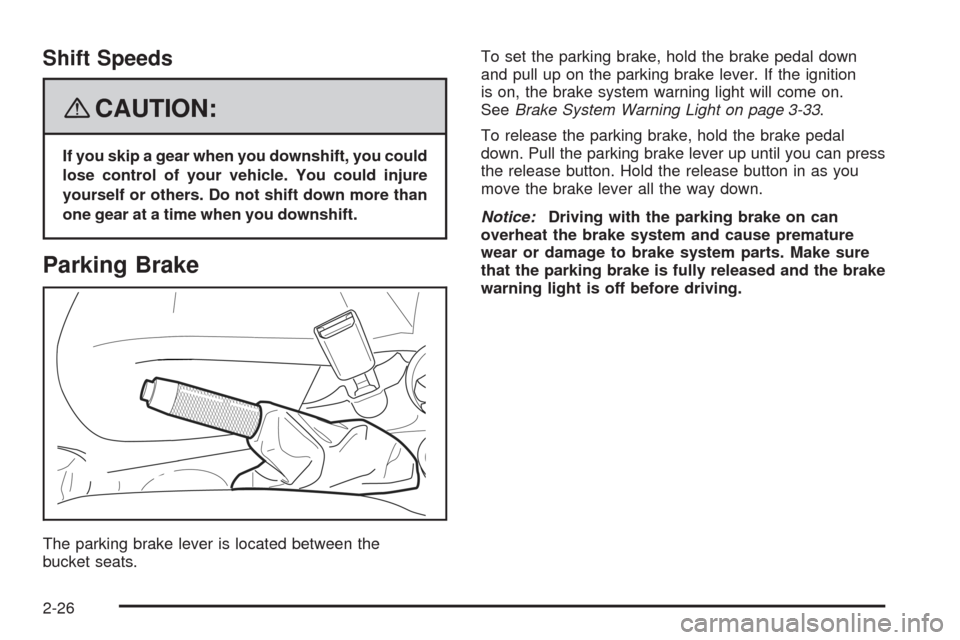
Parking Brake
The parking brake lever is located between the
bucket seats.To set the parking brake, hold the brake pedal down
and pull up on the parking brake lever. If the ignition
is on, the brake system warning light will come on.
SeeBrake System Warning Light on page 3-33.
To release the parking brake, hold the brake pedal
down. Pull the parking brake lever up until you can press
the release button. Hold the release button in as you
move the brake lever all the way down.
Notice:Driving with the parking brake on can
overheat the brake system and cause premature
wear or damage to brake system parts. Make sure
that the parking brake is fully released and the brake
warning light is off before driving.
2-26
Page 135 of 384
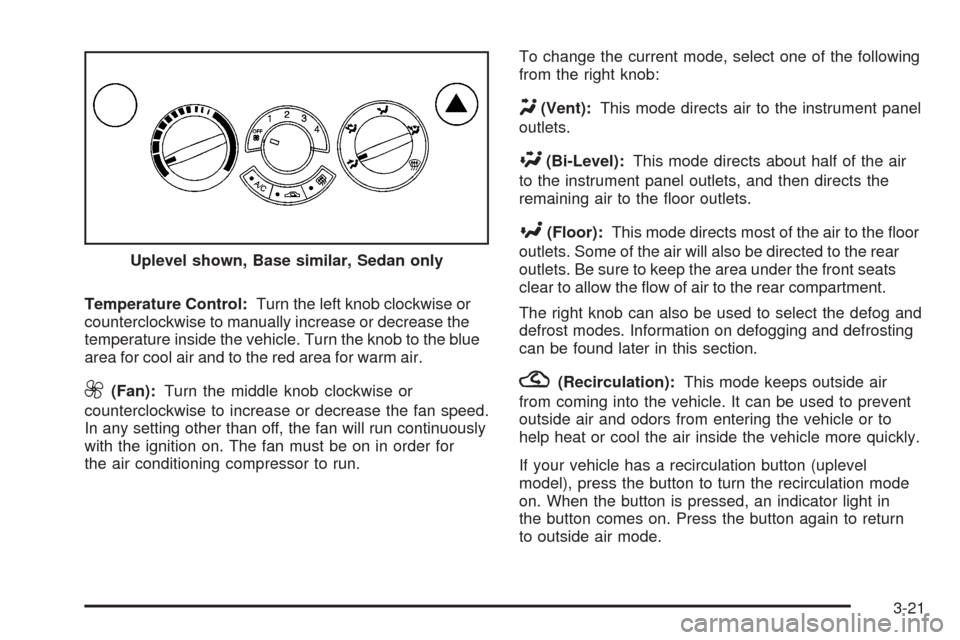
Temperature Control:Turn the left knob clockwise or
counterclockwise to manually increase or decrease the
temperature inside the vehicle. Turn the knob to the blue
area for cool air and to the red area for warm air.
9(Fan):Turn the middle knob clockwise or
counterclockwise to increase or decrease the fan speed.
In any setting other than off, the fan will run continuously
with the ignition on. The fan must be on in order for
the air conditioning compressor to run.To change the current mode, select one of the following
from the right knob:
Y(Vent):This mode directs air to the instrument panel
outlets.
\(Bi-Level):This mode directs about half of the air
to the instrument panel outlets, and then directs the
remaining air to the floor outlets.
[(Floor):This mode directs most of the air to the floor
outlets. Some of the air will also be directed to the rear
outlets. Be sure to keep the area under the front seats
clear to allow the flow of air to the rear compartment.
The right knob can also be used to select the defog and
defrost modes. Information on defogging and defrosting
can be found later in this section.
?(Recirculation):This mode keeps outside air
from coming into the vehicle. It can be used to prevent
outside air and odors from entering the vehicle or to
help heat or cool the air inside the vehicle more quickly.
If your vehicle has a recirculation button (uplevel
model), press the button to turn the recirculation mode
on. When the button is pressed, an indicator light in
the button comes on. Press the button again to return
to outside air mode. Uplevel shown, Base similar, Sedan only
3-21
Page 138 of 384
Outlet Adjustment
To open an outlet, press on its cover. Turn the cover to
change the direction of the airflow.
Operation Tips
•
Clear away any ice, snow or leaves from the air
inlets at the base of the windshield that may
block the flow of air into your vehicle.
•Use of non-GM approved hood deflectors may
adversely affect the performance of the system.
•Keep the path under the front seats clear of objects
to help circulate the air inside of your vehicle more
effectively.
Passenger Compartment Air Filter
Your vehicle may have a passenger compartment
air filter. It is located behind the glove box and can be
accessed after removing the glove box from its housing.
The filter traps most of the pollen from air entering
the module. The air cleaner/filter may need to be
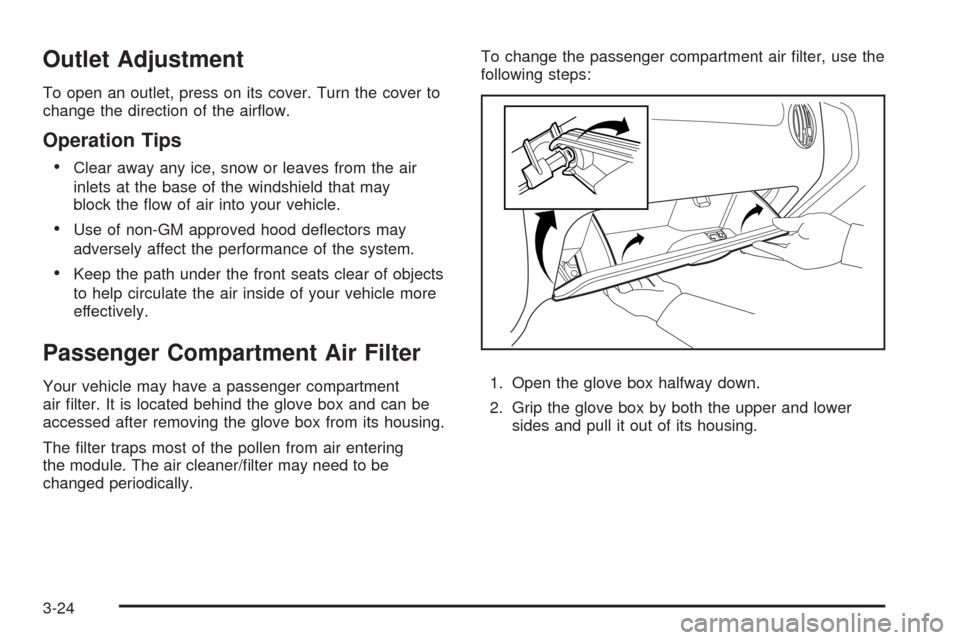
changed periodically.To change the passenger compartment air filter, use the
following steps:
1. Open the glove box halfway down.
2. Grip the glove box by both the upper and lower
sides and pull it out of its housing.
3-24
Page 220 of 384
And, if you do have a heavy load, you should
spread it out. See “Steps for Determining Correct
Load Limit” earlier in this section.
{CAUTION:
Do not load your vehicle any heavier than
the Gross Vehicle Weight Rating (GVWR),
or either the maximum front or rear Gross
Axle Weight Rating (GAWR). If you do,
parts on your vehicle can break, and it
can change the way your vehicle handles.
These could cause you to lose control and
crash. Also, overloading can shorten the
life of your vehicle.
Notice:Overloading your vehicle may cause
damage. Repairs would not be covered by
your warranty. Do not overload your vehicle.If you put things inside your vehicle — like
suitcases, tools, packages, or anything else — they
will go as fast as the vehicle goes. If you have to
stop or turn quickly, or if there is a crash, they will
keep going.{CAUTION:
Things you put inside your vehicle can
strike and injure people in a sudden stop
or turn, or in a crash.
Put things in the cargo area of your
vehicle. Try to spread the weight
evenly.
Never stack heavier things, like
suitcases, inside the vehicle so that
some of them are above the tops of
the seats.
Do not leave an unsecured child
restraint in your vehicle.
When you carry something inside the
vehicle, secure it whenever you can.
Do not leave a seat folded down
unless you need to.
4-26
Page 276 of 384

(D) Construction Code:A letter code is used
to indicate the type of ply construction in the tire.
The letter R means radial ply construction; the
letter D means diagonal or bias ply construction;
and the letter B means belted-bias ply
construction.
(E) Rim Diameter
:Diameter of the wheel in
inches.
(F) Service Description
:These characters
represent the load range and the speed rating of
a tire. The load range represents the load
carry capacity a tire is certified to carry. The speed
rating is the maximum speed a tire is certified to
carry a load. Speed ratings range from A to Z.
Tire Terminology and Denitions
Air Pressure:The amount of air inside the
tire pressing outward on each square inch of
the tire. Air pressure is expressed in pounds
per square inch (psi) or kilopascal (kPa).
Accessory Weight
:This means the combined
weight of optional accessories. Some examples of
optional accessories are, automatic transmission,
power steering, power brakes, power windows,
power seats, and air conditioning.Aspect Ratio
:The relationship of a tire’s height
to its width.
Belt
:A rubber coated layer of cords that is
located between the plies and the tread. Cords
may be made from steel or other reinforcing
materials.
Bead
:The tire bead contains steel wires wrapped
by steel cords that hold the tire onto the rim.
Bias Ply Tire
:A pneumatic tire in which the plies
are laid at alternate angles less than 90 degrees
to the centerline of the tread.
Cold Tire Pressure
:The amount of air pressure
in a tire, measured in pounds per square inch (psi)
or kilopascals (kPa) before a tire has built up heat
from driving. SeeInflation - Tire Pressure on
page 5-57.
Curb Weight
:The weight of a motor vehicle
with standard and optional equipment including
the maximum capacity of fuel, oil, and coolant,
but without passengers and cargo.
5-54
Page 379 of 384

Maintenance Schedule (cont.)
Using.......................................................... 6-4
Your Vehicle and the Environment................... 6-2
Malfunction Indicator Light........................3-36, 3-49
Manual Lumbar Controls.................................... 1-3
Manual Seats................................................... 1-2
Manual Transmission
Fluid..........................................................5-21
Operation...................................................2-25
Manual, Using..................................................... ii
Manual Windows............................................2-12
Mirrors
Manual Rearview Mirror................................2-32
Outside Convex Mirror.................................2-34
Outside Heated Mirrors................................2-34
Outside Manual Mirrors................................2-32
Outside Power Mirror...................................2-33
MP3 .....................................................3-72, 3-75
MyGMLink.com................................................ 7-5
N
Navigation System, Privacy..............................7-20
New Vehicle Break-In......................................2-17
Normal Maintenance Replacement Parts...........5-100
O
Odometer......................................................3-29
Odometer, Trip...............................................3-29
Off-Road Recovery........................................... 4-8
Oil
Engine.......................................................5-13
Pressure Light....................................3-39, 3-52
Older Children, Restraints................................1-32
Online Owner Center........................................ 7-5
OnStar, Privacy..............................................7-20
Other Warning Devices...................................... 3-8
Outlet Adjustment............................................3-24
Outlets
Accessory Power.........................................3-18
Outside
Convex Mirror.............................................2-34
Heated Mirrors............................................2-34
Manual Mirrors............................................2-32
Power Mirror...............................................2-33
Owners, Canadian............................................... ii
9
Page 381 of 384
Removing the Flat Tire and Installing the
Spare Tire..................................................5-73
Removing the Spare Tire and Tools...................5-71
Replacement Bulbs.........................................5-48
Reporting Safety Defects
Canadian Government..................................7-17
General Motors...........................................7-17
United States Government............................7-16
Restraint System Check
Checking the Restraint Systems....................1-72
Replacing Restraint System Parts
After a Crash..........................................1-73
Roadside
Assistance Program....................................... 7-8
Rocking Your Vehicle to Get it Out....................4-17
Routing, Engine Drive Belt..............................5-101
Running the Engine While Parked.....................2-31
S
Safety Belt
Reminder Light...................................3-30, 3-44
Safety Belts
Care of......................................................5-82
How to Wear Safety Belts Properly................1-19
Lap-Shoulder Belt........................................1-27Safety Belts (cont.)
Safety Belt Extender....................................1-31
Safety Belt Use During Pregnancy.................1-30
Safety Belts Are for Everyone.......................1-14
Safety Warnings and Symbols.............................. iii
Seats
Driver Seat Height Adjuster............................. 1-3
Head Restraints............................................ 1-6
Manual Lumbar............................................. 1-3
Rear Seat Operation..............................1-7, 1-10
Reclining Seatbacks...................................... 1-4
Secondary Information Center (SIC)...................3-43
Securing a Child Restraint
Rear Seat Position......................................1-49
Right Front Seat Position..............................1-52
Selecting the Right Schedule, Maintenance.......... 6-5
Service........................................................... 5-3
Accessories and Modifications......................... 5-3
Adding Equipment to the Outside of
Your Vehicle.............................................. 5-5
California Pershlorate Materials
Requirements............................................ 5-4
California Proposition 65 Warning.................... 5-4
Doing Your Own Work................................... 5-4
Engine Soon Light...............................3-36, 3-49
Publications Ordering Information...................7-17
11