2008 CHEVROLET AVEO service indicator
[x] Cancel search: service indicatorPage 163 of 384
Malfunction Indicator Lamp
Check Engine Light
A computer system called OBD II (On-Board
Diagnostics-Second Generation) monitors operation of
the fuel, ignition, and emission control systems. It makes
sure that emissions are at acceptable levels for the life of
the vehicle, helping to produce a cleaner environment.
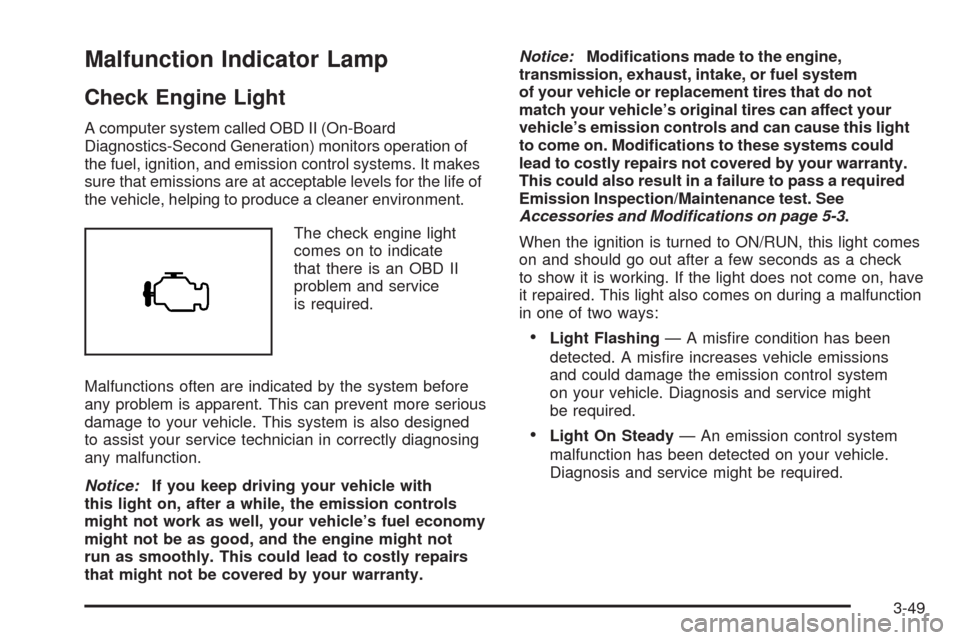
The check engine light
comes on to indicate
that there is an OBD II
problem and service
is required.
Malfunctions often are indicated by the system before
any problem is apparent. This can prevent more serious
damage to your vehicle. This system is also designed
to assist your service technician in correctly diagnosing
any malfunction.
Notice:If you keep driving your vehicle with
this light on, after a while, the emission controls
might not work as well, your vehicle’s fuel economy
might not be as good, and the engine might not
run as smoothly. This could lead to costly repairs
that might not be covered by your warranty.Notice:Modications made to the engine,
transmission, exhaust, intake, or fuel system
of your vehicle or replacement tires that do not
match your vehicle’s original tires can affect your
vehicle’s emission controls and can cause this light
to come on. Modications to these systems could
lead to costly repairs not covered by your warranty.
This could also result in a failure to pass a required
Emission Inspection/Maintenance test. See
Accessories and Modifications on page 5-3.
When the ignition is turned to ON/RUN, this light comes
on and should go out after a few seconds as a check
to show it is working. If the light does not come on, have
it repaired. This light also comes on during a malfunction
in one of two ways:
•Light Flashing— A misfire condition has been
detected. A misfire increases vehicle emissions
and could damage the emission control system
on your vehicle. Diagnosis and service might
be required.
•Light On Steady— An emission control system
malfunction has been detected on your vehicle.
Diagnosis and service might be required.
3-49
Page 228 of 384
California Fuel
If your vehicle is certified to meet California Emissions
Standards, it is designed to operate on fuels that meet
California specifications. See the underhood emission
control label. If this fuel is not available in states adopting
California emissions standards, your vehicle will operate
satisfactorily on fuels meeting federal specifications, but
emission control system performance might be affected.
The malfunction indicator lamp could turn on and your
vehicle might fail a smog-check test. SeeMalfunction
Indicator Lamp on page 3-36for sedans orMalfunction
Indicator Lamp on page 3-49for hatchbacks. If this
occurs, return to your authorized dealer/retailer for
diagnosis. If it is determined that the condition is caused
by the type of fuel used, repairs might not be covered by
your warranty.
Additives
To provide cleaner air, all gasolines in the United States
are now required to contain additives that help prevent
engine and fuel system deposits from forming, allowing
the emission control system to work properly. In
most cases, you should not have to add anything to the
fuel. However, some gasolines contain only the
minimum amount of additive required to meet U.S.
Environmental Protection Agency regulations. To help
keep fuel injectors and intake valves clean, or if
your vehicle experiences problems due to dirty injectorsor valves, look for gasoline that is advertised as TOP
TIER Detergent Gasoline. Also, your dealer/retailer has
additives that will help correct and prevent most
deposit-related problems.
Gasolines containing oxygenates, such as ethers and
ethanol, and reformulated gasolines might be available in
your area. We recommend that you use these gasolines,
if they comply with the specifications described earlier.
However, E85 (85% ethanol) and other fuels containing
more than 10% ethanol must not be used in vehicles that
were not designed for those fuels.
Notice:Your vehicle was not designed for fuel that
contains methanol. Do not use fuel containing
methanol. It can corrode metal parts in the fuel
system and also damage plastic and rubber parts.
That damage would not be covered under your
warranty.
Some gasolines that are not reformulated for low
emissions can contain an octane-enhancing additive
called methylcyclopentadienyl manganese tricarbonyl
(MMT); ask the attendant where you buy gasoline
whether the fuel contains MMT. We recommend against
the use of such gasolines. Fuels containing MMT can
reduce the life of spark plugs and the performance of the
emission control system could be affected. The
malfunction indicator lamp might turn on. If this occurs,
return to your dealer/retailer for service.
5-6
Page 256 of 384

Brake Wear
Your vehicle has front disc brakes and could have rear
drum brakes or rear disc brakes.
Disc brake pads have built-in wear indicators that make
a high-pitched warning sound when the brake pads
are worn and new pads are needed. The sound
can come and go or be heard all the time your vehicle
is moving, except when you are pushing on the
brake pedal firmly.
{CAUTION:
The brake wear warning sound means that
soon the brakes will not work well. That could
lead to an accident. When you hear the brake
wear warning sound, have your vehicle
serviced.
Notice:Continuing to drive with worn-out brake
pads could result in costly brake repair.Some driving conditions or climates can cause a brake
squeal when the brakes are first applied or lightly
applied. This does not mean something is wrong with
the brakes.
Properly torqued wheel nuts are necessary to help
prevent brake pulsation. When tires are rotated, inspect
brake pads for wear and evenly tighten wheel nuts in
the proper sequence to torque specifications in
Capacities and Specifications on page 5-99.
If you have rear drum brakes, they do not have wear
indicators, but if you ever hear a rear brake rubbing
noise, have the rear brake linings inspected immediately.
Also, the rear brake drums should be removed and
inspected each time the tires are removed for rotation or
changing. When you have the front brake pads
replaced, have the rear brakes inspected, too.
Brake linings should always be replaced as complete
axle sets.
SeeBrake System Inspection on page 6-22.
5-34
Page 281 of 384
Please note that the TPMS is not a substitute for proper
tire maintenance, and it is the driver’s responsibility to
maintain correct tire pressure, even if under-inflation
has not reached the level to trigger illumination of
the TPMS low tire pressure telltale.
Your vehicle has also been equipped with a TPMS
malfunction indicator to indicate when the system is
not operating properly. The TPMS malfunction indicator
is combined with the low tire pressure telltale. When
the system detects a malfunction, the telltale will
flash for approximately one minute and then remain
continuously illuminated. This sequence will continue
upon subsequent vehicle start-ups as long as the
malfunction exists.
When the malfunction indicator is illuminated, the
system may not be able to detect or signal low tire
pressure as intended. TPMS malfunctions may occur
for a variety of reasons, including the installation of
replacement or alternate tires or wheels on the
vehicle that prevent the TPMS from functioning properly.
Always check the TPMS malfunction telltale after
replacing one or more tires or wheels on your vehicle
to ensure that the replacement or alternate tires and
wheels allow the TPMS to continue to function properly.
SeeTire Pressure Monitor Operation on page 5-60,
for additional information.Federal Communications
Commission (FCC) and Industry
and Science Canada
The Tire Pressure Monitor System (TPMS) operates
on a radio frequency and complies with Part 15 of
the FCC Rules. Operation is subject to the following
two conditions:
1. This device may not cause harmful interference.
2. This device must accept any interference received,
including interference that may cause undesired
operation.
The Tire Pressure Monitor System (TPMS) operates
on a radio frequency and complies with RSS-210
of Industry and Science Canada. Operation is subject
to the following two conditions:
1. This device may not cause interference.
2. This device must accept any interference received,
including interference that may cause undesired
operation of the device.
Changes or modifications to this system by other than
an authorized service facility could void authorization to
use this equipment.
5-59
Page 371 of 384
A
Accessories and Modifications............................ 5-3
Adding Equipment to Your Airbag-Equipped
Vehicle.......................................................1-71
Additives, Fuel................................................. 5-6
Add-On Electrical Equipment............................5-88
Air Cleaner/Filter, Engine.................................5-17
Air Conditioning..............................................3-20
Airbag
Passenger Status Indicator...................3-31, 3-46
Readiness Light..................................3-30, 3-45
Airbag System................................................1-56
What Will You See After an Airbag Inflates?........1-64
When Should an Airbag Inflate?....................1-61
Where Are the Airbags?...............................1-59
Airbag Systems
Adding Equipment to Your Airbag-Equipped
Vehicle...................................................1-71
How Does an Airbag Restrain?......................1-63
Passenger Sensing System...........................1-65
Servicing Your Airbag-Equipped Vehicle..........1-70
What Makes an Airbag Inflate?......................1-63
AM-FM Radio.........................................3-55, 3-56
Antenna, Backglass.........................................3-80
Antenna, Fixed Mast.......................................3-80
Antilock Brake System (ABS)............................. 4-4Antilock Brake, System Warning Light........3-34, 3-48
Appearance Care
Aluminum Wheels........................................5-85
Care of Safety Belts....................................5-82
Chemical Paint Spotting...............................5-86
Cleaning Exterior Lamps/Lenses....................5-83
Fabric/Carpet..............................................5-80
Finish Care.................................................5-83
Finish Damage............................................5-86
Instrument Panel, Vinyl, and Other Plastic
Surfaces.................................................5-82
Interior Cleaning..........................................5-79
Leather......................................................5-81
Sheet Metal Damage...................................
5-85
Tires..........................................................5-85
Underbody Maintenance...............................5-86
Vehicle Care/Appearance Materials................5-87
Washing Your Vehicle...................................5-83
Weatherstrips..............................................5-82
Windshield and Wiper Blades........................5-84
Appointments, Scheduling Service.....................7-10
Ashtray.........................................................3-19
Audio System.................................................3-54
AM-FM Radio.....................................3-55, 3-56
Audio Steering Wheel Controls......................3-78
Backglass Antenna......................................3-80
Care of Your CD Player...............................3-79
1
Page 374 of 384
Customer Assistance Information (cont.)
GM Mobility Reimbursement Program............... 7-7
Reporting Safety Defects to General Motors.......7-17
Reporting Safety Defects to the
Canadian Government..............................7-17
Reporting Safety Defects to the
United States Government.........................7-16
Roadside Assistance Program......................... 7-8
Service Publications Ordering Information........7-17
D
Daytime Running Lamps..................................3-16
Daytime Running Lamps Indicator Light.............3-40
Defensive Driving............................................. 4-2
Disc, MP3.............................................3-72, 3-75
Doing Your Own Service Work........................... 5-4
Dome Lamp...................................................3-18
Door
Ajar Light...........................................3-41, 3-53
Central Door Unlocking System....................... 2-7
Door Ajar Reminder....................................... 2-7
Locks.......................................................... 2-6
Rear Door Security Locks............................... 2-8Driver
Seat Height Adjuster...................................... 1-3
Driving
At Night.....................................................4-10
Before a Long Trip......................................4-12
Defensive..................................................... 4-2
Drunken....................................................... 4-2
Highway Hypnosis.......................................4-12
Hill and Mountain Roads..............................4-12
In Rain and on Wet Roads...........................4-10
Rocking Your Vehicle to Get it Out.................4-17
Winter........................................................4-13
E
EDR .............................................................7-18
Electrical System
Add-On Equipment......................................5-88
Engine Compartment Fuse Block...................5-94
Fuses and Circuit Breakers...........................5-89
Headlamp Wiring.........................................5-89
Instrument Panel Fuse Block.........................5-90
Power Windows and Other Power Options......5-89
Windshield Wiper Fuses...............................5-89
4
Page 378 of 384
Light (cont.)
Oil Pressure.......................................3-39, 3-52
Passenger Airbag Status Indicator..................3-31
Safety Belt Reminders..........................3-30, 3-44
Tire Pressure..............................................3-36
Lights
Exterior Lamps............................................3-15
Flash-to-Pass..............................................3-10
High/Low Beam Changer..............................3-10
On Reminder..............................................3-16
Loading Your Vehicle.......................................4-18
Lockout Protection............................................ 2-8
Locks
Central Door Unlocking System....................... 2-7
Door........................................................... 2-6
Lockout Protection......................................... 2-8
Rear Door Security Locks............................... 2-8
Long Trip/Highway Scheduled Maintenance........6-13
Loss of Control................................................ 4-8
Low Fuel Warning Light...................................3-42
Lumbar
Manual Controls............................................ 1-3M
Maintenance, Normal Replacement Parts..........5-100
Maintenance Schedule
At Each Fuel Fill.........................................6-18
At Least Once a Month................................6-18
At Least Once a Year..................................6-19
At Least Twice a Year..................................6-18
Brake System Inspection..............................6-22
Engine Cooling System Inspection.................6-22
Exhaust System Inspection...........................6-22
Fuel System Inspection................................6-22
How This Section is Organized....................... 6-3
Introduction.................................................. 6-2
Long Trip/Highway Scheduled Maintenance.....6-13
Maintenance Requirements............................. 6-2
Part A - Scheduled Maintenance Services......... 6-4
Part B - Owner Checks and Services..............6-18
Part C - Periodic Maintenance Inspections.......6-22
Part D - Recommended Fluids and
Lubricants...............................................6-23
Part E - Maintenance Record.........................6-24
Selecting the Right Schedule.......................... 6-5
Short Trip/City Scheduled Maintenance............. 6-6
Steering, Suspension and Front Drive Axle
Boot and Seal Inspection..........................6-22
8
Page 380 of 384
P
Paint, Damage...............................................5-86
Park Brake....................................................2-26
Park (P)
Shifting Into................................................2-27
Shifting Out of............................................2-28
Parking
Over Things That Burn.................................2-30
Parking Your Vehicle.......................................2-29
Part A - Scheduled Maintenance Services............. 6-4
Part B - Owner Checks and Services.................6-18
Part C - Periodic Maintenance Inspections..........6-22
Part D - Recommended Fluids and Lubricants.....6-23
Part E - Maintenance Record............................6-24
Passenger Airbag Status Indicator.............3-31, 3-46
Passenger Compartment Air Filter.....................3-24
Passenger Sensing System..............................1-65
Passing........................................................... 4-8
Perchlorate Materials Requirements, California...... 5-4
Power
Electrical System.........................................5-89
Inadvertent Battery Saver.............................3-18
Steering Fluid.............................................5-30
Windows....................................................2-13Privacy..........................................................7-18
Event Data Recorders..................................7-19
Navigation System.......................................7-20
OnStar.......................................................7-20
Radio Frequency Identification.......................7-20
R
Radio Frequency Identification (RFID),
Privacy......................................................7-20
Radios..........................................................3-54
AM-FM Radio.....................................3-55, 3-56
Care of Your CD Player...............................3-79
Care of Your CDs........................................3-79
Radio with CD............................................3-60
Radio with Six-Disc CD................................3-66
Reception...................................................3-79
Rear Door Security Locks.................................. 2-8
Rear Seat Operation.................................1-7, 1-10
Rear Windshield Washer/Wiper.........................3-12
Rearview Mirrors.............................................2-32
Reclining Seatbacks.......................................... 1-4
Recreational Vehicle Towing.............................4-27
Remote Keyless Entry (RKE) System.................. 2-3
Remote Keyless Entry (RKE) System,
Operation..................................................... 2-4
10