2008 CADILLAC XLR brake
[x] Cancel search: brakePage 137 of 470

Using Cruise Control on Hills
How well your cruise control works on hills depends upon
your speed, load and the steepness of the hills. When
going up steep hills, you might have to step on the
accelerator pedal to maintain your speed. When going
downhill, you might have to brake or shift to a lower gear
to keep your vehicle’s speed down. Of course, applying
the brake turns off the cruise control. Many drivers nd
this to be too much trouble and do not use cruise control
on steep hills.
Ending Cruise Control
There are two ways to turn off the cruise control:
Step lightly on the brake pedal
Move the cruise control switch to off
Erasing Speed Memory
Turning off the cruise control or the ignition, will erase
your cruise control set speed memory.
Adaptive Cruise Control
If your vehicle has this feature, be sure to read this
entire section before using it.
The system operates on a radio frequency subject to
Federal Communications Commission (FCC) Rules and
with Industry Canada.
This device complies with Part 15 of the FCC Rules.
Operation is subject to the following two conditions:
1. This device may not cause interference.
2. This device must accept any interference received,
including interference that may cause undesired
operation of the device.
This device complies with RSS-210 of Industry Canada.
Operation is subject to the following two conditions:
1. This device may not cause interference.
2. This device must accept any interference received,
including interference that may cause undesired
operation of the device.
Changes or modications to this system by other than
an authorized service facility could void authorization to
use this equipment.
3-15
Page 138 of 470

Adaptive Cruise Control is an enhancement to
traditional cruise control and is not a safety system.
It allows you to keep cruise control engaged in moderate
traffic conditions without it having to be constantly
reset. Adaptive Cruise Control uses radar to detect a
vehicle directly ahead in your path, within a distance
of 328 ft (100 m), and operates at speeds above
25 mph (40 km/h). When it is engaged by the driver,
the system can apply limited braking or acceleration
of the vehicle, automatically, to maintain a selected
following distance to the vehicle ahead. The vehicle’s
braking during Adaptive Cruise Control is comparable
to a person applying moderate pressure to the vehicle’s
brake pedal. To disengage Adaptive Cruise Control,
apply the brake. If no vehicle is in your path, your
vehicle will react like traditional cruise control.
{CAUTION:
Adaptive Cruise Control will not apply hard
braking or bring the vehicle to a complete
stop. It will not respond to stopped vehicles,
pedestrians or animals. When you are
approaching a vehicle or object, Adaptive
Cruise Control may not have time to slow your
vehicle enough to avoid a collision. Your
complete attention is always required while
driving and you should be ready to take action
and apply the brakes. For more information,
seeDefensive Driving on page 5-2.
{CAUTION:
On winding roads, Adaptive Cruise Control
may not detect a vehicle ahead. You could
crash into a vehicle ahead of you. Do not
use Adaptive Cruise Control on winding
roads.
CAUTION: (Continued)
3-16
Page 140 of 470

Engaging Adaptive Cruise Control
With the Set Button
{CAUTION:
If you leave your Adaptive Cruise Control
switch on when you are not using cruise, you
might hit a button and go into cruise when you
do not want to. You could be startled and even
lose control. Keep the Adaptive Cruise Control
switch off until you want to use cruise control.
{CAUTION:
If you operate Adaptive Cruise Control without
your Head-up Display (HUD) properly adjusted,
your Adaptive Cruise Control settings may not
be visible. You could forget your settings and
be startled by Adaptive Cruise Control
response and even lose control. Keep your
HUD on and properly adjusted when using
Adaptive Cruise Control.The set speed is selected by the driver. This is the speed
you will travel if there is no vehicle detected in your path.
To set Adaptive Cruise Control, do the following:
1. Make sure the Head-Up Display (HUD) is on and
properly adjusted. You cannot engage Adaptive
Cruise Control unless the HUD is on. SeeHead-Up
Display (HUD) on page 3-33for more information.
2. Move the switch to the on position.
3. Get up to the desired speed.
4. Press in the set button at the end of the lever and
release the button.
5. Take your foot off the accelerator pedal.
Once Adaptive Cruise Control is set, it might immediately
apply the brakes if it detects a vehicle ahead that is too
close or moving slower than your vehicle.
This symbol appears
on the Head-Up
Display (HUD) to indicate
that Adaptive Cruise
Control is active.
SeeHead-Up Display (HUD) on page 3-33for more
information.
3-18
Page 141 of 470

Make sure the set speed is visible on the HUD so you
know the speed your vehicle will accelerate to if a vehicle
is not detected in your path. Keep in mind speed limits,
surrounding traffic speeds, and weather conditions when
adjusting your set speed.
If your vehicle is in Adaptive Cruise Control when the
traction control system begins to limit wheel spin, the
Adaptive Cruise Control automatically disengages.
SeeTraction Control System (TCS) on page 5-6and
StabiliTrak
®System on page 5-8. When road conditions
allow you to safely use it again, the Adaptive Cruise
Control can be turned back on.
Increasing Set Speed While Using
Adaptive Cruise Control
There are two ways to increase the set speed:
Use the accelerator to get to the higher speed. Press
the set button at the end of the lever, then release
the button and the accelerator pedal. Your vehicle
will now cruise at the higher speed.
Move the Adaptive Cruise Control switch from on to
resume/increase. Hold it there until the desired set
speed is displayed in the HUD, then release the
switch. To increase your set speed in very small
amounts, move the switch briey to resume/increase.
Each time this is done, your vehicle set speed
increases by about 1 mph (1.6 km/h).Your vehicle will not reach the set speed until the system
determines there is no vehicle in front of you. At that
point, your vehicle speed will increase to the set speed.
Decreasing Set Speed While Using
Adaptive Cruise Control
Press in the set/decrease button on the end of the lever
until you reach the lower desired speed, then release
the button.
To slow down in very small amounts, briey press the
set/decrease button. Each this is done, your set
speed will be 1 mph (1.6 km/h) slower.
Resuming a Set Speed
If you apply the brakes while the Adaptive Cruise Control
is at a set speed, this disengages the Adaptive Cruise
Control. But it does not need to be reset.
Once the vehicle reaches about 25 mph (40 km/h) or
more, move the Adaptive Cruise Control switch briey
from on to resume/increase. Adaptive Cruise Control will
be engaged with the speed selected previously.
3-19
Page 143 of 470
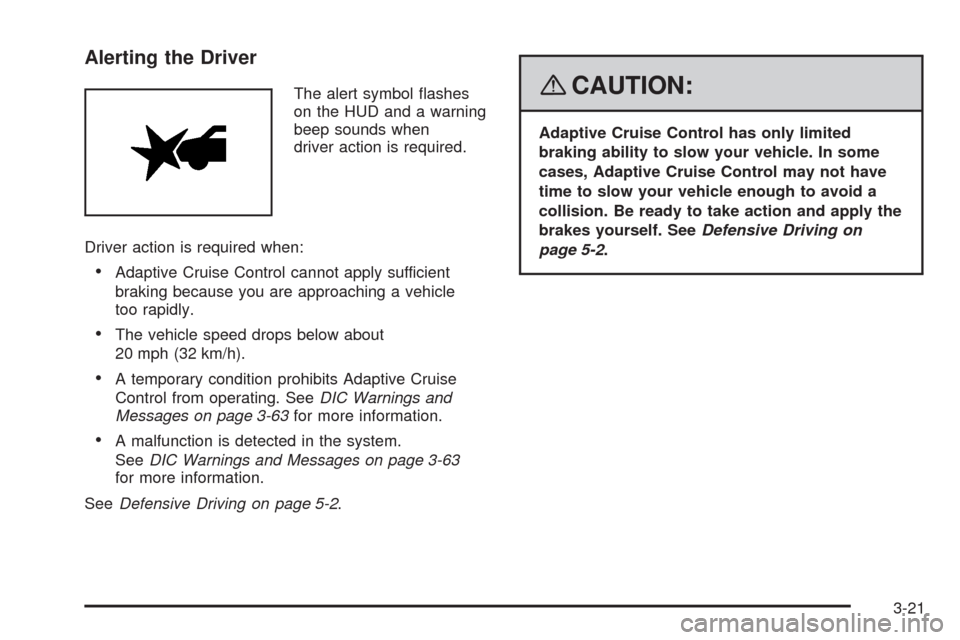
Alerting the Driver
The alert symbol ashes
on the HUD and a warning
beep sounds when
driver action is required.
Driver action is required when:
Adaptive Cruise Control cannot apply sufficient
braking because you are approaching a vehicle
too rapidly.
The vehicle speed drops below about
20 mph (32 km/h).
A temporary condition prohibits Adaptive Cruise
Control from operating. SeeDIC Warnings and
Messages on page 3-63for more information.
A malfunction is detected in the system.
SeeDIC Warnings and Messages on page 3-63
for more information.
SeeDefensive Driving on page 5-2.
{CAUTION:
Adaptive Cruise Control has only limited
braking ability to slow your vehicle. In some
cases, Adaptive Cruise Control may not have
time to slow your vehicle enough to avoid a
collision. Be ready to take action and apply the
brakes yourself. SeeDefensive Driving on
page 5-2.
3-21
Page 144 of 470

Approaching and Following a Vehicle
The vehicle ahead symbol
only appears on the HUD
when a vehicle ahead
is detected in your path.
If this symbol does not appear, or disappears briey,
Adaptive Cruise Control will not respond to vehicles
you may see ahead.{CAUTION:
When the Adaptive Cruise Control radar is
blocked by snow, ice, or dirt, it may not detect
a vehicle ahead. Adaptive Cruise Control may
not have time to slow your vehicle enough to
avoid a collision. Do not use Adaptive Cruise
Control when the radar is blocked by snow,
ice, or dirt. Keep your radar clean. See
“Cleaning the System” later in this section.
Adaptive Cruise Control automatically slows your
vehicle down when approaching a slower moving vehicle.
It then adjusts your speed to follow the vehicle in front at
the selected following distance. Your speed increases
or decreases to follow the vehicle in front of you, but will
not exceed the set speed. It may apply limited braking,
if necessary. When braking is active, your brake lights
come on. It may feel or sound different than if you were
applying the brakes yourself. This is normal.
3-22
Page 145 of 470

Stationary or Very Slow-Moving Objects
{CAUTION:
Adaptive Cruise Control may not detect and
react to stationary or slow-moving vehicles or
other objects ahead of you. You could crash
into an object ahead of you. Do not use
Adaptive Cruise Control when approaching
stationary or slow-moving vehicles or other
objects.
{CAUTION:
Adaptive Cruise Control may not detect and
react to stationary or slow-moving vehicles or
other objects ahead of you. Your vehicle may
accelerate toward objects, such as a stopped
vehicle that suddenly appears after the lead
vehicle changes lanes. Your complete attention
is always required while driving and you should
be ready to take action and apply the brakes.
Low-Speed Deactivation
If your speed falls below 20 mph (32 km/h) while
following a vehicle ahead, Adaptive Cruise Control
begins to disengage. The driver alert symbol on
the HUD ashes and the warning beep sounds.
The driver must take action since Adaptive Cruise
Control will not slow the vehicle to a stop.
Passing a Vehicle
To increase speed to pass a vehicle, use the accelerator
pedal. While your foot is on the accelerator pedal,
the system will not automatically apply the brakes.
Once you pass the vehicle and remove your foot from
the accelerator pedal, Adaptive Cruise Control returns
to normal operation and the brakes can be applied,
if needed.
{CAUTION:
If you rest your foot on the accelerator pedal,
the system will not automatically apply the
brakes. You could crash into a vehicle ahead
of you. Do not rest your foot on the accelerator
pedal when using Adaptive Cruise Control.
3-23
Page 146 of 470

Curves in the Road
{CAUTION:
Due to Adaptive Cruise Control limitations in
curves, it may respond to a vehicle in another
lane, or may not have time to react to a vehicle
in your lane. You could crash into a vehicle
ahead of you, or lose control of your vehicle.
Give extra attention in curves and be ready to
use the brakes if necessary. Select an
appropriate speed while driving in curves.
Adaptive Cruise Control might operate differently in a
sharp curve. It might reduce your speed if the curve is
too sharp. The TIGHT CURVE message will also display
on the HUD. SeeHead-Up Display (HUD) on page 3-33
for more information.When following a vehicle and entering a curve, Adaptive
Cruise Control could lose track of the vehicle in your
lane and accelerate your vehicle. When this happens,
the vehicle ahead symbol will not appear on the HUD.
3-24