2008 CADILLAC SRX instrument panel
[x] Cancel search: instrument panelPage 310 of 448

Adding Coolant
If more coolant is needed, add the proper DEX-COOL®
coolant mixture at the surge tank, but only when the
engine is cool.
{CAUTION:
You can be burned if you spill coolant on hot
engine parts. Coolant contains ethylene glycol,
and it will burn if the engine parts are hot
enough. Do not spill coolant on a hot engine.
When replacing the pressure cap, make sure it is
hand-tight and fully seated.
Coolant Surge Tank Pressure Cap
Notice:If the pressure cap is not tightly installed,
coolant loss and possible engine damage may
occur. Be sure the cap is properly and tightly
secured.
The coolant surge tank pressure cap must be fully
installed on the coolant surge tank. SeeEngine
Compartment Overview on page 5-12for more
information on location.
Engine Overheating
There are two engine hot messages that could be
displayed in the Driver Information Center (DIC).
SeeDIC Warnings and Messages on page 3-53for
more information.
If the engine is overheating, then you will nd a coolant
temperature gage and a coolant warning light on the
instrument panel. SeeEngine Coolant Temperature
Gage on page 3-40andEngine Coolant Temperature
Warning Light on page 3-40for more information.
5-26
Page 347 of 448

When a low tire pressure
condition is detected, the
TPMS illuminates the
low tire pressure warning
light located on the
instrument panel cluster.
At the same time a message to check the pressure
in a specic tire appears on the Driver Information
Center (DIC) display. The low tire pressure warning
light and the DIC warning message come on at
each ignition cycle until the tires are inated to the
correct ination pressure. Using the DIC, tire pressure
levels can be viewed by the driver. For additional
information and details about the DIC operation and
displays seeDIC Operation and Displays on page 3-48
andDIC Warnings and Messages on page 3-53.The low tire pressure warning light may come on in cool
weather when the vehicle is rst started, and then
turn off as you start to drive. This could be an early
indicator that the air pressure in the tire(s) are getting
low and need to be inated to the proper pressure.
A Tire and Loading Information label, attached to
your vehicle, shows the size of your vehicle’s original
equipment tires and the correct ination pressure
for your vehicle’s tires when they are cold. SeeLoading
Your Vehicle on page 4-33, for an example of the
Tire and Loading Information label and its location
on your vehicle. Also seeInflation - Tire Pressure
on page 5-59.
Your vehicle’s TPMS can warn you about a low tire
pressure condition but it does not replace normal
tire maintenance. SeeTire Inspection and Rotation
on page 5-66andTires on page 5-51.
Notice:Liquid tire sealants could damage the
Tire Pressure Monitor System (TPMS) sensors.
Sensor damage caused by using a tire sealant is
not covered by your warranty. Do not use liquid
tire sealants.
5-63
Page 377 of 448

Leather
A soft cloth dampened with water can be used to
remove dust. If a more thorough cleaning is necessary,
a soft cloth dampened with a mild soap solution can
be used. Allow the leather to dry naturally. Do not use
heat to dry. Never use steam to clean leather. Never
use spot lifters or spot removers on leather. Many
commercial leather cleaners and coatings that are sold
to preserve and protect leather may permanently
change the appearance and feel of your leather and are
not recommended. Do not use silicone or wax-based
products, or those containing organic solvents to clean
your vehicle’s interior because they can alter the
appearance by increasing the gloss in a non-uniform
manner. Never use shoe polish on leather.
Instrument Panel, Vinyl, and
Other Plastic Surfaces
A soft cloth dampened with water may be used to
remove dust. If a more thorough cleaning is necessary,
a clean soft cloth dampened with a mild soap solution
can be used to gently remove dust and dirt. Never
use spot lifters or removers on plastic surfaces.Many commercial cleaners and coatings that are sold
to preserve and protect soft plastic surfaces may
permanently change the appearance and feel of your
interior and are not recommended. Do not use silicone
or wax-based products, or those containing organic
solvents to clean your vehicle’s interior because
they can alter the appearance by increasing the gloss
in a non-uniform manner.
Some commercial products may increase gloss on your
instrument panel. The increase in gloss may cause
annoying reections in the windshield and even make
it difficult to see through the windshield under certain
conditions.
Wood Panels
Use a clean cloth moistened in warm, soapy water
(use mild dish washing soap). Dry the wood immediately
with a clean cloth.
Speaker Covers
Vacuum around a speaker cover gently, so that the
speaker will not be damaged. Clean spots with
just water and mild soap.
5-93
Page 383 of 448
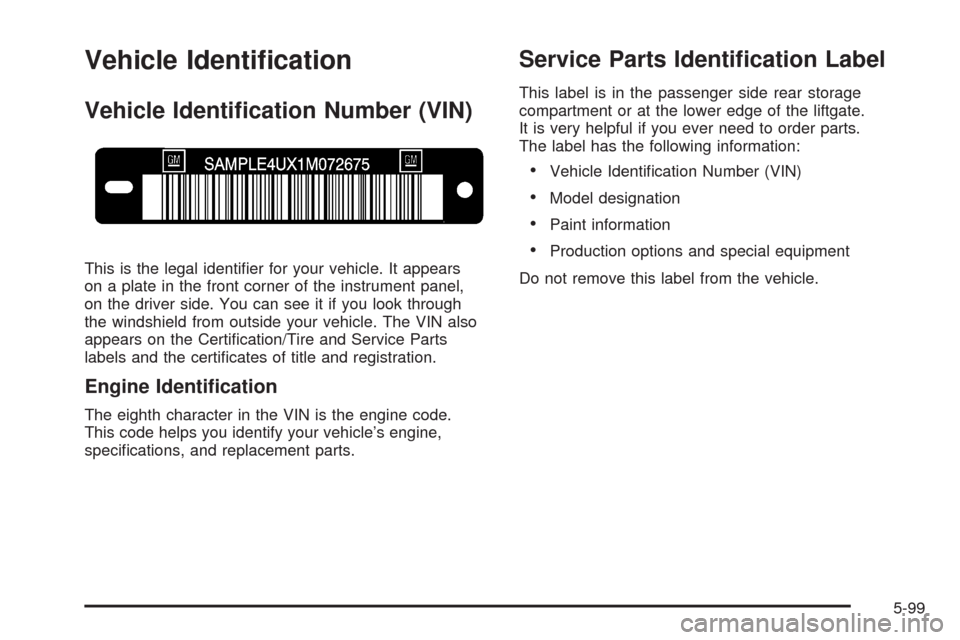
Vehicle Identication
Vehicle Identication Number (VIN)
This is the legal identier for your vehicle. It appears
on a plate in the front corner of the instrument panel,
on the driver side. You can see it if you look through
the windshield from outside your vehicle. The VIN also
appears on the Certication/Tire and Service Parts
labels and the certicates of title and registration.
Engine Identication
The eighth character in the VIN is the engine code.
This code helps you identify your vehicle’s engine,
specications, and replacement parts.
Service Parts Identication Label
This label is in the passenger side rear storage
compartment or at the lower edge of the liftgate.
It is very helpful if you ever need to order parts.
The label has the following information:
Vehicle Identication Number (VIN)
Model designation
Paint information
Production options and special equipment
Do not remove this label from the vehicle.
5-99
Page 388 of 448

Mini Fuses Usage
ECM/TCM IGNEngine Control Module/Transmission
Control Module Ignition Power,
Mass Airow Sensor (V6)
MISC IGN Air Quality Sensor
EMIS 1Pre 02 Sensors, Cam Phasor (V6),
Canister Purge (V6), Intake Manifold
Tuning Valve (V6)
SPARE Spare
DISPLYInstrument Panel Cluster, Climate
Control Module, Diagnostic Link
Connector
BCM 2LED Instrument Panel Dimming,
Overhead Lamps, Vanity Lamps
EVEN COILSEven Ignition Coils, Even Fuel
Injectors
BCM 6Right Side Rear Stoplamp, Turn
Lamps, Key Capture Solenoid
RDO Radio
ODD COILSOdd Ignition Coils, Odd Fuel
Injectors
BCM 1 Body Control Module (BCM) Power
LT HI BEAM Left Side High-Beam HeadlampMini Fuses Usage
BCM 7/CLOCK Switch Dimming, Analog Clock
SPARE Spare
EMIS 2Cooling Fan Relays, Air Conditioning
Clutch Relay, Post O2 Sensors,
Mass Airow Sensor (V8),
Canister Purge (V8)
ECM BATT Engine Control Module (ECM)
RT HI BEAM Right Side High-Beam Headlamp
RVC SNSRBattery Regulated Voltage
Control Sense
FOG LAMP Front Fog Lamps
ECM 1 Engine Control Module (ECM)
BCM 5Left Side Front Turn Lamps,
Rear Stoplamps, Turn Lamps
WPR Windshield Wiper Motor
SPARE Spare
BCM 4Center High-Mounted Stoplamp
(CHMSL), Back-up Lamps
CIGInstrument Panel Accessory Power
Outlet (Cigarette Lighter)
RT LO BEAM Right Side Low-Beam Headlamp
5-104
Page 416 of 448

Customer Assistance and
Information
Customer Satisfaction Procedure
Your satisfaction and goodwill are important to
your dealer and to Cadillac. Normally, any concerns
with the sales transaction or the operation of your
vehicle will be resolved by your dealer’s sales or service
departments. Sometimes, however, despite the best
intentions of all concerned, misunderstandings can
occur. If your concern has not been resolved to your
satisfaction, the following steps should be taken:
STEP ONE:Discuss your concern with a member of
dealership management. Normally, concerns can be
quickly resolved at that level. If the matter has already
been reviewed with the sales, service or parts manager,
contact the owner of the dealership or the general
manager.STEP TWO:If after contacting a member of dealership
management, it appears your concern cannot be
resolved by the dealership without further help, in the
United States, contact the Cadillac Customer Assistance
Center, 24 hours a day, by calling 1-800-458-8006.
In Canada, contact the Canadian Cadillac Customer
Communication Centre by calling 1-888-446-2000.
We encourage you to call the toll-free number in order
to give your inquiry prompt attention. Please have
the following information available to give the Customer
Assistance Representative:
Vehicle Identication Number (VIN). This is
available from the vehicle registration or title,
or the plate at the top left of the instrument panel
and visible through the windshield.
Dealership name and location.
Vehicle delivery date and present mileage.
When contacting Cadillac, please remember that your
concern will likely be resolved at a dealer’s facility.
That is why we suggest you follow Step One rst if
you have a concern.
7-2
Page 435 of 448

A
Accessories and Modications............................ 5-3
Adding Equipment to Your Airbag-Equipped
Vehicle.......................................................1-70
Additives, Fuel................................................. 5-7
Add-On Electrical Equipment...........................5-100
Adjustable Throttle and Brake Pedal..................2-28
Air Cleaner/Filter, Engine.................................5-21
Air Conditioning..............................................3-23
Airbag
Passenger Status Indicator...........................3-35
Readiness Light..........................................3-34
Airbag System................................................1-55
What Will You See After an Airbag Inates?....1-64
When Should an Airbag Inate?....................1-61
Where Are the Airbags?...............................1-58
Airbag Systems
Adding Equipment to Your Airbag-Equipped
Vehicle...................................................1-70
How Does an Airbag Restrain?......................1-63
Passenger Sensing System...........................1-65
Servicing Your Airbag-Equipped Vehicle..........1-70
What Makes an Airbag Inate?......................1-63
All-Wheel Drive...............................................5-44
All-Wheel-Drive (AWD) System........................... 4-8
Analog Clock..................................................3-22
Antenna, Rear Side Window.............................3-94Antenna, XM™ Satellite Radio Antenna System.....3-94
Antilock Brake System (ABS)............................. 4-4
Antilock Brake, System Warning Light................3-39
Appearance Care
Aluminum or Chrome-Plated Wheels..............5-96
Care of Safety Belts....................................5-94
Chemical Paint Spotting...............................5-97
Cleaning Exterior Lamps/Lenses....................5-94
Fabric/Carpet..............................................5-92
Finish Care.................................................5-95
Finish Damage............................................5-97
Instrument Panel, Vinyl, and Other
Plastic Surfaces.......................................5-93
Interior Cleaning..........................................5-91
Leather......................................................5-93
Sheet Metal Damage...................................5-97
Speaker Covers..........................................5-93
Tires..........................................................5-96
Underbody Maintenance...............................5-97
Vehicle Care/Appearance Materials................5-98
Washing Your Vehicle...................................5-94
Weatherstrips..............................................5-94
Windshield and Wiper Blades........................5-95
Wood Panels..............................................5-93
Appointments, Scheduling Service.....................7-10
Ashtray.........................................................3-21
1
Page 437 of 448

Check
Engine Light...............................................3-42
Checking Things Under the Hood......................5-10
Chemical Paint Spotting...................................5-97
Child Restraints
Child Restraint Systems...............................1-39
Infants and Young Children...........................1-35
Lower Anchors and Tethers for Children..........1-43
Older Children.............................................1-32
Securing a Child Restraint in a
Rear Seat Position...................................1-49
Securing a Child Restraint in the
Right Front Seat Position..........................1-52
Where to Put the Restraint...........................1-41
Cigarette Lighter.............................................3-21
Cleaning
Aluminum or Chrome-Plated Wheels..............5-96
Exterior Lamps/Lenses.................................5-94
Fabric/Carpet..............................................5-92
Finish Care.................................................5-95
Instrument Panel, Vinyl, and Other
Plastic Surfaces.......................................5-93
Interior.......................................................5-91
Leather......................................................5-93
Speaker Covers..........................................5-93
Tires..........................................................5-96
Underbody Maintenance...............................5-97
Washing Your Vehicle...................................5-94Cleaning (cont.)
Weatherstrips..............................................5-94
Windshield and Wiper Blades........................5-95
Wood Panels..............................................5-93
Climate Control System
Air Filter, Passenger Compartment.................3-30
Dual..........................................................3-23
Outlet Adjustment........................................3-29
Rear Air Conditioning System........................3-29
Clock....................................................3-22, 3-71
Collision Damage Repair..................................7-12
Compact Spare Tire........................................5-90
Compass.......................................................2-41
Control of a Vehicle.......................................... 4-3
Coolant
Engine Temperature Gage............................3-40
Engine Temperature Warning Light.................3-40
Heater, Engine............................................2-28
Surge Tank Pressure Cap.............................5-26
Cooling System..............................................5-29
Cruise Control................................................3-12
Cruise Control Light........................................3-46
Cupholder(s)..................................................2-57
Customer Assistance Information
Courtesy Transportation................................7-11
Customer Assistance for Text
Telephone (TTY) Users............................... 7-6
Customer Assistance Offices........................... 7-6
3