2008 CADILLAC ESCALADE flat tire
[x] Cancel search: flat tirePage 410 of 490
{CAUTION:
Rust or dirt on a wheel, or on the parts to
which it is fastened, can make wheel nuts
become loose after time. The wheel could
come off and cause an accident. When you
change a wheel, remove any rust or dirt from
places where the wheel attaches to the vehicle.
In an emergency, you can use a cloth or a
paper towel to do this; but be sure to use a
scraper or wire brush later, if needed, to get all
the rust or dirt off. SeeChanging a Flat Tire on
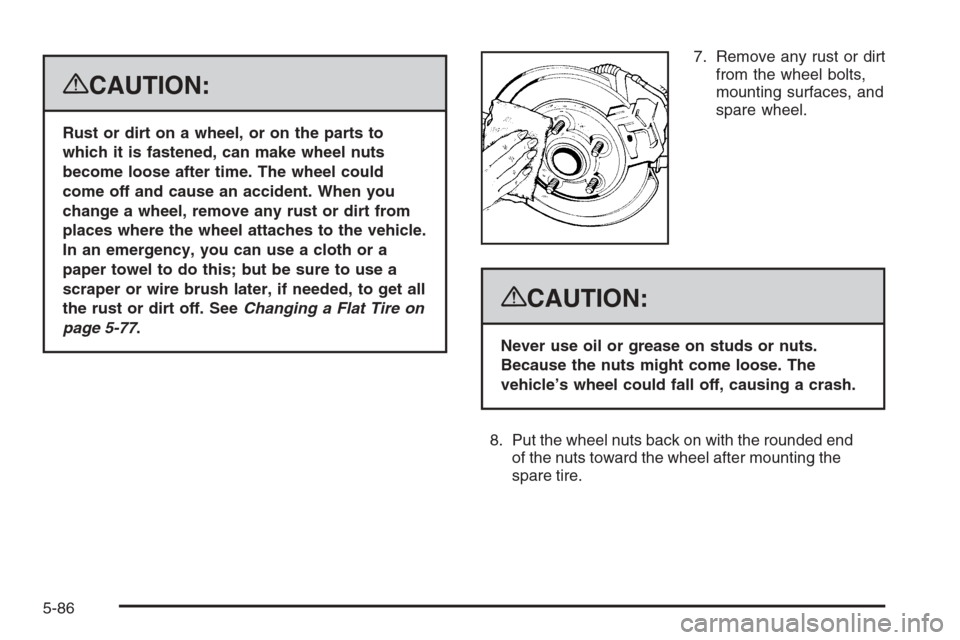
page 5-77.7. Remove any rust or dirt
from the wheel bolts,
mounting surfaces, and
spare wheel.
{CAUTION:
Never use oil or grease on studs or nuts.
Because the nuts might come loose. The
vehicle’s wheel could fall off, causing a crash.
8. Put the wheel nuts back on with the rounded end
of the nuts toward the wheel after mounting the
spare tire.
5-86
Page 412 of 490

Secondary Latch System
Your vehicle has an underbody-mounted tire hoist
assembly equipped with a secondary latch system. It is
designed to stop the spare tire from suddenly falling
off your vehicle. For the secondary latch to work,
the spare must be installed with the valve stem pointing
down. SeeStoring a Flat or Spare Tire and Tools on
page 5-91.
{CAUTION:
Before beginning this procedure read all the
instructions. Failure to read and follow the
instructions could damage the hoist assembly
and you and others could get hurt. Read and
follow the instructions listed next.To release the spare tire from the secondary latch:
1. Check under the
vehicle to see if the
cable end is visible.
If the cable is not
visible proceed
to Step 6.
2. If it is visible, rst try to tighten the cable by turning
the wheel wrench clockwise until you hear two clicks
or feel it skip twice. You cannot overtighten the cable.
3. Loosen the cable by turning the wrench
counterclockwise three or four turns.
4. Repeat this procedure at least two times. If the spare
tire lowers to the ground, continue with Step 5 of
Removing the Spare Tire and Tools on page 5-78.
5-88
Page 415 of 490

14. Tilt the tire retainer at the end of the cable and pull
it through the wheel opening. Pull the tire out from
under the vehicle.
15. Turn the wheel wrench in the hoist shaft hole in the
bumper clockwise to raise the cable back up if the
cable is hanging under the vehicle.
Have the hoist assembly inspected as soon as you can.
You will not be able to store a spare or at tire using
the hoist assembly until it has been replaced.
To continue changing the at tire, seeRemoving the
Flat Tire and Installing the Spare Tire on page 5-83.
Storing a Flat or Spare Tire
and Tools
{CAUTION:
Storing a jack, a tire, or other equipment in the
passenger compartment of the vehicle could
cause injury. In a sudden stop or collision,
loose equipment could strike someone.
Store all these in the proper place.
Notice:Storing an aluminum wheel with a at tire
under your vehicle for an extended period of time or
with the valve stem pointing up can damage the
wheel. Always stow the wheel with the valve stem
pointing down and have the wheel/tire repaired
as soon as possible.
Store the tire under the rear of the vehicle in the spare
tire carrier.
5-91
Page 416 of 490
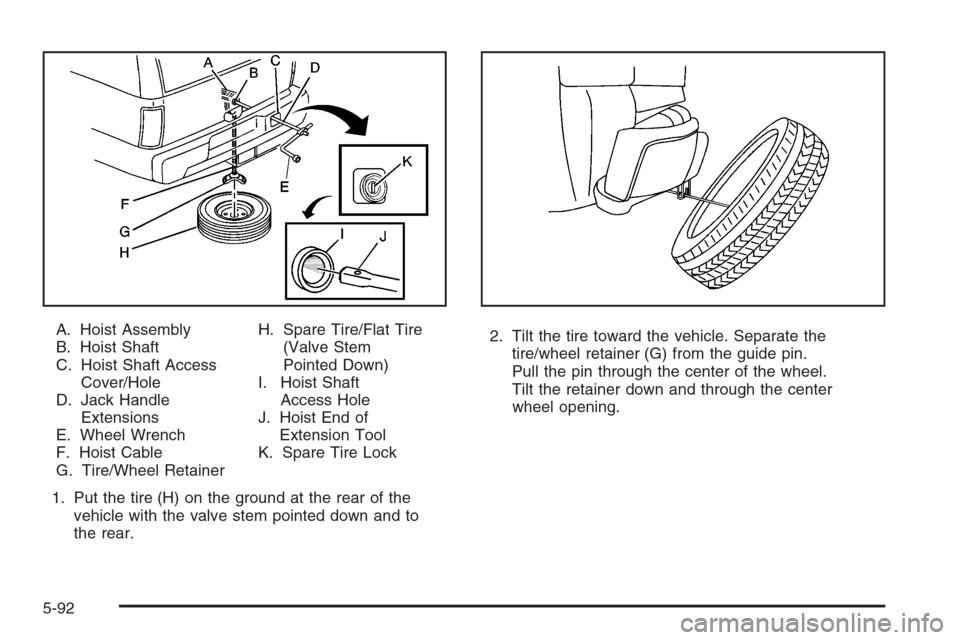
A. Hoist Assembly
B. Hoist Shaft
C. Hoist Shaft Access
Cover/Hole
D. Jack Handle
Extensions
E. Wheel Wrench
F. Hoist Cable
G. Tire/Wheel RetainerH. Spare Tire/Flat Tire
(Valve Stem
Pointed Down)
I. Hoist Shaft
Access Hole
J. Hoist End of
Extension Tool
K. Spare Tire Lock
1. Put the tire (H) on the ground at the rear of the
vehicle with the valve stem pointed down and to
the rear.2. Tilt the tire toward the vehicle. Separate the
tire/wheel retainer (G) from the guide pin.
Pull the pin through the center of the wheel.
Tilt the retainer down and through the center
wheel opening.
5-92
Page 419 of 490

3. Position the jack (E) and wheel blocks (A) in the
driver’s side trim panel over the wheelhouse.
4. Turn the wing nut (G) clockwise until the jack is
secured tight in the mounting bracket. Be sure to
position the holes in the base of the jack onto
the pin in the mounting bracket.
5. Use the retaining bracket (C) to fasten the tool
bag (B) on the stud and turn the wing nut (D)
clockwise to secure.
6. Return the storage tray to its original stored position.Spare Tire
Your vehicle, when new, had a fully-inated spare tire.
A spare tire may lose air over time, so check its
ination pressure regularly. SeeInflation - Tire Pressure
on page 5-60andLoading Your Vehicle on page 4-35
for information regarding proper tire ination and loading
your vehicle. For instruction on how to remove, install
or store a spare tire, seeRemoving the Flat Tire
and Installing the Spare Tire on page 5-83andStoring
a Flat or Spare Tire and Tools on page 5-91.
After installing the spare tire on your vehicle, you should
stop as soon as possible and make sure the spare is
correctly inated. The spare tire is made to perform well
at speeds up to 70 mph (112 km/h) at the recommended
ination pressure, so you can nish your trip.
Have the damaged or at road tire repaired or replaced
as soon as you can and installed back onto your
vehicle. This way, a spare tire will be available in case
you need it again. Do not mix tires and wheels of
different sizes, because they will not t. Keep your spare
tire and its wheel together.
Regular Wheelbase shown, Extended Wheelbase
similar.
5-95
Page 448 of 490

Owner Checks and Services
These owner checks and services should be performed
at the intervals specied to help ensure the safety,
dependability, and emission control performance of your
vehicle. Your dealer/retailer can assist you with these
checks and services.
Be sure any necessary repairs are completed at once.
Whenever any uids or lubricants are added to your
vehicle, make sure they are the proper ones, as shown
inRecommended Fluids and Lubricants on page 6-13.
At Each Fuel Fill
It is important to perform these underhood checks at
each fuel fill.
Engine Oil Level Check
Notice:It is important to check the engine oil
regularly and keep it at the proper level. Failure to
keep the engine oil at the proper level can cause
damage to the engine not covered by your warranty.
Check the engine oil level and add the proper oil if
necessary. SeeEngine Oil on page 5-14.
Engine Coolant Level Check
Check the engine coolant level and add DEX-COOL®
coolant mixture if necessary. SeeEngine Coolant
on page 5-23.
Windshield Washer Fluid Level Check
Check the windshield washer uid level in the windshield
washer uid reservoir and add the proper uid if
necessary.
At Least Once a Month
Tire Ination Check
Inspect your vehicle’s tires and make sure they are
inated to the correct pressures. Do not forget to
check the spare tire. SeeInflation - Tire Pressure on
page 5-60. Check to make sure the spare tire is stored
securely. SeeChanging a Flat Tire on page 5-77.
Tire Wear Inspection
Tire rotation may be required for high mileage highway
drivers prior to the Engine Oil Life System service
notication. Check the tires for wear and, if necessary,
rotate the tires. SeeTire Inspection and Rotation on
page 5-67.
6-10
Page 465 of 490

Cadillac Owner Privileges™
The following services are provided in the U.S. and
Canada up to 5 years/100,000 miles (160 000 km),
whichever occurs rst, and, in Canada only, up to a
maximum coverage of $100. These services are
provided at a nominal charge if the vehicle is no longer
within the Powertrain warranty.
Roadside Service provides several Cadillac Owner
Privileges™ at “no charge,” throughout yourCadillac
Powertrain Warranty — 5 years/100,000 miles
(160 000 km).
Emergency Road Service is performed on site for the
following situations:
Fuel Delivery:Delivery of enough fuel for the
vehicle to get to the nearest service station
(approximately $5 in Canada). In Canada, for safety
reasons, propane and other alternative fuels will
not be provided through this service.
Lock-out Service:Lock-out service will be covered
at no charge if you are unable to gain entry into
your vehicle. A remote unlock may be available
if you have an active OnStar
®subscription.
To ensure security, the driver must present personal
identication before lock-out service is provided.
In Canada, the vehicle registration is also required.
Emergency Tow From a Public Roadway or
Highway:Tow to the nearest dealership for
warranty service or in the event of a
vehicle-disabling crash. Winch-out assistance is
provided when the vehicle is mired in sand, mud,
or snow.
Flat Tire Change:Installation of a spare tire in
good condition, when equipped and properly
inated, is covered at no charge. The customer is
responsible for the repair or replacement of the
tire if not covered by a warrantable failure.
Jump Start:A battery jump start is covered at no
charge if the vehicle does not start.
Trip Routing Service:Upon request, Cadillac
Roadside Service will send you detailed, computer
personalized maps, highlighting your choice of
either the most direct route or the most scenic route
to your destination, anywhere in North America,
along with helpful travel information pertaining
to your trip.
Please allow three weeks before your planned
departure date. In Canada, trip routing requests
will be limited to six per calendar year.
7-7
Page 481 of 490
Electrical System (cont.)
Power Windows and Other Power Options.......5-106
Underhood Fuse Block...............................5-109
Windshield Wiper Fuses.............................5-106
Electronic Immobilizer
PASS-Key
®III+...........................................2-22
Electronic Immobilizer Operation
PASS-Key
®III+...........................................2-23
Engine
Air Cleaner/Filter.........................................5-17
Check and Service Engine Soon Light............3-43
Coolant......................................................5-23
Coolant Heater............................................2-28
Coolant Temperature Gage...........................3-42
Drive Belt Routing.......................................6-16
Engine Compartment Overview......................5-12
Exhaust.....................................................2-38
Fan Noise..................................................5-32
Oil .............................................................5-14
Oil Life System...........................................5-16
Overheated Protection Operating Mode...........5-28
Overheating................................................5-26
Starting......................................................2-26
Entry Lighting.................................................3-22
Event Data Recorders.....................................7-17
Exit Lighting...................................................3-22
Extender, Safety Belt.......................................1-48
Exterior Lamps...............................................3-16
F
Filter
Engine Air Cleaner......................................5-17
Finish Damage.............................................5-103
Flashers, Hazard Warning.................................. 3-6
Flat Tire........................................................5-76
Flat Tire, Changing.........................................5-77
Flat Tire, Storing.............................................5-91
Fluid
Automatic Transmission................................5-20
Power Steering...........................................5-33
Windshield Washer......................................5-34
Fog Lamp
Fog ...........................................................3-21
Fog Lamp Light..............................................3-46
Front Axle......................................................5-46
Fuel............................................................... 5-5
Additives...................................................... 5-6
California Fuel.............................................. 5-5
Filling a Portable Fuel Container..................... 5-9
Filling the Tank............................................. 5-7
Fuels in Foreign Countries.............................. 5-6
Gage .........................................................3-47
Gasoline Octane........................................... 5-5
Gasoline Specications.................................. 5-5
Running Out of...........................................2-39
5