2008 CADILLAC ESCALADE ESV lights
[x] Cancel search: lightsPage 229 of 500

EXIT LIGHTING This feature allows you to select the amount of time you
want the exterior lamps to remain on when it is dark
enough outside. This happens after the key is turned
from ON/RUN to LOCK/OFF.
Press the customization button until EXIT LIGHTING
appears on the DIC display. Press the set/reset button
once to access the settings for this feature. Then
press the customization button to scroll through the
following settings:
OFF: The exterior lamps will not turn on.
30 SECONDS (default): The exterior lamps will stay on
for 30 seconds.
1 MINUTE: The exterior lamps will stay on for
one minute.
2 MINUTES: The exterior lamps will stay on for
two minutes.
NO CHANGE: No change will be made to this feature.
The current setting will remain.
To select a setting, press the set/reset button while the
desired setting is displayed on the DIC. APPROACH LIGHTING This feature allows you to select whether or not to have
the exterior lights turn on briey during low light
periods after unlocking the vehicle using the Remote
Keyless Entry (RKE) transmitter.
Press the customization button until APPROACH
LIGHTING appears on the DIC display. Press the
set/reset button once to access the settings for
this feature. Then press the customization button to
scroll through the following settings:
OFF: The exterior lights will not turn on when you
unlock the vehicle with the RKE transmitter.
ON (default): If it is dark enough outside, the exterior
lights will turn on briey when you unlock the vehicle
with the RKE transmitter.
The lights will remain on for 20 seconds or until the lock
button on the RKE transmitter is pressed, or the
vehicle is no longer off. See Remote Keyless Entry
(RKE) System Operation on page 2-4 for more
information.
NO CHANGE: No change will be made to this feature.
The current setting will remain.
To select a setting, press the set/reset button while the
desired setting is displayed on the DIC.
3-65
Page 278 of 500

Avoid needless heavy braking. Some people drive
in spurts — heavy acceleration followed by heavy
braking — rather than keeping pace with traffic. This is
a mistake. The brakes might not have time to cool
between hard stops. The brakes will wear out much
faster if you do a lot of heavy braking. If you keep pace
with the traffic and allow realistic following distances,
you will eliminate a lot of unnecessary braking.
That means better braking and longer brake life.
If your vehicle’s engine ever stops while you are driving,
brake normally but do not pump the brakes. If you do,
the pedal could get harder to push down. If the
engine stops, you will still have some power brake
assist. But you will use it when you brake. Once the
power assist is used up, it can take longer to stop and
the brake pedal will be harder to push.
Adding non-dealer/non-retailer accessories can affect
your vehicle’s performance. See Accessories and
Modifications on page 5-3 . Antilock Brake System (ABS) Your vehicle has the Antilock Brake System (ABS), an
advanced electronic braking system that will help
prevent a braking skid.
When you start the engine and begin to drive away, ABS
will check itself. You might hear a momentary motor or
clicking noise while this test is going on. This is normal.
If there is a problem with
ABS, this warning light will
stay on. See Antilock
Brake System Warning
Light on page 3-41 .
Along with ABS, your vehicle has a Dynamic Rear
Proportioning (DRP) system. If there is a DRP problem,
both the brake and ABS warning lights come on
accompanied by a 10-second chime. The lights and
chime will come on each time the ignition is turned on
until the problem is repaired. See your dealer/retailer for
service.
4-4
Page 282 of 500

Traction Control Operation The traction control system is part of the StabiliTrak ®
system. Traction control limits wheel spin by reducing
engine power to the wheels (engine speed management)
and by applying brakes to each individual wheel
(brake-traction control) as necessary.
The traction control system is enabled automatically
when you start your vehicle. It will activate and the
StabiliTrak ®
light will ash if it senses that any of the
wheels are spinning or beginning to lose traction while
driving. If you turn off traction control, only the
brake-traction control portion of traction control will work.
The engine speed management will be disabled. In this
mode, engine power is not reduced automatically and the
driven wheels can spin more freely. This can cause the
brake-traction control to activate constantly.
Notice: If you allow the wheel(s) of one axle to spin
excessively while the StabiliTrak ®
, ABS and brake
warning lights and the SERVICE STABILITRAK
message are displayed, you could damage the
transfer case. The repairs would not be covered by
your warranty. Reduce engine power and do not
spin the wheel(s) excessively while these lights and
this message are displayed. The traction control system may activate on dry or rough
roads or under conditions such as heavy acceleration
while turning or abrupt upshifts/downshifts of the
transmission. When this happens, you may notice a
reduction in acceleration, or may hear a noise or
vibration. This is normal.
If your vehicle is in cruise control when the system
activates, the StabiliTrak ®
light will ash and the cruise
control will automatically disengage. When road
conditions allow you to use cruise again, you may
re-engage the cruise control. See Cruise Control on
page 3-13 .
StabiliTrak ®
may also turn off automatically if it
determines that a problem exists with the system. If
the problem does not clear itself after restarting the
vehicle, you should see your dealer/retailer for service.
All-Wheel Drive (AWD) System If your vehicle is equipped with this feature, engine
power is sent to all four wheels when extra traction
is needed. This is like four-wheel drive, but there is
no separate lever or switch to engage or disengage
the front axle. It is fully automatic, and adjusts itself
as needed for road conditions.
4-8
Page 291 of 500

When you drive over obstacles or rough terrain, keep
a rm grip on the steering wheel. Ruts, troughs, or other
surface features can jerk the wheel out of your hands
if you are not prepared.
When you drive over bumps, rocks, or other obstacles,
the wheels can leave the ground. If this happens,
even with one or two wheels, you cannot control the
vehicle as well or at all.
Because you will be on an unpaved surface, it is
especially important to avoid sudden acceleration,
sudden turns, or sudden braking.
In a way, off-road driving requires a different kind of
alertness from driving on paved roads and highways.
There are no road signs, posted speed limits, or signal
lights. You have to use your own good judgment
about what is safe and what is not.
Drinking and driving can be very dangerous on any
road. And this is certainly true for off-road driving. At
the very time you need special alertness and driving
skills, your reexes, perceptions, and judgment can be
affected by even a small amount of alcohol. You
could have a serious — or even fatal — accident if you
drink and drive or ride with a driver who has been
drinking. See Drunk Driving on page 4-2 . Driving on Off-Road Hills Off-road driving often takes you up, down, or across a
hill. Driving safely on hills requires good judgment
and understanding of what your vehicle can and cannot
do. There are some hills that simply cannot be driven,
no matter how well built the vehicle.
{ CAUTION: Many hills are simply too steep for any vehicle.
If you drive up them, you will stall. If you drive
down them, you cannot control your speed. If
you drive across them, you will roll over. You
could be seriously injured or killed. If you have
any doubt about the steepness, do not drive
the hill.
4-17
Page 356 of 500
Engine Coolant The cooling system in your vehicle is lled with
DEX-COOL ®
engine coolant. This coolant is designed
to remain in your vehicle for ve years or 150,000 miles
(240 000 km), whichever occurs rst, if you add only
DEX-COOL ®
extended life coolant.
The following explains your cooling system and how to
add coolant when it is low. If you have a problem
with engine overheating, see Engine Overheating
on page 5-26 .
A 50/50 mixture of clean, drinkable water and
DEX-COOL ®
coolant will:
Give freezing protection down to − 34°F ( − 37°C).
Give boiling protection up to 265°F (129°C).
Protect against rust and corrosion.
Help keep the proper engine temperature.
Let the warning lights and gages work as they
should.
Notice: Using coolant other than DEX-COOL ®
may
cause premature engine, heater core, or radiator
corrosion. In addition, the engine coolant may
require changing sooner, at the rst maintenance
service after each 30,000 miles (50 000 km) or
24 months, whichever occurs rst. Any repairs
would not be covered by your warranty. Always use
DEX-COOL ®
(silicate-free) coolant in your vehicle. What to Use Use a mixture of one-half clean, drinkable water and
one-half DEX-COOL ®
coolant which will not damage
aluminum parts. If you use this coolant mixture, you do
not need to add anything else.
{ CAUTION: Adding only plain water to your cooling
system can be dangerous. Plain water, or
some other liquid such as alcohol, can boil
before the proper coolant mixture will. Your
vehicle’s coolant warning system is set for the
proper coolant mixture. With plain water or the
wrong mixture, your engine could get too hot
but you would not get the overheat warning.
Your engine could catch re and you or others
could be burned. Use a 50/50 mixture of clean,
drinkable water and DEX-COOL ®
coolant.
Notice: If you use an improper coolant mixture,
your engine could overheat and be badly damaged.
The repair cost would not be covered by your
warranty. Too much water in the mixture can freeze
and crack the engine, radiator, heater core, and
other parts.
5-24
Page 445 of 500
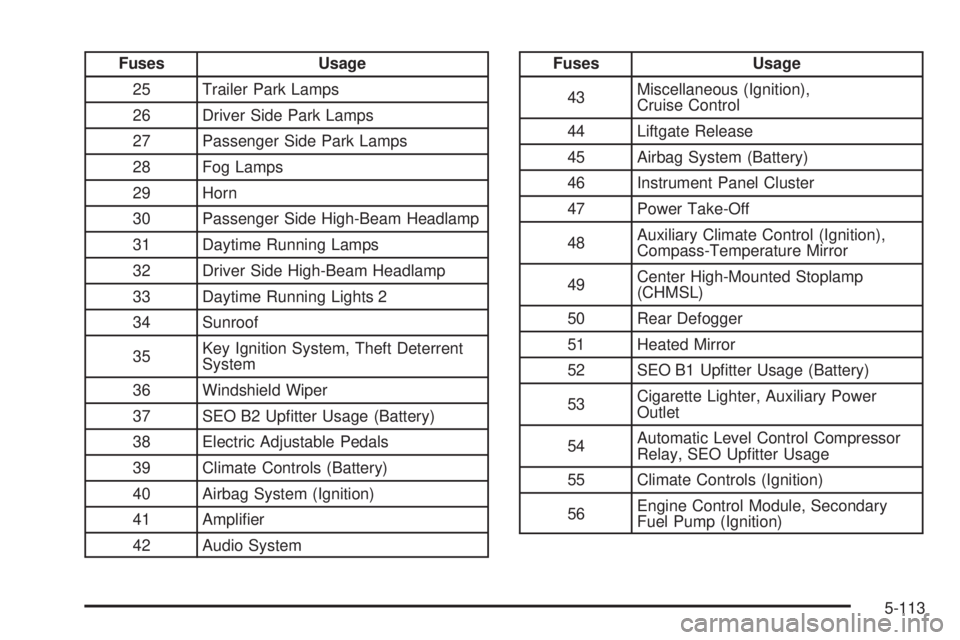
Fuses Usage
25 Trailer Park Lamps
26 Driver Side Park Lamps
27 Passenger Side Park Lamps
28 Fog Lamps
29 Horn
30 Passenger Side High-Beam Headlamp
31 Daytime Running Lamps
32 Driver Side High-Beam Headlamp
33 Daytime Running Lights 2
34 Sunroof
35 Key Ignition System, Theft Deterrent
System
36 Windshield Wiper
37 SEO B2 Uptter Usage (Battery)
38 Electric Adjustable Pedals
39 Climate Controls (Battery)
40 Airbag System (Ignition)
41 Amplier
42 Audio System Fuses Usage
43 Miscellaneous (Ignition),
Cruise Control
44 Liftgate Release
45 Airbag System (Battery)
46 Instrument Panel Cluster
47 Power Take-Off
48 Auxiliary Climate Control (Ignition),
Compass-Temperature Mirror
49 Center High-Mounted Stoplamp
(CHMSL)
50 Rear Defogger
51 Heated Mirror
52 SEO B1 Uptter Usage (Battery)
53 Cigarette Lighter, Auxiliary Power
Outlet
54 Automatic Level Control Compressor
Relay, SEO Uptter Usage
55 Climate Controls (Ignition)
56 Engine Control Module, Secondary
Fuel Pump (Ignition)
5-113
Page 493 of 500

JJump Starting ................................................. 5-40
KKeyless Entry System ....................................... 2-4
Keys ............................................................... 2-3
LLabeling, Tire Sidewall ..................................... 5-57
Lamps
Dome ........................................................ 3-22
Dome Lamp Override ................................... 3-22
Reading ..................................................... 3-22
Lap Belt ........................................................ 1-48
Lap-Shoulder Belt ........................................... 1-42
LATCH System
Child Restraints ........................................... 1-61
License Plate Lamps ....................................... 5-53
Liftgate, Power ............................................... 2-14
Liftgate/Liftglass .............................................. 2-13
Liftglass/Liftgate .............................................. 2-13
Light
Airbag Readiness ........................................ 3-36
Antilock Brake System Warning ..................... 3-41
Brake System Warning ................................. 3-40
Charging System ......................................... 3-39 Light (cont.)
Cruise Control ............................................. 3-47
Fog Lamp .................................................. 3-46
Highbeam On ............................................. 3-47
Lights On Reminder ..................................... 3-47
Malfunction Indicator .................................... 3-43
Oil Pressure ............................................... 3-46
Passenger Airbag Status Indicator .................. 3-37
Safety Belt Reminders .................................. 3-35
Security ..................................................... 3-46
StabiliTrak ®
Indicator .................................... 3-41
Tire Pressure .............................................. 3-42
Tow/Haul Mode ........................................... 3-47
Lighting
Entry ......................................................... 3-22
Exit ........................................................... 3-22
Lights
Exterior Lamps ............................................ 3-16
High/Low Beam Changer ................................ 3-9
On Reminder .............................................. 3-19
Loading Your Vehicle ....................................... 4-35
Locking Differential ........................................... 4-5
Lockout Protection .......................................... 2-12
Locks
Delayed Locking .......................................... 2-11
Door .......................................................... 2-10
Lockout Protection ....................................... 2-12
Power Door ................................................ 2-10
Programmable Automatic Door Locks ............. 2-11
Rear Door Security Locks ............................. 2-11
7
Page 500 of 500

VVehicle
Control ........................................................ 4-3
Damage Warnings ........................................... iv
Loading ...................................................... 4-35
Symbols ......................................................... iv
Vehicle Customization, DIC .............................. 3-61
Vehicle Data Recording and Privacy .................. 7-15
Vehicle Identication
Number (VIN) ............................................ 5-107
Service Parts Identication Label .................. 5-107
Vehicle, Remote Start ....................................... 2-7
Ventilation Adjustment ...................................... 3-31
Visors ........................................................... 2-20
WWarning Lights, Gages and Indicators ................ 3-33
Warnings
DIC Warnings and Messages ........................ 3-53
Hazard Warning Flashers ............................... 3-6
Other Warning Devices .................................. 3-6
Safety and Symbols ......................................... iii
Vehicle Damage .............................................. iv
Wheels
Alignment and Tire Balance .......................... 5-75
Different Size .............................................. 5-73
Replacement ............................................... 5-76 Where to Put the Restraint ............................... 1-60
Windows ....................................................... 2-18
Power ........................................................ 2-19
Windshield
Backglass, and Wiper Blades, Cleaning ........ 5-103
Rainsense™ II Wipers .................................. 3-10
Washer ...................................................... 3-11
Washer Fluid .............................................. 5-35
Wiper Blade Replacement ............................. 5-54
Wiper Fuses ............................................. 5-108
Wipers ......................................................... 3-9
Windshield, Rear Washer/Wiper ........................ 3-12
Winter Driving ................................................ 4-30
X XM Radio Messages ....................................... 3-94
XM™ Satellite Radio Antenna System .............. 3-109
Y Your Vehicle and the Environment ....................... 6-2
14