Page 283 of 440

A. Windshield Washer Fluid Reservoir. See “Adding
Washer Fluid” underWindshield Washer Fluid on
page 5-44.
B. Battery. SeeBattery on page 5-49.
C. Remote Positive (+) Terminal. SeeJump Starting on
page 5-50.
D. Underhood Fuse Block. SeeUnderhood Fuse Block
on page 5-112.
E. Passenger Compartment Air Filter. SeePassenger
Compartment Air Filter on page 3-29.
F. Engine Coolant Recovery Tank. SeeCooling System
on page 5-33.
G. Power Steering Fluid Reservoir. SeePower Steering
Fluid on page 5-43.
H. Pressure Cap. SeeRadiator Pressure Cap on
page 5-29.I. Engine Oil Fill Cap. See “When to Add Engine Oil”
underEngine Oil on page 5-18.
J. Electric Engine Cooling Fans. SeeCooling System
on page 5-33.
K. Engine Oil Dipstick. See “Checking Engine Oil”
underEngine Oil on page 5-18.
L. Automatic Transmission Fluid Dipstick. See
“Checking the Fluid Level” underAutomatic
Transmission Fluid on page 5-25.
M. Brake Master Cylinder Reservoir. See “Brake Fluid”
underBrakes on page 5-46.
N. Engine Air Cleaner/Filter. SeeEngine Air
Cleaner/Filter on page 5-23.
5-13
Page 285 of 440
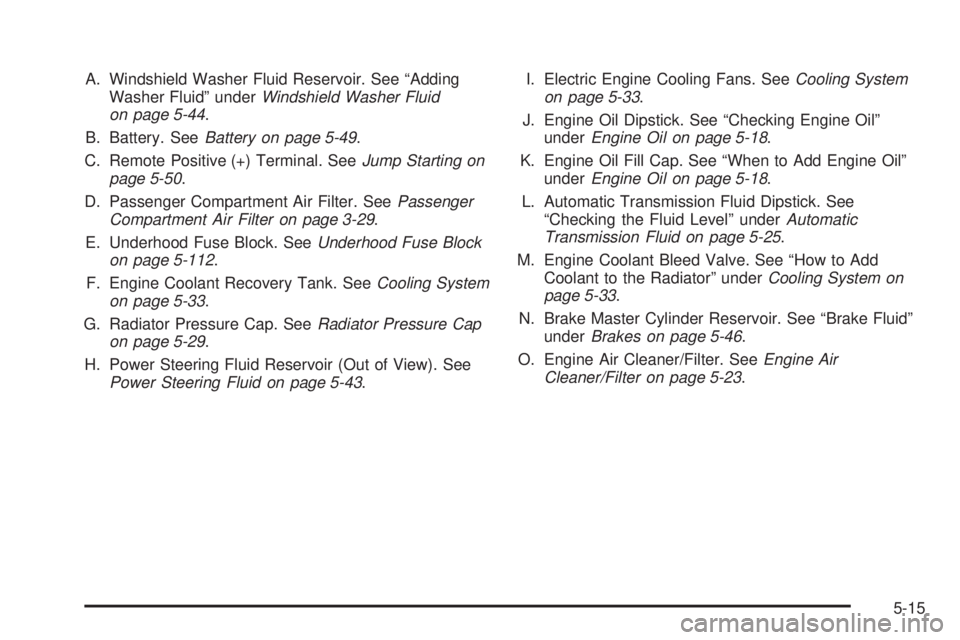
A. Windshield Washer Fluid Reservoir. See “Adding
Washer Fluid” underWindshield Washer Fluid
on page 5-44.
B. Battery. SeeBattery on page 5-49.
C. Remote Positive (+) Terminal. SeeJump Starting on
page 5-50.
D. Passenger Compartment Air Filter. SeePassenger
Compartment Air Filter on page 3-29.
E. Underhood Fuse Block. SeeUnderhood Fuse Block
on page 5-112.
F. Engine Coolant Recovery Tank. SeeCooling System
on page 5-33.
G. Radiator Pressure Cap. SeeRadiator Pressure Cap
on page 5-29.
H. Power Steering Fluid Reservoir (Out of View). See
Power Steering Fluid on page 5-43.I. Electric Engine Cooling Fans. SeeCooling System
on page 5-33.
J. Engine Oil Dipstick. See “Checking Engine Oil”
underEngine Oil on page 5-18.
K. Engine Oil Fill Cap. See “When to Add Engine Oil”
underEngine Oil on page 5-18.
L. Automatic Transmission Fluid Dipstick. See
“Checking the Fluid Level” underAutomatic
Transmission Fluid on page 5-25.
M. Engine Coolant Bleed Valve. See “How to Add
Coolant to the Radiator” underCooling System on
page 5-33.
N. Brake Master Cylinder Reservoir. See “Brake Fluid”
underBrakes on page 5-46.
O. Engine Air Cleaner/Filter. SeeEngine Air
Cleaner/Filter on page 5-23.
5-15
Page 287 of 440
A. Windshield Washer Fluid Reservoir. See “Adding
Washer Fluid” underWindshield Washer Fluid
on page 5-44.
B. Battery. SeeBattery on page 5-49.
C. Underhood Fuse Block. SeeUnderhood Fuse Block
on page 5-112.
D. Remote Positive (+) Terminal. SeeJump Starting on
page 5-50.
E. Pressure Cap. SeePressure Cap on page 5-30.
F. Power Steering Fluid Reservoir. SeePower Steering
Fluid on page 5-43.
G. Engine Oil Dipstick. See “Checking Engine Oil”
underEngine Oil on page 5-18.H. Engine Oil Fill Cap. See “When to Add Engine Oil”
underEngine Oil on page 5-18.
I. Automatic Transmission Fluid Dipstick. See
“Checking the Fluid Level” underAutomatic
Transmission Fluid on page 5-25.
J. Brake Master Cylinder Reservoir. See “Brake Fluid”
underBrakes on page 5-46.
K. Engine Air Cleaner/Filter. SeeEngine Air
Cleaner/Filter on page 5-23.
L. Engine Coolant Recovery Tank. SeeCooling System
on page 5-33.
5-17
Page 321 of 440

Notice:If you leave your radio or other accessories
on during the jump starting procedure, they could
be damaged. The repairs would not be covered by
your warranty. Always turn off your radio and other
accessories when jump starting your vehicle.
3. Turn off the ignition on both vehicles. Unplug
unnecessary accessories plugged into the cigarette
lighter or the accessory power outlets. Turn off the
radio and all lamps that are not needed. This will
avoid sparks and help save both batteries. And it
could save the radio!
4. Open the hood on the other vehicle and locate the
positive (+) and negative (−) terminal locations on
that vehicle.
You will not use your vehicle’s battery for jump
starting. It has a remote positive (+) jump starting
terminal, located on the underhood fuse block,
for that purpose. SeeEngine Compartment
Overview on page 5-12for more information on
location.If your vehicle has a
V6 engine, to uncover
the remote positive (+)
terminal, press the tab at
the bottom of the fuse block
and lift the cover up.
3.8L V6 Engine shown,
3.6L V6 Engine
similar
5-51
Page 322 of 440

Always use the remote positive (+) terminal instead
of the positive (+) terminal on the battery.
If your vehicle has the
5.3L V8 engine, to uncover
the remote positive (+)
terminal, remove the fuse
block cover.
{CAUTION:
An electric fan can start up even when the
engine is not running and can injure you. Keep
hands, clothing and tools away from any
underhood electric fan.
{CAUTION:
Fans or other moving engine parts can injure
you badly. Keep your hands away from moving
parts once the engine is running.
{CAUTION:
Using a match near a battery can cause battery
gas to explode. People have been hurt doing
this, and some have been blinded. Use a
ashlight if you need more light.
Be sure the battery has enough water. You do
not need to add water to the battery installed
in your new vehicle. But if a battery has
llercaps, be sure the right amount of uid is
there. If it is low, add water to take care of that
rst. If you do not, explosive gas could be
present.
CAUTION: (Continued) 5.3L Engine
5-52
Page 325 of 440
A. Heavy, Unpainted Metal Engine Part or Remote
Negative (−) Terminal
B. Good Battery or Remote Positive (+) and Remote
Negative (−) Terminals
C. Dead Battery or Remote Positive (+) TerminalTo disconnect the jumper cables from both vehicles, do
the following:
1. Disconnect the black negative (−) cable from the
vehicle that had the dead battery.
2. Disconnect the black negative (−) cable from the
vehicle with the good battery.
3. Disconnect the red positive (+) cable from the
vehicle with the good battery.
4. Disconnect the red positive (+) cable from the other
vehicle.
5. Return the fuse block cover to its original position.
Jumper Cable Removal
5-55
Page 379 of 440

Headlamp Wiring
The headlamp wiring is protected by a circuit breaker.
An electrical overload will cause the lamps to go on and
off, or in some cases to remain off. If this happens, have
your headlamp wiring checked right away.
Windshield Wiper Fuses
The windshield wiper motor is protected by a circuit
breaker and a fuse. If the motor overheats due to heavy
snow, etc., the wiper will stop until the motor cools. If the
overload is caused by some electrical problem, have
it xed.
Power Windows and Other Power
Options
Circuit breakers in the fuse block protect the power
windows and other power accessories. When the current
load is too heavy, the circuit breaker opens and
closes, protecting the circuit until the problem is xed or
goes away.
Fuses and Circuit Breakers
The wiring circuits in the vehicle are protected from
short circuits by a combination of fuses, circuit breakers
and in the fuse block wiring itself. This greatly reduces
the chance of res caused by electrical problems.
Look at the silver-colored band inside the fuse. If the
band is broken or melted, replace the fuse. Make sure a
bad fuse is replaced with a new one of the identical
size and rating.
5-109
Page 380 of 440
Instrument Panel Fuse Block
The instrument panel fuse
block is located on the
passenger side of the
instrument panel. Pull off
the cover labeled FUSES to
expose the fuse block.
5-110


