Page 296 of 440
Checking the Fluid Level
Prepare the vehicle as follows:
1. Park the vehicle on a level place. Keep the engine
running.
2. With the parking brake applied, place the shift lever
in PARK (P).
3. With your foot on the brake pedal, move the shift
lever through each gear, pausing for about
three seconds in each one. Then, position the shift
lever in PARK (P).
4. Let the engine run at idle for three to ve minutes.
Then, without shutting off the engine, follow these steps:
The transmission uid
dipstick handle has this
symbol on it, and is located
near the rear of the engine
compartment.SeeEngine Compartment Overview on page 5-12for
more information on location.
1. Pull out the dipstick and wipe it with a clean rag or
paper towel.
2. Push it back in all the way, wait three seconds and
then pull it back out again.
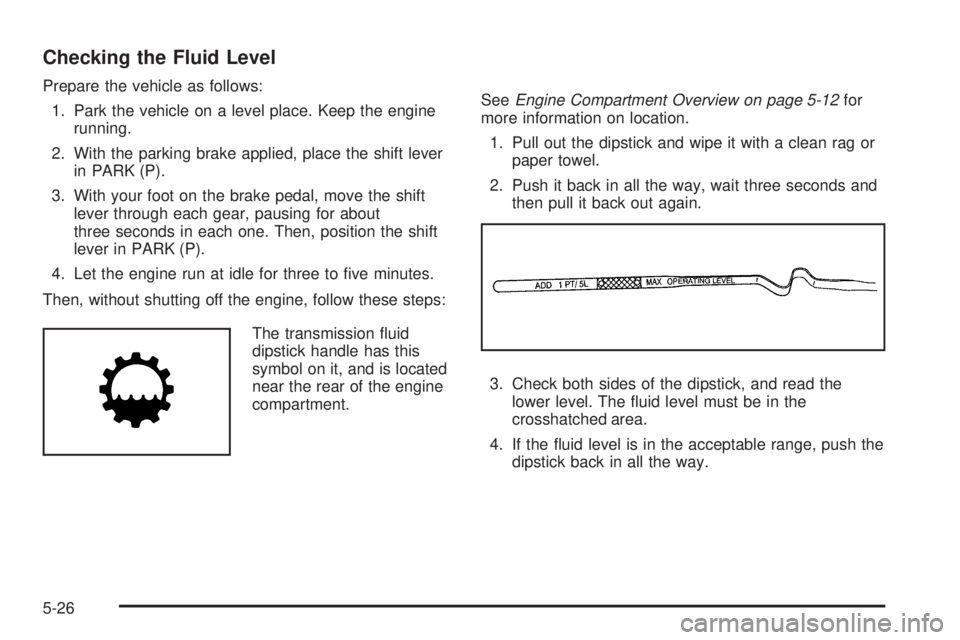
3. Check both sides of the dipstick, and read the
lower level. The uid level must be in the
crosshatched area.
4. If the uid level is in the acceptable range, push the
dipstick back in all the way.
5-26
Page 298 of 440

What to Use
Use a mixture of one-half clean, drinkable water and
one-half DEX-COOL®engine coolant which will not
damage aluminum parts. If this coolant mixture is used,
nothing else needs to be added.
{CAUTION:
Adding only plain water to your cooling system
can be dangerous. Plain water, or some other
liquid such as alcohol, can boil before the
proper coolant mixture will. Your vehicle’s
coolant warning system is set for the proper
coolant mixture. With plain water or the wrong
mixture, your engine could get too hot but you
would not get the overheat warning. Your
engine could catch re and you or others could
be burned. Use a 50/50 mixture of clean,
drinkable water and DEX-COOL
®coolant.
Notice:If you use an improper coolant mixture,
your engine could overheat and be badly damaged.
The repair cost would not be covered by your
warranty. Too much water in the mixture can freeze
and crack the engine, radiator, heater core, and
other parts.If coolant needs to be added more than four times a
year, have your dealer/retailer check the cooling system.
Notice:If you use extra inhibitors and/or additives
in your vehicle’s cooling system, you could damage
your vehicle. Use only the proper mixture of the
engine coolant listed in this manual for the cooling
system. SeeRecommended Fluids and Lubricants on
page 6-12for more information.
Checking Coolant
The coolant recovery tank
is located in the engine
compartment toward the
rear of the engine on the
passenger side of the
vehicle.
If your vehicles is equipped with the 5.3L engine the
coolant recovery tank is located in the engine
compartment toward the rear of the engine on the driver
side of the vehicle SeeEngine Compartment Overview
on page 5-12for more information on location.
5-28
Page 299 of 440

The vehicle must be on a level surface when checking
the coolant level.
When the engine is cold, the coolant level should be at
the COLD FILL line or a little higher. The COLD FILL
line is near the bottom of the recovery tank and has an
arrow pointing down at it.
Adding Coolant
If more coolant is needed, add the proper DEX-COOL®
coolant mixture at the coolant recovery tank, but be
careful not to spill it.
If the coolant recovery tank is completely empty, add
coolant to the radiator. SeeEngine Overheating
on page 5-30.
{CAUTION:
Turning the radiator pressure cap when the
engine and radiator are hot can allow steam
and scalding liquids to blow out and burn you
badly. With the coolant recovery tank, you will
almost never have to add coolant at the
radiator. Never turn the radiator pressure
cap — even a little — when the engine and
radiator are hot.
{CAUTION:
You can be burned if you spill coolant on hot
engine parts. Coolant contains ethylene glycol,
and it will burn if the engine parts are hot
enough. Do not spill coolant on a hot engine.
Occasionally check the coolant level in the radiator. For
information on how to add coolant to the radiator,
seeCooling System on page 5-33.
Radiator Pressure Cap
Notice:If the pressure cap is not tightly installed,
coolant loss and possible engine damage may
occur. Be sure the cap is properly and tightly
secured.
The radiator pressure cap is located in the front of the
engine compartment on the passenger’s side of the
vehicle. SeeEngine Compartment Overview on
page 5-12for more information on location.
5-29
Page 300 of 440
Pressure Cap
Notice:If the pressure cap is not tightly installed,
coolant loss and possible engine damage may
occur. Be sure the cap is properly and tightly
secured.
SeeEngine Compartment Overview on page 5-12for
more information on location.
Engine Overheating
There is a coolant temperature gage and a warning light
on the instrument panel cluster that indicate an
overheated engine condition. SeeEngine Coolant
Temperature Gage on page 3-40andEngine Coolant
Temperature Warning Light on page 3-40for more
information.
In addition, if your vehicle is equipped with a Driver
Information Center (DIC), you will nd an ENGINE
COOLANT HOT and a REDUCED POWER STOP
WHEN SAFE message displayed on the DIC. SeeDIC
Warnings and Messages on page 3-58for more
information.
5-30
Page 310 of 440
2. Then keep turning the pressure cap, but now push
down as you turn it. Remove the pressure cap.
3. Open the coolant air
bleed valve located on
the thermostat housing,
near the upper
radiator hose.SeeEngine Compartment Overview on page 5-12
for more information on location.
4. Fill the radiator with the proper DEX-COOL
®
coolant mixture, up to the base of the ller neck.
SeeEngine Coolant on page 5-27for more
information about the proper coolant mixture.
If you see a stream of coolant coming from the air
bleed valve, close the valve. Otherwise, close
the valve after the radiator is lled.
5. Rinse or wipe any spilled coolant from the engine
and the compartment.
5-40
Page 313 of 440
5. Then ll the coolant recovery tank to the COLD
FILL line.
6. Install the coolant recovery tank cap and the
pressure cap. After a day or two of driving, when the
engine is cold, check the coolant level in the
recovery tank. If it is low, rell it to the COLD
FILL line.
If the coolant in the recovery tank is constantly low, you
should have a dealer/retailer service department
inspect the vehicle for leaks.
Power Steering Fluid
SeeEngine Compartment
Overview on page 5-12for
reservoir location.
When to Check Power Steering Fluid
It is not necessary to regularly check power steering uid
unless you suspect there is a leak in the system or you
hear an unusual noise. A uid loss in this system could
indicate a problem. Have the system inspected and
repaired.
5-43
Page 315 of 440

Adding Washer Fluid
When the windshield washer uid is low, a low washer
uid light may appear on the instrument panel cluster.
SeeLow Washer Fluid Warning Light on page 3-47
for more information.
In addition, if your vehicle has a Driver Information
Center (DIC), the LOW WASHER FLUID message will
display when the uid level is low. SeeDIC Warnings
and Messages on page 3-58for more information.
Open the cap with the
washer symbol on it. Add
washer uid until the
tank is full. SeeEngine
Compartment Overview on
page 5-12for reservoir
location.Notice:
When using concentrated washer uid, follow
the manufacturer’s instructions for adding
water.
Do not mix water with ready-to-use washer uid.
Water can cause the solution to freeze and
damage your washer uid tank and other parts
of the washer system. Also, water does not
clean as well as washer uid.
Fill the washer uid tank only three-quarters full
when it is very cold. This allows for uid
expansion if freezing occurs, which could
damage the tank if it is completely full.
Do not use engine coolant (antifreeze) in your
windshield washer. It can damage the vehicle’s
windshield washer system and paint.
5-45
Page 316 of 440

Brakes
Brake Fluid
The brake master cylinder
reservoir is lled with
DOT-3 brake uid. See
Engine Compartment
Overview on page 5-12for
the location of the
reservoir.
There are only two reasons why the brake uid level in
the reservoir might go down. The rst is that the brake
uid goes down to an acceptable level during normal
brake lining wear. When new linings are put in, the uid
level goes back up. The other reason is that uid is
leaking out of the brake hydraulic system. If it is, you
should have the brake hydraulic system xed, since a
leak means that sooner or later the brakes will not
work well.
It is not a good idea to top off the brake uid. Adding
brake uid will not correct a leak. If uid is added when
the linings are worn, there will be too much uid whennew brake linings are installed. Add or remove brake
uid, as necessary, only when work is done on the brake
hydraulic system.
{CAUTION:
If your vehicle has too much brake uid, it can
spill on the engine. The uid will burn if the
engine is hot enough. You or others could be
burned, and your vehicle could be damaged.
Add brake uid only when work is done on the
brake hydraulic system.
When the brake uid falls to a low level, the brake
warning light comes on. SeeBrake System Warning
Light on page 3-37.
What to Add
When you need brake uid, use only DOT-3 brake uid.
Use new brake uid from a sealed container only.
SeeRecommended Fluids and Lubricants on page 6-12.
Always clean the brake uid reservoir cap and the area
around the cap before removing it. This helps keep dirt
from entering the reservoir.
5-46