2008 BMW 335XI SEDAN reserve
[x] Cancel search: reservePage 39 of 274

Controls
37Reference
At a glance
Driving tips
Communications
Navigation
Entertainment
Mobility
>The engine can only be started when the
vehicle detects that the remote control cur-
rently in use is inside the vehicle.
Comparison to the standard remote
control
In general, there is no difference between using
convenient access or pressing the buttons on
the remote control to carry out the functions
mentioned above. You should therefore first
familiarize yourself with the instructions on
opening and closing starting on page28.
Special features regarding the use of conve-
nient access are described below.
If you notice a brief delay while opening or
closing windows or the glass roof/pan-
orama glass roof, the system is checking
whether a remote control is inside the vehicle.
Please repeat the opening or closing proce-
dure, if necessary.<
Unlocking
Grasp the handle on the driver's or front pas-
senger's door completely, arrow 1. This corre-
sponds to pressing the button.
Locking
Touch the surface, arrow 2, with your finger for
approx. 1 second. This corresponds to pressing
the button.
To preserve the battery, please make
sure that the ignition and all electrical
consumers are switched off before locking the
vehicle.<
Convenient closure
For convenient closure, keep your finger on the
surface, arrow 2.
Unlocking the luggage compartment
lid/tailgate separately
Press the button on the outside of the luggage
compartment lid/tailgate. This corresponds to
pressing the button.
If the vehicle detects that a remote con-
trol has been accidentally left inside the
locked vehicle's cargo bay after the luggage
compartment lid/tailgate or rear window is
closed, the lid will reopen. The hazard warning
flashers flash and an acoustic signal
* sounds.<
Switching on radio readiness
Radio readiness is switched on by pressing the
start/stop button, refer to page56.
Do not depress the brake or the clutch,
otherwise the engine will start.<
Starting the engine
You can start the engine or switch on the igni-
tion when a remote control is inside the vehicle.
It is not necessary to insert a remote control into
the ignition switch, refer to page56.
Switching off the engine in cars with
automatic transmission
The engine can only be switched off when the
selector lever is in position P, refer to page57.
T o s w i t c h t h e e n g i n e o f f w h e n t h e s e l e c t o r l e v e r
is in position N, the remote control must be in
the ignition switch.
Before driving a vehicle with automatic
transmission into a car wash
1.Insert remote control into ignition switch.
2.Depress the brake.
3.Move the selector lever to position N.
4.Switch off the engine.
The vehicle can roll.
Page 58 of 274
Driving
56
Driving
Ignition lock
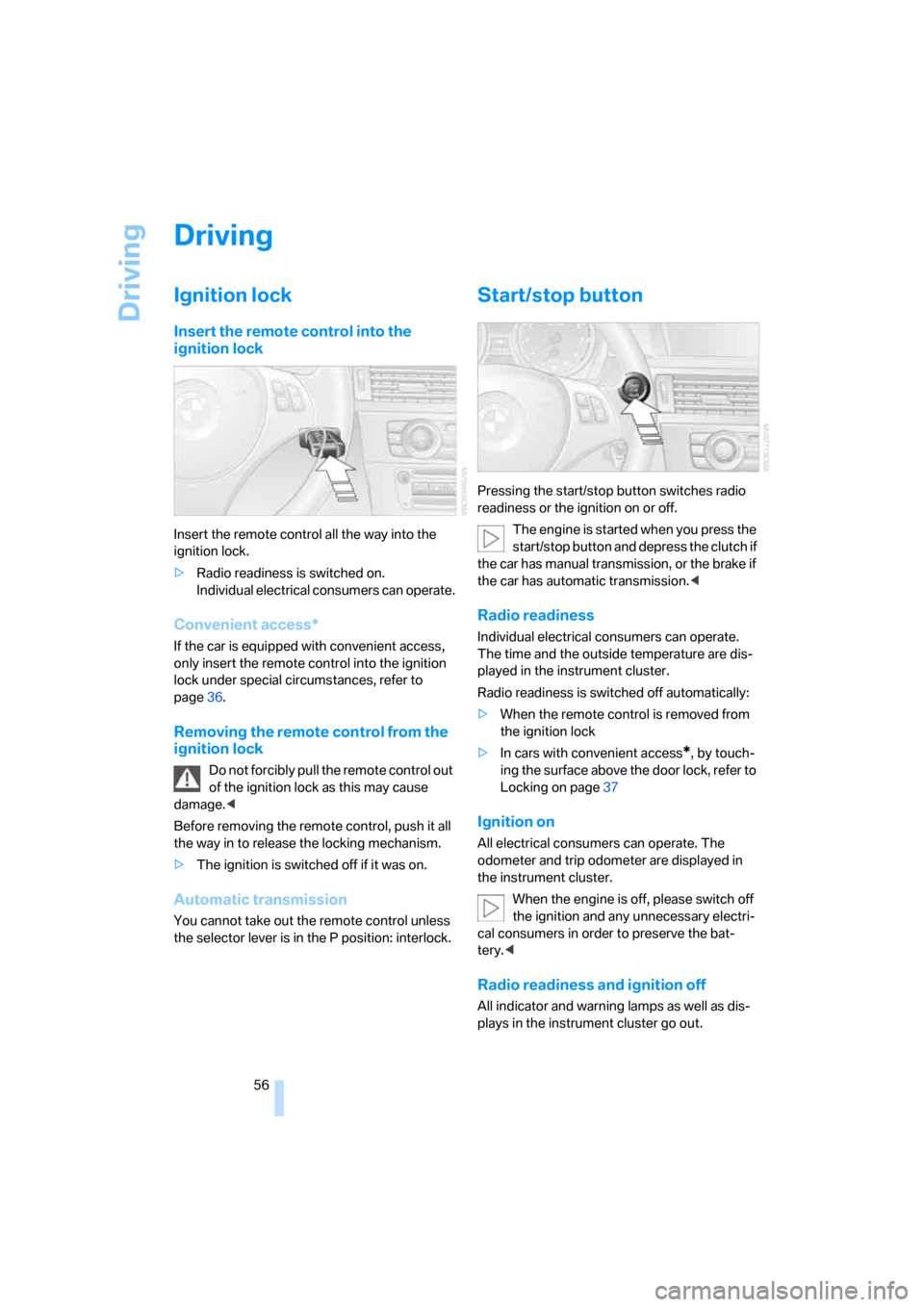
Insert the remote control into the
ignition lock
Insert the remote control all the way into the
ignition lock.
>Radio readiness is switched on.
Individual electrical consumers can operate.
Convenient access*
If the car is equipped with convenient access,
only insert the remote control into the ignition
lock under special circumstances, refer to
page36.
Removing the remote control from the
ignition lock
Do not forcibly pull the remote control out
of the ignition lock as this may cause
damage.<
Before removing the remote control, push it all
the way in to release the locking mechanism.
>The ignition is switched off if it was on.
Automatic transmission
You cannot take out the remote control unless
the selector lever is in the P position: interlock.
Start/stop button
Pressing the start/stop button switches radio
readiness or the ignition on or off.
The engine is started when you press the
start/stop button and depress the clutch if
the car has manual transmission, or the brake if
the car has automatic transmission.<
Radio readiness
Individual electrical consumers can operate.
The time and the outside temperature are dis-
played in the instrument cluster.
Radio readiness is switched off automatically:
>When the remote control is removed from
the ignition lock
>In cars with convenient access
*, by touch-
ing the surface above the door lock, refer to
Locking on page37
Ignition on
All electrical consumers can operate. The
odometer and trip odometer are displayed in
the instrument cluster.
When the engine is off, please switch off
the ignition and any unnecessary electri-
cal consumers in order to preserve the bat-
tery.<
Radio readiness and ignition off
All indicator and warning lamps as well as dis-
plays in the instrument cluster go out.
Page 74 of 274

Everything under control
72
Coolant temperature
A warning lamp will come on if the coolant, and
therefore the engine, becomes too hot. In addi-
tion, a message will appear on the Control Dis-
play.
Check coolant level, refer to page225.
Energy Control*
Displays the current fuel consumption. This
allows you to see whether your current driving
style is conducive to fuel economy with mini-
mum exhaust emissions.
Engine oil temperature*
When the engine is at normal operating temper-
ature, the engine oil temperature is between
approx. 2107/1006 and approx. 3007/
1506.
If the engine oil temperature is too high, a mes-
sage appears on the Control Display.
Fuel gauge
Fuel tank capacity: approx. 15.9 US gallons/
60 liters.
You can find information on refueling on
page207.
If the tilt of the vehicle varies for a longer period,
when you are driving in mountainous areas, for
example, the indicator may fluctuate slightly.
Reserve
Once the fuel level has fallen to the reserve
zone, a message briefly appears on the Control
Display and the cruising range for the remaining
amount of fuel is displayed on the computer.
Under a cruising range of approx. 30 miles/
50 km, the message remains in the Control Dis-
play.
Refuel as soon as possible once your
cruising range falls below 30 miles/
50 km, otherwise engine functions are not
ensured and damage can occur.<
Page 209 of 274
Mobility
207Reference
At a glance
Controls
Driving tips
Communications
Navigation
Entertainment
Observe the following when refueling
When handling fuels, follow the safety
instructions provided at filling stations,
otherwise there is a risk of personal injury or
property damage.<
When refueling, insert the filler nozzle com-
pletely into the filler pipe. Avoid lifting the filler
nozzle while filling the tank, as that would lead
to
>premature pump shutoff
>reduced efficiency of the fuel-vapor recov-
ery system.
The fuel tank is full when the filler nozzle clicks
off the first time.
Fuel tank capacity
Approx. 16.1 US gallons/61 liters, including the
reserve capacity of 2.1 US gallons/8 liters.
Refuel as soon as possible once your
cruising range falls below 30 miles/
50 km, otherwise engine functions are not
ensured and damage can occur.<
Fuel specifications
Do not fill the tank with leaded fuel, as this
would cause permanent damage to the
catalytic converter.
Do not fill the tank with E85, i.e. fuel containing
85 % ethanol, nor with FlexFuel. Otherwise the
engine and fuel supply system will be dam-
aged.<
Required fuel
Super Premium Gasoline/AKI 91
This gasoline is highly recommended.
However, you may also use gasoline with less
AKI. The minimum AKI Rating is:
>323i, 328i/xi: 87
>335i/xi: 89.
If you use gasoline with this minimum AKI Rat-
ing, the engine may produce knocking sounds
when starting at high outside temperatures.
This has no effect on the engine life.Do not use any gasoline below the speci-
fied minimum fuel grade. Otherwise the
engine could be damaged.<
Use high-quality brands
Field experience has indicated significant dif-
ferences in fuel quality: volatility, composition,
additives, etc., among gasolines offered for sale
in the United States and Canada. Fuels contain-
ing up to and including 10 % ethanol or other
oxygenates with up to 2.8 % oxygen by weight,
that is, 15 % MTBE or 3 % methanol plus an
equivalent amount of co-solvent, will not void
the applicable warranties with respect to
defects in materials or workmanship.
The use of poor-quality fuels may result in
driveability, starting and stalling problems
especially under certain environmental condi-
tions such as high ambient temperature and
high altitude.
Should you encounter driveability problems
which you suspect could be related to the fuel
you are using, we recommend that you respond
by switching to a recognized high-quality brand
such as gasoline that is advertised as Top Tier
Detergent Gasoline.
Failure to comply with these recommendations
may also result in unscheduled maintenance.<
Page 248 of 274
Technical data
246
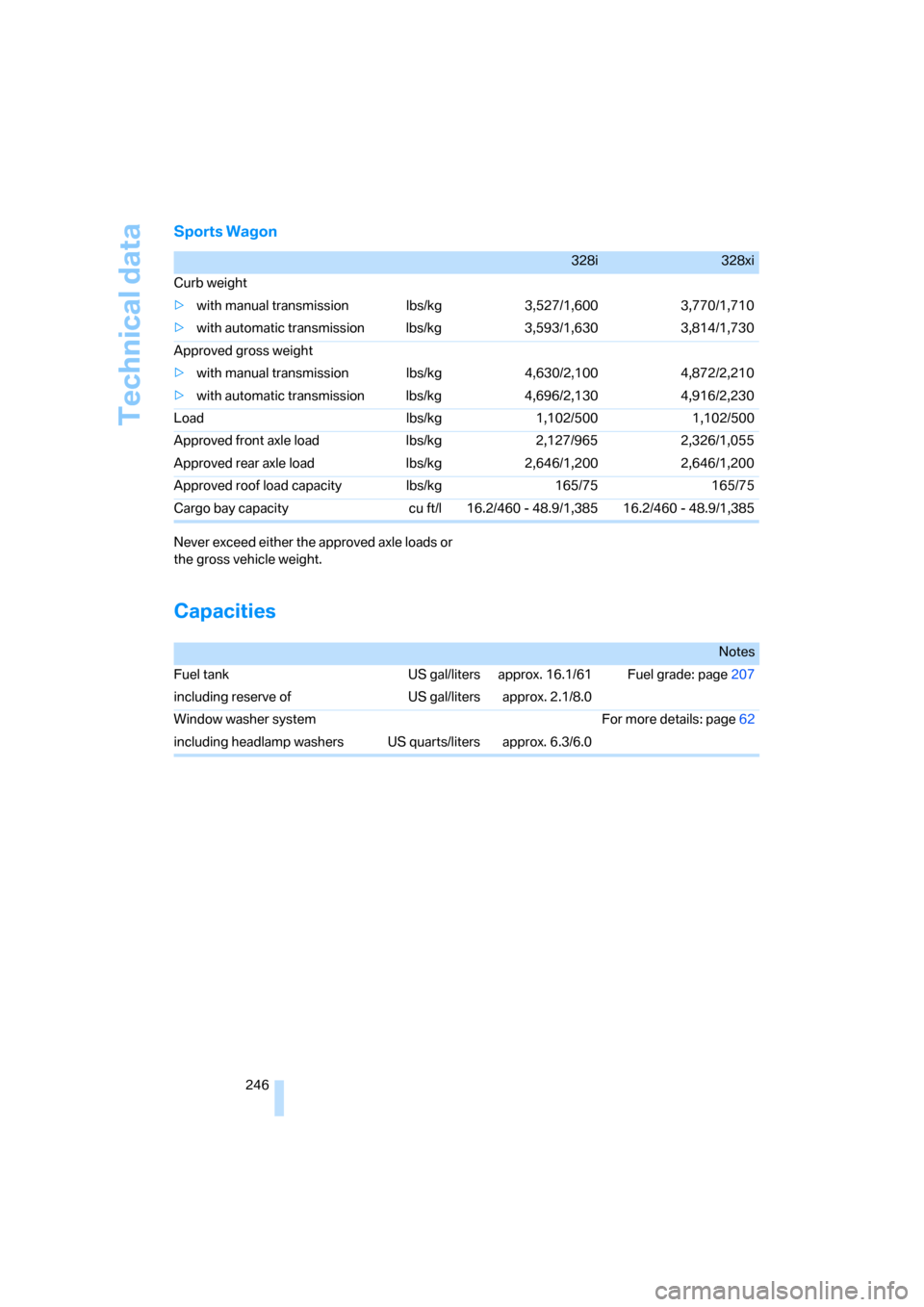
Sports Wagon
Never exceed either the approved axle loads or
the gross vehicle weight.
Capacities
328i328xi
Curb weight
>with manual transmission lbs/kg 3,527/1,600 3,770/1,710
>with automatic transmission lbs/kg 3,593/1,630 3,814/1,730
Approved gross weight
>with manual transmission lbs/kg 4,630/2,100 4,872/2,210
>with automatic transmission lbs/kg 4,696/2,130 4,916/2,230
Load lbs/kg 1,102/500 1,102/500
Approved front axle load lbs/kg 2,127/965 2,326/1,055
Approved rear axle load lbs/kg 2,646/1,200 2,646/1,200
Approved roof load capacity lbs/kg 165/75 165/75
Cargo bay capacity cu ft/l 16.2/460 - 48.9/1,385 16.2/460 - 48.9/1,385
Notes
Fuel tank US gal/liters approx. 16.1/61 Fuel grade: page207
including reserve of US gal/liters approx. 2.1/8.0
Window washer system For more details: page62
including headlamp washers US quarts/liters approx. 6.3/6.0
Page 266 of 274

Everything from A - Z
264 Remote control28
– battery renewal38
– convenient access36
– garage door opener106
– luggage compartment lid30
– malfunction31,38
– removing from the ignition
lock56
– service data226
– tailgate30
"Repeat directory" for audio
mode172
"Repeat" for audio mode172
"Repeat track" for audio
mode172
Replacement remote
control28
Replacing bulbs, refer to
Lamps and bulbs229
Replacing tires219
Replacing tires, refer to New
wheels and tires219
Reporting safety defects6
Reserve warning, refer to Fuel
gauge72
"Reset"89,91
Reset, refer to Resetting tone
settings159
"Reset" for stopwatch84
"Reset" for tone settings159
Residual heat103
Restraint systems
– for children52
– refer to Safety belts48
Reverse
– CD changer173
– CD player173
Reverse gear
– automatic transmission with
Steptronic59
– manual transmission58
Road map145
"Roadside Assistance"198
Roadside
Assistance198,235
Roadside parking lamps98
– replacing bulbs230
Roadworthiness test, refer to
Service requirements76Roller blind
– sun blinds109
Roof load capacity245
Roof-mounted luggage
rack124
"Roomsound", refer to Tone
control158
Rope, refer to Tow-starting,
towing away
239
Rotary/pushbutton, refer to
iDrive16
Route141
– arrow display144
– changing147
– display144
– displaying streets and
towns/cities146
– displaying town146
– list146
– map display145
– selecting141
– selecting criteria141
RSC Runflat System
Component, refer to Run-
Flat Tires219
Rubber parts, refer to Caring
for your vehicle brochure
Runflat System Component
RSC, refer to Run-Flat
Tires219
Run-Flat Tires219
– continuing driving with a
damaged tire90
– flat tire90
– Flat Tire Monitor90
– new tires219
– replacing219
– tire inflation pressure208
– winter tires220
S
Safety-belt height
adjustment48
Safety belts48
– damage49
– indicator/warning lamp48
– reminder48
– sitting safely43Safety belts, care, refer to
Caring for your vehicle
brochure
Safety systems
– airbags94
– Antilock Brake System
ABS86
– brake system86
– driving stability control
systems86
– Dynamic Stability Control
DSC86
– safety belts48
Safety tires, refer to Run-Flat
Tires219
"SAT"156,166
Satellite radio166
– displaying additional
information167
– enabling166
– selecting channel167
– storing channel167
Saving fuel120
"Scan"
– sampling radio stations161
– sampling tracks on CD171
Scan
– CD changer171
– CD player171
– radio161
"Scan all" for audio mode171
"Scan directory" for audio
mode171
Screen, refer to iDrive
controls16
Screw thread for tow
fitting238
SDARS, refer to Satellite
radio166
Seat adjustment
– electric44
– mechanical44
Seat and mirror memory47
Seat belt reminder, refer to
'Fasten safety belts'
reminder48
Seat heating47