2008 AUDI S8 air condition
[x] Cancel search: air conditionPage 295 of 404

_____________________________________________ C_ l_ e _a_ n_ in~ g_a
_ n_d_ p_ r_ o_ t
_ e_ c_t _io _ n __ ffllll
•
The best way to remove snow from windows and mirrors is to use a
brush. Use a non -abrasive
plastic ice scraper -better still, a spray
deicer -to remove
ice from windows and mirrors .
Oil, grease or silicone residue can be removed with
glass cleaner or
silicone remover . However, wax residue requires the use of a
specially formulated solvent. Please contact your Audi dealer for
advice on safe products for wax removal.
Windows should also be cleaned on the inside at regular intervals .
Never dry windows with the same chamois that you use to dry
painted surfaces . Wax residue on the chamois can impair vision
through the windows.
& WARNING
• Always read and heed all WARNINGS and other information
=> page 288 .
• The windshield must not be treated with water-repellent mate
rials . They can increase glare under poor visibility conditions such
as wetness, darkness, or when the sun is low on the horizon. In
addition, they can cause the windshield wipers to chatter.
0 Note
• Never use warm or hot water to remove snow and ice from
windows and mirrors. This could cause the glass to crack.
• To prevent damage to the wires of the rear defogger, do not place
any adhesive stickers on the inside of the rear window over the
wires .
• To help prevent dirt from scratching the window, always scrape
in a forward direction -pushing the scraper away from you -never
back and forth. •
Weatherstrips
Complete car care includes the weatherstrips as well.
-Apply a suitable rubber conditioner to the weatherstrips
from time to time.
To be able seal properly, the weatherstrips around the hood, doors,
rear lid, etc . must remain pliable. Spray the weatherstrips with sili
cone or coat them with talcum powder or glycerine to retain the
flexibility of the rubber and to protect them against freezing in the
winter.
& WARNING
Always read and heed all WARNINGS and other information
=> page 288.
[ i ] Tips
Keep silicone sprays off the windshield to avoid wiper smear in
rain. •
Cast (light) alloy wheels
Cast (light) alloy wheels require special care.
-Wash the wheels with a sponge or hose brush every
other week.
-For deep cleaning afterwards, use only a dedicated acid
free cast alloy wheel cleaner.
-Rub a coat of liquid wax onto the rims every three month.
Be sure to reach and treat all parts of the rim.
To preserve the decorative appearance of the cast alloy wheels,
some special care is necessary . In addition to road dirt and salt,
Vehicle care
Page 298 of 404

___ C_ le_ a_n _i_n ~g _ a_ n_ d
__ p_r _o _t _e _c_ t_ i_o _n ___________________________________________ _
wards, use copious amounts of clean water to remove the
rema ining detergen t. App ly the water with a damp cloth or sponge
and pat the fabric dry with an absorbent, dry c loth .
Stains from chocolate or makeup should have detergent paste (e.g .
ox -ga ll soap) rubbed into them. A fterwards, remove the soap w ith
water (damp sponge).
A lcohol can be used to treat stains from grease, o il, lipstick or a ba ll
point pen . Melted grease or dye must be patted off using absorbent
mater ial. It may be necessary to retreat the areas w ith de tergent
paste and water .
In the case of genera l soiling of the upho lstery and cover material,
we recommend h iring a spec ialist that has the equ ip m ent to c lean
the seat covers and other fabric surfaces by shampooing and spray
extraction .
& WARNING
Always read and heed all WARNING S and the information
=> page 288 .
[ i] Tip s
Open Ve lcro fasteners on your clothing can damage the seat cover.
Please make sure that Velcro fasteners a re c losed .•
Plastic parts and instrument panel
A lways use a c lean cloth mo istened in clear water to clean these
areas . For persistent dirt use an Audi approved solvent-free plastic
cleaner/protectant .
& WARNING
Solvents can ch ange the propertie s of some plasti cs and make it
harder for the airbag to deploy.
& W AR NING (continued )
• Never clean the instrument panel or the surface of airbag
module s with cle aning pr oduct s that contain sol vent s.
• Product s containing solvent s will make the surface of this part
porou s.
• Seriou s injurie s can result if plastic parts come loo se when the
a irbag i s deployed .
• Alway s re ad and heed all WARNING S and other information
=> page 288.
0 Note
Cleaning agents containing solvents wil l attack the material and can
change the way it behaves .•
Ap plies to vehicles : w ith natu ra l l eathe r
Natural leather
Audi makes great eff orts to maintai n the properti es,
n at ural look and feel of interior leather.
General
We offer many different types of leat her on our veh icles . M ost are
different types of nappa leather, which has a smooth surface and
comes in va rious co lors .
T he intens ity of the color determines the visua l c h aracteristics and
appearance. If the surface of the leather has a typica l natural look,
then t he leat her is a nappa leather that has been left in a re lative ly
natural condition. This leather offers particu lar ly good comfort and
breathes well. F ine ve ins, closed gra ins, insect bites, skin folds, and
subt le variations in color remain visib le. These characterist ics
dem onstra te that the material is natura l.
Natura l nappa leather is not covered by a color fin ish . It is therefore
more sensitive to soiling and wea r, which is something you need to
.,.
Page 312 of 404

___ C_ h_e _c _ k_ i_ n ~g~ a_ n_ d_ f_ i_ll _in _g~--------------------------------------------
to help keep your vehicle's engine running smoothly and help
prevent the formation of harmfu l deposits, sometimes called
"sludge, " that over time can lead to expensive repairs .
At the time of printing, engine oils available in the U.S. and Canada
that meet the exacting specificat ions of Audi oil standard VW 502 00
are synthetic engine oils. This does not mean, however, that every
synthetic engine oil will meet Audi oi l standard VW 502 00. So
a lways b e sur e that you use an approved oil.
To help prevent the formation of harmful deposits use only oi l with
the following specifications printed on the oil container :
Audi oil sta nda rd VW 502 00
Oil container labels may carry the specification singly or in combi
nation with other designations and oil quality standards.
V iscosi ty
Engine oi ls are graded according to their viscosity . The proper
viscosi ty grade oi l for your engin e depends on climactic or seasonal
conditions where you drive . You can use o il with a v iscosity grade of
SAE 5W40 across all temperature ranges for normal driving condi
tions.
However , if eng ine oil viscosity grade SAE 5W40 is not available, you
can a lso use viscosity grade SAE 5W -30 or SAE 0W -40 as long as it
meets Audi oil quality standard VW 502 00 specifications.
B ecause engin e oil that meets the Audi oi l standard may not be
avai lable everywhere when you need it, we strongly recommend
that you a lways carry with you an extra quart !liter) of oil that
express ly conforms to t he VW 502 00 specification, in case you have
to top off the oil while on the road.
Only if th e level of the oil is at or be low the minimum mark on the
oi l dipstick -and no oil that express ly conforms to Audi oi l standard
VW 502 00 specifications is avai lable -may you top off with a high
quality engine oi l, preferably synthetic -based, that meets ACEA A3,
ACEA A5 or ACEA B5, API SL or ILSAC GF -3 specifications , but even
t hen, only in viscosity grades SAE 5W -40, SAE 5W -30, or SAE 0W -40.
However, during the entire time betwe en oil change int erva ls, nev er top off with more than a total of 0
.5 qt/ liter engine oil that does not
conform to Audi oil specifica tion VW 502 00.
For more information about engine oil that has been approved for
your vehic le, please contact either your authorized Audi dealer or
Aud i Customer Relat ions at 1 (800) 822-2834 or v isit our web s ite at
www.audiusa.com or www.audicanada.ca. Here you will also find a
current list of o ils (manufacturers, brand names
etc.I that conform
to Audi oi l standard VW 502 00.
Ch an g in g t he en gin e oil
The engine oil and o il filter must be changed according to the
mileage (ki lometers) and time intervals specified in your vehic le 's
Warranty & Maintenance booklet . Do not exceed these intervals -
harmful deposits from old engin e oil can reduce engin e perfor
mance and can lead to expensive eng ine repa irs.
Changing the oil at the recommended intervals is so very impor tant
because the lubricating properties of oi l decrease gradua lly during
normal vehicle use. If you are not sure when you have your o il
changed, ask your authorized Audi Service Advisor.
Under some circumstances the eng ine oil should even be changed
mor e frequen tly . Change oil more oft en if you drive most ly short
distances, operate the vehicle in dusty areas or mostly under stop
and -go traffic conditions, or when you use your vehicle where
t emperatures stay be low freezing po int for long per iods .
Detergent add it ives in the oi l wi ll make fresh oil look dark after the
engine has be en running for a short time. This is normal and is not
a reason to change the oi l more often than recommended .
Dam age or malfun ction s du e to lack of m aint enan ce
It is essential that you change your oil at the recommended interva ls
using on ly engine oil that complies with Audi oil standard
VW 502 00. Your Limited New Vehicle Warranty does not cover
damage or malfunctions due to fai lure to follow recommended
maintenance and use requirements as set forth in the Audi Owner's
Manual and Warranty
& Maintenance booklet. Your dea ler wi ll have
to deny warranty coverage un less you pr esent to the dea ler proof in
.,_
Page 313 of 404
Checkin g and fillin g 1111
-------------~~~
•
the form of Service or Repair Ord ers that all scheduled maintenance
was perfo rmed in a t imely man ner. •
Engine oil consumption
The engin e in your vehicle d ep ends on an adequate
amount of oil to lubricate and cool all of its moving parts.
In order to provide effect ive lubrication and cool ing of internal
engine components, all internal combustion engines consume a
certain amount of o il. Oil consumption varies from engine to eng ine
and may change significantly over the life of the engine . Typically,
eng ines wi th a specif ied break -in period
(see => page 2771 consume
more oil during the break -in period than they consume after oi l
consumption has stabi lized .
Under normal conditions, the rate of oil consumption depends on
the quality and viscosity of the oil, the RPM (revolutions per minute)
at which the engine is operated, the ambient temperature and road
conditions. Further factors are the amount of oil dilution from water
co ndensation or fue l residue and the oxidation level of the o il. As
any engine is subject to wear as mileage builds up, the oil consump
t io n may increase over time until rep lacement of worn components
may become necessary .
With all these variables coming into play, no standard rate of oil consu mption can be estab lished or specified. T here is no a lternative
to regular and frequent checking of the oil level, see
Note .
If the yellow eng ine o il level warni ng symbol in the instrume nt
cluster ~ lights up, you should check the oil level as soon as
poss ible
with the oil dipstick => page 311 . Top off the oil at your
earliest
convenience=> page 312.
& WARNING
Bef ore you che ck anything in the eng ine comp artment , alw ay s
read and heed all WARNINGS
=> & in "Working in the engine
c ompartment " on
page 307 .
0 Note
Driving with an insuff ic ie n t o il level is l ikely to cause severe damage
to the engine.
[ i ] Tip s
• The oil pr es sure warning displ ay
regular inter vals, preferably ea ch time you refuel , and al ways before
going on a long trip.
• I f you have the impression your engine consumes excessive
amounts of oi l, we reco mmend that you consult your Audi dealer to
have the cause of your concern properly diagnosed . Keep in mind
t hat t he acc urate measureme nt of oil consump tion requ ires g reat
care and may take some time. Your Audi dealer has instructions
about how t o measure oil consumpt ion accurately. •
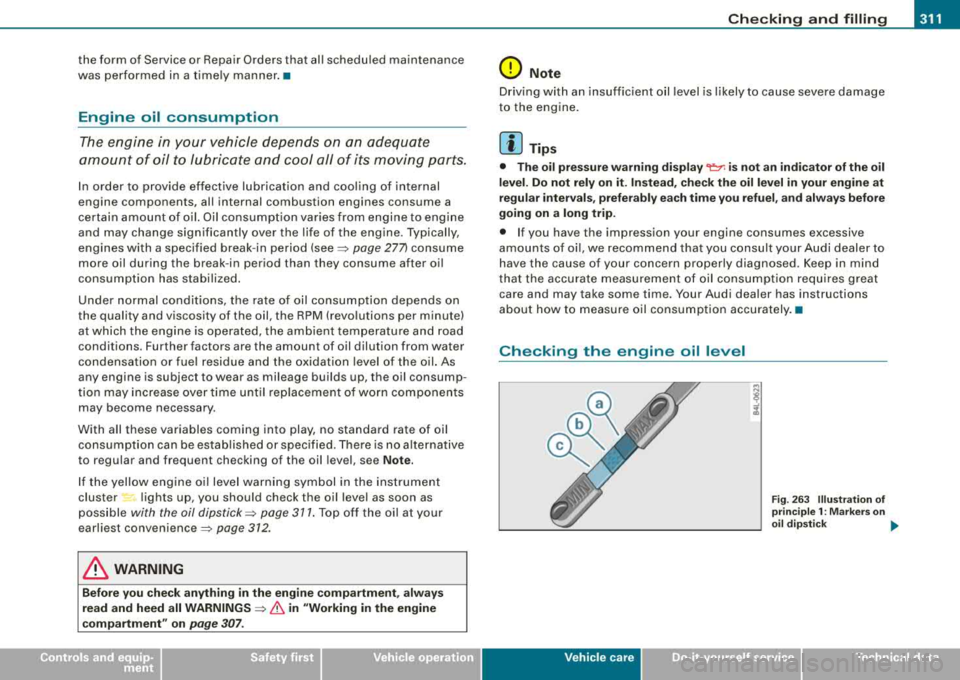
Checking the engine oil level
Vehicle care
Fig. 26 3 Illu stration of
prin cipl e 1: Mar ker s on
o il dip sti ck ...
Page 317 of 404

___________________________________________ C;:_:_: h..:e ..:c :..;.k..: i_n ..::g :.._ a_n _d_ f_il _li _n ..::g :.._--JIIIII
0 Note
• Before winter sets in, have the coolant checked to see if the
coolant additive in your vehicle is sufficient to meet the climate
conditions. This is especially important if you live in a region where
the winter is extremely cold. If necessary , increase the proportion of
coolant additive to 60%.
• When adding coolant additive to your cooling system,
remember:
-We recommend using only coolant additive G12+ + (check the
label) for your vehicle. This coolant additive is available at autho
rized Audi dealers. Other types of antifreeze can significantly
reduce corrosion protection . The resulting corrosion can cause a
loss of coolant and serious engine damage .
• Do not add any type of radiator leak sealant to your vehicle's
engine coolant. Adding radiator repair fluid may adversely affect the
function and performance of your cooling system and could result
in damage not covered by your New Vehicle Limited Warranty .•
Checking the engine coolant level
The engine coolant level can be checked with a quick
glance.
Fig . 267 Engine
compartment : Coolant
expansion tank
Before you check anything in the engine compartment,
always read and heed all WARNINGS => & in "Working in
the engine compartment" on
page 307.
Turn off the ignition.
Read the engine coolant level from the coolant expan
sion
tank => fig. 267 . With a cold engine, the coolant level
should be between the "min" and "max" markings. When
the engine is warm, the level may be slightly above the
"max" marking.
The location of the coolant expansion tank can be seen in the
engine compartment illustration =>
page 308.
To obtain an accurate reading, the engine must be switched off.
The expansion tank in your vehicle is equipped with an electric
coolant level sensor.
When the coolant level is too low, the warning light in the Auto
Check
System => page 31 will blink until you add coolant and the
level has been restored to normal. Even though there is an electric
coolant level sensor, we still recommend you check the coolant level
from time to time.
Coolant loss
Coolant loss may indicate a leak in the cooling system. In the event
of coolant loss, the cooling system should be inspected immedi
ately by your authorized Audi dealer . It is not enough merely to add
coolant .
In a
sealed system, losses can occur only if the boiling point of the
coolant is exceeded as a result of overheating.
& WARNING
The cooling system is under pressure and can get very hot. Reduce
the risk of scalding from hot coolant by following these steps.
.,_
Vehic le care I I Technical data
Page 318 of 404

___ C_ h_e _c _ k_ i_ n ~g~ a_ n_ d_ f_ i_ll _in _g~--------------------------------------------
&, WARNING (continued)
• Turn off the engine and allow it to cool down.
• Protect your face, hands and arms from escaping fluid and
steam by covering the cap with a large, thick rag.
• Turn the cap slowly and very carefully
in a counter-clockwise
direction while applying light, downward pressure on the top of
the cap.
• To avoid being burned, do not spill antifreeze or coolant on the
exhaust system or hot engine parts. Under certain conditions, the
ethylene glycol in engine coolant can catch fire.
0 Note
Do not add any type of radiator leak sealant to your vehicle's engine
coo lant. Adding radiator repair fluid may adversely affect the func
tion and perfo rmance of your cooling system and could result in
damage not covered by your New Vehicle Limited Warranty .
[ i] Tips
On vehicles with the 12-cylinder engine, the expansion tank is
located under a cover. •
Adding coolant
Be very careful when adding engine coolant.
Before you check anything in the engine compartment,
always read and heed all WARNINGS => & in "Wor king in
the engine compartment" on
page 307.
-Turn off the engine.
-Let the engine cool down.
-Place a thick rag over the coolant expansion tank
=> page 315, fig. 267 and carefully twist the cap counter
clockwise
=> & .
-Add coolant.
-Twist the cap on again tightly.
Replacement engine coolant must conform to exact specifications
=> page 314, "Coolant". Even in an emergency, if coolant additive
G12++, G12+ or G12 is not available, do
not use a different additive.
Use plain water instead until you can get the correct additive and
can restore the correct ratio. This should be done as soon as
possible.
If you have lost a considerable amount of coolant, then you should
add cold antifreeze and cold water only when the engine is cold.
Always use
new engine coolant when refilling.
Do not fill coolant above the "MAX" mark. Excess coolant will be
forced out through the pressure relief valve in the cap when the
engine becomes hot.
& WARNING
• The cooling system is under pressure and can get very hot.
Reduce the risk of scalding from hot coolant by following these
steps.
-Turn off the engine and allow it to cool down.
- Protect your face, hands and arms from escaping fluid and
steam by covering the cap with a large, thick rag.
- Turn the cap slowly and very carefully
in a counter-clockwise
direction while applying light, downward pressure on the top
of the cap.
- To avoid being burned, do not spill antifreeze or coolant on
the exhaust system or hot engine parts. Under certain condi-
tions, the ethylene glycol in engine coolant can catch fire. .,,
Page 320 of 404

___ C_ h_e _c _ k_ i_ n ~g~ a_ n_ d_ f_ i_ll _in _g~--------------------------------------------
-Read the brake fluid level from the brake fluid reservoir
=> fig. 268. The brake fluid level must be between the
"MIN" and "MAX" markings.
The brake fluid reservoir is located at the rear partition of the engine
compartment on the left
side~ page 308.
The fluid level may drop slightly after some time due to the auto
matic adjustment of the brake pads. This is not cause for alarm.
If the brake fluid level falls considerably below the "MIN" mark, the
brake warning/indicator light (U.S. models:
BRAKE , Canadian models:
«D>l will come on~ page 22 and~ page 30. Do not continue to
operate the vehicle. The complete brake system should be thor
oughly checked by an authorized Audi dealer or other qualified
facility and the cause corrected. If the brake fluid level is too low, the
brake warning/indicator light will illuminate. Contact an authorized
Audi dealer
immediately. •
Changing brake fluid
Have the brake fluid changed by an experienced techni
cian.
Brake fluid absorbs moisture from the air. If the water content in the
brake fluid is too high, corrosion in the brake system may result
after a period of time. The boiling point of the brake fluid will also
decrease considerably and decrease braking performance.
Therefore, the brake fluid must be changed
every two years. Always
use new brake fluid which conforms to Federal Motor Vehicle Stan
dard "FMVSS 116 DOT 4".
The brake fluid reservoir can be difficult to reach, therefore, we
recommend that you have the brake fluid changed by your autho
rized
Audi dealer. Your dealer has the correct tools, the right brake
fluid and the know-how to do this for you.
& WARNING
• Brake fluid is poisonous . It must be stored only in the closed
original container out of the reach of children!
• Brake failure can result from old or inappropriate brake fluid .
Observe these precautions:
-Use only brake fluid that meets SAE specification J 1703 and
conforms to Federal Motor Vehicle Standard 116. Always check
with your authorized Audi dealer to make sure you are using
the correct brake fluid. The correct type of brake fluid is also indicated on the brake fluid reservoir .
- The brake fluid must be new. Heavy use of the brakes can
cause a vapor lock if the brake fluid is left in the system too
long. This can seriously affect the efficiency of the brakes as
well as your safety . This could result in an accident .
0 Note
Brake fluid will damage the paint of your vehicle .
<£> For the sake of the environment
Because of the problem of proper disposal of brake fluid as well as
the special tools required and the necessary expertise, we recom
mend that you have the brake fluid changed by your authorized Audi
dealer. •
Battery
General information
Under normal operating conditions, the battery in your Audi does
not need any maintenance. With high outside temperatures or long
daily drives we recommend that you have the electrolyte level .,,_
Page 331 of 404

________________________________________________ T_ i
_ r_e _s_ a_n_ d_ w_ h_ e_e _ l_s __ fflll
•
pressure label lists the recommended cold tire inflation pressures
for the vehic le at its maximum capacity weight and tires that were
on your vehicle at the time it was manufactured .
If yo u w is h to impro ve comfo rt when oper ating the vehi cle at
norm al lo ad (up to 3 occup ants), y ou can adju st tire pre ssure s to
tho se spe cified for norm al v ehi cle lo ad . Before oper ating the vehi cle
a t maximum lo ad , you mu st incre as e the tire pre ssure s to tho se
s p ec ified for m aximum vehi cle lo ad ::::>
& .
Bear in m ind that the tire pressure monito ring system can only
monitor the tire pressures you have stored . The system does not
recognize the load condition of your vehicle .
The effect iveness of the t ire pressure mon itoring system will be
impaired if you store normal load pressures but then operate the
veh ic le at its maximum
load ::::>& .
Engin e II Tire design ati on See the i
llustration::::>
page 328, fig . 272 for the location of the label
e it h er o n driver's side 8 -p illar or inside the fue l fil ler flap (color of
the actual label and exact location on the vehicle will vary slight ly!.
Note that the following tab le is accurate at the time of going to
press and is subject to change . In the event o f discrepanc ies, the t ire
pressure label (On USA vehic les, the tire pressure labe l is located on
the driver's s ide 8 -p illar . On Canada vehicles, the tire pressure label
is located either on the driver's side 8 -pi llar or inside the fuel fil ler
fl ap) always takes precedence .
The table below lists the recommended cold tire inflation pressures
for the Audi mode l covered by your Owner's Literature at the
veh ic le's capacity weight and the tire s izes insta lled on the respec
tive models as original equipment, or as a factory option.
Tire pressure front Tire pressure rear
( displa ce-
normal load
II full load norm
al load
full load
ment in
c ondition al condition condition al condition
liter)
PSI II kPA PSI II kPA PSI I I kPA If PSI IT kPA .,
8-c ylinder 255 /45 R1 8 99H All Sea son
33 230 33 230 30 2
10
33 230
4 .2
255/40 R19100V XL All Sea son 36 250 38 260 33 230 36 250
255 /40 R1 9 1 00 Y XL High P erformanc e 33 230 33 230 30 2 10 33 230
275 /35 R20 102V XL High Performance
33 230 36 250 30 2
10
39 270
8-cylinder 2 55/45 R1 8 99H All Sea son
33 230 35 240 30 2
10
33 230
4 .2 L
255/40 R1 9 100V XL All Sea son 36 250 38 260 33 230 36 250
255 /40 R1 9 1 00Y XL High Perfo rman ce
33 230 35 240
30 2
10
33 230
275 /35 R20 102V XL High Performance 33 230 36 250 30 2 10 39 270
Vehicle care
I