2008 AUDI S8 check oil
[x] Cancel search: check oilPage 311 of 404

_____________________________________________ C_h_ e_ c
_ k_in --= g'-a
_ n_d _ f_il _li _n ..::g ::.-__.ffllll
& WARNING
B efor e you che ck an ything in the eng ine comp artm ent, a lw ays
read and heed all WARN ING S
~ & in "W orkin g in the engin e
c omp artment " on
page 30 7. •
Appl ies to vehicles: with 12- cy linder engine
Engine compartment overview : 1 2-cyl inder
engine
These are the most important items that you can check.
F ig . 262 Ty pi cal layout for c ontain ers, en gine oil dip st ic k a nd e ngine o il filler
ca p
G) Windshield/head light washer container ( Q ) . . . . . . . . 323
@ Brake fluid reservoir ( ) . . . . . . . . . . . . . . . . . . . . . . . . 317
© Engine oi l dipstick (orange) . . . . . . . . . . . . . . . . . . . . . . 311
© Engine oil filler cap ('t=:11) .. ...... .... ... ... ... .. . .
© Coolant expansion tank (- L l ..................... .
& WARNING
Before you check anything in th e engine co mpartment , alway s
read and he ed all W ARNI NGS
~ & in "Wo rking in t he engin e
c ompartm ent " on
page 307.
[ i ] Tip s
The coolant expansion tank is located under a cover .•
Engine oil
Engine oil specifications
312
315
The engine oil us ed in your Audi needs the right kind of
oil.
The engine in your Audi is a sophisticated powerplant that was built
to exacting specifications. This engine needs the right kind of engine oil that meets specifications regarding quality and viscosity
so that it can run smoothly and re liably. Choosing the righ t oil and
changing oil within the time and mileage interva ls printed in your
vehicle's Warranty
& Ma intenance book let matters a lo t more today
than it did years ago. Audi has developed a special quality standard
for engine oil that wil l help assure that your vehicle's engine wi ll get
the lubrication it needs for proper operation .
Mode rn engine lubrication has taken a quantum leap in the last few
years . Many syn thetic oils available today provide better engine
lubrication that can outlast traditional petroleum-based oils,
making them a smart choice for use throughout the life of your Audi.
Whether you use synthetic or petroleum -based engine oil, the oi l
that you use must conform to Audi's oi l qua lity standard VW 502 00
..,
Vehic le care I I irechnical data
Page 313 of 404
Checkin g and fillin g 1111
-------------~~~
•
the form of Service or Repair Ord ers that all scheduled maintenance
was perfo rmed in a t imely man ner. •
Engine oil consumption
The engin e in your vehicle d ep ends on an adequate
amount of oil to lubricate and cool all of its moving parts.
In order to provide effect ive lubrication and cool ing of internal
engine components, all internal combustion engines consume a
certain amount of o il. Oil consumption varies from engine to eng ine
and may change significantly over the life of the engine . Typically,
eng ines wi th a specif ied break -in period
(see => page 2771 consume
more oil during the break -in period than they consume after oi l
consumption has stabi lized .
Under normal conditions, the rate of oil consumption depends on
the quality and viscosity of the oil, the RPM (revolutions per minute)
at which the engine is operated, the ambient temperature and road
conditions. Further factors are the amount of oil dilution from water
co ndensation or fue l residue and the oxidation level of the o il. As
any engine is subject to wear as mileage builds up, the oil consump
t io n may increase over time until rep lacement of worn components
may become necessary .
With all these variables coming into play, no standard rate of oil consu mption can be estab lished or specified. T here is no a lternative
to regular and frequent checking of the oil level, see
Note .
If the yellow eng ine o il level warni ng symbol in the instrume nt
cluster ~ lights up, you should check the oil level as soon as
poss ible
with the oil dipstick => page 311 . Top off the oil at your
earliest
convenience=> page 312.
& WARNING
Bef ore you che ck anything in the eng ine comp artment , alw ay s
read and heed all WARNINGS
=> & in "Working in the engine
c ompartment " on
page 307 .
0 Note
Driving with an insuff ic ie n t o il level is l ikely to cause severe damage
to the engine.
[ i ] Tip s
• The oil pr es sure warning displ ay
regular inter vals, preferably ea ch time you refuel , and al ways before
going on a long trip.
• I f you have the impression your engine consumes excessive
amounts of oi l, we reco mmend that you consult your Audi dealer to
have the cause of your concern properly diagnosed . Keep in mind
t hat t he acc urate measureme nt of oil consump tion requ ires g reat
care and may take some time. Your Audi dealer has instructions
about how t o measure oil consumpt ion accurately. •
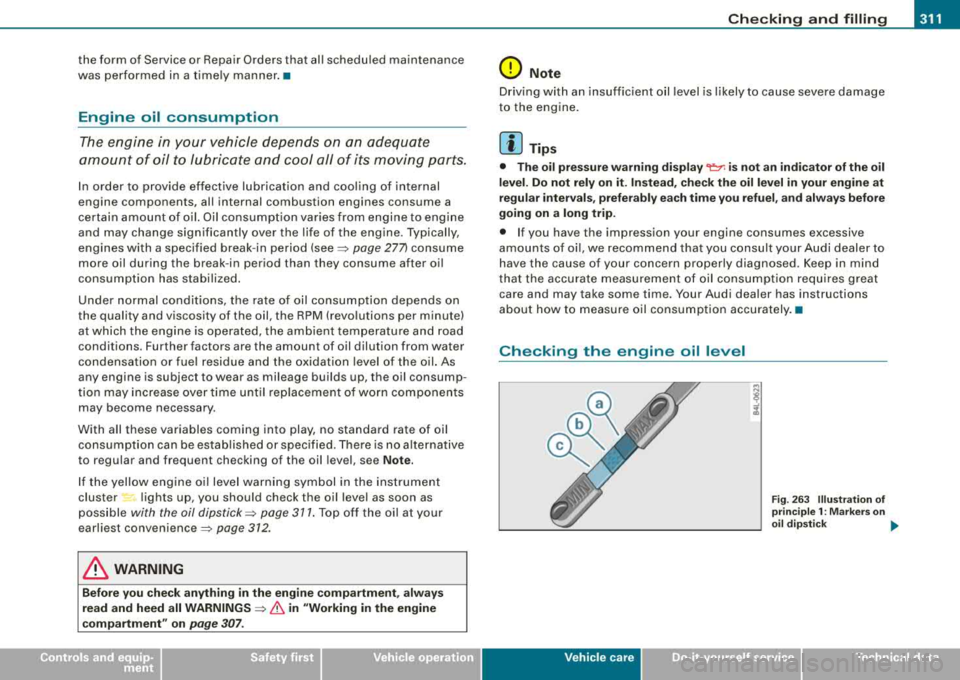
Checking the engine oil level
Vehicle care
Fig. 26 3 Illu stration of
prin cipl e 1: Mar ker s on
o il dip sti ck ...
Page 314 of 404

-
Checking and filling
..._--=--=--------------
Fig. 264 Illustration of
principle 2: Markers on
oil dipstick
Before you check anything in the engine compartment,
always read and heed all
WARNINGS ~ & in "Working in
the engine compartment" on
page 307 .
Determining oil level
-Park your vehicle so that it is horizontally level.
-While at operating state temperature, briefly let the
engine run at idle and then shut it off.
-Wait approx. two minutes.
Pull out the oil dipstick. Wipe off the oil dipstick with a
clean cloth, and slide it back in as far as it will go.
-Pull it back out and read off the oil level ~ page 311,
fig. 263 or~ fig. 264. Top off the engine oil, if applicable
~ page 312.
Oil level within range @
-Do not add oil.
Oil level within range
@
-You can add oil. Afterwards, the oil level should be within
range @. Oil level within range
©
You must add oil. Afterwards, the oil level should be
within range @.
The oil level needs to be checked at regular intervals. The best times
to do this are whenever you refuel and prior to long trips. •
Adding engin e oil 'l:::7:
Fig. 265 Oil filler cap
location: 4.2 L
8-
cylinder
Fig . 266 Oil filler cap
location : 6.0 L
12 -
cylinder
Before you check anything in the engine compartment,
always read and heed all
WARNINGS ~ & in "Working in
the engine compartment" on
page 307.
-Turn off the engine . .._
Page 315 of 404
Checkin g and fillin g -
-----------------=-----------"'---
•
-Unsc rew the oil filler cap f rom the cylinde r head cover
=>
page 312, f ig . 265 or=> page 312, fi g. 266 .
-Carefully top off with the appropriate o il in 0.5 liter doses.
-Check the oi l level again after two minutes => page 311 .
-Top off the oil again, if necessary .
-Screw the cap bac k on the filling hole and slide the oil
dipstick in as fa r as i t will go .
& WARNING
• Whil e topping off , the oil mu st not com e in c ontact with hot
e ng ine p art s
-fire h azard!
• The oil filler cap mu st be prop erly se cur ed to pr even t oil from
be ing spr aye d on the hot en gi ne a nd exha ust sys te m when the
engin e is running
-fir e haza rd!
• If your skin h as c ome in cont act wi th the engine oil , you mu st
s ubs equen tly c leanse it thoroughl y.
0 Not e
• The o il level must not be above range @- da nger of converter or
engine damage! Contact an authorized dealership to draw off oi l, if
necessary.
• Audi d oes no t re commend the u se of o il a ddit ives. The y m ay
damage th e engine and adv erse ly a ffect y our New Vehicle Warr ant y.
<£> For the sake of the environment
• Under no circumstances can the o il come i n contact w ith the
sewage network or the soil.
• Observe and fol low legal regulat ions when d ispos ing of empty
oi l containers. •
Changing the engine oil
We recommend that have your oil changed by an auth o
rized Audi dealer or a qualified service station.
Before you check anything in the engine compartment, always rea d
and heed all
WARNING S=> & in "Working in the engine co mpart
ment" on
page 307.
The engine oi l must be changed according to the interva ls specified
in your Warranty
& Maintenance booklet . This is very important
because the lubricating properties of oi l diminish gradua lly during
normal vehicle use.
Under some circumstances the engine oil shou ld be changed more
frequently . Change oil mo re often if you drive most ly short
distances, operate the vehicle in dusty areas or under predomi
nantly stop -and -go traffic conditions, or have your ve hicle where
temperatures remain below freezing for extended periods.
Detergent additives in the oil will make fresh oi l look dark after the
eng ine has been runn ing for a short t ime . Th is is normal and is not
a reason to change the oil more often than recommended .
Because of the problem of proper disposal, along with the spec ial
tools and necessary expertise required, we strong ly recommend
that you have your oi l ch anged by an authorized Audi dealer or a
qualified service station .
If you choo se to ch ang e y our oil your self, please note the following
important information:
& WARNING
To r edu ce the ri sk of per son al inju ry if you mu st change th e engine
oil in your v ehicl e your self :
• Wear eye prote ction .
• To r educ e the ri sk of burn s from hot en gine oil , le t the engine
c ool do wn t o th e tou ch . .,_
Vehicle care
Page 316 of 404

___ C_ h_e _c _ k_ i_ n ~g~ a_ n_ d_ f_ i_ll _in _g~--------------------------------------------
&, WARNING (continued)
• When removing the oil drain plug with your fingers, stay as far
away as possible. Always keep your forearm parallel to the ground
to help prevent hot oil from running down your arm.
• Drain the oil into a container designed for this purpose, one
large enough to hold at least the total amount of oil in your engine.
• Engine oil is poisonous. Keep it well out of the reach of children.
• Continuous contact with used engine oil is harmful to your
skin. Always protect your skin by washing oil off thoroughly with
soap and water.
0 Note
Never mix oil additives with your engine oil. These additives can
damage your engine and adversely affect your Audi Lim ited New
Vehicle Warranty.
<£> For the sake of the environment
• Before changing your oil, first make sure you know where you
can properly dispose of the used oil.
• Always dispose of used engine oil properly. Do not dump it on
garden soil , wooded areas , into open streams or down sewage
drains.
• Recycle used engine oil by taking it to a used engine oil collec
tion facility in your area, or contact a service station. •
Engine cooling system
Coolant
The engine coolant performs two functions: it keeps the
engine from overheating and it protects the engine from
freezing in the winter.
The cooling system is sealed and generally requires little attention.
The cooling system has been filled at the factory with a permanent
coolant which does not need to be changed . The coolant consists of
a mixture of water and the manufacturer's glycol -basedcoolant
additive G12 ++ antifreeze with anti corrosion addi tives (50% for USA
models; 60% for Canadian models). This mixture both assures the
necessary frost protection and protects metal components in the
engine's cooling system from corrosion and scaling. It also raises
the boiling point of the coolant.
Do not reduce the concentration of the coolant in the summer by
adding plain water.
The proportion of coolant additive must be at
least 50% but not more than 60%
to maintain antifree ze protection
and cooling efficiency. If the coolant frost protection is too low, the
coolant could freeze and damage the vehicle heating and engine
cooling system.
For year-round driving, antifreeze is added at the factory for temper
atures down to :
• -31 °F ( -35 °C) USA
•
-40 °F ( -40 °C) Canada .
You can mix the G12 ++ coolant additive with other additives (G12 +
or G12). Always check with your authori zed Audi dealer .
& WARNING
Before you check anything in the engine compartment, always
read and heed all WARNINGS
~ & in "Working in the engine
compartment" on
page 307.
Page 317 of 404

___________________________________________ C;:_:_: h..:e ..:c :..;.k..: i_n ..::g :.._ a_n _d_ f_il _li _n ..::g :.._--JIIIII
0 Note
• Before winter sets in, have the coolant checked to see if the
coolant additive in your vehicle is sufficient to meet the climate
conditions. This is especially important if you live in a region where
the winter is extremely cold. If necessary , increase the proportion of
coolant additive to 60%.
• When adding coolant additive to your cooling system,
remember:
-We recommend using only coolant additive G12+ + (check the
label) for your vehicle. This coolant additive is available at autho
rized Audi dealers. Other types of antifreeze can significantly
reduce corrosion protection . The resulting corrosion can cause a
loss of coolant and serious engine damage .
• Do not add any type of radiator leak sealant to your vehicle's
engine coolant. Adding radiator repair fluid may adversely affect the
function and performance of your cooling system and could result
in damage not covered by your New Vehicle Limited Warranty .•
Checking the engine coolant level
The engine coolant level can be checked with a quick
glance.
Fig . 267 Engine
compartment : Coolant
expansion tank
Before you check anything in the engine compartment,
always read and heed all WARNINGS => & in "Working in
the engine compartment" on
page 307.
Turn off the ignition.
Read the engine coolant level from the coolant expan
sion
tank => fig. 267 . With a cold engine, the coolant level
should be between the "min" and "max" markings. When
the engine is warm, the level may be slightly above the
"max" marking.
The location of the coolant expansion tank can be seen in the
engine compartment illustration =>
page 308.
To obtain an accurate reading, the engine must be switched off.
The expansion tank in your vehicle is equipped with an electric
coolant level sensor.
When the coolant level is too low, the warning light in the Auto
Check
System => page 31 will blink until you add coolant and the
level has been restored to normal. Even though there is an electric
coolant level sensor, we still recommend you check the coolant level
from time to time.
Coolant loss
Coolant loss may indicate a leak in the cooling system. In the event
of coolant loss, the cooling system should be inspected immedi
ately by your authorized Audi dealer . It is not enough merely to add
coolant .
In a
sealed system, losses can occur only if the boiling point of the
coolant is exceeded as a result of overheating.
& WARNING
The cooling system is under pressure and can get very hot. Reduce
the risk of scalding from hot coolant by following these steps.
.,_
Vehic le care I I Technical data
Page 320 of 404

___ C_ h_e _c _ k_ i_ n ~g~ a_ n_ d_ f_ i_ll _in _g~--------------------------------------------
-Read the brake fluid level from the brake fluid reservoir
=> fig. 268. The brake fluid level must be between the
"MIN" and "MAX" markings.
The brake fluid reservoir is located at the rear partition of the engine
compartment on the left
side~ page 308.
The fluid level may drop slightly after some time due to the auto
matic adjustment of the brake pads. This is not cause for alarm.
If the brake fluid level falls considerably below the "MIN" mark, the
brake warning/indicator light (U.S. models:
BRAKE , Canadian models:
«D>l will come on~ page 22 and~ page 30. Do not continue to
operate the vehicle. The complete brake system should be thor
oughly checked by an authorized Audi dealer or other qualified
facility and the cause corrected. If the brake fluid level is too low, the
brake warning/indicator light will illuminate. Contact an authorized
Audi dealer
immediately. •
Changing brake fluid
Have the brake fluid changed by an experienced techni
cian.
Brake fluid absorbs moisture from the air. If the water content in the
brake fluid is too high, corrosion in the brake system may result
after a period of time. The boiling point of the brake fluid will also
decrease considerably and decrease braking performance.
Therefore, the brake fluid must be changed
every two years. Always
use new brake fluid which conforms to Federal Motor Vehicle Stan
dard "FMVSS 116 DOT 4".
The brake fluid reservoir can be difficult to reach, therefore, we
recommend that you have the brake fluid changed by your autho
rized
Audi dealer. Your dealer has the correct tools, the right brake
fluid and the know-how to do this for you.
& WARNING
• Brake fluid is poisonous . It must be stored only in the closed
original container out of the reach of children!
• Brake failure can result from old or inappropriate brake fluid .
Observe these precautions:
-Use only brake fluid that meets SAE specification J 1703 and
conforms to Federal Motor Vehicle Standard 116. Always check
with your authorized Audi dealer to make sure you are using
the correct brake fluid. The correct type of brake fluid is also indicated on the brake fluid reservoir .
- The brake fluid must be new. Heavy use of the brakes can
cause a vapor lock if the brake fluid is left in the system too
long. This can seriously affect the efficiency of the brakes as
well as your safety . This could result in an accident .
0 Note
Brake fluid will damage the paint of your vehicle .
<£> For the sake of the environment
Because of the problem of proper disposal of brake fluid as well as
the special tools required and the necessary expertise, we recom
mend that you have the brake fluid changed by your authorized Audi
dealer. •
Battery
General information
Under normal operating conditions, the battery in your Audi does
not need any maintenance. With high outside temperatures or long
daily drives we recommend that you have the electrolyte level .,,_
Page 327 of 404

Tires and wheels -
----------------
•
& WARNING (continued)
crashes and serious personal injuries . Have worn or damaged tires
replaced immediately.
• Tires age even if they are not being used and can fail suddenly,
especially at high speeds. Tires that are more than 6 years old can
only be used in an emergency and then with special care and at
low speed.
Glossary of tire and loading terminology
Accessory weight
means the combined weight (in excess of those standard items
which may be replaced) of automatic transmission, power steering,
power brakes, power windows, power seats, radio, and heater, to
the extent that these items are available as factory-installed equip
ment (whether installed or not).
Aspect ratio means the ratio of the height to the width of the tire in percent.
Numb ers of 55 or lower indicate a low sidewall for improved
steering response and better overall handling on dry pavement.
Bead
means the part of the tire that is made of steel wires, wrapped or
reinforced by ply cords and that is shaped to fit the rim.
Bead separation
means a breakdown of the bond between components in the bead.
Cord
means the strands forming the plies in the tire.
& WARNING (continued)
• Never mount used tires on your vehicle if you are not sure of
their
"previous history." Old used tires may have been damaged
even though the damage cannot be seen that can lead to sudden
tire failure and loss of vehicle control.
• If you notice unusual vibration or if the vehicle pulls to one side
when driving, always stop as soon as it is safe to do so and check
the wheels and tires for damage.
•
Cold tire inflation pressure
means the tire pressure recommended by the vehicle manufacturer
for a tire of a designated size that has not been driven for more than
a couple of miles (kilometers) at low speeds in the three hour period
before the tire pressure is measured or adjusted.
Curb weight
means the weight of a motor vehicle with standard equipment
including the maximum capacity of fuel, oil, and coolant, air condi
tioning and additional weight of optional equipment.
Extra load tire
means a tire design to operate at higher loads and at higher infla
tion pressures than the corresponding standard tire. Extra load tires
may be identified as
"XL", "xi", "EXTRA LOAD", or "RF" on the side
wall.
Gross Axle Weight Rating
("GAWR")
means the load-carrying capacity of a single axle system, measured
at the tire -ground interfaces.
Gross Vehicle Weight Rating
( " GVWR")
means the maximum total loaded weight of the vehicle.
Vehicle care