2008 AUDI S5 towing
[x] Cancel search: towingPage 259 of 294
Downloaded from www.Manualslib.com manuals search engine Self-help257
Controls
Safety
Driving tips
General maintenance
Self-help
Technical data terminal must not touch metal parts of the vehicle: this can cause
short circuiting.
•
Do not bend over the batteries – risk of acid burns.
•
The screw plugs on the battery cells must be screwed in firmly.
•
Keep sparks, flame and lighted cigarettes away from batteries:
the gases given off can cause an explosion.
•
If jump-starting another vehicle, position the jump leads in
such a way that they cannot come into contact with any moving
parts in the engine compartment of the other vehicle.Caution
Please note that the above method of connecting the leads is meant
for jump-starting your vehicle. If jump-starting another vehicle, you
should not connect the negative lead (–) to the negative terminal of
the discharged battery, but directly to the engine block or a solid
metal part bolted to the engine block. If the battery of the other
vehicle does not have a gas vent, there is a risk that a mixture of
oxygen and hydrogen gas can accumulate and cause an
explosion.Tow-starting and towing awayGeneral notes
Points to observe when tow-starting or towing awayIf you use a towrope:
Notes for the driver of the towing vehicle
– The towrope must be taut before driving off.– Engage the clutch very gently when starting to move; on
vehicles with automatic gearbox press the accelerator
slowly.
Notes for the driver of the towed vehicle
– The ignition should be switched on so that the turn
signals, horn, windscreen wipers and washers can be
used. Please ensure that the steering wheel is unlocked
when you switch on the ignition, and that it moves freely.
–Put gear lever in neutral (manual gearbox) or move
selector lever to position N (automatic gearbox).
– The brake servo and power steering only work when the
engine is running. Considerably more effort is required
on the brake pedal and steering wheel when the engine
is switched off.
– Ensure that the towrope remains taut at all times when
towing.
Towrope or towbar
It is easier and safer to tow a vehicle with a towbar. You should only
use a towrope if you do not have a towbar.
A towrope should be slightly elastic to reduce the loading on both
vehicles. It is advisable to use a towrope made of synthetic fibre or
similar material.
Attach the tow-rope or tow-bar only to the towing anchorages
intended for this purpose ⇒page 258 or ⇒page 259.
Driving technique
Towing requires some experience – especially when using a
towrope. Both drivers should be familiar with the technique required
for towing. Inexperienced drivers should not attempt to tow-start or
tow away another vehicle.
WARNING (continued)
document_0900452a81793dcc.book Seite 257 Mittwoch, 21. März 2007 5:42 17
Page 260 of 294
Downloaded from www.Manualslib.com manuals search engine Self-help 258Do not pull too hard with the towing vehicle and take care to avoid
jerking the towrope. When towing on a loose surface there is always
a risk of overloading and damaging the anchorage points.
Caution
If there is no oil in the gearbox or no lubricant in the automatic
transmission the car may only be towed with the driven wheels
lifted clear of the road, or transported on a special car transporter
or trailer.
Note
•
Note the regulations concerning towing.
•
The hazard warning lights of both vehicles must normally be
switched on. However, observe any regulations to the contrary.
•
Make sure that the towrope is not twisted, as otherwise the front
towline anchorage on your vehicle could work itself loose.
Front towline anchorage
The front towline anchorage is only mounted if the vehicle
has to be towed.
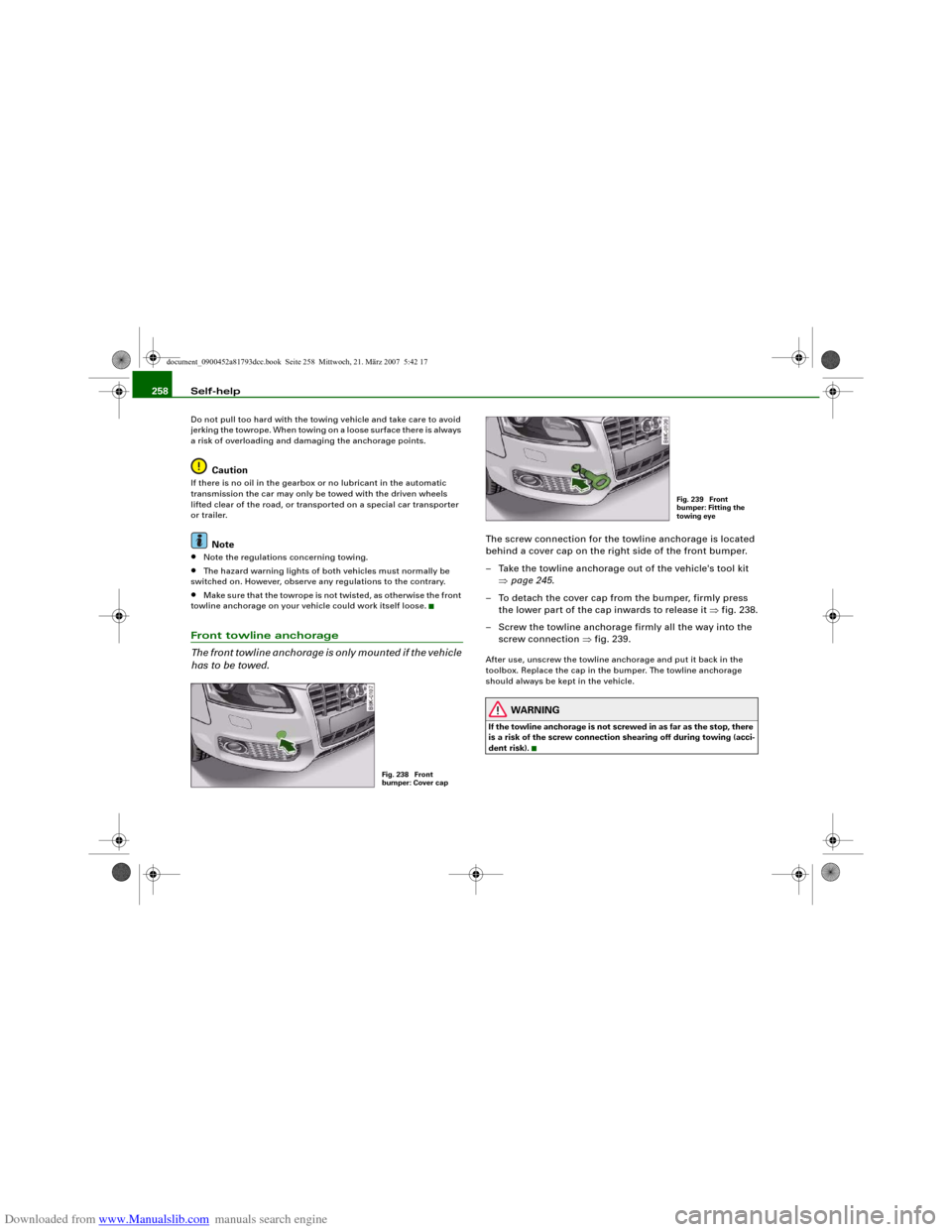
The screw connection for the towline anchorage is located
behind a cover cap on the right side of the front bumper.
– Take the towline anchorage out of the vehicle's tool kit
⇒page 245.
– To detach the cover cap from the bumper, firmly press
the lower part of the cap inwards to release it ⇒fig. 238.
– Screw the towline anchorage firmly all the way into the
screw connection ⇒fig. 239.After use, unscrew the towline anchorage and put it back in the
toolbox. Replace the cap in the bumper. The towline anchorage
should always be kept in the vehicle.
WARNING
If the towline anchorage is not screwed in as far as the stop, there
is a risk of the screw connection shearing off during towing (acci-
dent risk).
Fig. 238 Front
bumper: Cover cap
Fig. 239 Front
bumper: Fitting the
towing eye
document_0900452a81793dcc.book Seite 258 Mittwoch, 21. März 2007 5:42 17
Page 261 of 294
Downloaded from www.Manualslib.com manuals search engine Self-help259
Controls
Safety
Driving tips
General maintenance
Self-help
Technical data
Rear towline anchorage
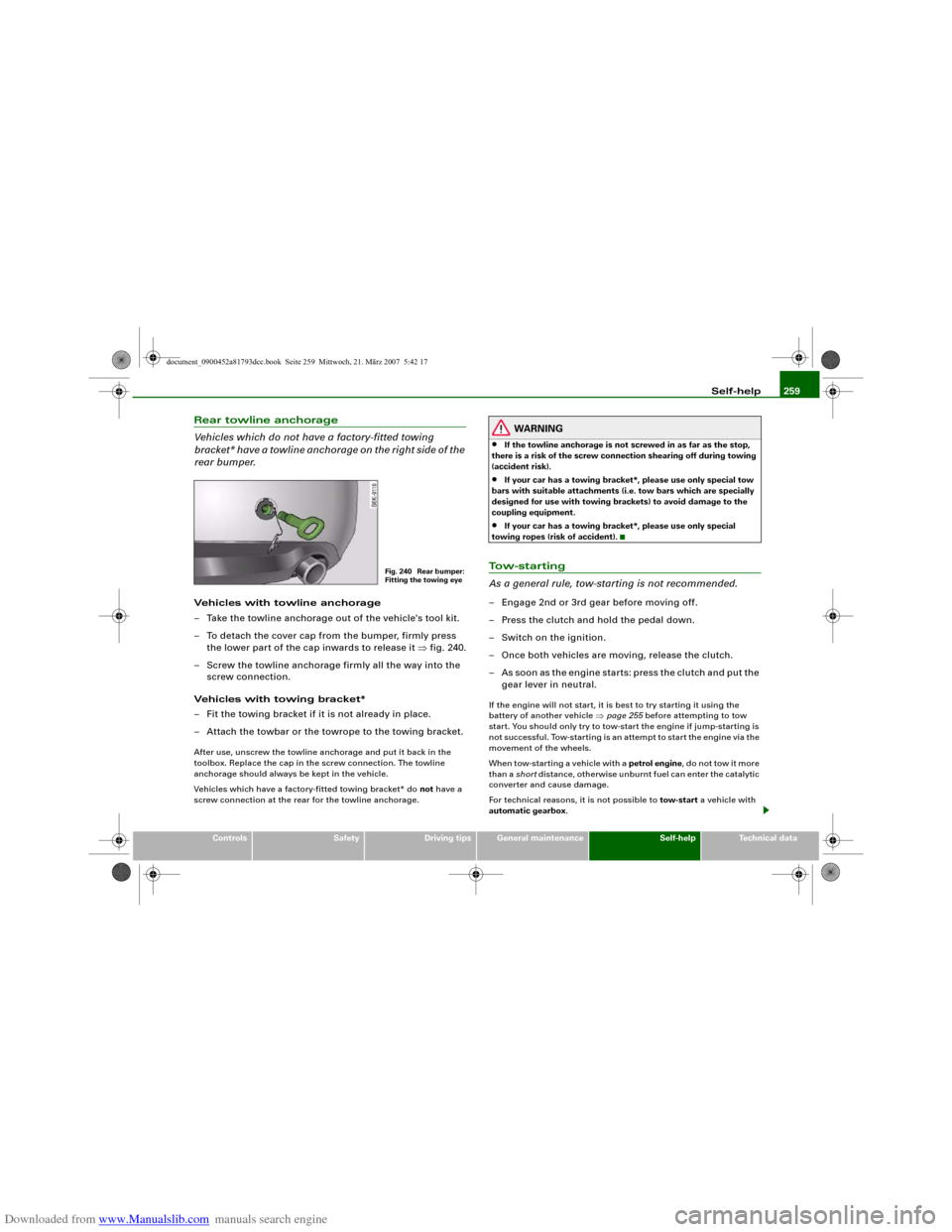
Vehicles which do not have a factory-fitted towing
bracket* have a towline anchorage on the right side of the
rear bumper.Vehicles with towline anchorage
– Take the towline anchorage out of the vehicle's tool kit.
– To detach the cover cap from the bumper, firmly press
the lower part of the cap inwards to release it ⇒fig. 240.
– Screw the towline anchorage firmly all the way into the
screw connection.
Vehicles with towing bracket*
– Fit the towing bracket if it is not already in place.
– Attach the towbar or the towrope to the towing bracket.After use, unscrew the towline anchorage and put it back in the
toolbox. Replace the cap in the screw connection. The towline
anchorage should always be kept in the vehicle.
Vehicles which have a factory-fitted towing bracket* do not have a
screw connection at the rear for the towline anchorage.
WARNING
•
If the towline anchorage is not screwed in as far as the stop,
there is a risk of the screw connection shearing off during towing
(accident risk).
•
If your car has a towing bracket*, please use only special tow
bars with suitable attachments (i.e. tow bars which are specially
designed for use with towing brackets) to avoid damage to the
coupling equipment.
•
If your car has a towing bracket*, please use only special
towing ropes (risk of accident).
To w - s t a r t i n g
As a general rule, tow-starting is not recommended.– Engage 2nd or 3rd gear before moving off.
– Press the clutch and hold the pedal down.
– Switch on the ignition.
– Once both vehicles are moving, release the clutch.
– As soon as the engine starts: press the clutch and put the
gear lever in neutral.If the engine will not start, it is best to try starting it using the
battery of another vehicle ⇒page 255 before attempting to tow
start. You should only try to tow-start the engine if jump-starting is
not successful. Tow-starting is an attempt to start the engine via the
movement of the wheels.
When tow-starting a vehicle with a petrol engine, do not tow it more
than a short distance, otherwise unburnt fuel can enter the catalytic
converter and cause damage.
For technical reasons, it is not possible to tow-start a vehicle with
automatic gearbox.
Fig. 240 Rear bumper:
Fitting the towing eye
document_0900452a81793dcc.book Seite 259 Mittwoch, 21. März 2007 5:42 17
Page 262 of 294
Downloaded from www.Manualslib.com manuals search engine Self-help 260
WARNING
There is a high risk of accidents when tow-starting, as the towed
vehicle can easily be driven into the towing vehicle.
Caution
When tow-starting the vehicle, do not tow it further than 50 metres:
otherwise the catalytic converter could be damaged.Towing a vehicle with manual gearbox and four-wheel drive
Certain restrictions must be observed when towing your
vehicle.Please observe the notes ⇒page 257.
The vehicle can be towed with a towbar or towrope in the normal
way, with all four wheels on the ground. It can also be towed by a
breakdown truck, with the wheels lifted at either the front or rear.
When doing so, please note the following points:•
The vehicle must not be towed faster than 50 km/h.
•
The vehicle must not be towed further than 50 km.Note
If it is not possible to tow the vehicle as described above, or if it has
to be towed further than 50 km, it must be transported on a special
car transporter or trailer.
Towing a vehicle with automatic gearbox and four-wheel drive
Certain restrictions must be observed when towing your
vehicle.Please observe the notes ⇒page 257.
The vehicle can be towed with a towbar or towrope in the normal
way, with all four wheels on the ground. When doing so, please note
the following points:•
Release the parking brake ⇒page 119.
•
Make sure the selector lever is in the N position.
•
The vehicle must not be towed faster than 50 km/h.
•
The vehicle must not be towed further than 50 km. The reason
for this is: when the engine is not running, the gearbox oil pump
does not work and the gearbox is not adequately lubricated for
higher speeds or longer distances.
The vehicle must not be towed with the wheels lifted at either the
front or rear.Note
If it is not possible to tow the vehicle as described above, or if it has
to be towed further than 50 km, it must be transported on a special
car transporter or trailer.
document_0900452a81793dcc.book Seite 260 Mittwoch, 21. März 2007 5:42 17
Page 280 of 294
Downloaded from www.Manualslib.com manuals search engine General notes 278General notesExplanation of technical dataWhere not otherwise indicated or separately listed, all technical
data apply to vehicles with standard equipment for the German
market. Other figures may apply for special versions and export
models.
Please note that the details listed in the vehicle's registration docu-
ments can be taken as correct.
Engine data
The figures for engine power output are determined according to
EU standards.
Performance figures
The performance figures were measured without equipment which
may influence performance, such as mudflaps or extremely wide-
section tyres.
Kerb weight (unladen weight)
These figures (kerb weight according to the currently applicable
version of EU Directive 92/21/EEC) apply to the vehicle with the tank
90% full, with no special equipment. The figures include an addi-
tional 75 kg to allow for the weight of the driver.
When towing a trailer, the gross vehicle weight may be exceeded by
up to 30 kg and the maximum rear axle weight may be exceeded by
up to 80 kg.
Maximum trailer weights
The maximum trailer weights are calculated in accordance with the
currently applicable version of EU Directive 92/21/EEC.
The figures for a trailer with brakes, on gradients up to 8% are appli-
cable only up to a maximum speed of 80 km/h (even though higher
speeds may be permitted when towing a trailer in some countries).The figures for a trailer with brakes on gradients up to 12% and for
the weight of car and trailer on gradients up to 12% are applicable
up to a maximum speed of 100 km/h. This maximum speed must not
be exceeded even in countries where higher speeds are permitted.
Maximum draw bar loading
The vertical load exerted by the trailer drawbar on the ball joint of
the towing bracket must not exceed 80 kg.
In the interest of safety, we recommend applying the maximum
permitted draw bar weight. The stability of the trailer could be
adversely affected if too little weight is applied.
If the maximum permitted drawbar weight cannot be obtained, e.g.
when using small or light trailers, statutory regulations require that
the drawbar weight be at least 4% of the actual trailer weight (for
single-axle trailers or twin-axle trailers with an axle spacing less
than 1.0 m).
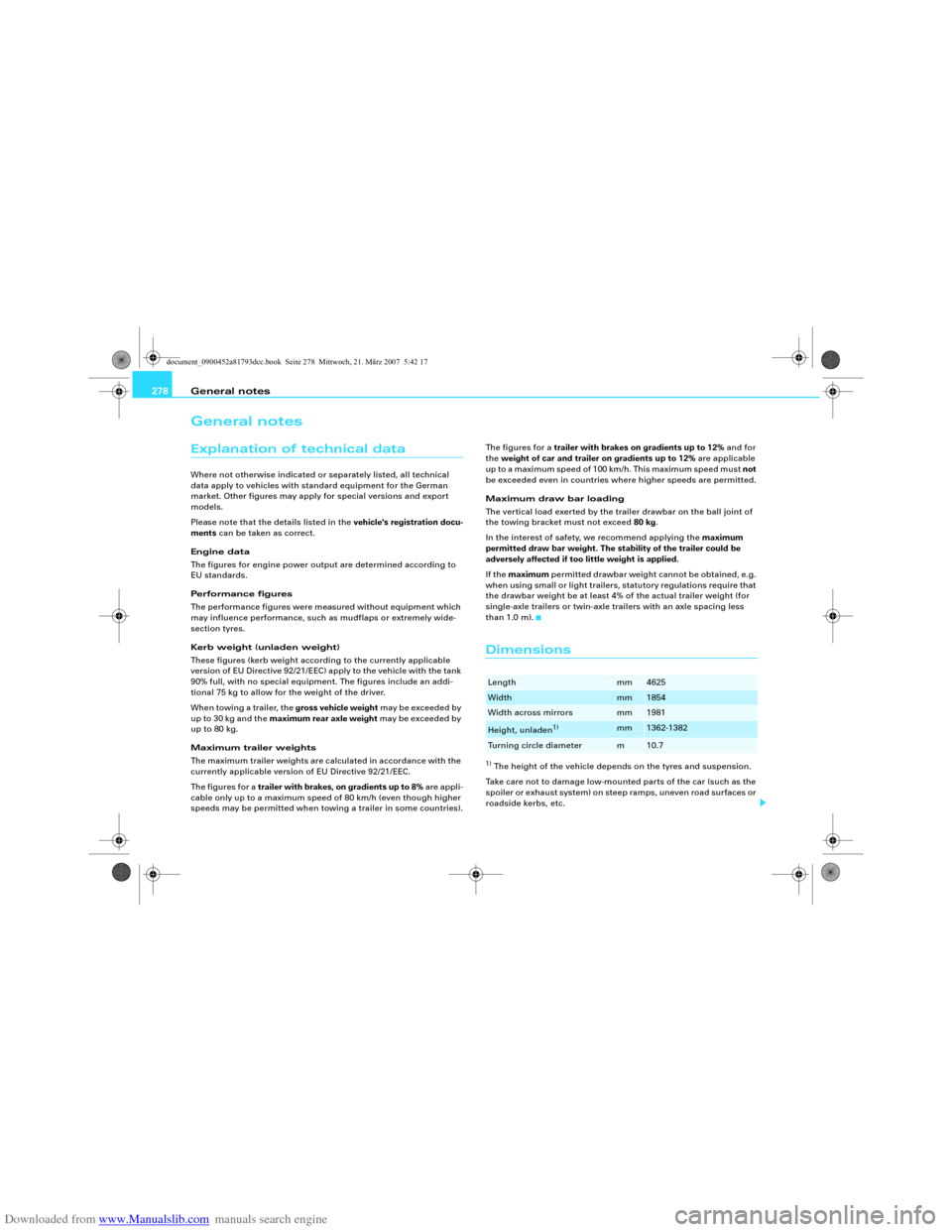
Dimensions1) The height of the vehicle depends on the tyres and suspension.
Take care not to damage low-mounted parts of the car (such as the
spoiler or exhaust system) on steep ramps, uneven road surfaces or
roadside kerbs, etc.Length
mm
4625
Width
mm
1854
Width across mirrors
mm
1981
Height, unladen
1)
mm
1362-1382
Turning circle diameter
m
10.7
document_0900452a81793dcc.book Seite 278 Mittwoch, 21. März 2007 5:42 17
Page 283 of 294
Downloaded from www.Manualslib.com manuals search engine Performance, weights and dimensions281
Controls
Safety
Driving tips
General maintenance
Self-help
Technical data
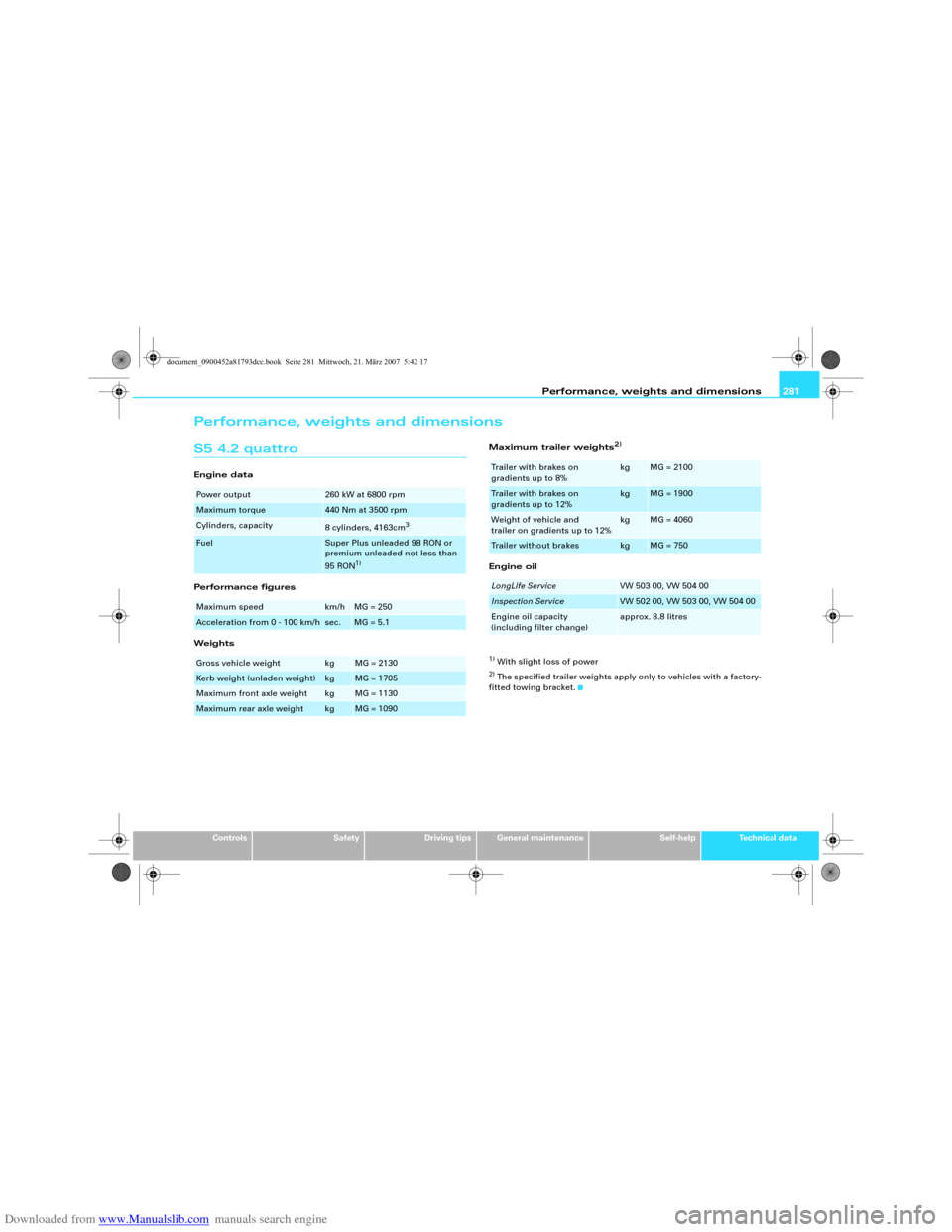
Performance, weights and dimensionsS5 4.2 quattroEngine data
Performance figures
WeightsMaximum trailer weights
2)
Engine oil1) With slight loss of power2) The specified trailer weights apply only to vehicles with a factory-
fitted towing bracket.
Power output
260 kW at 6800 rpm
Maximum torque
440 Nm at 3500 rpm
Cylinders, capacity
8 cylinders, 4163cm
3
Fuel
Super Plus unleaded 98 RON or
premium unleaded not less than
95 RON
1)
Maximum speed
km/h
MG = 250
Acceleration from 0 - 100 km/h
sec.
MG = 5.1
Gross vehicle weight
kg
MG = 2130
Kerb weight (unladen weight)
kg
MG = 1705
Maximum front axle weight
kg
MG = 1130
Maximum rear axle weight
kg
MG = 1090
Trailer with brakes on
gradients up to 8%
kg
MG = 2100
Trailer with brakes on
gradients up to 12%
kg
MG = 1900
Weight of vehicle and
trailer on gradients up to 12%
kg
MG = 4060
Trailer without brakes
kg
MG = 750
LongLife Service
VW 503 00, VW 504 00
Inspection Service
VW 502 00, VW 503 00, VW 504 00
Engine oil capacity
(including filter change)
approx. 8.8 litres
document_0900452a81793dcc.book Seite 281 Mittwoch, 21. März 2007 5:42 17
Page 288 of 294
Downloaded from www.Manualslib.com manuals search engine Index 286Cruise control system
Adjusting speed . . . . . . . . . . . . . . . . . 125
Control lever on steering wheel . . . . 123
Cruise mode . . . . . . . . . . . . . . . . . . . . 124
Indicator lamp . . . . . . . . . . . . . . . . . . . . 17
Introduction . . . . . . . . . . . . . . . . . . . . . 123
Pre-selecting a speed . . . . . . . . . . . . . 126
Resuming cruise control . . . . . . . . . . 126
Safety notes . . . . . . . . . . . . . . . . . . . . . 123
Switching off . . . . . . . . . . . . . . . . . . . . 127
Switching off temporarily . . . . . . . . . 126
Cup holders . . . . . . . . . . . . . . . . . . . . . . . . . 83
Current fuel consumption . . . . . . . . . . . . . 25DDate display . . . . . . . . . . . . . . . . . . . . . . . . 13
Daytime running lights . . . . . . . . . . . . . . . 56
Deactivating front passenger's airbag . . 173
Deadlock mechanism . . . . . . . . . . . . . . 42, 45
Defrosting windows . . . . . . . . . . . . . . 96, 104
Deluxe automatic air conditioner . . . . . . . 91
Air distribution . . . . . . . . . . . . . . . . . . . 95
Air outlets . . . . . . . . . . . . . . . . . . . . . . . 97
Air outlets for rear passengers . . . . . . 97
Air recirculation mode . . . . . . . . . . . . . 95
Automatic mode . . . . . . . . . . . . . . . . . . 93
Basic settings . . . . . . . . . . . . . . . . . . . . 98
Blower . . . . . . . . . . . . . . . . . . . . . . . . . . 94
Controls . . . . . . . . . . . . . . . . . . . . . . . . . 92
Defrosting . . . . . . . . . . . . . . . . . . . . . . . 96
Description . . . . . . . . . . . . . . . . . . . . . . 91
Economical operation . . . . . . . . . . . . . 98Heated rear window . . . . . . . . . . . . . . . 96
Seat heating, front . . . . . . . . . . . . . . . 112
Switching on and off . . . . . . . . . . . . . . 93
Temperature . . . . . . . . . . . . . . . . . . . . . 94
Deluxe automatic air conditioner plus . . . 99
AC mode . . . . . . . . . . . . . . . . . . . . . . . . 105
Air distribution . . . . . . . . . . . . . . . . . . 104
Air outlets . . . . . . . . . . . . . . . . . . . . . . . 105
Air outlets for rear passengers . . . . . 106
Air recirculation mode . . . . . . . . . . . . 103
Automatic mode . . . . . . . . . . . . . . . . . 101
Automatic recirculation . . . . . . . . . . . 107
Auxiliary heating . . . . . . . . . . . . . . . . . 108
Auxiliary heating - remote control . . 111
Auxiliary heating - running time . . . . 111
Basic settings . . . . . . . . . . . . . . . . . . . 107
Blower . . . . . . . . . . . . . . . . . . . . . . . . . 102
Controls . . . . . . . . . . . . . . . . . . . . . . . . 100
Defrosting . . . . . . . . . . . . . . . . . . . . . . 104
Description . . . . . . . . . . . . . . . . . . . . . . . 99
Economical operation . . . . . . . . . . . . . 106
Heated rear window . . . . . . . . . . . . . . 104
Switching on and off . . . . . . . . . . . . . 101
Synchronisation . . . . . . . . . . . . . . . . . 108
Temperature . . . . . . . . . . . . . . . . . . . . 102
Digital clock . . . . . . . . . . . . . . . . . . . . . . . . . 13
Digital compass . . . . . . . . . . . . . . . . . . . . . 68
Digital speedometer . . . . . . . . . . . . . . . . . . 22
Dimensions . . . . . . . . . . . . . . . . . . . . . . . . 278
Dipped headlights . . . . . . . . . . . . . . . . . . . 54
Defective . . . . . . . . . . . . . . . . . . . . . . . . 36
DIS
SeeDriver information system . . . . . . 20Door catches/boot lid warning . . . . . . . . . 23
Doors
Manual locking . . . . . . . . . . . . . . . . . . . 47
Driver
SeeSitting position . . . . . . . . . . . . . . . 154
Driver information system . . . . . . . . . . . . . 20
Auto-check control . . . . . . . . . . . . . . . . 29
Bulb monitor . . . . . . . . . . . . . . . . . . . . . 36
CD and radio display . . . . . . . . . . . . . . . 21
Digital speedometer . . . . . . . . . . . . . . . 22
Door catches/boot lid warning . . . . . . 23
Driver messages . . . . . . . . . . . . . . . . . . 30
On-board computer . . . . . . . . . . . . . . . . 25
Outside temperature display . . . . . . . . 21
Red symbols . . . . . . . . . . . . . . . . . . . . . 30
Service interval display . . . . . . . . . . . . . 23
Speed warning . . . . . . . . . . . . . . . . . . . . 28
Yellow symbols . . . . . . . . . . . . . . . . . . . 34
Driver messages . . . . . . . . . . . . . . . . . . . . . 30
Driving abroad . . . . . . . . . . . . . . . . . . . . . 195
Headlights . . . . . . . . . . . . . . . . . . . . . . 195
Unleaded fuel . . . . . . . . . . . . . . . . . . . 195
Driving away from a standstill . . . . . . . . 120
Driving away when towing a trailer . . . . 121
Driving safety . . . . . . . . . . . . . . . . . . . . . . 153
Driving time . . . . . . . . . . . . . . . . . . . . . . . . . 25
Dust filter
Deluxe automatic air conditioner . . . . 91
Deluxe automatic air conditioner plus 99
DVD player . . . . . . . . . . . . . . . . . . . . . . . . . . 77
document_0900452a81793dcc.book Seite 286 Mittwoch, 21. März 2007 5:42 17
Page 289 of 294
Downloaded from www.Manualslib.com manuals search engine Index287
Controls
Safety
Driving tips
General maintenance
Self-help
Technical data
EEasy-entry function . . . . . . . . . . . . . . . . . . . 71
Economical driving . . . . . . . . . . . . . . . . . . 196
EDL
SeeElectronic differential lock . . . . . . . 17
Electric seat adjustment
SeeSeat adjustment . . . . . . . . . . . . . . . 70
Electric windows . . . . . . . . . . . . . . . . . . . . . 49
Central locking system . . . . . . . . . . . . . 50
Controls . . . . . . . . . . . . . . . . . . . . . . . . . 49
Convenience open/close function . . . . 50
Malfunctions . . . . . . . . . . . . . . . . . . . . . 51
Settings . . . . . . . . . . . . . . . . . . . . . . . . . 51
Electrical accessories
SeeElectrical socket . . . . . . . . . . . . . . . 86
Electrical socket . . . . . . . . . . . . . . . . . . 85, 86
Electro-mechanical parking brake . . . . . . 122
Auto release function . . . . . . . . . . . . . 120
Driving away from a standstill . . . . . . 120
Driving away when towing a trailer . . 121
Emergency braking function . . . . . . . 121
Malfunction . . . . . . . . . . . . . . . . . . . . . 121
Operation . . . . . . . . . . . . . . . . . . . . . . . 119
Parking . . . . . . . . . . . . . . . . . . . . . . . . . 120
Releasing and applying . . . . . . . . . . . 119
Warning lamp . . . . . . . . . . . . . . . . . . . . 18
Electronic differential lock
How the system works . . . . . . . . . . . . 189
Warning lamp . . . . . . . . . . . . . . . . . . . . 17
Electronic immobiliser . . . . . . . . . . . . . . . . 14Electronic stabilisation program
How the system works . . . . . . . . . . . . 186
Warning lamp . . . . . . . . . . . . . . . . . . . . . 16
Emergency braking function . . . . . . . . . . 121
Emergency key . . . . . . . . . . . . . . . . . . . . . . 40
Emergency release
Ignition key . . . . . . . . . . . . . . . . . . . . . . . 41
Emission control systems
Catalytic converter . . . . . . . . . . . . . . . . 195
Emissions . . . . . . . . . . . . . . . . . . . . . . . . . . 279
Engine compartment
Safety notes . . . . . . . . . . . . . . . . . . . . . 221
Engine compartment layout . . . . . . . . . . 222
Engine data
SeePerformance, weights and
dimensions . . . . . . . . . . . . . . . . . . . . 281
Engine hood
SeeBonnet . . . . . . . . . . . . . . . . . . . . . . 220
Engine management
(EPC) warning lamp . . . . . . . . . . . . . . . . 15
Engine oil . . . . . . . . . . . . . . . . . . . . . . . . . . 222
Checking oil level . . . . . . . . . . . . . . . . . 223
Consumption . . . . . . . . . . . . . . . . . . . . 223
LongLife Service . . . . . . . . . . . . . . . . . . 222
Topping up . . . . . . . . . . . . . . . . . . . . . . 224
See alsoPerformance, weights and
dimensions . . . . . . . . . . . . . . . . . . . . 281
Engine oil capacity
SeePerformance, weights and
dimensions . . . . . . . . . . . . . . . . . . . . 281
Engine oil pressure
Warning lamp . . . . . . . . . . . . . . . . . . . . . 33Engine oil sensor
Malfunction . . . . . . . . . . . . . . . . . . . . . . 37
Environmental compatibility . . . . . . . . . . 197
Environmental tips
Filling the tank . . . . . . . . . . . . . . . . . . . 217
Heated rear window . . . . . . . . . . . 96, 104
Leaks . . . . . . . . . . . . . . . . . . . . . . . . . . . 221
Roof carrier . . . . . . . . . . . . . . . . . . . . . . . 83
EPC
SeeEngine management . . . . . . . . . . . 15
ESP
SeeElectronic stabilisation program . . 16
Ethanol fuel . . . . . . . . . . . . . . . . . . . . . . . . 217
Exterior mirrors . . . . . . . . . . . . . . . . . . . . . . 66
FFastening rings . . . . . . . . . . . . . . . . . . 76, 159
Filling the tank . . . . . . . . . . . . . . . . . . . . . . 217
Releasing the tank flap manually . . . . 219
Fire extinguisher . . . . . . . . . . . . . . . . . . . . 245
First-aid kit . . . . . . . . . . . . . . . . . . . . . . . . . 244
Floor mats . . . . . . . . . . . . . . . . . . . . . 157, 158
Fog lights . . . . . . . . . . . . . . . . . . . . . . . . . . . 55
Foreign countries
SeeDriving abroad . . . . . . . . . . . . . . . . 195
Four-wheel drive . . . . . . . . . . . . . . . . . . . . 191
Front passenger
SeeSitting position . . . . . . . . . . . . . . . 155
Fuel
Capacity . . . . . . . . . . . . . . . . . . . . . . . . 279
Consumption . . . . . . . . . . . . . . . . . . . . 279
Current fuel consumption . . . . . . . . . . . 25
document_0900452a81793dcc.book Seite 287 Mittwoch, 21. März 2007 5:42 17