2008 AUDI S5 airbag
[x] Cancel search: airbagPage 176 of 294
Downloaded from www.Manualslib.com manuals search engine Airbag system 174
– The front passenger's airbag can be reactivated by
turning the key to position .Deactivating front passenger's airbag when a child
safety seat is in use
If you have no alternative but to install a rearward-facing child safety
seat on the front passenger's seat you must deactivate the front
passenger's airbag beforehand.
We recommend, however, that child seats should be only fitted on
the rear seat so that the front passenger's airbag can remain func-
tional and provide protection in an accident ⇒page 175.
Monitoring of airbag system
The airbag warning lamp will light up for a few seconds every time
the ignition is switched on.
If the front passenger's airbag has been deactivated via the key-
operated switch, the indicator lamp “PASSENGER AIRBAG OFF” will
light up constantly as a reminder ⇒fig. 185. Please refer also to the
description of the
warning lamp in the instrument cluster
⇒page 16.
When the front passenger's airbag is deactivated using the key-
operated switch, the seat belt warning lamp for the front passenger
⇒page 17 is also switched off.
WARNING
•
If you have no alternative but to install a rearward-facing child
seat on the front passenger's seat, the front passenger's airbag
must be deactivated beforehand. Potentially fatal injuries to the
child can result if the front passenger's airbag is not deactvated!
⇒page 176, “Using a child safety seat on the front passenger's
seat”
•
If you have deactivated the front passenger's airbag, reactivate
it as soon as the child seat is no longer needed so that the airbag
can continue to give the required protection.
•
It is the driver's responsibility to ensure that the key-operated
switch is set to the correct position.Note
All the other airbags in the car will remain functional if the front
passenger's airbag has been deactivated with the key-operated
switch.
AON
WARNING (continued)
document_0900452a81793dcc.book Seite 174 Mittwoch, 21. März 2007 5:42 17
Page 178 of 294
Downloaded from www.Manualslib.com manuals search engine Child safety 176•
If children lean forward or are otherwise out of position when
the car is moving, they are at greater risk of injury in an accident.
This is particularly the case if the child is travelling on the front
passenger's seat and the airbag system is triggered in an accident.
There is then a risk of serious or potentially fatal injury.
•
To ensure proper protection, it is important to wear the seat
belts in the correct position ⇒page 163, “How to wear seat belts
properly”. Always check that the belt is properly positioned
according to the instructions provided by the manufacturer of the
child safety seat. Incorrectly worn seat belts can give rise to inju-
ries even in a minor collision.
•
Never install a rearward-facing child safety seat on the front
passenger's seat if the front passenger's airbag has not been deac-
tivated ⇒page 176.
•
Extra caution is advised if you are installing a child safety seat
using the same mounting bolts as the existing car seat belts. The
bolts must be screwed in all the way to the full depth of the
mounting holes and tightened to a torque of 50 Nm. Failure to
observe this precaution could result in potentially fatal injury. We
recommend having the installation performed by a qualified
workshop.
Using a child safety seat on the front passenger's seat
Whenever possible, child safety seats should always be
installed on the rear seat.For safety reasons, we recommend that child safety seats should be
installed on the rear seats whenever possible. However, if you have
to use a child seat on the front passenger's seat when there is no
other alternative, it is most important to note the following warn-
ings:
WARNING
•
Do not use a rearward-facing child safety seat on the front
passenger's seat unless the front passenger's airbag has been
deactivated. The child seat would be directly in the path of the
airbag as it inflates, and the child could sustain serious or fatal
injuries if the airbag were to be deployed.
•
However, if you have no alternative but to use a rearward-
facing child seat on the front passenger's seat, the front
passenger's airbag must be deactivated beforehand by means of
the key-operated switch* ⇒page 173. Failure to observe this
precaution could result in serious or potentially fatal injury.
•
Make sure that the front passenger's airbag is reactivated by
means of the key-operated switch* as soon as the child seat is no
longer needed on the front passenger's seat.
•
When using a child safety seat of the type which faces in the
direction of travel, the front passenger's seat must be moved back
to the rearmost position.
Child safety seatsChild seat categories
Only use child restraint systems that are officially
approved and suitable for the child.Child restraint systems are covered by the European standard
ECE R 44 (issued by the Economic Commission of Europe).
The child seats are divided into 5 categories:
WARNING (continued)
document_0900452a81793dcc.book Seite 176 Mittwoch, 21. März 2007 5:42 17
Page 179 of 294
Downloaded from www.Manualslib.com manuals search engine Child safety177
Controls
Safety
Driving tips
General maintenance
Self-help
Technical data Children who are taller than 1.5 metres can use the existing seat
belts without a booster cushion.
Child restraints that have been tested and approved under the ECE
R 44 standard bear the ECE-R 44 test mark on the seat (the letter E
in a circle with the test number below it).
Child safety seat: category 0 / 0+
A suitable child safety seat and a correctly worn seat belt
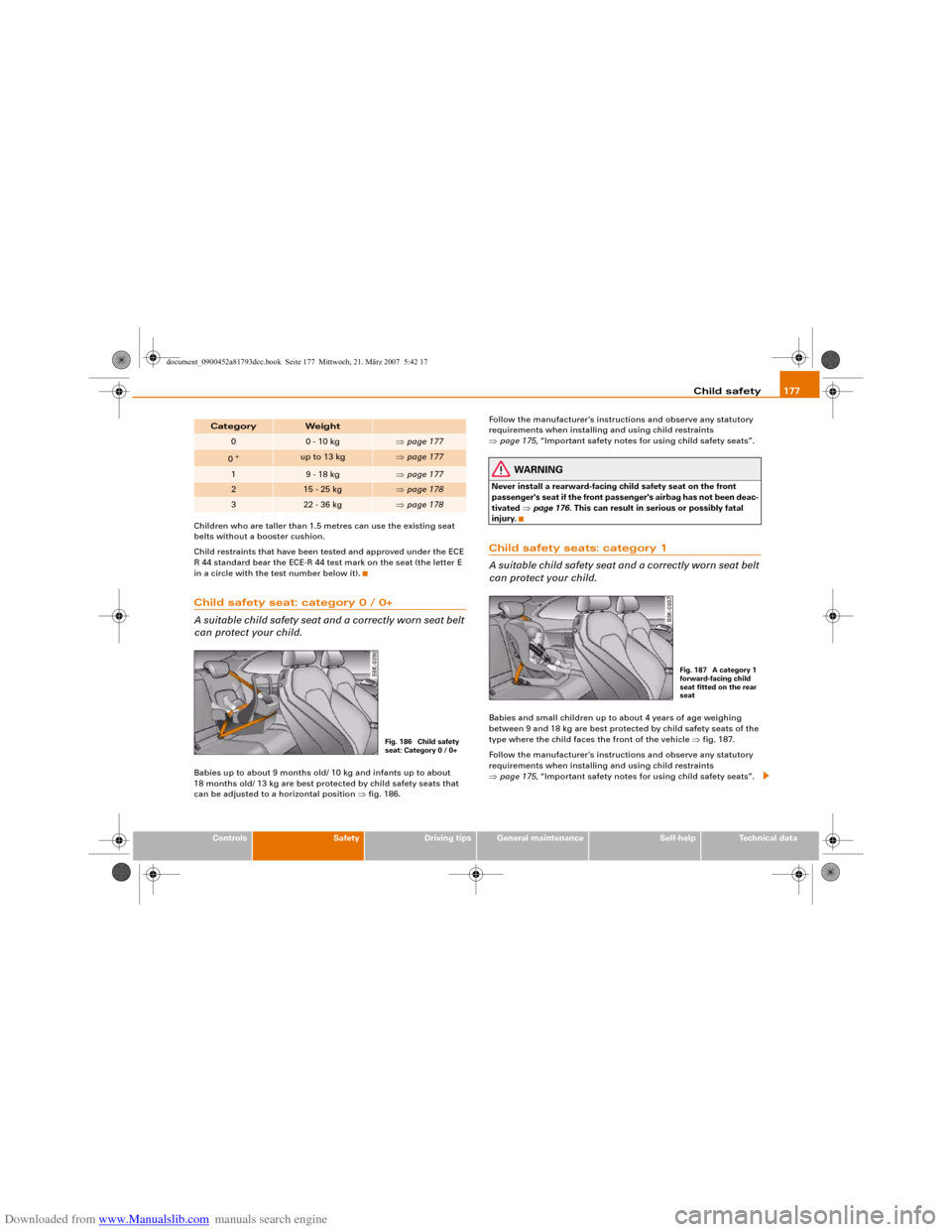
can protect your child.Babies up to about 9 months old/ 10 kg and infants up to about
18 months old/ 13 kg are best protected by child safety seats that
can be adjusted to a horizontal position ⇒fig. 186.Follow the manufacturer's instructions and observe any statutory
requirements when installing and using child restraints
⇒page 175, “Important safety notes for using child safety seats”.
WARNING
Never install a rearward-facing child safety seat on the front
passenger's seat if the front passenger's airbag has not been deac-
tivated ⇒page 176. This can result in serious or possibly fatal
injury.Child safety seats: category 1
A suitable child safety seat and a correctly worn seat belt
can protect your child.Babies and small children up to about 4 years of age weighing
between 9 and 18 kg are best protected by child safety seats of the
type where the child faces the front of the vehicle ⇒fig. 187.
Follow the manufacturer's instructions and observe any statutory
requirements when installing and using child restraints
⇒page 175, “Important safety notes for using child safety seats”.
Category
Weight
0
0 - 10 kg
⇒page 177
0 +
up to 13 kg
⇒page 177
1
9 - 18 kg
⇒page 177
2
15 - 25 kg
⇒page 178
3
22 - 36 kg
⇒page 178Fig. 186 Child safety
seat: Category 0 / 0+
Fig. 187 A category 1
forward-facing child
seat fitted on the rear
seat
document_0900452a81793dcc.book Seite 177 Mittwoch, 21. März 2007 5:42 17
Page 180 of 294
Downloaded from www.Manualslib.com manuals search engine Child safety 178
WARNING
Never install a rearward-facing child safety seat on the front
passenger's seat if the front passenger's airbag has not been deac-
tivated ⇒page 176. This can result in serious or possibly fatal
injury.Child safety seats: category 2/3
A suitable child safety seat and a correctly worn seat belt
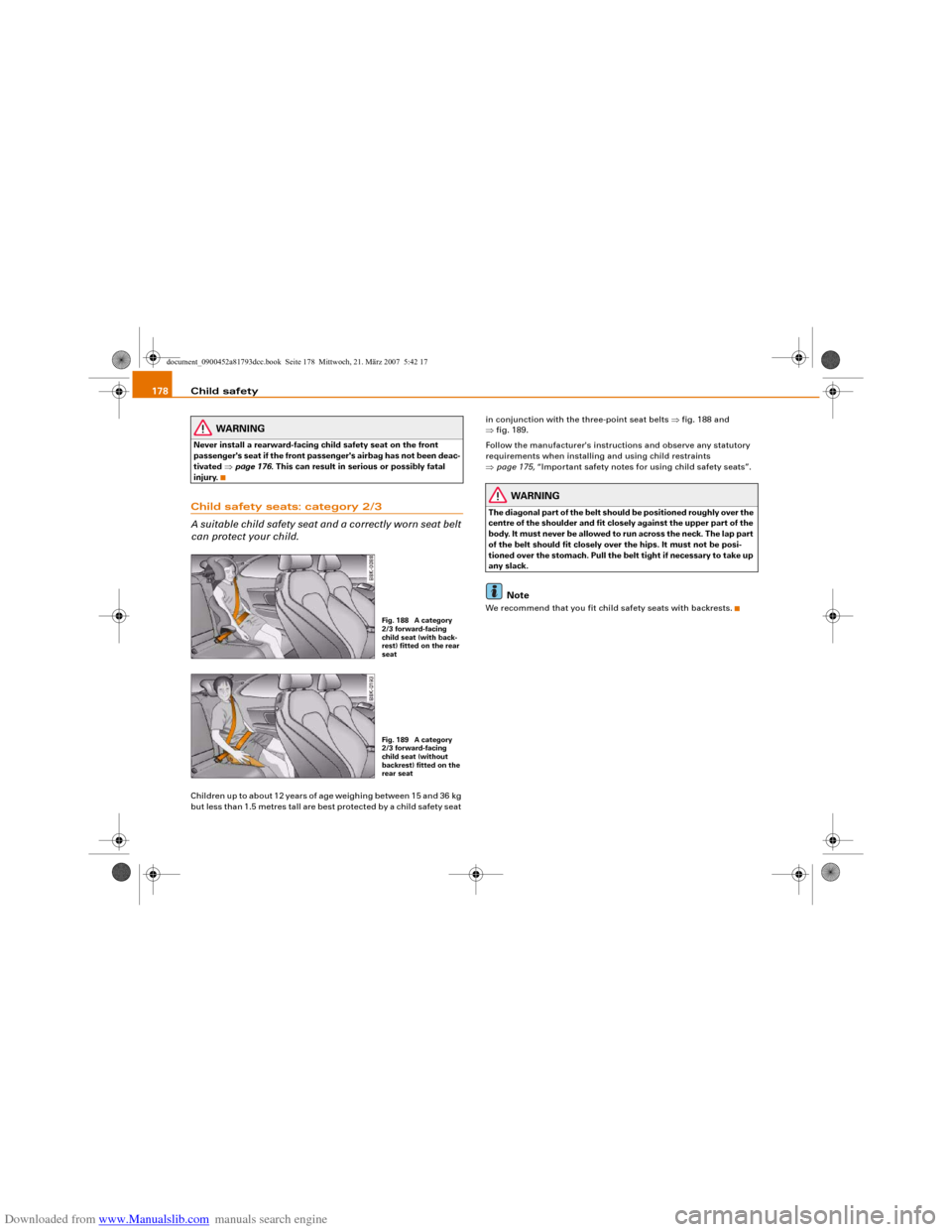
can protect your child.Children up to about 12 years of age weighing between 15 and 36 kg
but less than 1.5 metres tall are best protected by a child safety seat in conjunction with the three-point seat belts ⇒fig. 188 and
⇒fig. 189.
Follow the manufacturer's instructions and observe any statutory
requirements when installing and using child restraints
⇒page 175, “Important safety notes for using child safety seats”.
WARNING
The diagonal part of the belt should be positioned roughly over the
centre of the shoulder and fit closely against the upper part of the
body. It must never be allowed to run across the neck. The lap part
of the belt should fit closely over the hips. It must not be posi-
tioned over the stomach. Pull the belt tight if necessary to take up
any slack.
Note
We recommend that you fit child safety seats with backrests.
Fig. 188 A category
2/3 forward-facing
child seat (with back-
rest) fitted on the rear
seatFig. 189 A category
2/3 forward-facing
child seat (without
backrest) fitted on the
rear seat
document_0900452a81793dcc.book Seite 178 Mittwoch, 21. März 2007 5:42 17
Page 183 of 294
Downloaded from www.Manualslib.com manuals search engine Child safety181
Controls
Safety
Driving tips
General maintenance
Self-help
Technical data
Possible alternatives for securing a child safety seat
A child safety seat can be secured on the rear seats and
on the front passenger's seat.The following alternatives are available for safely securing a child
safety seat on the rear seats and on the front passenger's seat.•
Child safety seats of the categories 0 to 3 can be secured with the
standard three-point seat belts.
•
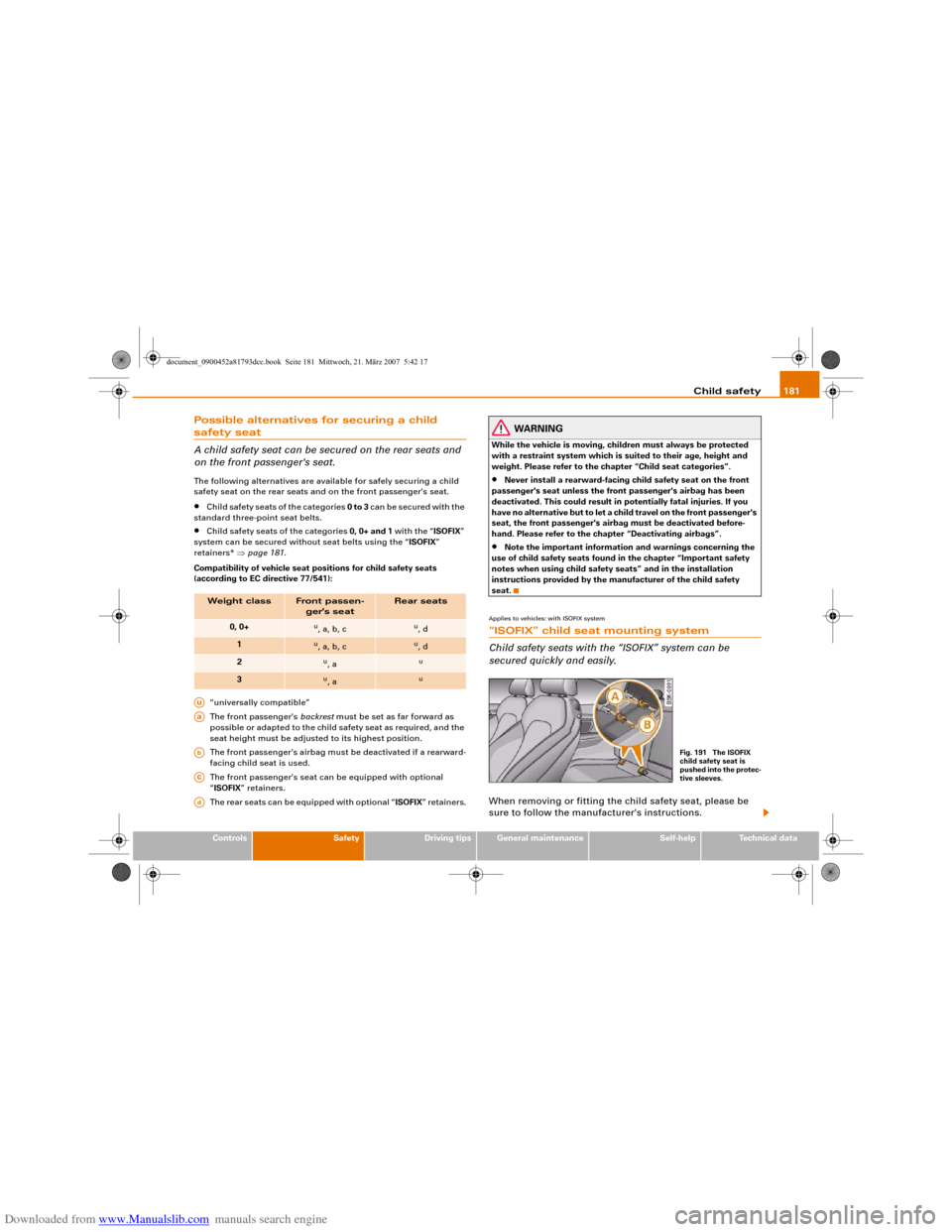
Child safety seats of the categories 0, 0+ and 1 with the “ISOFIX”
system can be secured without seat belts using the “ISOFIX”
retainers* ⇒page 181.
Compatibility of vehicle seat positions for child safety seats
(according to EC directive 77/541):
“universally compatible”
The front passenger's backrest must be set as far forward as
possible or adapted to the child safety seat as required, and the
seat height must be adjusted to its highest position.
The front passenger's airbag must be deactivated if a rearward-
facing child seat is used.
The front passenger's seat can be equipped with optional
“ISOFIX” retainers.
The rear seats can be equipped with optional “ISOFIX” retainers.
WARNING
While the vehicle is moving, children must always be protected
with a restraint system which is suited to their age, height and
weight. Please refer to the chapter “Child seat categories”.•
Never install a rearward-facing child safety seat on the front
passenger's seat unless the front passenger's airbag has been
deactivated. This could result in potentially fatal injuries. If you
have no alternative but to let a child travel on the front passenger's
seat, the front passenger's airbag must be deactivated before-
hand. Please refer to the chapter “Deactivating airbags”.
•
Note the important information and warnings concerning the
use of child safety seats found in the chapter “Important safety
notes when using child safety seats” and in the installation
instructions provided by the manufacturer of the child safety
seat.
Applies to vehicles: with ISOFIX system“ISOFIX” child seat mounting system
Child safety seats with the “ISOFIX” system can be
secured quickly and easily.When removing or fitting the child safety seat, please be
sure to follow the manufacturer's instructions.
Weight class
Front passen-
ger's seat
Rear seats
0, 0+
u, a, b, c
u, d
1
u, a, b, c
u, d
2
u, a
u
3
u, a
u
AuAaAbAcAd
Fig. 191 The ISOFIX
child safety seat is
pushed into the protec-
tive sleeves.
document_0900452a81793dcc.book Seite 181 Mittwoch, 21. März 2007 5:42 17
Page 230 of 294
Downloaded from www.Manualslib.com manuals search engine Checking and topping up fluids 228
For the sake of the environmentIf the fluid has to be drained out of the brake system, use an appro-
priate container to catch the used brake fluid and dispose of it in the
proper manner.BatteryGeneral notes
All work on batteries requires specialist knowledge.The battery is virtually maintenance-free. It is checked as part of the
Inspection Service.
We recommend that you replace a battery once it is older than 5
years.
When an airbag is triggered, the battery will, under certain circum-
stances, be disconnected from the on-board power supply for
safety reasons ⇒ in “General notes on airbag system” on
page 166.
Disconnecting the battery
If the battery is disconnected, some of the vehicle's functions will
become inoperative (e.g. electric windows). These functions will
require resetting after the battery is reconnected. For this reason,
the battery should only be disconnected from the vehicle's electrical
system when absolutely necessary.
If the vehicle is not used for long periods
If you do not drive your vehicle for a period of several days or weeks,
the power management will gradually shut off the on-board
systems one by one, or reduce the amount of current they are using.
This limits the amount of power consumed and helps to ensure reli-
able starting even after a long period ⇒page 192.Please note that certain convenience features, such as the Audi
advanced key*, the remote control key or the electrical seat adjust-
ment may not be available when you unlock the vehicle. These func-
tions will be restored when you switch on the ignition and start the
engine.
Winter conditions
At low temperatures the battery has to work very hard. It also
provides only a fraction of the starting power it has at normal
temperatures.
For this reason, we recommend having the battery checked and
charged if necessary before the start of winter ⇒page 230.
WARNING
•
All work on batteries requires specialist knowledge. For queries
regarding the vehicle battery please contact an Audi dealership or
other qualified workshop (risk of chemical burns / risk of explo-
sion).
•
The battery must not be opened. Do not attempt to make any
changes to the electrolyte level of the battery. Otherwise, there is
a risk that a mixture of oxygen and hydrogen gas can accumulate
and cause an explosion.Note
If the vehicle is to be left standing for a period of several weeks at
extremely low temperatures, the battery should be removed from
the vehicle. This ensures that it cannot “freeze up” and be
damaged.
document_0900452a81793dcc.book Seite 228 Mittwoch, 21. März 2007 5:42 17
Page 241 of 294
Downloaded from www.Manualslib.com manuals search engine Accessories and modifications to the vehicle239
Controls
Safety
Driving tips
General maintenance
Self-help
Technical data
Accessories and modifications to the vehicleAccessories and replacement partsAlways ask your dealer or specialist retailer for advice
before purchasing accessories and replacement parts.Your car is designed to offer a high standard of active and passive
safety. For this reason, we recommend that you ask an Audi dealer
for advice before fitting accessories or replacement parts. Audi
dealers have the latest information from the manufacturer and can
recommend accessories and replacement parts which are suitable
for your requirements. They can also answer any questions you
might have regarding official regulations.
We recommend you to use only Audi accessories and Audi Genuine
parts
®. Audi has tested these parts and accessories for suitability,
reliability and safety. Audi dealers have the necessary experience
and facilities to ensure that the parts are installed properly.
Although the market is constantly scrutinised, Audi cannot judge or
assume responsibility for the reliability, safety and suitability of
non-genuine products - even though in some instances, these parts
may have been approved by an officially recognised technical
testing authority or accompanied by an official approval certificate.
Any retro-fitted equipment which has a direct effect on the vehicle
and/or the way it is driven (e.g. cruise control system or electroni-
cally-controlled suspension) must be approved for use in your
vehicle and bear the e mark (the European Union's approval
symbol).
If any additional electrical components are fitted which do not serve
to control the vehicle itself (for instance a refrigerator box, laptop or
ventilator fan, etc.), these must bear the CE mark (manufacturer
conformity declaration in the European Union).
WARNING
Never attach accessories (such as cup holders or telephone
brackets) to the surfaces covering the airbag units or the areas
around the airbags: this could cause injury if the airbag is
triggered.ModificationsModifications must always be carried out according to
our specifications.Unauthorised modifications to the electronic components or soft-
ware in the vehicle may cause malfunctioning. Due to the way the
electronic components are linked together in networks, other
systems may be affected by the faults. This can seriously impair
safety, lead to excessive wear of components, and also invalidate
the type approval for your vehicle.
You will appreciate that your Audi dealer cannot be held liable for
any damage caused by modifications and/or work performed incor-
rectly.
We recommend that all work should be performed by an Audi work-
shop using Audi Genuine parts
®.
WARNING
Incorrectly performed modifications or other work on your vehicle
can lead to malfunctions and cause accidents.
document_0900452a81793dcc.book Seite 239 Mittwoch, 21. März 2007 5:42 17
Page 267 of 294
Downloaded from www.Manualslib.com manuals search engine Fuses and bulbs265
Controls
Safety
Driving tips
General maintenance
Self-help
Technical data
BulbsChanging bulbs
Changing bulbs requires a certain degree of practical
skill.You can change the following bulbs for exterior lights yourself:•
Bulb for turn signals
•
Bulb for fog light
•
Bulbs for rear lights in boot lid
•
Bulbs for rear lights in side panel
•
Bulbs for number plate light
The following bulbs should only be changed by a qualified work-
shop:
•
Xenon headlights: Light source for daytime running
lights/parking lights
•
Bulb for headlights: Bi-xenon lights ⇒
•
Light source for turn signal in exterior mirror housing
•
Light source for high-level brake light
As a rule, you require a certain degree of practical skill to change
defective bulbs. This applies in particular to those bulbs which are
only accessible from the engine compartment.
If in doubt, we recommend that you have defective bulbs changed
by a qualified workshop or qualified mechanic.
If you do decide to change bulbs in the engine compartment your-
self, be aware of the safety risks involved ⇒page 221 ⇒.
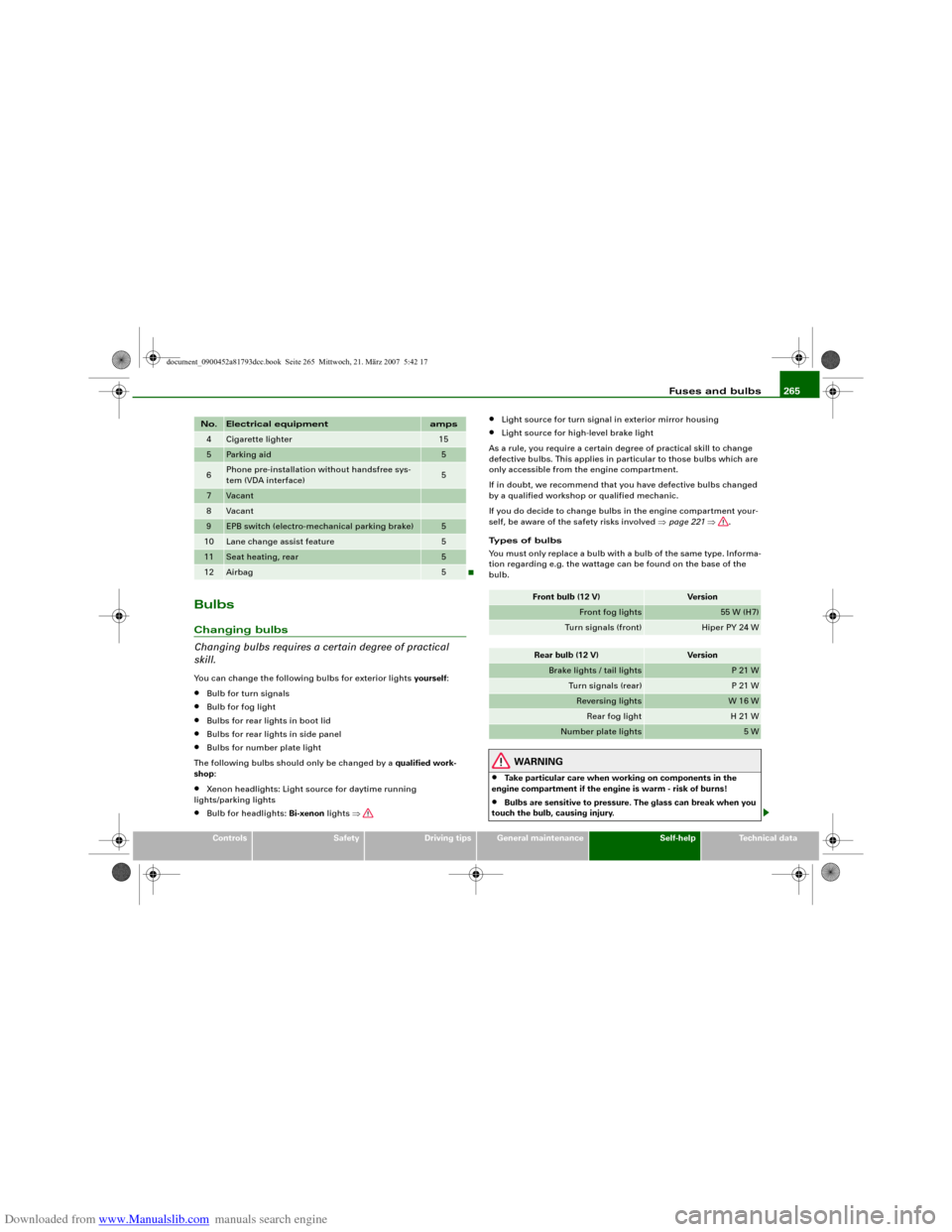
Types of bulbs
You must only replace a bulb with a bulb of the same type. Informa-
tion regarding e.g. the wattage can be found on the base of the
bulb.
WARNING
•
Take particular care when working on components in the
engine compartment if the engine is warm - risk of burns!
•
Bulbs are sensitive to pressure. The glass can break when you
touch the bulb, causing injury.
4
Cigarette lighter
15
5
Parking aid
5
6
Phone pre-installation without handsfree sys-
tem (VDA interface)
5
7
Vacant
8
Vacant
9
EPB switch (electro-mechanical parking brake)
5
10
Lane change assist feature
5
11
Seat heating, rear
5
12
Airbag
5
No.
Electrical equipment
amps
Front bulb (12 V)
Version
Front fog lights
55 W (H7)
Turn signals (front)
Hiper PY 24 W
Rear bulb (12 V)
Version
Brake lights / tail lights
P 21 W
Turn signals (rear)
P 21 W
Reversing lights
W 16 W
Rear fog light
H 21 W
Number plate lights
5 W
document_0900452a81793dcc.book Seite 265 Mittwoch, 21. März 2007 5:42 17