2008 AUDI S5 service
[x] Cancel search: servicePage 229 of 294
Downloaded from www.Manualslib.com manuals search engine Checking and topping up fluids227
Controls
Safety
Driving tips
General maintenance
Self-help
Technical data
Brake fluidChecking brake fluid level
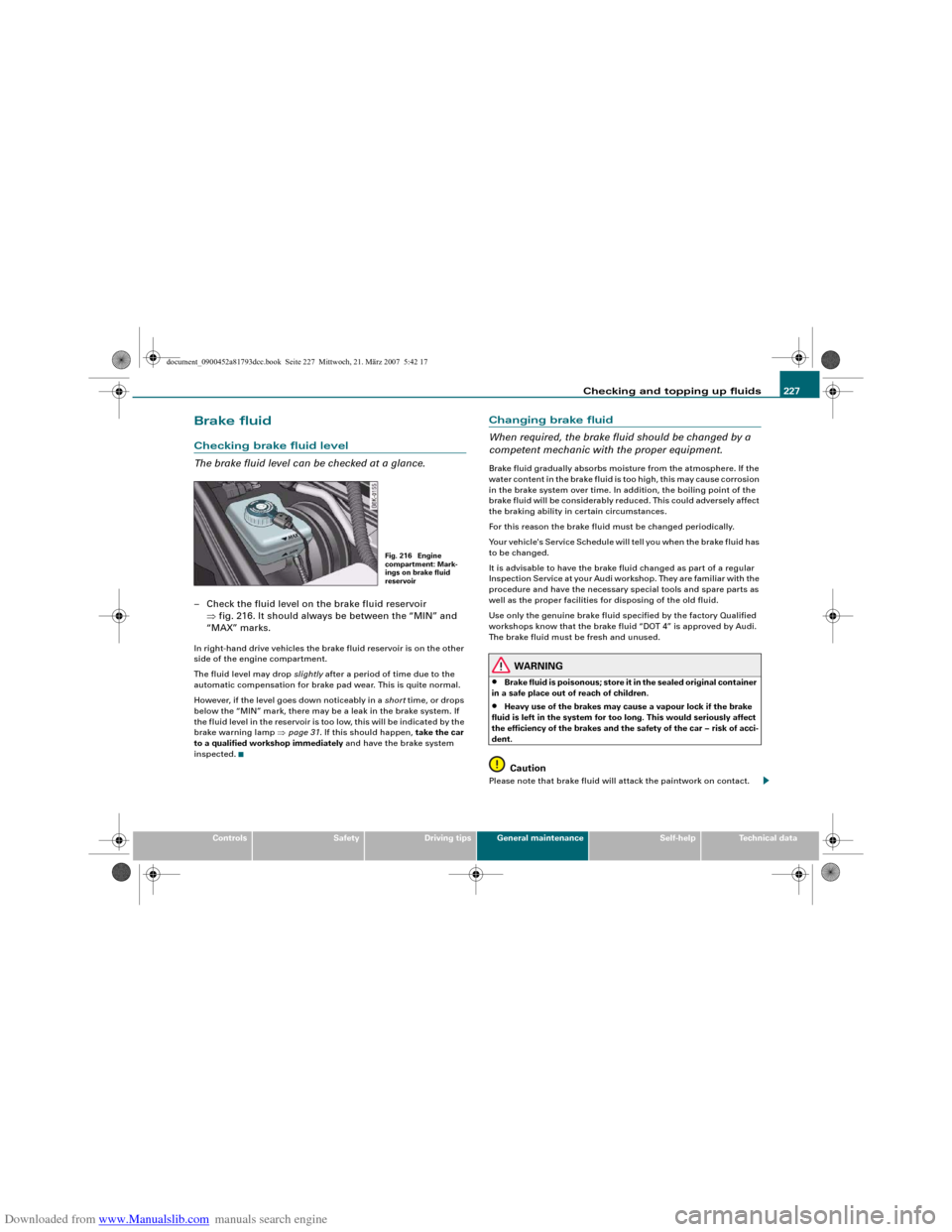
The brake fluid level can be checked at a glance.– Check the fluid level on the brake fluid reservoir
⇒fig. 216. It should always be between the “MIN” and
“MAX” marks.In right-hand drive vehicles the brake fluid reservoir is on the other
side of the engine compartment.
The fluid level may drop slightly after a period of time due to the
automatic compensation for brake pad wear. This is quite normal.
However, if the level goes down noticeably in a short time, or drops
below the “MIN” mark, there may be a leak in the brake system. If
the fluid level in the reservoir is too low, this will be indicated by the
brake warning lamp ⇒page 31. If this should happen, take the car
to a qualified workshop immediately and have the brake system
inspected.
Changing brake fluid
When required, the brake fluid should be changed by a
competent mechanic with the proper equipment.Brake fluid gradually absorbs moisture from the atmosphere. If the
water content in the brake fluid is too high, this may cause corrosion
in the brake system over time. In addition, the boiling point of the
brake fluid will be considerably reduced. This could adversely affect
the braking ability in certain circumstances.
For this reason the brake fluid must be changed periodically.
Your vehicle's Service Schedule will tell you when the brake fluid has
to be changed.
It is advisable to have the brake fluid changed as part of a regular
Inspection Service at your Audi workshop. They are familiar with the
procedure and have the necessary special tools and spare parts as
well as the proper facilities for disposing of the old fluid.
Use only the genuine brake fluid specified by the factory Qualified
workshops know that the brake fluid “DOT 4” is approved by Audi.
The brake fluid must be fresh and unused.
WARNING
•
Brake fluid is poisonous; store it in the sealed original container
in a safe place out of reach of children.
•
Heavy use of the brakes may cause a vapour lock if the brake
fluid is left in the system for too long. This would seriously affect
the efficiency of the brakes and the safety of the car – risk of acci-
dent.Caution
Please note that brake fluid will attack the paintwork on contact.
Fig. 216 Engine
compartment: Mark-
ings on brake fluid
reservoir
document_0900452a81793dcc.book Seite 227 Mittwoch, 21. März 2007 5:42 17
Page 230 of 294
Downloaded from www.Manualslib.com manuals search engine Checking and topping up fluids 228
For the sake of the environmentIf the fluid has to be drained out of the brake system, use an appro-
priate container to catch the used brake fluid and dispose of it in the
proper manner.BatteryGeneral notes
All work on batteries requires specialist knowledge.The battery is virtually maintenance-free. It is checked as part of the
Inspection Service.
We recommend that you replace a battery once it is older than 5
years.
When an airbag is triggered, the battery will, under certain circum-
stances, be disconnected from the on-board power supply for
safety reasons ⇒ in “General notes on airbag system” on
page 166.
Disconnecting the battery
If the battery is disconnected, some of the vehicle's functions will
become inoperative (e.g. electric windows). These functions will
require resetting after the battery is reconnected. For this reason,
the battery should only be disconnected from the vehicle's electrical
system when absolutely necessary.
If the vehicle is not used for long periods
If you do not drive your vehicle for a period of several days or weeks,
the power management will gradually shut off the on-board
systems one by one, or reduce the amount of current they are using.
This limits the amount of power consumed and helps to ensure reli-
able starting even after a long period ⇒page 192.Please note that certain convenience features, such as the Audi
advanced key*, the remote control key or the electrical seat adjust-
ment may not be available when you unlock the vehicle. These func-
tions will be restored when you switch on the ignition and start the
engine.
Winter conditions
At low temperatures the battery has to work very hard. It also
provides only a fraction of the starting power it has at normal
temperatures.
For this reason, we recommend having the battery checked and
charged if necessary before the start of winter ⇒page 230.
WARNING
•
All work on batteries requires specialist knowledge. For queries
regarding the vehicle battery please contact an Audi dealership or
other qualified workshop (risk of chemical burns / risk of explo-
sion).
•
The battery must not be opened. Do not attempt to make any
changes to the electrolyte level of the battery. Otherwise, there is
a risk that a mixture of oxygen and hydrogen gas can accumulate
and cause an explosion.Note
If the vehicle is to be left standing for a period of several weeks at
extremely low temperatures, the battery should be removed from
the vehicle. This ensures that it cannot “freeze up” and be
damaged.
document_0900452a81793dcc.book Seite 228 Mittwoch, 21. März 2007 5:42 17
Page 234 of 294
Downloaded from www.Manualslib.com manuals search engine Wheels and tyres 232Wheels and tyresWheelsGeneral notes–When driving with new tyres, be especially careful during
the first 500 km.
– If you have to drive over a kerb or similar obstacle, drive
very slowly and as near as possible at a right angle to the
kerb.
– Inspect the tyres regularly for damage (cuts, cracks or
blisters, etc.). Remove any foreign bodies embedded in
the treads.
– Damaged wheels and tyres must be replaced immedi-
ately.
– Keep grease, oil and fuel off the tyres.
– Replace any missing valve caps as soon as possible.
– Mark the wheels before taking them off so that they
rotate in the same direction when put back.
– When removed, the wheels or tyres should be stored in a
cool, dry and preferably dark place.New tyres
New tyres do not give maximum grip straight away and should
therefore be “run in” by driving carefully and at moderate speeds for
about the first 500 km. This will also help to make the tyres last
longer.
The tread depth of new tyres may vary, according to the type and
make of tyre and the tread pattern.Concealed damage
Damage to tyres and rims is often not readily visible. If you notice
unusual vibration or the car pulling to one side, this may indicate
that one of the tyres is damaged. Reduce speed immediately if there
is any reason to suspect that damage may have occurred. Inspect
the tyres for damage. If no external damage is visible, drive slowly
and carefully to the nearest qualified workshop and have the car
inspected.
Tyres with directional tread pattern
An arrow on the tyre sidewall indicates the direction of rotation on
tyres with directional tread. Always note the direction of rotation
indicated when mounting the wheel. This guarantees optimum grip
and helps to avoid aquaplaning, excessive noise and wear.
Tyre service life
Correct inflation pressures and sensible driving habits
will increase the service life of your tyres.– Check the tyre pressures at least once a month.
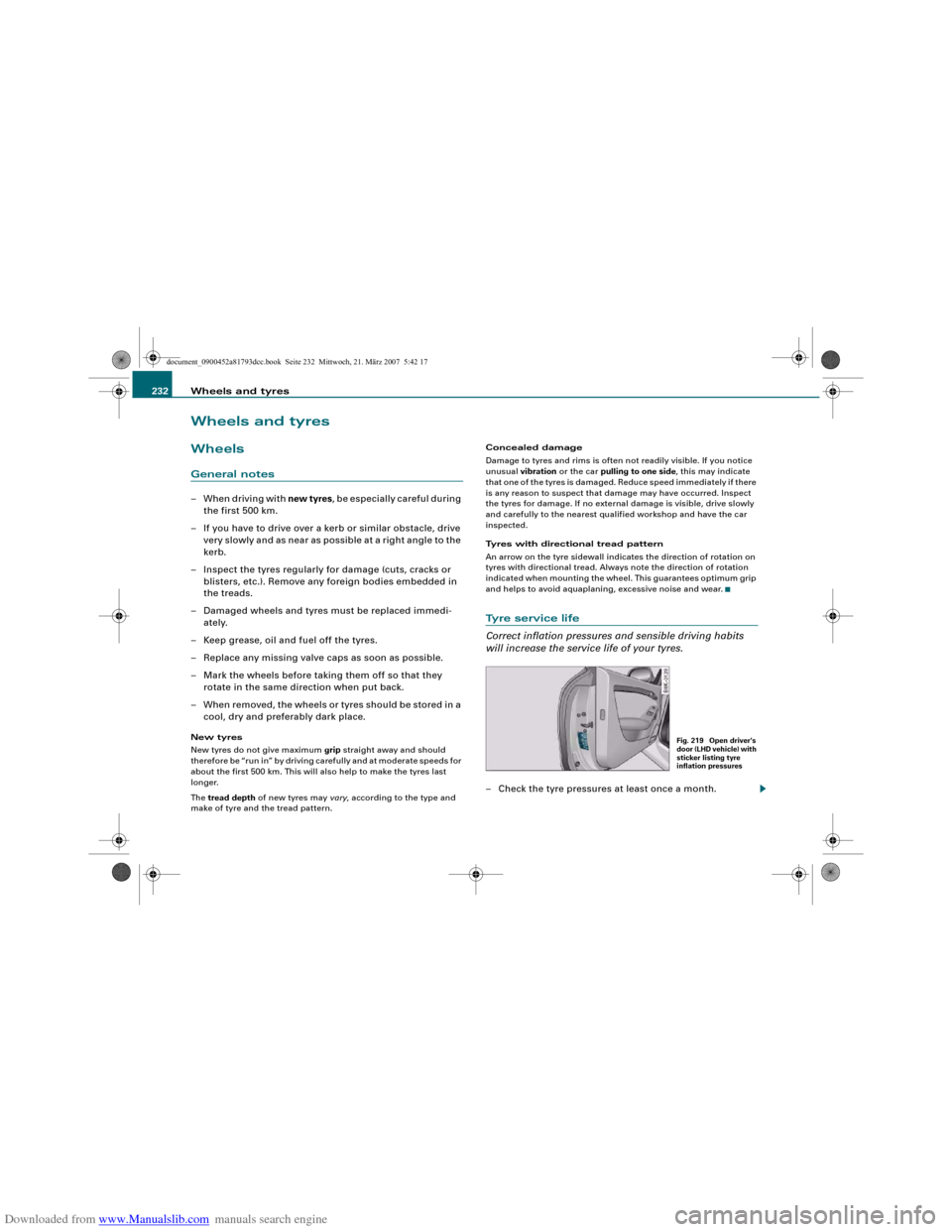
Fig. 219 Open driver's
door (LHD vehicle) with
sticker listing tyre
inflation pressures
document_0900452a81793dcc.book Seite 232 Mittwoch, 21. März 2007 5:42 17
Page 247 of 294
Downloaded from www.Manualslib.com manuals search engine Self-help245
Controls
Safety
Driving tips
General maintenance
Self-help
Technical data
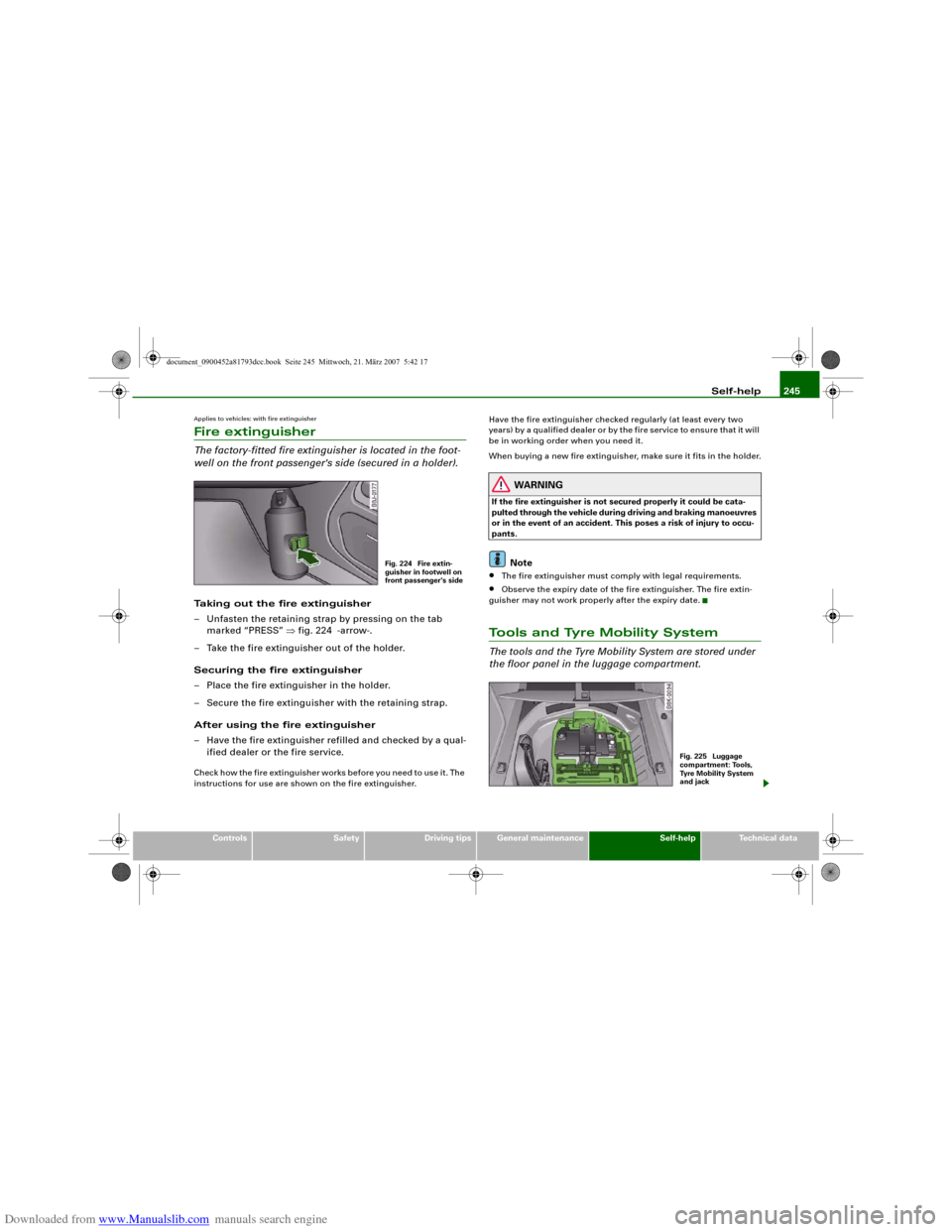
Applies to vehicles: with fire extinguisherFire extinguisherThe factory-fitted fire extinguisher is located in the foot-
well on the front passenger's side (secured in a holder).Taking out the fire extinguisher
– Unfasten the retaining strap by pressing on the tab
marked “PRESS” ⇒fig. 224 -arrow-.
– Take the fire extinguisher out of the holder.
Securing the fire extinguisher
– Place the fire extinguisher in the holder.
– Secure the fire extinguisher with the retaining strap.
After using the fire extinguisher
– Have the fire extinguisher refilled and checked by a qual-
ified dealer or the fire service.Check how the fire extinguisher works before you need to use it. The
instructions for use are shown on the fire extinguisher.Have the fire extinguisher checked regularly (at least every two
years) by a qualified dealer or by the fire service to ensure that it will
be in working order when you need it.
When buying a new fire extinguisher, make sure it fits in the holder.
WARNING
If the fire extinguisher is not secured properly it could be cata-
pulted through the vehicle during driving and braking manoeuvres
or in the event of an accident. This poses a risk of injury to occu-
pants.
Note
•
The fire extinguisher must comply with legal requirements.
•
Observe the expiry date of the fire extinguisher. The fire extin-
guisher may not work properly after the expiry date.
Tools and Tyre Mobility SystemThe tools and the Tyre Mobility System are stored under
the floor panel in the luggage compartment.
Fig. 224 Fire extin-
guisher in footwell on
front passenger's side
Fig. 225 Luggage
compartment: Tools,
Tyre Mobility System
and jack
document_0900452a81793dcc.book Seite 245 Mittwoch, 21. März 2007 5:42 17
Page 282 of 294

Downloaded from www.Manualslib.com manuals search engine General notes 280Vehicle data sticker
The vehicle data sticker ⇒page 279, fig. 264 is located near the
battery in the luggage compartment. One section of the vehicle data
sticker is attached to the inside cover of the Service Schedule before
the vehicle is handed over.
The sticker lists the following data:
Vehicle identification number (chassis number)
Vehicle type / engine power / gearbox type
Engine and gearbox code letters
Paint No. / Interior equipment No.
Optional equipment codes
Fuel consumption and emissions
Fuel consumption and emissions
Information on the vehicle's fuel consumption and emissions is
given at the bottom of the vehicle data sticker :
Urban cycle consumption (ltr./100 km)
Extra-urban cycle consumption (ltr./100 km)
Combined cycle consumption (ltr./100 km)
Combined CO
2 emissions (g/km)
The specified values were determined in accordance with the test
procedure prescribed by the currently applicable version of
Directive 80/1268/EEC. The specifications do not refer to an indi-
vidual vehicle. The consumption figures achieved during normal
driving may differ from the test values quoted in accordance with
the above Directive, depending on special equipment fitted, vehicle
loading, personal driving style, road and traffic conditions, environ-
mental factors and the condition of the car.
A1A2A3A4A5A6
A6
AAABACAD
document_0900452a81793dcc.book Seite 280 Mittwoch, 21. März 2007 5:42 17
Page 283 of 294
Downloaded from www.Manualslib.com manuals search engine Performance, weights and dimensions281
Controls
Safety
Driving tips
General maintenance
Self-help
Technical data
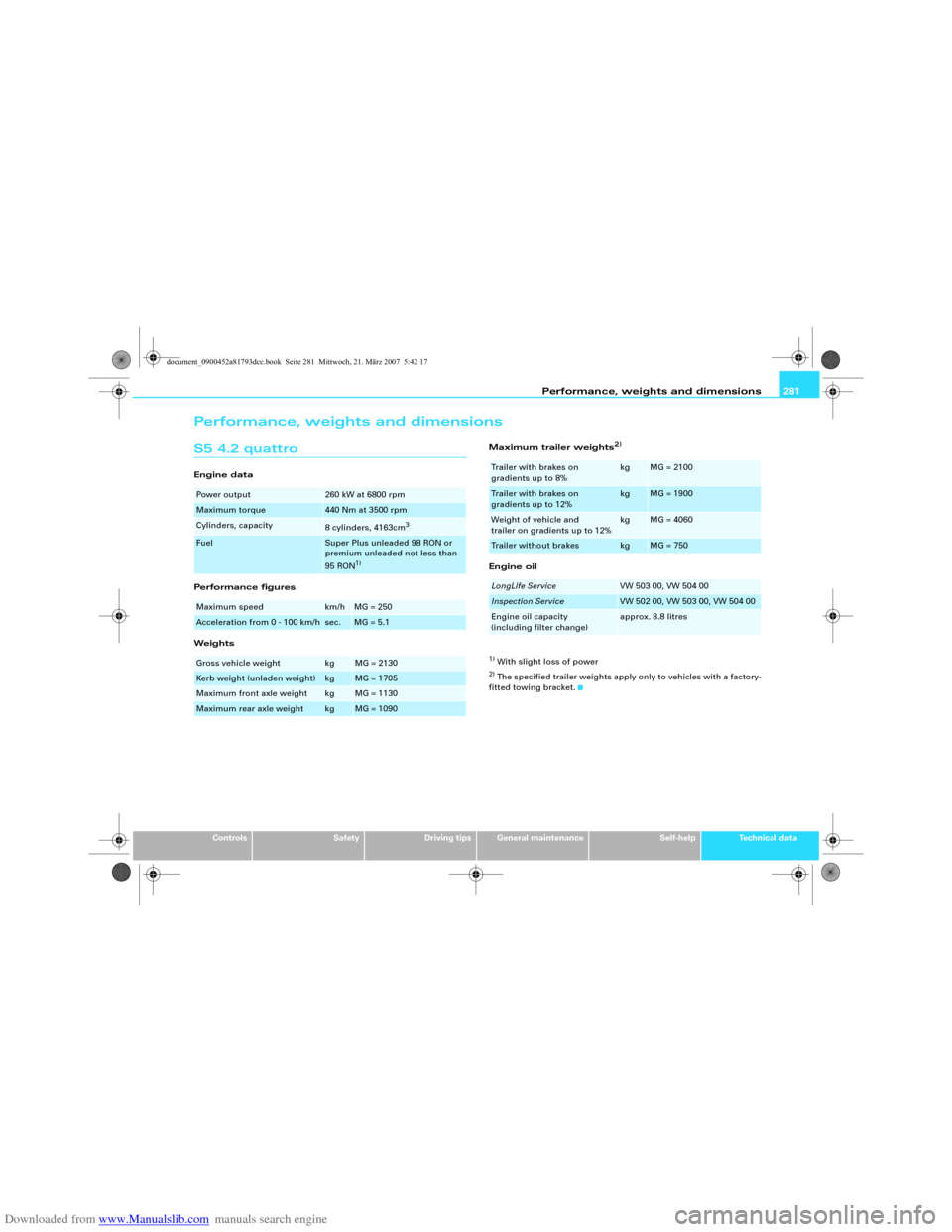
Performance, weights and dimensionsS5 4.2 quattroEngine data
Performance figures
WeightsMaximum trailer weights
2)
Engine oil1) With slight loss of power2) The specified trailer weights apply only to vehicles with a factory-
fitted towing bracket.
Power output
260 kW at 6800 rpm
Maximum torque
440 Nm at 3500 rpm
Cylinders, capacity
8 cylinders, 4163cm
3
Fuel
Super Plus unleaded 98 RON or
premium unleaded not less than
95 RON
1)
Maximum speed
km/h
MG = 250
Acceleration from 0 - 100 km/h
sec.
MG = 5.1
Gross vehicle weight
kg
MG = 2130
Kerb weight (unladen weight)
kg
MG = 1705
Maximum front axle weight
kg
MG = 1130
Maximum rear axle weight
kg
MG = 1090
Trailer with brakes on
gradients up to 8%
kg
MG = 2100
Trailer with brakes on
gradients up to 12%
kg
MG = 1900
Weight of vehicle and
trailer on gradients up to 12%
kg
MG = 4060
Trailer without brakes
kg
MG = 750
LongLife Service
VW 503 00, VW 504 00
Inspection Service
VW 502 00, VW 503 00, VW 504 00
Engine oil capacity
(including filter change)
approx. 8.8 litres
document_0900452a81793dcc.book Seite 281 Mittwoch, 21. März 2007 5:42 17
Page 288 of 294

Downloaded from www.Manualslib.com manuals search engine Index 286Cruise control system
Adjusting speed . . . . . . . . . . . . . . . . . 125
Control lever on steering wheel . . . . 123
Cruise mode . . . . . . . . . . . . . . . . . . . . 124
Indicator lamp . . . . . . . . . . . . . . . . . . . . 17
Introduction . . . . . . . . . . . . . . . . . . . . . 123
Pre-selecting a speed . . . . . . . . . . . . . 126
Resuming cruise control . . . . . . . . . . 126
Safety notes . . . . . . . . . . . . . . . . . . . . . 123
Switching off . . . . . . . . . . . . . . . . . . . . 127
Switching off temporarily . . . . . . . . . 126
Cup holders . . . . . . . . . . . . . . . . . . . . . . . . . 83
Current fuel consumption . . . . . . . . . . . . . 25DDate display . . . . . . . . . . . . . . . . . . . . . . . . 13
Daytime running lights . . . . . . . . . . . . . . . 56
Deactivating front passenger's airbag . . 173
Deadlock mechanism . . . . . . . . . . . . . . 42, 45
Defrosting windows . . . . . . . . . . . . . . 96, 104
Deluxe automatic air conditioner . . . . . . . 91
Air distribution . . . . . . . . . . . . . . . . . . . 95
Air outlets . . . . . . . . . . . . . . . . . . . . . . . 97
Air outlets for rear passengers . . . . . . 97
Air recirculation mode . . . . . . . . . . . . . 95
Automatic mode . . . . . . . . . . . . . . . . . . 93
Basic settings . . . . . . . . . . . . . . . . . . . . 98
Blower . . . . . . . . . . . . . . . . . . . . . . . . . . 94
Controls . . . . . . . . . . . . . . . . . . . . . . . . . 92
Defrosting . . . . . . . . . . . . . . . . . . . . . . . 96
Description . . . . . . . . . . . . . . . . . . . . . . 91
Economical operation . . . . . . . . . . . . . 98Heated rear window . . . . . . . . . . . . . . . 96
Seat heating, front . . . . . . . . . . . . . . . 112
Switching on and off . . . . . . . . . . . . . . 93
Temperature . . . . . . . . . . . . . . . . . . . . . 94
Deluxe automatic air conditioner plus . . . 99
AC mode . . . . . . . . . . . . . . . . . . . . . . . . 105
Air distribution . . . . . . . . . . . . . . . . . . 104
Air outlets . . . . . . . . . . . . . . . . . . . . . . . 105
Air outlets for rear passengers . . . . . 106
Air recirculation mode . . . . . . . . . . . . 103
Automatic mode . . . . . . . . . . . . . . . . . 101
Automatic recirculation . . . . . . . . . . . 107
Auxiliary heating . . . . . . . . . . . . . . . . . 108
Auxiliary heating - remote control . . 111
Auxiliary heating - running time . . . . 111
Basic settings . . . . . . . . . . . . . . . . . . . 107
Blower . . . . . . . . . . . . . . . . . . . . . . . . . 102
Controls . . . . . . . . . . . . . . . . . . . . . . . . 100
Defrosting . . . . . . . . . . . . . . . . . . . . . . 104
Description . . . . . . . . . . . . . . . . . . . . . . . 99
Economical operation . . . . . . . . . . . . . 106
Heated rear window . . . . . . . . . . . . . . 104
Switching on and off . . . . . . . . . . . . . 101
Synchronisation . . . . . . . . . . . . . . . . . 108
Temperature . . . . . . . . . . . . . . . . . . . . 102
Digital clock . . . . . . . . . . . . . . . . . . . . . . . . . 13
Digital compass . . . . . . . . . . . . . . . . . . . . . 68
Digital speedometer . . . . . . . . . . . . . . . . . . 22
Dimensions . . . . . . . . . . . . . . . . . . . . . . . . 278
Dipped headlights . . . . . . . . . . . . . . . . . . . 54
Defective . . . . . . . . . . . . . . . . . . . . . . . . 36
DIS
SeeDriver information system . . . . . . 20Door catches/boot lid warning . . . . . . . . . 23
Doors
Manual locking . . . . . . . . . . . . . . . . . . . 47
Driver
SeeSitting position . . . . . . . . . . . . . . . 154
Driver information system . . . . . . . . . . . . . 20
Auto-check control . . . . . . . . . . . . . . . . 29
Bulb monitor . . . . . . . . . . . . . . . . . . . . . 36
CD and radio display . . . . . . . . . . . . . . . 21
Digital speedometer . . . . . . . . . . . . . . . 22
Door catches/boot lid warning . . . . . . 23
Driver messages . . . . . . . . . . . . . . . . . . 30
On-board computer . . . . . . . . . . . . . . . . 25
Outside temperature display . . . . . . . . 21
Red symbols . . . . . . . . . . . . . . . . . . . . . 30
Service interval display . . . . . . . . . . . . . 23
Speed warning . . . . . . . . . . . . . . . . . . . . 28
Yellow symbols . . . . . . . . . . . . . . . . . . . 34
Driver messages . . . . . . . . . . . . . . . . . . . . . 30
Driving abroad . . . . . . . . . . . . . . . . . . . . . 195
Headlights . . . . . . . . . . . . . . . . . . . . . . 195
Unleaded fuel . . . . . . . . . . . . . . . . . . . 195
Driving away from a standstill . . . . . . . . 120
Driving away when towing a trailer . . . . 121
Driving safety . . . . . . . . . . . . . . . . . . . . . . 153
Driving time . . . . . . . . . . . . . . . . . . . . . . . . . 25
Dust filter
Deluxe automatic air conditioner . . . . 91
Deluxe automatic air conditioner plus 99
DVD player . . . . . . . . . . . . . . . . . . . . . . . . . . 77
document_0900452a81793dcc.book Seite 286 Mittwoch, 21. März 2007 5:42 17
Page 289 of 294

Downloaded from www.Manualslib.com manuals search engine Index287
Controls
Safety
Driving tips
General maintenance
Self-help
Technical data
EEasy-entry function . . . . . . . . . . . . . . . . . . . 71
Economical driving . . . . . . . . . . . . . . . . . . 196
EDL
SeeElectronic differential lock . . . . . . . 17
Electric seat adjustment
SeeSeat adjustment . . . . . . . . . . . . . . . 70
Electric windows . . . . . . . . . . . . . . . . . . . . . 49
Central locking system . . . . . . . . . . . . . 50
Controls . . . . . . . . . . . . . . . . . . . . . . . . . 49
Convenience open/close function . . . . 50
Malfunctions . . . . . . . . . . . . . . . . . . . . . 51
Settings . . . . . . . . . . . . . . . . . . . . . . . . . 51
Electrical accessories
SeeElectrical socket . . . . . . . . . . . . . . . 86
Electrical socket . . . . . . . . . . . . . . . . . . 85, 86
Electro-mechanical parking brake . . . . . . 122
Auto release function . . . . . . . . . . . . . 120
Driving away from a standstill . . . . . . 120
Driving away when towing a trailer . . 121
Emergency braking function . . . . . . . 121
Malfunction . . . . . . . . . . . . . . . . . . . . . 121
Operation . . . . . . . . . . . . . . . . . . . . . . . 119
Parking . . . . . . . . . . . . . . . . . . . . . . . . . 120
Releasing and applying . . . . . . . . . . . 119
Warning lamp . . . . . . . . . . . . . . . . . . . . 18
Electronic differential lock
How the system works . . . . . . . . . . . . 189
Warning lamp . . . . . . . . . . . . . . . . . . . . 17
Electronic immobiliser . . . . . . . . . . . . . . . . 14Electronic stabilisation program
How the system works . . . . . . . . . . . . 186
Warning lamp . . . . . . . . . . . . . . . . . . . . . 16
Emergency braking function . . . . . . . . . . 121
Emergency key . . . . . . . . . . . . . . . . . . . . . . 40
Emergency release
Ignition key . . . . . . . . . . . . . . . . . . . . . . . 41
Emission control systems
Catalytic converter . . . . . . . . . . . . . . . . 195
Emissions . . . . . . . . . . . . . . . . . . . . . . . . . . 279
Engine compartment
Safety notes . . . . . . . . . . . . . . . . . . . . . 221
Engine compartment layout . . . . . . . . . . 222
Engine data
SeePerformance, weights and
dimensions . . . . . . . . . . . . . . . . . . . . 281
Engine hood
SeeBonnet . . . . . . . . . . . . . . . . . . . . . . 220
Engine management
(EPC) warning lamp . . . . . . . . . . . . . . . . 15
Engine oil . . . . . . . . . . . . . . . . . . . . . . . . . . 222
Checking oil level . . . . . . . . . . . . . . . . . 223
Consumption . . . . . . . . . . . . . . . . . . . . 223
LongLife Service . . . . . . . . . . . . . . . . . . 222
Topping up . . . . . . . . . . . . . . . . . . . . . . 224
See alsoPerformance, weights and
dimensions . . . . . . . . . . . . . . . . . . . . 281
Engine oil capacity
SeePerformance, weights and
dimensions . . . . . . . . . . . . . . . . . . . . 281
Engine oil pressure
Warning lamp . . . . . . . . . . . . . . . . . . . . . 33Engine oil sensor
Malfunction . . . . . . . . . . . . . . . . . . . . . . 37
Environmental compatibility . . . . . . . . . . 197
Environmental tips
Filling the tank . . . . . . . . . . . . . . . . . . . 217
Heated rear window . . . . . . . . . . . 96, 104
Leaks . . . . . . . . . . . . . . . . . . . . . . . . . . . 221
Roof carrier . . . . . . . . . . . . . . . . . . . . . . . 83
EPC
SeeEngine management . . . . . . . . . . . 15
ESP
SeeElectronic stabilisation program . . 16
Ethanol fuel . . . . . . . . . . . . . . . . . . . . . . . . 217
Exterior mirrors . . . . . . . . . . . . . . . . . . . . . . 66
FFastening rings . . . . . . . . . . . . . . . . . . 76, 159
Filling the tank . . . . . . . . . . . . . . . . . . . . . . 217
Releasing the tank flap manually . . . . 219
Fire extinguisher . . . . . . . . . . . . . . . . . . . . 245
First-aid kit . . . . . . . . . . . . . . . . . . . . . . . . . 244
Floor mats . . . . . . . . . . . . . . . . . . . . . 157, 158
Fog lights . . . . . . . . . . . . . . . . . . . . . . . . . . . 55
Foreign countries
SeeDriving abroad . . . . . . . . . . . . . . . . 195
Four-wheel drive . . . . . . . . . . . . . . . . . . . . 191
Front passenger
SeeSitting position . . . . . . . . . . . . . . . 155
Fuel
Capacity . . . . . . . . . . . . . . . . . . . . . . . . 279
Consumption . . . . . . . . . . . . . . . . . . . . 279
Current fuel consumption . . . . . . . . . . . 25
document_0900452a81793dcc.book Seite 287 Mittwoch, 21. März 2007 5:42 17