2008 AUDI S5 oil pressure
[x] Cancel search: oil pressurePage 234 of 294
Downloaded from www.Manualslib.com manuals search engine Wheels and tyres 232Wheels and tyresWheelsGeneral notes–When driving with new tyres, be especially careful during
the first 500 km.
– If you have to drive over a kerb or similar obstacle, drive
very slowly and as near as possible at a right angle to the
kerb.
– Inspect the tyres regularly for damage (cuts, cracks or
blisters, etc.). Remove any foreign bodies embedded in
the treads.
– Damaged wheels and tyres must be replaced immedi-
ately.
– Keep grease, oil and fuel off the tyres.
– Replace any missing valve caps as soon as possible.
– Mark the wheels before taking them off so that they
rotate in the same direction when put back.
– When removed, the wheels or tyres should be stored in a
cool, dry and preferably dark place.New tyres
New tyres do not give maximum grip straight away and should
therefore be “run in” by driving carefully and at moderate speeds for
about the first 500 km. This will also help to make the tyres last
longer.
The tread depth of new tyres may vary, according to the type and
make of tyre and the tread pattern.Concealed damage
Damage to tyres and rims is often not readily visible. If you notice
unusual vibration or the car pulling to one side, this may indicate
that one of the tyres is damaged. Reduce speed immediately if there
is any reason to suspect that damage may have occurred. Inspect
the tyres for damage. If no external damage is visible, drive slowly
and carefully to the nearest qualified workshop and have the car
inspected.
Tyres with directional tread pattern
An arrow on the tyre sidewall indicates the direction of rotation on
tyres with directional tread. Always note the direction of rotation
indicated when mounting the wheel. This guarantees optimum grip
and helps to avoid aquaplaning, excessive noise and wear.
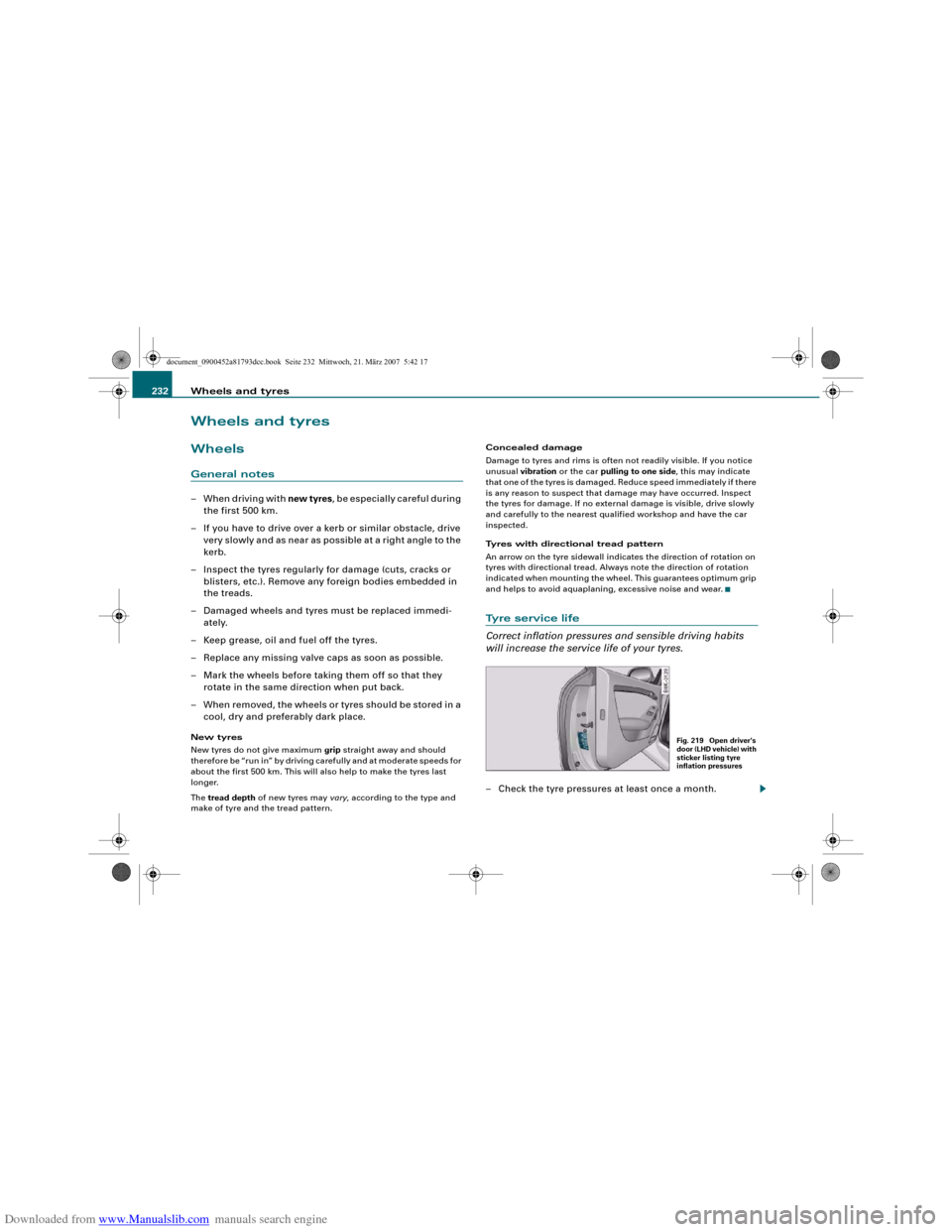
Tyre service life
Correct inflation pressures and sensible driving habits
will increase the service life of your tyres.– Check the tyre pressures at least once a month.
Fig. 219 Open driver's
door (LHD vehicle) with
sticker listing tyre
inflation pressures
document_0900452a81793dcc.book Seite 232 Mittwoch, 21. März 2007 5:42 17
Page 250 of 294
Downloaded from www.Manualslib.com manuals search engine Self-help 248The TMS can be used at outside temperatures down to – 20 °C.
WARNING
After repairing a tyre please note the following points:•
Do not drive faster than 80 km/h.
•
Avoid heavy acceleration, hard braking and fast cornering.
•
Vehicle handling could be impaired.
•
Tyres which have been sealed using the TMS are only suitable
for temporary use. Damaged tyres must be renewed.
•
The TMS must NOT be used,
−on cuts and punctures larger than 4 mm
−if the wheel rim has been damaged
−if you have been driving with very low pressure or a
completely flat tyre
•
Seek professional assistance if the repair of a tyre puncture is
not possible with the sealing compound.
•
Do not allow the sealant to come into contact with your eyes,
skin or clothing.
•
If you do come into contact with the sealant immediately rinse
the eyes or skin affected with clean water.
•
Change clothing immediately if it becomes soiled with the tyre
sealant.
•
Make sure you do not breathe in the fumes!
•
If any of the tyre sealant is accidentally ingested, immediately
rinse the mouth thoroughly and drink lots of water.
•
Do not induce vomiting. Immediately contact a doctor!
•
If any allergic reactions should occur get medical help immedi-
ately.
•
Keep the sealant away from children.
For the sake of the environment
Used bottles of sealing compound can be returned to an Audi dealer
for disposal.
Note
•
If sealant should leak out, leave it to dry. When it has dried, you
can pull it off like a piece of foil.
•
Observe the expiry date stated on the sealing compound can.
Have the sealing compound exchanged by a qualified workshop.
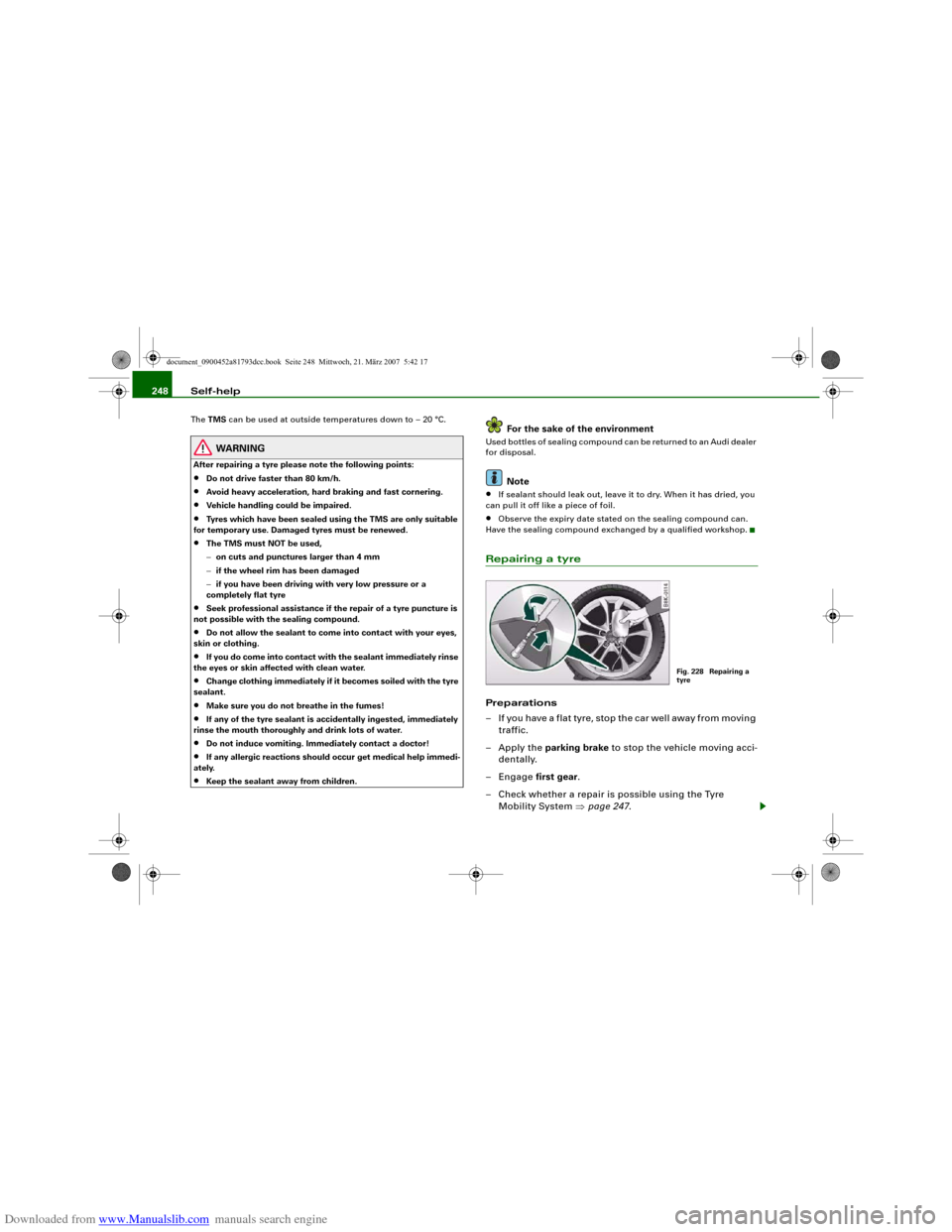
Repairing a tyrePreparations
– If you have a flat tyre, stop the car well away from moving
traffic.
– Apply the parking brake to stop the vehicle moving acci-
dentally.
–Engage first gear.
– Check whether a repair is possible using the Tyre
Mobility System ⇒page 247.
Fig. 228 Repairing a
tyre
document_0900452a81793dcc.book Seite 248 Mittwoch, 21. März 2007 5:42 17
Page 251 of 294

Downloaded from www.Manualslib.com manuals search engine Self-help249
Controls
Safety
Driving tips
General maintenance
Self-help
Technical data
– Ensure that all passengers leave the vehicle and move
away from the danger area ⇒.
– Take the tyre sealant can and the electric compressor out
of the luggage compartment ⇒page 245.
– Fix the sticker “max. 80 km/h”, which is included with the
tyre sealant can, onto the instrument cluster where the
driver will see it.
Filling the tyre
– Shake the tyre sealant can well.
– Screw the enclosed filling hose onto the sealant can as
far as it will go. This will automatically pierce the foil
sealing the can.
– Take the valve cap off the tyre valve and use the enclosed
valve insert tool to unscrew the valve insert ⇒page 248,
fig. 228.
– Place the valve insert onto a clean surface.
– Remove the sealing plug from the filling hose and insert
the hose into the tyre valve.
– Hold the tyre sealant can upside down and fill the
complete contents of the can into the tyre.
– Then disconnect the hose and screw the valve insert
firmly back into the tyre valve.
Inflating the tyre
– Screw the filling hose of the electric compressor onto the
tyre valve and plug the connector into the cigarette
lighter.– Pump the tyre up to 2.0 to 2.5 bar and monitor the pres-
sure shown on the pressure gauge.
– If the tyre pressure remains lower than the value speci-
fied above drive the vehicle approx. 10 metres forwards
or backwards, so that the sealant can spread evenly in
the tyre. If the pressure is still lower than the specifica-
tion the tyre is too badly damaged and cannot be
repaired using the tyre sealant.
Final checks
– After about 10 minutes stop to check the tyre pressure.
– If tyre pressure is less than 1.3 bar, the tyre is too badly
damaged. Do not drive on. You should obtain profes-
sional assistance.
WARNING
•
If you have a puncture in moving traffic, switch on the hazard
warning lights and place the warning triangle in a visible location.
This is for your own safety and also warns other road users.
•
Make sure your passengers wait in a safe place (for instance
behind the roadside crash barrier).
•
Please observe the manufacturers' safety notes on the
compressor and the instructions supplied with the tyre sealant
can.
•
If it was not possible to build up a tyre pressure of 2.0 bar
within 6 minutes this means that the tyre is too badly damaged.
Do not drive on.
•
Seek professional assistance if the repair of a tyre puncture is
not possible with the sealing compound.
•
If tyre pressure is less than 1.3 bar after driving about 10
minutes, the tyre is too badly damaged. Do not drive on. You
should obtain professional assistance.
document_0900452a81793dcc.book Seite 249 Mittwoch, 21. März 2007 5:42 17
Page 289 of 294

Downloaded from www.Manualslib.com manuals search engine Index287
Controls
Safety
Driving tips
General maintenance
Self-help
Technical data
EEasy-entry function . . . . . . . . . . . . . . . . . . . 71
Economical driving . . . . . . . . . . . . . . . . . . 196
EDL
SeeElectronic differential lock . . . . . . . 17
Electric seat adjustment
SeeSeat adjustment . . . . . . . . . . . . . . . 70
Electric windows . . . . . . . . . . . . . . . . . . . . . 49
Central locking system . . . . . . . . . . . . . 50
Controls . . . . . . . . . . . . . . . . . . . . . . . . . 49
Convenience open/close function . . . . 50
Malfunctions . . . . . . . . . . . . . . . . . . . . . 51
Settings . . . . . . . . . . . . . . . . . . . . . . . . . 51
Electrical accessories
SeeElectrical socket . . . . . . . . . . . . . . . 86
Electrical socket . . . . . . . . . . . . . . . . . . 85, 86
Electro-mechanical parking brake . . . . . . 122
Auto release function . . . . . . . . . . . . . 120
Driving away from a standstill . . . . . . 120
Driving away when towing a trailer . . 121
Emergency braking function . . . . . . . 121
Malfunction . . . . . . . . . . . . . . . . . . . . . 121
Operation . . . . . . . . . . . . . . . . . . . . . . . 119
Parking . . . . . . . . . . . . . . . . . . . . . . . . . 120
Releasing and applying . . . . . . . . . . . 119
Warning lamp . . . . . . . . . . . . . . . . . . . . 18
Electronic differential lock
How the system works . . . . . . . . . . . . 189
Warning lamp . . . . . . . . . . . . . . . . . . . . 17
Electronic immobiliser . . . . . . . . . . . . . . . . 14Electronic stabilisation program
How the system works . . . . . . . . . . . . 186
Warning lamp . . . . . . . . . . . . . . . . . . . . . 16
Emergency braking function . . . . . . . . . . 121
Emergency key . . . . . . . . . . . . . . . . . . . . . . 40
Emergency release
Ignition key . . . . . . . . . . . . . . . . . . . . . . . 41
Emission control systems
Catalytic converter . . . . . . . . . . . . . . . . 195
Emissions . . . . . . . . . . . . . . . . . . . . . . . . . . 279
Engine compartment
Safety notes . . . . . . . . . . . . . . . . . . . . . 221
Engine compartment layout . . . . . . . . . . 222
Engine data
SeePerformance, weights and
dimensions . . . . . . . . . . . . . . . . . . . . 281
Engine hood
SeeBonnet . . . . . . . . . . . . . . . . . . . . . . 220
Engine management
(EPC) warning lamp . . . . . . . . . . . . . . . . 15
Engine oil . . . . . . . . . . . . . . . . . . . . . . . . . . 222
Checking oil level . . . . . . . . . . . . . . . . . 223
Consumption . . . . . . . . . . . . . . . . . . . . 223
LongLife Service . . . . . . . . . . . . . . . . . . 222
Topping up . . . . . . . . . . . . . . . . . . . . . . 224
See alsoPerformance, weights and
dimensions . . . . . . . . . . . . . . . . . . . . 281
Engine oil capacity
SeePerformance, weights and
dimensions . . . . . . . . . . . . . . . . . . . . 281
Engine oil pressure
Warning lamp . . . . . . . . . . . . . . . . . . . . . 33Engine oil sensor
Malfunction . . . . . . . . . . . . . . . . . . . . . . 37
Environmental compatibility . . . . . . . . . . 197
Environmental tips
Filling the tank . . . . . . . . . . . . . . . . . . . 217
Heated rear window . . . . . . . . . . . 96, 104
Leaks . . . . . . . . . . . . . . . . . . . . . . . . . . . 221
Roof carrier . . . . . . . . . . . . . . . . . . . . . . . 83
EPC
SeeEngine management . . . . . . . . . . . 15
ESP
SeeElectronic stabilisation program . . 16
Ethanol fuel . . . . . . . . . . . . . . . . . . . . . . . . 217
Exterior mirrors . . . . . . . . . . . . . . . . . . . . . . 66
FFastening rings . . . . . . . . . . . . . . . . . . 76, 159
Filling the tank . . . . . . . . . . . . . . . . . . . . . . 217
Releasing the tank flap manually . . . . 219
Fire extinguisher . . . . . . . . . . . . . . . . . . . . 245
First-aid kit . . . . . . . . . . . . . . . . . . . . . . . . . 244
Floor mats . . . . . . . . . . . . . . . . . . . . . 157, 158
Fog lights . . . . . . . . . . . . . . . . . . . . . . . . . . . 55
Foreign countries
SeeDriving abroad . . . . . . . . . . . . . . . . 195
Four-wheel drive . . . . . . . . . . . . . . . . . . . . 191
Front passenger
SeeSitting position . . . . . . . . . . . . . . . 155
Fuel
Capacity . . . . . . . . . . . . . . . . . . . . . . . . 279
Consumption . . . . . . . . . . . . . . . . . . . . 279
Current fuel consumption . . . . . . . . . . . 25
document_0900452a81793dcc.book Seite 287 Mittwoch, 21. März 2007 5:42 17