2008 AUDI A5 tyre pressure
[x] Cancel search: tyre pressurePage 249 of 313
Wheels and tyres247
Controls
Safety
Driving tips
General maintenance
Self-help
Technical data replacement parts, trained personnel and facilities for disposing of
the old tyres.
WARNING
•
It is very important to ensure that the tyres you have chosen
have adequate clearance. When selecting replacement tyres, do
not rely entirely on the nominal tyre size marked on the tyre; with
some makes of tyre the effective tyre size can differ significantly
from the nominal dimensions, even though the tyres have the
same size designation. Inadequate tyre clearance can result in
damage to the tyres or the vehicle, causing a serious safety risk. It
may also invalidate the vehicle's type approval for use on public
roads.
•
Please ask your Audi dealer or qualified workshop whether run
flat tyres can be used on your vehicle. Unauthorised use of these
tyres can invalidate the vehicle's type approval for use on public
roads. Furthermore, this could cause damage to your vehicle and
possibly also result in an accident.
•
Avoid running the car on tyres that are more than 6 years old.
If you have no alternative, you should drive slowly and with extra
care at all times.For the sake of the environment
Old tyres must be disposed of according to the laws in the country
concerned.
Note
•
Never mount used tyres if you are not sure of their previous
history.
•
For technical reasons it is not normally possible to use wheel
rims from other vehicles. In some cases this also applies to rims
from other vehicles of the same model.
Wheel bolts
The wheel bolts are designed to suit the rims on your car.The wheel bolts are matched to the rims. When installing different
wheels (for instance wheels with winter tyres) it is important to use
the correct wheel bolts with the right length and correctly shaped
bolt heads. This is essential for the secure fit of the wheels and for
the proper function of the brake system.
Audi dealers have full information on the technical requirements
when installing or changing tyres, rims or wheel trims.
The wheel bolts should be clean and turn easily.
A special adapter is required to turn the anti-theft wheel bolts*
⇒page 264.Winter tyres
Winter tyres will significantly improve the car's handling
in winter road conditions.–Use only radial ply winter tyres.
– Winter tyres must be fitted on all four wheels.
– Only use winter tyres of the correct type approved for
your vehicle.
– Please note that the maximum permissible speed for
winter tyres may be lower than for summer tyres.
– Also note that winter tyres are no longer effective when
the tread is worn down.
– After fitting the wheels you must always check the tyre
pressures. The correct tyre pressures are listed on the
sticker on the end face of the driver's door.
document_0900452a8179700c.book Seite 247 Donnerstag, 22. März 2007 10:19 10
Page 259 of 313
Self-help257
Controls
Safety
Driving tips
General maintenance
Self-help
Technical data How to use the compact temporary spare wheel
Should you ever have a punctured tyre, the compact temporary
spare wheel is only intended for temporary use until you can reach
a workshop. The standard-size road wheel should be refitted as
soon as possible.
Please note the following restrictions when using the compact
temporary spare wheel. The compact temporary spare wheel is
designed specifically for this model. For this reason, do not use a
temporary spare from a different type of vehicle.
Snow chains
For technical reasons, snow chains must not be used on the
compact temporary spare wheel.
If you should have a puncture on one of the front wheels when using
snow chains, fit the compact temporary spare in place of one of the
rear wheels. You can then attach the snow chains to the wheel taken
from the rear and use this wheel to replace the punctured front
wheel.
WARNING
•
The tyre pressures must be checked and corrected as soon as
possible. The tyre pressure of the compact temporary spare wheel
must be 4.2 bar – an incorrectly inflated tyre can cause an acci-
dent.
•
Do not drive faster than 80 km/h - higher speeds can cause an
accident.
•
Avoid heavy acceleration, hard braking and fast cornering – risk
of accident.
•
Never use two or more compact spare tyres at the same time –
risk of accident.
•
No other type of tyre (normal summer or winter tyres) may be
fitted on the compact temporary spare wheel.
Ty r e r e p a i r sGeneral information and safety notes
Repaired tyres are only suitable for temporary use.Your vehicle is equipped with a tyre repair kit: the Tyre Mobility
System (TMS).
In the event of a puncture you will find the TMS, which consists of a
sealing compound and an electric compressor, located under the
floor panel in the luggage compartment.
The TMS will reliably seal tyres damaged by foreign bodies,
provided that the cuts or punctures are no larger than approx. 4 mm
in diameter.
It is not necessary to remove the foreign body from the tyre.
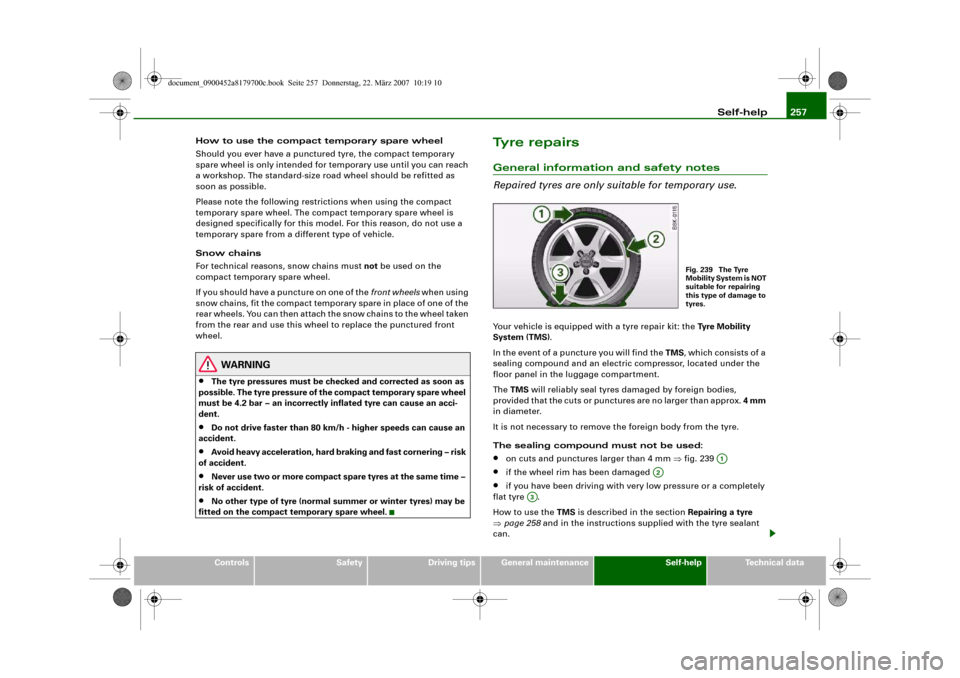
The sealing compound must not be used:•
on cuts and punctures larger than 4 mm ⇒fig. 239
•
if the wheel rim has been damaged
•
if you have been driving with very low pressure or a completely
flat tyre .
How to use the TMS is described in the section Repairing a tyre
⇒page 258 and in the instructions supplied with the tyre sealant
can.
Fig. 239 The Tyre
Mobility System is NOT
suitable for repairing
this type of damage to
tyres.
A1
A2
A3
document_0900452a8179700c.book Seite 257 Donnerstag, 22. März 2007 10:19 10
Page 260 of 313
Self-help 258The TMS can be used at outside temperatures down to – 20 °C.
WARNING
After repairing a tyre please note the following points:•
Do not drive faster than 80 km/h.
•
Avoid heavy acceleration, hard braking and fast cornering.
•
Vehicle handling could be impaired.
•
Tyres which have been sealed using the TMS are only suitable
for temporary use. Damaged tyres must be renewed.
•
The TMS must NOT be used,
−on cuts and punctures larger than 4 mm
−if the wheel rim has been damaged
−if you have been driving with very low pressure or a
completely flat tyre
•
Seek professional assistance if the repair of a tyre puncture is
not possible with the sealing compound.
•
Do not allow the sealant to come into contact with your eyes,
skin or clothing.
•
If you do come into contact with the sealant immediately rinse
the eyes or skin affected with clean water.
•
Change clothing immediately if it becomes soiled with the tyre
sealant.
•
Make sure you do not breathe in the fumes!
•
If any of the tyre sealant is accidentally ingested, immediately
rinse the mouth thoroughly and drink lots of water.
•
Do not induce vomiting. Immediately contact a doctor!
•
If any allergic reactions should occur get medical help immedi-
ately.
•
Keep the sealant away from children.
For the sake of the environment
Used bottles of sealing compound can be returned to an Audi dealer
for disposal.
Note
•
If sealant should leak out, leave it to dry. When it has dried, you
can pull it off like a piece of foil.
•
Observe the expiry date stated on the sealing compound can.
Have the sealing compound exchanged by a qualified workshop.
Repairing a tyrePreparations
– If you have a flat tyre, stop the car well away from moving
traffic.
– Apply the parking brake to stop the vehicle moving acci-
dentally.
–Engage first gear (manual gearbox) or move selector
lever to position P (automatic gearbox).
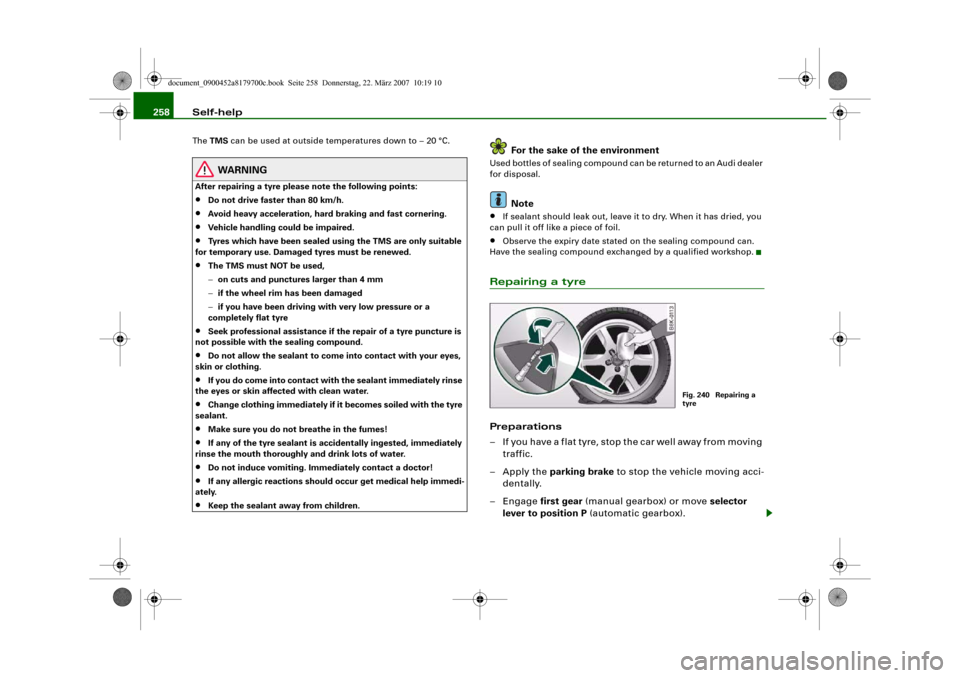
Fig. 240 Repairing a
tyre
document_0900452a8179700c.book Seite 258 Donnerstag, 22. März 2007 10:19 10
Page 261 of 313
Self-help259
Controls
Safety
Driving tips
General maintenance
Self-help
Technical data
– Check whether a repair is possible using the Tyre
Mobility System ⇒page 257.
– Ensure that all passengers leave the vehicle and move
away from the danger area ⇒.
– Take the tyre sealant can and the electric compressor out
of the luggage compartment ⇒page 255.
– Fix the sticker “max. 80 km/h”, which is included with the
tyre sealant can, onto the instrument cluster where the
driver will see it.
Filling the tyre
– Shake the tyre sealant can well.
– Screw the enclosed filling hose onto the sealant can as
far as it will go. This will automatically pierce the foil
sealing the can.
– Take the valve cap off the tyre valve and use the enclosed
valve insert tool to unscrew the valve insert ⇒page 258,
fig. 240.
– Place the valve insert onto a clean surface.
– Remove the sealing plug from the filling hose and insert
the hose into the tyre valve.
– Hold the tyre sealant can upside down and fill the
complete contents of the can into the tyre.
– Then disconnect the hose and screw the valve insert
firmly back into the tyre valve.Inflating the tyre
– Screw the filling hose of the electric compressor onto the
tyre valve and plug the connector into the cigarette
lighter.
– Pump the tyre up to 2.0 to 2.5 bar and monitor the pres-
sure shown on the pressure gauge.
– If the tyre pressure remains lower than the value speci-
fied above drive the vehicle approx. 10 metres forwards
or backwards, so that the sealant can spread evenly in
the tyre. If the pressure is still lower than the specifica-
tion the tyre is too badly damaged and cannot be
repaired using the tyre sealant.
Final checks
– After about 10 minutes stop to check the tyre pressure.
– If tyre pressure is less than 1.3 bar, the tyre is too badly
damaged. Do not drive on. You should obtain profes-
sional assistance.
WARNING
•
If you have a puncture in moving traffic, switch on the hazard
warning lights and place the warning triangle in a visible location.
This is for your own safety and also warns other road users.
•
Make sure your passengers wait in a safe place (for instance
behind the roadside crash barrier).
•
Please observe the manufacturers' safety notes on the
compressor and the instructions supplied with the tyre sealant
can.
•
If it was not possible to build up a tyre pressure of 2.0 bar
within 6 minutes this means that the tyre is too badly damaged.
Do not drive on.
document_0900452a8179700c.book Seite 259 Donnerstag, 22. März 2007 10:19 10
Page 262 of 313
Self-help 260•
Seek professional assistance if the repair of a tyre puncture is
not possible with the sealing compound.
•
If tyre pressure is less than 1.3 bar after driving about 10
minutes, the tyre is too badly damaged. Do not drive on. You
should obtain professional assistance.Caution
Take special care if you have to repair a tyre on a gradient.
Note
•
Do not use the compressor for longer than 6 minutes at a time,
as it could overheat. When the compressor has cooled down, you
can use it again.
•
If tyre sealant should leak out, leave it to dry and then pull it off
like foil.
•
After carrying out a tyre repair remember to buy a new tyre
sealant can at a qualified workshop. This will ensure that the Tyre
Mobility System is operative again.
•
Please observe the relevant regulations.
Changing a wheelPreparations
Some preparations are necessary before changing a
wheel.– If you have a flat tyre, stop the car well away from moving
traffic. Choose a location that is as level as possible.– All passengers should leave the car. They should wait in
a safe place (for instance behind the roadside crash
barrier).
– Apply the parking brake to stop the vehicle moving acci-
dentally.
–Engage first gear (manual gearbox) or move selector
lever to position P (automatic gearbox).
– When towing a trailer: unhitch the trailer from your
vehicle.
– Take the tools ⇒page 255 and the spare wheel*
⇒page 256 out of the luggage compartment.
WARNING
If you have a puncture in moving traffic, switch on the hazard
warning lights and place the warning triangle in a visible location.
This is for your own safety and also warns other road users.
Caution
If you have to change the tyre on a gradient, block the wheel oppo-
site the wheel being changed by placing a stone or similar object
under it to prevent the vehicle from rolling away.
Note
Please observe the relevant regulations.How to change a wheel
Change the wheel as described below.–Pull off the hub cap. Also refer to ⇒page 261, “Hub
caps”.
WARNING (continued)
document_0900452a8179700c.book Seite 260 Donnerstag, 22. März 2007 10:19 10
Page 263 of 313
Self-help261
Controls
Safety
Driving tips
General maintenance
Self-help
Technical data
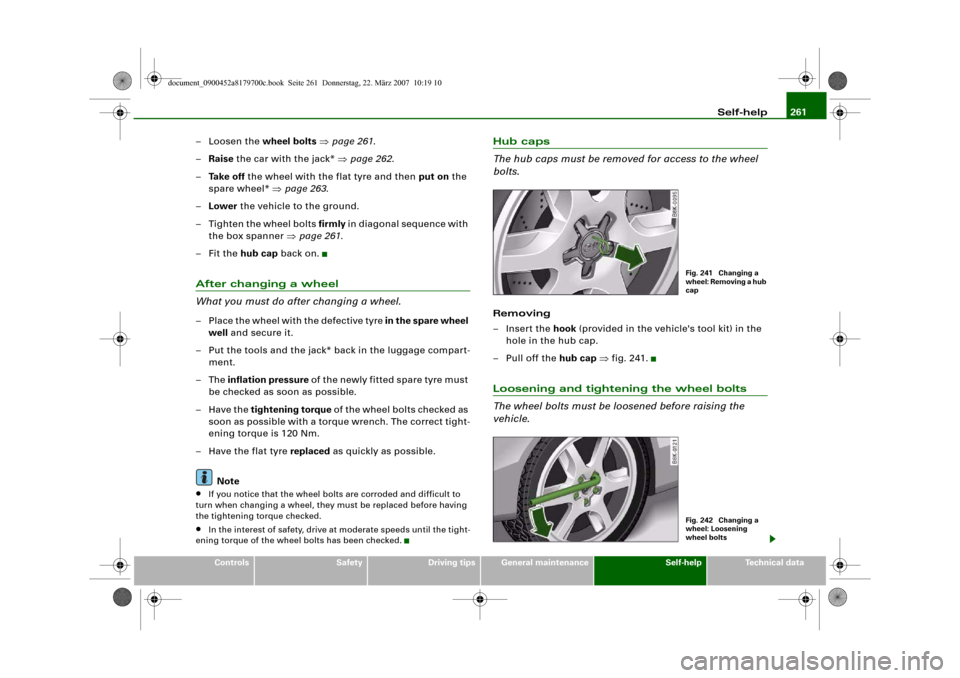
–Loosen the wheel bolts ⇒page 261.
–Raise the car with the jack* ⇒page 262.
–Ta k e o f f the wheel with the flat tyre and then put on the
spare wheel* ⇒page 263.
–Lower the vehicle to the ground.
– Tighten the wheel bolts firmly i n d i a g o n a l s e qu e n c e w i t h
the box spanner ⇒page 261.
–Fit the hub cap back on.After changing a wheel
What you must do after changing a wheel.– Place the wheel with the defective tyre in the spare wheel
well and secure it.
– Put the tools and the jack* back in the luggage compart-
ment.
–The inflation pressure of the newly fitted spare tyre must
be checked as soon as possible.
–Have the tightening torque of the wheel bolts checked as
soon as possible with a torque wrench. The correct tight-
ening torque is 120 Nm.
– Have the flat tyre replaced as quickly as possible.
Note•
If you notice that the wheel bolts are corroded and difficult to
turn when changing a wheel, they must be replaced before having
the tightening torque checked.
•
In the interest of safety, drive at moderate speeds until the tight-
ening torque of the wheel bolts has been checked.
Hub caps
The hub caps must be removed for access to the wheel
bolts.Removing
– Insert the hook (provided in the vehicle's tool kit) in the
hole in the hub cap.
–Pull off the hub cap ⇒fig. 241.Loosening and tightening the wheel bolts
The wheel bolts must be loosened before raising the
vehicle.
Fig. 241 Changing a
wheel: Removing a hub
capFig. 242 Changing a
wheel: Loosening
wheel bolts
document_0900452a8179700c.book Seite 261 Donnerstag, 22. März 2007 10:19 10
Page 308 of 313

Index 306FFastening rings . . . . . . . . . . . . . . . . . . 78, 169
Filling the tank . . . . . . . . . . . . . . . . . . . . . 228
Releasing the tank flap manually . . . 229
Fire extinguisher . . . . . . . . . . . . . . . . . . . . 255
First-aid kit . . . . . . . . . . . . . . . . . . . . . . . . 254
Floor mats . . . . . . . . . . . . . . . . . . . . . 167, 168
Fog lights . . . . . . . . . . . . . . . . . . . . . . . . . . . 55
Foreign countries
SeeDriving abroad . . . . . . . . . . . . . . . 205
Four-wheel drive . . . . . . . . . . . . . . . . . . . . 201
Front passenger
SeeSitting position . . . . . . . . . . . . . . . 165
Fuel
Biodiesel . . . . . . . . . . . . . . . . . . . . . . . 227
Capacity . . . . . . . . . . . . . . . . . . . . . . . . 293
Consumption . . . . . . . . . . . . . . . . . . . . 293
Current fuel consumption . . . . . . . . . . 25
Diesel . . . . . . . . . . . . . . . . . . . . . . . . . . 227
Ethanol . . . . . . . . . . . . . . . . . . . . . . . . . 227
Fuel gauge . . . . . . . . . . . . . . . . . . . . . . . 19
Fuel level low . . . . . . . . . . . . . . . . . . . . . 36
Petrol . . . . . . . . . . . . . . . . . . . . . . . . . . 227
Saving fuel . . . . . . . . . . . . . . . . . . . . . . 206
Fuel consumption . . . . . . . . . . . . . . . . . . . 293
Fuel gauge . . . . . . . . . . . . . . . . . . . . . . . . . . 19
Fuel range . . . . . . . . . . . . . . . . . . . . . . . . . . 25
Fuel tank flap . . . . . . . . . . . . . . . . . . . . . . 228
Fuse, changing . . . . . . . . . . . . . . . . . . . . . 272
GGarage door opener . . . . . . . . . . . . . . . . . 154
Gear-change indicator . . . . . . . . . . . . . . . . 21
Generator
SeeAlternator . . . . . . . . . . . . . . . . . . . . 31
Glove box . . . . . . . . . . . . . . . . . . . . . . . . . . . 91
Glow plug system
Indicator lamp . . . . . . . . . . . . . . . . . . . . 16HHandbrake
SeeElectro-mechanical parking brake . . .
121
Hazard warning lights . . . . . . . . . . . . . . . . 58
Indicator lamp . . . . . . . . . . . . . . . . . . . . 17
Head restraints
Front seats . . . . . . . . . . . . . . . . . . . . . . . 76
Rear seats . . . . . . . . . . . . . . . . . . . . . . . 76
Headlight flasher . . . . . . . . . . . . . . . . . . . . 59
Headlight range control . . . . . . . . . . . . . . . 56
Malfunction . . . . . . . . . . . . . . . . . . . . . . 37
Headlights . . . . . . . . . . . . . . . . . . . . . . . . . . 54
adaptive light . . . . . . . . . . . . . . . . . . . . . 58
Changing dip settings . . . . . . . . . . . . 205
Headlight range control . . . . . . . . . . . . 56
Washer system . . . . . . . . . . . . . . . . . . . 64
Heated
Exterior mirrors . . . . . . . . . . . . . . . . . . . 67
Front seats (deluxe automatic air
conditioner) . . . . . . . . . . . . . . . . . . . . 115
Rear seats . . . . . . . . . . . . . . . . . . . . . . 115Rear window . . . . . . . . . . . . . . . . . 98, 107
Washer jets . . . . . . . . . . . . . . . . . . . . . . 62
Heated rear window . . . . . . . . . . . . . . 98, 107
Heating
Deluxe automatic air conditioner . . . . 93
Deluxe automatic air conditioner plus . . .
101
HomeLink . . . . . . . . . . . . . . . . . . . . . . . . . . 154
Horn . . . . . . . . . . . . . . . . . . . . . . . . . . . . . . . . 9
IIgnition key
Emergency release . . . . . . . . . . . . . . . . 41
Safety interlock . . . . . . . . . . . . . . . . . . 116
Ignition lock . . . . . . . . . . . . . . . . . . . . . . . . 116
Malfunction . . . . . . . . . . . . . . . . . . . 34, 37
Immobiliser . . . . . . . . . . . . . . . . . . . . . . 14, 39
Indicator lamps . . . . . . . . . . . . . . . . . . . . . . 15
Cruise control system . . . . . . . . . . . . . . 17
Glow plug system . . . . . . . . . . . . . . . . . 16
Main beam headlights . . . . . . . . . . . . . 17
Overview . . . . . . . . . . . . . . . . . . . . . . . . . 15
Trailer turn signals . . . . . . . . . . . . . . . . 17
Turn signals . . . . . . . . . . . . . . . . . . . . . . 17
Inflation pressures (tyres) . . . . . . . . . . . . 243
Inspection intervals . . . . . . . . . . . . . . . . . . 23
Instrument cluster . . . . . . . . . . . . . . . . . . . 11
Instrument lighting . . . . . . . . . . . . . . . . . . . 57
Interior lights
Dimming . . . . . . . . . . . . . . . . . . . . . . . . . 60
Front . . . . . . . . . . . . . . . . . . . . . . . . . . . . 60
Rear . . . . . . . . . . . . . . . . . . . . . . . . . . . . . 60
document_0900452a8179700c.book Seite 306 Donnerstag, 22. März 2007 10:19 10
Page 312 of 313

Index 310Sunroof (tilting panorama roof)
Convenience open/close function . . . . 50
Supplementary heater
Deluxe automatic air conditioner . . . 101
Deluxe automatic air conditioner plus . . .
110
Switches on driver's door
Central locking system . . . . . . . . . . . . . 47
Switching off the engine . . . . . . . . . 118, 120
Symbols . . . . . . . . . . . . . . . . . . . . . . . . . . . . 15TTailgate
SeeBoot lid . . . . . . . . . . . . . . . . . . . . . . 48
Tank capacity . . . . . . . . . . . . . . . . . . . . . . 293
Technical data . . . . . . . . . . . . . . . . . . . . . 292
Text messages . . . . . . . . . . . . . . . . . . . . . . 30
Tools . . . . . . . . . . . . . . . . . . . . . . . . . . . . . 255
Total journey memory . . . . . . . . . . . . . . . . 26
Tow-away protection . . . . . . . . . . . . . . . . . 47
Towing
Automatic braking . . . . . . . . . . . . . . . 209
Trailer stabilisation . . . . . . . . . . . . . . . 209
Towing away . . . . . . . . . . . . . . . . . . . . . . . 267
Towing bracket
Parking system . . . . . . . . . . . . . . . . . . 147
Towing bracket, removable . . . . . . . . . . . 211
Towing bracket, retrofitting . . . . . . . . . . 216
Towline anchorage
Front . . . . . . . . . . . . . . . . . . . . . . . . . . . 268
Rear . . . . . . . . . . . . . . . . . . . . . . . . . . . 269
Tow-starting . . . . . . . . . . . . . . . . . . . . . . . 269Traction control system
How the system works . . . . . . . . . . . . 198
Trailer . . . . . . . . . . . . . . . . . . . . . . . . . . . . . 208
Accessories . . . . . . . . . . . . . . . . . . . . . 211
Notes on towing . . . . . . . . . . . . . . . . . 210
Points to check before towing . . . . . . 208
Technical requirements . . . . . . . . . . . 208
Trailer stabilisation . . . . . . . . . . . . . . . . . . 209
Trailer turn signals
Indicator lamp . . . . . . . . . . . . . . . . . . . . 17
Trailer weights
SeePerformance, weights and
dimensions . . . . . . . . . . . . . . . . . . . . 295
Transport bag
SeeLoad-through hatch . . . . . . . . . . . . 83
Tread depth . . . . . . . . . . . . . . . . . . . . . . . . 245
Trip recorder . . . . . . . . . . . . . . . . . . . . . . . . 14
Trips, checklist . . . . . . . . . . . . . . . . . . . . . 162
Turn signals . . . . . . . . . . . . . . . . . . . . . . . . . 59
Indicator lamp . . . . . . . . . . . . . . . . . . . . 17
Type plate . . . . . . . . . . . . . . . . . . . . . . . . . 293
Tyre Mobility System . . . . . . . . . . . . . . . . 257
Tyre pressure . . . . . . . . . . . . . . . . . . . . . . 243
Tyre repair kit . . . . . . . . . . . . . . . . . . . . . . 255
Tyre Mobility System . . . . . . . . . . . . . 257
Tyres
Inflation pressures . . . . . . . . . . . . . . . 243
Tread wear indicators . . . . . . . . . . . . . 245
Tyre service life . . . . . . . . . . . . . . . . . . 243
UUniversal transmitter . . . . . . . . . . . . . . . . 154Unleaded fuel . . . . . . . . . . . . . . . . . . . . . . 227
Unlocking . . . . . . . . . . . . . . . . . . . . . . . . . . . 44
Central locking system . . . . . . . . . . . . . 46
VVehicle data sticker . . . . . . . . . . . . . . . . . . 293
Vehicle identification data . . . . . . . . . . . . 293
Vehicle identification number . . . . . . . . . 293
Ventilation
Deluxe automatic air conditioner . . . . 93
Deluxe automatic air conditioner plus . . .
101
Ventilation slots . . . . . . . . . . . . . . . . . . . . 168WWarning lamps . . . . . . . . . . . . . . . . . . . . . . 15
Airbag system . . . . . . . . . . . . . . . . . . . . 16
Anti-lock brake system . . . . . . . . . . . . . 18
Brake system . . . . . . . . . . . . . . . . . . . . . 19
Electro-mechanical parking brake . 18, 19
Electronic stabilisation program . . . . . 16
Emission control system . . . . . . . . . . . 17
Engine management . . . . . . . . . . . . . . . 15
Seat belt . . . . . . . . . . . . . . . . . . . . . . . . . 17
Warning triangle . . . . . . . . . . . . . . . . . . . . 254
Washer fluid level low . . . . . . . . . . . . . . . . 36
Washing the vehicle
By hand . . . . . . . . . . . . . . . . . . . . . . . . . 220
Car wash . . . . . . . . . . . . . . . . . . . . . . . . 220
With high-pressure cleaner . . . . . . . . 220
Waxing . . . . . . . . . . . . . . . . . . . . . . . . . . . . 221
document_0900452a8179700c.book Seite 310 Donnerstag, 22. März 2007 10:19 10