Page 101 of 140

93
5
SAFETY
Air bags
For the air bags to be fully effective, observe the following safety rules:
Sit in a normal upright position.
Wear a correctly adjusted seat belt.
Do not leave anything between the
occupants and the air bags (a child,
pet, object, etc.). This could hamper the
operation of the air bags or injure the
occupants.
After an accident or if the vehicle has been
stolen or broken into, have the air bag
systems checked.
All work on the air bag systems is strictly
forbidden unless it is carried out by the
qualified personnel of a CITROËN dealer .
Even if all of the precautions mentioned are
observed, a risk of injury or of slight burns
to the head, chest or arms when an air bag
is triggered cannot be ruled out. In fact,
the bag inflates almost instantly (within a
few milliseconds) then deflates within the
same time, discharging the hot gas through
openings provided for this purpose.
Front air bags
Do not drive holding the steering wheel
by its spokes or resting your hands on the
centre part of the wheel.
Passengers must not place their feet on the
fascia.
Smoke as little as possible as deployment of
the air bags can cause burns or the risk of
injury from a cigarette or pipe.
Never remove or pierce the steering wheel
or hit it violently.
Side air bags
Only put approved covers on the seats.
These will not hinder the triggering of the
side air bags. Consult a CITROËN dealer .
Do not fix or glue anything to the seat backs.
This could cause injury to the chest or arms
when the side air bag inflates.
Do not sit with the upper part of the body
any nearer to the door than necessary.
Page 110 of 140
101
6
ACCESSORIES
Towing a trailer
TOWING A TRAILER, CARAVAN, BOAT, ETC...
Driving advice
A towed vehicle must free wheel: gearbox in
neutral.
Cooling: towing a trailer on a slope
increases the coolant temperature. As the fan is electrically controlled, its
cooling capacity is not dependent on the
engine speed.
On the contrary, use a high gear to lower the
engine speed and reduce your speed. In all cases, pay attention to the coolant
temperature.
Page 117 of 140
107
7
TROUBLESHOOTING
Changing a wheel
CHANGING A WHEEL
PARKING THE VEHICLE
As far as possible, park the vehicle on level,
stable and non-slippery ground.
Apply the handbrake, switch off the ignition
and engage first gear (on a hill).
If possible, place a chock under the
wheel diagonally opposite the wheel to be
changed.
TOOLS
The tools required are stored in a tool kit
located behind the driver ’s seat (Van) or
behind the rear benchseat (Combi).
1. Wheelbrace.
2. Centring guide.
3. Screwdriver.
4. Jack with handle.
5. Removable towing eye.
TAKING OUT THE SPARE WHEEL
The spare wheel retaining bolt is located on
the rear left part of the loading sill.
1. Slacken the wheel retaining bolt using the
wheelbrace.
2.
Unscrew fully to unwind the cable winch.
3. Take out the spare wheel using the
wheelbrace.
4. Raise the cover A .
5. Remove the cable B from its housing.
6. Release the spare wheel and place it
near the wheel to be changed.
Page 118 of 140
108
Changing a wheel
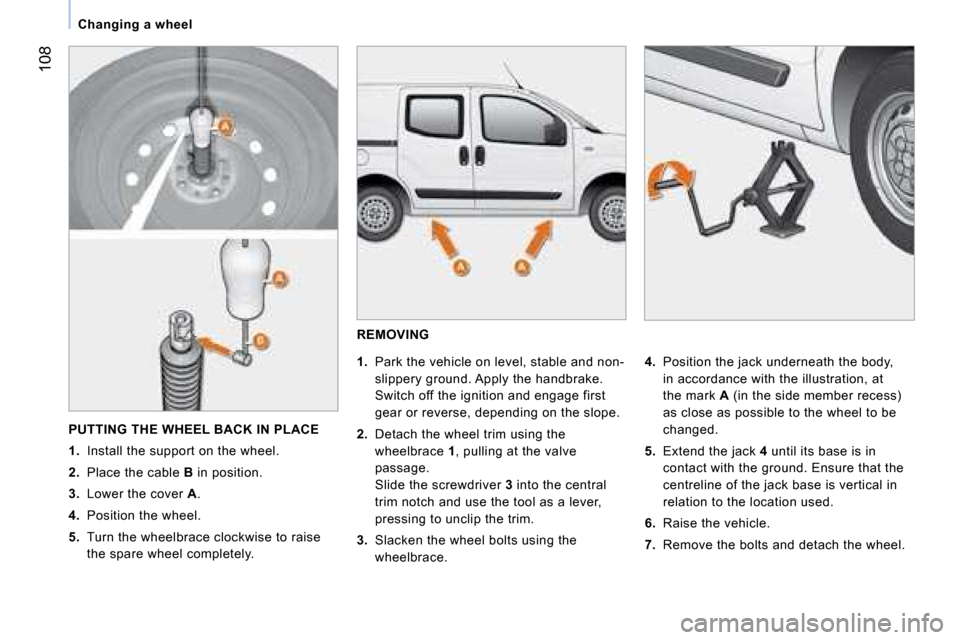
REMOVING
1. Park the vehicle on level, stable and non-
slippery ground. Apply the handbrake.
Switch off the ignition and engage first
gear or reverse, depending on the slope.
2.
Detach the wheel trim using the
wheelbrace 1, pulling at the valve
passage.
Slide the screwdriver 3 into the central
trim notch and use the tool as a lever,
pressing to unclip the trim.
3. Slacken the wheel bolts using the
wheelbrace.
4. Position the jack underneath the body,
in accordance with the illustration, at
the mark A (in the side member recess)
as close as possible to the wheel to be
changed.
5. Extend the jack 4 until its base is in
contact with the ground. Ensure that the
centreline of the jack base is vertical in
relation to the location used.
6. Raise the vehicle.
7. Remove the bolts and detach the wheel.
PUTTING THE WHEEL BACK IN PLACE
1. Install the support on the wheel.
2. Place the cable B in position.
3. Lower the cover A .
4. Position the wheel.
5. Turn the wheelbrace clockwise to raise
the spare wheel completely.
Page 119 of 140
109
7
TROUBLESHOOTING
Changing a wheel
REFITTING THE WHEEL
6. Put the trim back in place, starting by
placing its notch facing the valve, and
press with the palm of your hand.
7. Stow the tools and the wheel.
8. Check the wheel inflation pressure
(see "Identification") and have the
balance checked. Refer to the "Identification features"
section of chapter 8 to locate the tyre
label.
Have the tightening of the bolts and the
pressure of the spare wheel checked by a
CITROËN dealer without delay.
1. Put the wheel in place using the centring
guide 2 to assist you.
2. Screw in the 3 bolts by hand and remove
the centring guide. Position the 4th bolt.
3. Pre-tighten using the wheelbrace 1 .
4. Fold the jack 4 and detach it.
5. Tighten the wheel bolts using the
wheelbrace. Also, have the original wheel repaired
and refitted by a CITROËN dealer as
soon as possible.
Page 120 of 140
110
Changing a wheel
PUNCTURE REPAIR KIT
If present, this is located behind the driver ’s
seat. This consists of:
- a puncture repair bottle A, containing the
filling liquid, fitted with:
�
Page 121 of 140
111
7
TROUBLESHOOTING
Changing a wheel
- If a pressure of at least 1.5 bars is not
reached within 5 minutes:
�
Page 132 of 140
120
Having your vehicle towed
BEING TOWED
Without lifting (four wheels on the ground)
You must always use a towbar.
From the front
The removable towing eye is located in the
tool kit behind the driver ’s seat (Van) or
behind the rear benchseat (Combi).
Unclip the cover using a flat tool.
Screw the removable towing eye in fully.
From the rear
Hook the bar onto the rigid eye located
under the bumper.
With lifting (2 wheels only on the ground)
It is preferable to lift the vehicle using
professional lifting equipment. When being towed with the engine
off, there is no braking or steering
assistance.


