Page 92 of 140
86
Driving safety
PARKING BRAKE
Applying
Pull the parking brake to immobilise your
vehicle.
Check that the parking brake is applied
firmly before leaving the vehicle. If the parking brake is still on or has
not been released properly, this is
indicated by this warning light which
comes on on the instrument panel.
When parking on a slope, direct your wheels
towards the pavement and pull the parking brake.
There is no advantage in engaging a gear
after parking the vehicle, particularly if the
vehicle is loaded.
Releasing
Pull the handle and press the button to lower
the parking brake.
HAZARD WARNING LIGHTS
Press this button, the two direction
indicators flash.
They operate with the ignition off.
When the hazard warning lights are switched
on, the change of direction function, via the
right-hand or left-hand direction indicator, is
deactivated.
Page 93 of 140

87
5
SAFETY
Driving safety
HORN
Press the centre of the steering wheel.
ABS ANTI-LOCK BRAKING SYSTEM
The ABS system improves vehicle stability
and handling during braking, particularly on
surfaces with poor adhesion (e.g. damaged
or slippery road surfaces).
Note: when changing a wheel (tyres
and rims), ensure that they meet the
manufacturer's requirements.
The anti-locking system automatically
intervenes when there is a risk of the wheels
locking.
The normal functioning of the ABS system
may be indicated by light vibrations on the
brake pedal.
When braking in an emergency, press
hard on the brake pedal without releasing
the force.
If the ABS warning lamp lights
up on the instrument panel, this
indicates a malfunction of the ABS
system, which could lead to a loss
of control of the vehicle when braking.
You must stop.
Contact a CITROËN dealer. Good practice
The anti-lock braking system comes into
operation automatically when there is a risk
of wheel lock. It does not permit shorter
braking. On very slippery road surfaces
(ice, oil, etc.) the ABS may lengthen the
braking distances. In emergency braking,
do not hesitate to press the brake pedal
firmly, without releasing the pressure, even
on slippery roads, you will then be able to
continue to manoeuvre the vehicle to avoid
an obstacle.
Page 111 of 140

102
Towing a trailer
In certain cases of particularly arduous
use (towing the maximum load up a steep
slope in high temperatures), the engine
automatically limits its power. In this
case, the automatic cutting off of the air
conditioning allows the engine power to be
recovered. If the coolant temperature
warning light comes on, stop the
vehicle and switch off the engine
as soon as possible.
See the "Levels" section of chapter 7.
Tyres: check the tyre pressures of the
towing vehicle (see the "Identification
features" section of chapter 7) and of
the trailer, observing the recommended
pressure.
Brakes: towing increases the braking
distance. Drive at a moderate speed,
change down early and brake gradually.
Side wind: sensitivity to side wind is
increased. Drive smoothly and at a
moderate speed.
ABS: the system only controls the vehicle,
not the trailer.
Rear parking assistance:
the assistance will be deactivated
automatically when a CITROËN towbar is
used (see the "Rear parking assistance"
section of chapter 4). Towbar
We recommend the use of CITROËN
towbars and their harnesses, which have
been tested and approved from the design
stage of your vehicle, and that the fitting of
this equipment is entrusted to a CITROËN
dealer .
If this equipment is not fitted by a CITROËN
dealer , it is essential that it is fitted using
the electrical pre-equipment located at the
rear of the vehicle in accordance with the
manufacturer ’s instructions.
The operation of the sensors is deactivated
automatically when the pin of the trailer
cable is inserted in the towbar socket.
When the trailer cable pin is removed, the
sensors are re-activated.
Distribution of loads
Distribute the load in the trailer so that the
heaviest objects are as close as possible
to the axle and the nose weight is close to
the maximum authorised without, however,
exceeding it. The air density decreases with
altitude, so reducing the performance of
the engine. The maximum towed load must
be reduced by 10 % for each 1 000 metres
of altitude. Refer to the "Technical data"
chapter for details of the weights and
towed loads applicable to your vehicle and
also to the administrative documents
(V5 registration document, ...).
Page 117 of 140
107
7
TROUBLESHOOTING
Changing a wheel
CHANGING A WHEEL
PARKING THE VEHICLE
As far as possible, park the vehicle on level,
stable and non-slippery ground.
Apply the handbrake, switch off the ignition
and engage first gear (on a hill).
If possible, place a chock under the
wheel diagonally opposite the wheel to be
changed.
TOOLS
The tools required are stored in a tool kit
located behind the driver ’s seat (Van) or
behind the rear benchseat (Combi).
1. Wheelbrace.
2. Centring guide.
3. Screwdriver.
4. Jack with handle.
5. Removable towing eye.
TAKING OUT THE SPARE WHEEL
The spare wheel retaining bolt is located on
the rear left part of the loading sill.
1. Slacken the wheel retaining bolt using the
wheelbrace.
2.
Unscrew fully to unwind the cable winch.
3. Take out the spare wheel using the
wheelbrace.
4. Raise the cover A .
5. Remove the cable B from its housing.
6. Release the spare wheel and place it
near the wheel to be changed.
Page 118 of 140
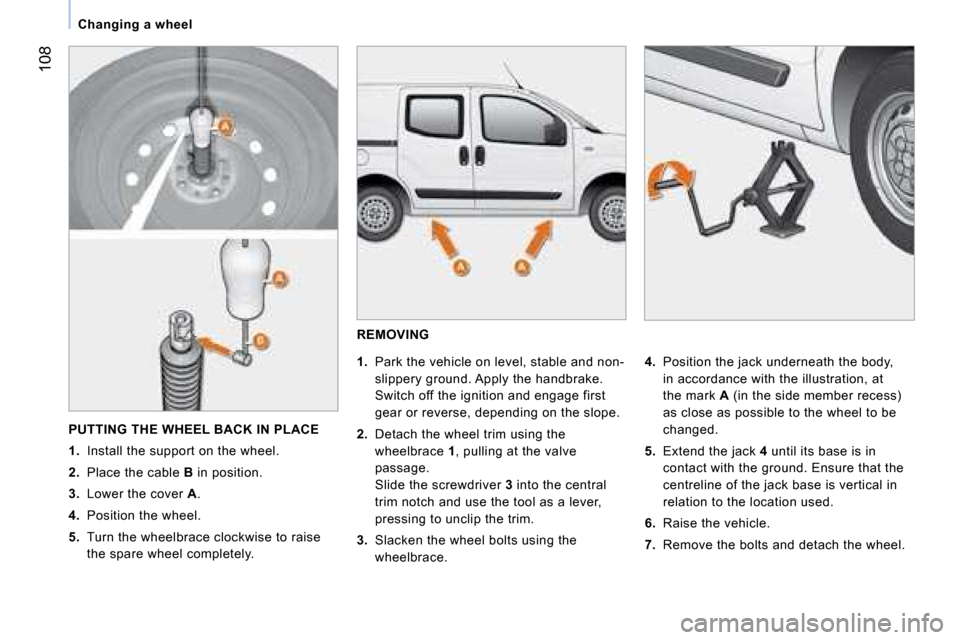
108
Changing a wheel
REMOVING
1. Park the vehicle on level, stable and non-
slippery ground. Apply the handbrake.
Switch off the ignition and engage first
gear or reverse, depending on the slope.
2.
Detach the wheel trim using the
wheelbrace 1, pulling at the valve
passage.
Slide the screwdriver 3 into the central
trim notch and use the tool as a lever,
pressing to unclip the trim.
3. Slacken the wheel bolts using the
wheelbrace.
4. Position the jack underneath the body,
in accordance with the illustration, at
the mark A (in the side member recess)
as close as possible to the wheel to be
changed.
5. Extend the jack 4 until its base is in
contact with the ground. Ensure that the
centreline of the jack base is vertical in
relation to the location used.
6. Raise the vehicle.
7. Remove the bolts and detach the wheel.
PUTTING THE WHEEL BACK IN PLACE
1. Install the support on the wheel.
2. Place the cable B in position.
3. Lower the cover A .
4. Position the wheel.
5. Turn the wheelbrace clockwise to raise
the spare wheel completely.
Page 126 of 140

115
7
TROUBLESHOOTING
Changing a bulb
REAR LIGHTS
For further information concerning the bulbs,
refer to the table "Types of bulb".
1. Brake lights
Type B, P21 W - 21 W
2. Direction indicators
Type B, PY 21 W - 21 W - amber
3. Reversing lights
Type B, P21 W - 21 W
4. Side lights /Fog lamps
Type B, P4/21 W - 4 W/21 W - Identify the faulty bulb then open the rear
doors.
- Unscrew the two screws using the screwdriver supplied in the tool kit
(behind the driver ’s seat) and extract the
bulb holder.
- Release the light unit.
- Disconnect the electrical connector.
- Remove the support by moving aside the tabs.
- Change the bulb.
NUMBER PLATE LIGHTS
Type A, C 5 W - 5 W
- Unclip the transparent cover using the screwdriver supplied in the tool kit
(behind the driver ’s seat) and extract the
bulb holder. - Change the bulb by moving aside
the two contacts.
- Ensure that the new bulbs are secured correctly between the two contacts.
- Replace the plastic lens and press on it.
THIRD BRAKE LIGHT
Type B, W 5 W - 5 W (4 bulbs)
- Unclip the transparent cover using the screwdriver located in the tool kit
(behind the driver).
- Disconnect the electrical connector.
- Remove the bulb holder by squeezing the two tabs.
- Remove the faulty bulb.
- Change the bulb.
If you encounter any difficulty, consult a
CITROËN dealer.
Page 131 of 140
118
Changing a fuse
DRIVER’S SIDE FASCIA PANEL FUSES
Identifi cation mark Amperage
Functions
F12 7.5 A Right-hand dipped headlamp supply
F13 7.5 A Left-hand dipped headlamp supply - headlamp height adjuster
F31 5 A Engine control unit supply switch
F32 7.5 A Front light - front courtesy light - rear courtesy light lamp
F36 10 A Audio equipment - mobile telephone pre-equipment - air conditioning control panel - EODB diag socket
F37 5 A Brake light - instrument panel
F38 20 A Locking of the doors
F43 15 A Wipers pump
F47 20 A Driver ’s electric window motor supply
F48 20 A Passenger ’s electric window motor supply
F49 5 A Parking assistance control unit - rear lighting sw itch - electric exterior mirrors
F50 7.5 A Air bags control unit
F51 5 A Switch on brake pedal - switch on clutch pedal
F53 5 A Instrument panel - rear fog lamps
Page 136 of 140
125
7
TROUBLESHOOTING
Under the bonnet
Diesel engine
UNDER THE BONNET
4. Brake and clutch fluid reservoir.
5. Air filter.
6. Dipstick.
7. Engine oil filler cap.
8. Power steering fluid reservoir.
1. Windscreen wash reservoir.
2. Fuse box.
3. Engine coolant reservoir.


