Page 60 of 163
63
3
ERGONOMICS AND COMFORT
Practical information
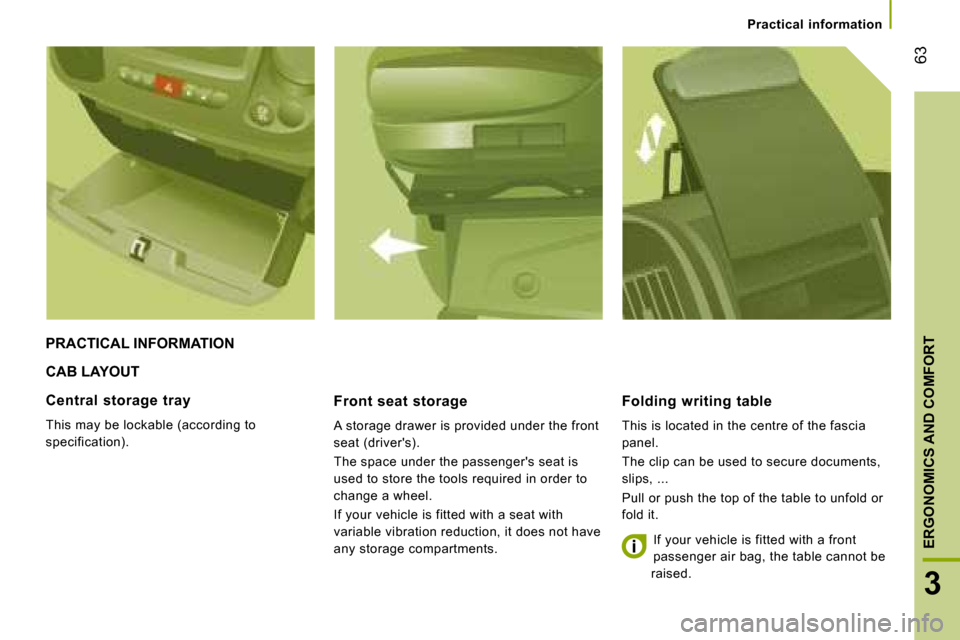
CAB LAYOUT Front seat storage
A storage drawer is provided under the front
seat (driver's).
The space under the passenger's seat is
used to store the tools required in order to
change a wheel.
If your vehicle is fitted with a seat with
variable vibration reduction, it does not have
any storage compartments. Folding writing table
This is located in the centre of the fascia
panel.
The clip can be used to secure documents,
slips, ...
Pull or push the top of the table to unfold or
fold it.
PRACTICAL INFORMATION
Central storage tray
This may be lockable (according to
specification).
If your vehicle is fitted with a front
passenger air bag, the table cannot be
raised.
Page 63 of 163
66
Practical information
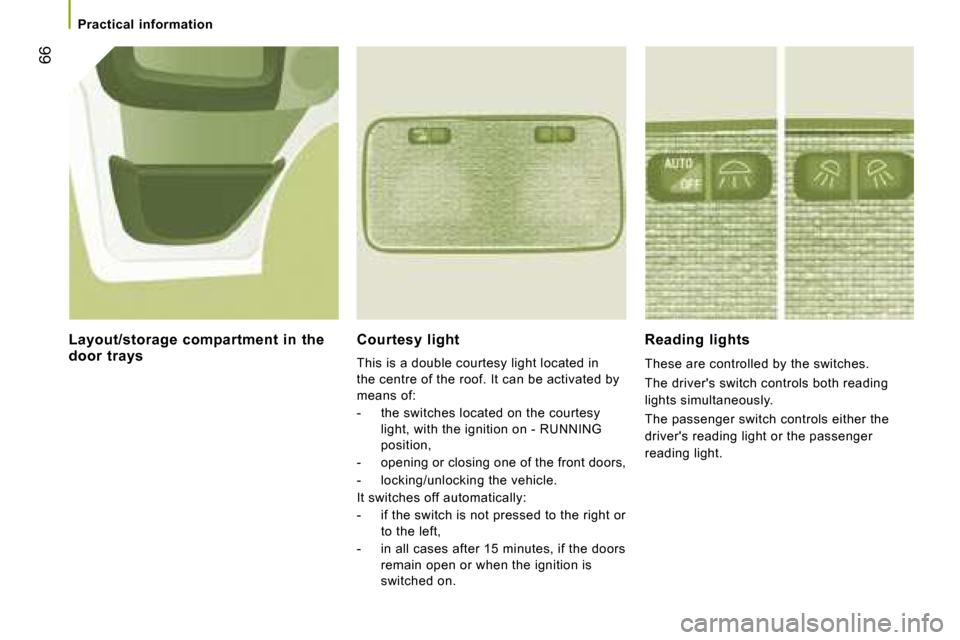
Courtesy light
This is a double courtesy light located in
the centre of the roof. It can be activated by
means of:
- the switches located on the courtesy light, with the ignition on - RUNNING
position,
- opening or closing one of the front doors,
- locking/unlocking the vehicle.
It switches off automatically:
- if the switch is not pressed to the right or to the left,
- in all cases after 15 minutes, if the doors remain open or when the ignition is
switched on. Reading lights
These are controlled by the switches.
The driver's switch controls both reading
lights simultaneously.
The passenger switch controls either the
driver's reading light or the passenger
reading light.
Layout/storage compartment in the
door trays
Page 70 of 163
73
4
IN-CAR TECHNOLOGY
Mode
Menu… Press... Sub-menu… Press... Select…
Confirm
and exit
Enables you to...
4 Setting
the time Hours/
Minutes
Increase
Set the clock.
Decrease
Time format 24
Select the clock display mode.
12
5 Setting
the date Year/Month/
Day Activate
Set the date.
Deactivate
6 See radio ON
Display the name of the station.
OFF
7 Autoclose While moving ON
Activate/Deactivate the
automatic locking of the doors
above approx 12 mph (20 km/h).
OFF
8 Measurement
unit
Distance Km
Select the distance display
unit.
Miles
Consumption km/l
Select the consumption display
unit.
l/100 km
9 Languages List of languages
available Select the display language.
10
Volume of
announcements Increase
Increase/decrease the volume
of the announcements.
Decrease
Page 99 of 163
101
5
Driving safety
SAFETY
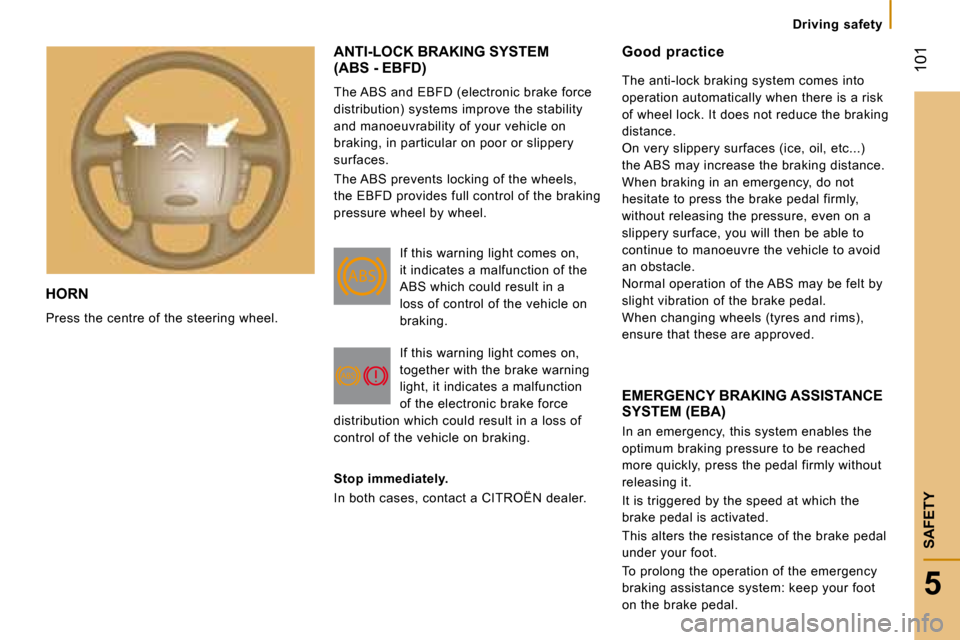
HORN
Press the centre of the steering wheel. ANTI-LOCK BRAKING SYSTEM
(ABS - EBFD)
The ABS and EBFD (electronic brake force
distribution) systems improve the stability
and manoeuvrability of your vehicle on
braking, in particular on poor or slippery
surfaces.
The ABS prevents locking of the wheels,
the EBFD provides full control of the braking
pressure wheel by wheel.
EMERGENCY BRAKING ASSISTANCE
SYSTEM (EBA)
In an emergency, this system enables the
optimum braking pressure to be reached
more quickly, press the pedal firmly without
releasing it.
It is triggered by the speed at which the
brake pedal is activated.
This alters the resistance of the brake pedal
under your foot.
To prolong the operation of the emergency
braking assistance system: keep your foot
on the brake pedal.
Good practice
The anti-lock braking system comes into
operation automatically when there is a risk
of wheel lock. It does not reduce the braking
distance.
On very slippery surfaces (ice, oil, etc...)
the ABS may increase the braking distance.
When braking in an emergency, do not
hesitate to press the brake pedal firmly,
without releasing the pressure, even on a
slippery surface, you will then be able to
continue to manoeuvre the vehicle to avoid
an obstacle.
Normal operation of the ABS may be felt by
slight vibration of the brake pedal.
When changing wheels (tyres and rims),
ensure that these are approved.
If this warning light comes on,
it indicates a malfunction of the
ABS which could result in a
loss of control of the vehicle on
braking.
If this warning light comes on,
together with the brake warning
light, it indicates a malfunction
of the electronic brake force
distribution which could result in a loss of
control of the vehicle on braking.
Stop immediately.
In both cases, contact a CITROËN dealer.
Page 103 of 163
104
Seat belts
SEAT BELTS
CAB SEAT BELTS
The front seats are fitted with pre-tensioners
and force limiters.
REAR SEAT BELTS
The seats/bench seats are fitted with
three-point seat belts and inertia reels.
The centre seat has a seat belt guide and
inertia reel, solid with the seat back.
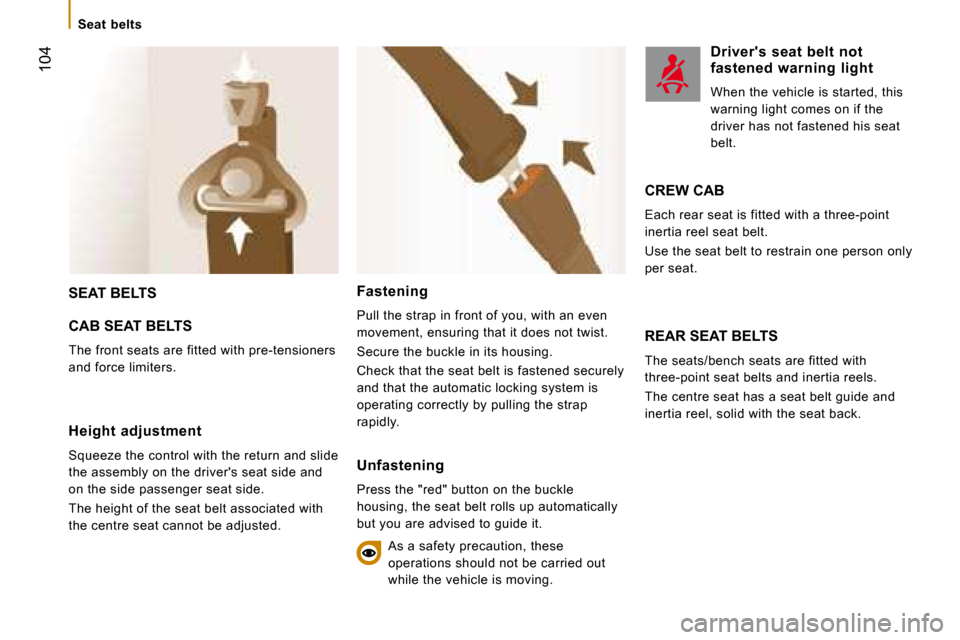
Height adjustment
Squeeze the control with the return and slide
the assembly on the driver's seat side and
on the side passenger seat side.
The height of the seat belt associated with
the centre seat cannot be adjusted.
Fastening
Pull the strap in front of you, with an even
movement, ensuring that it does not twist.
Secure the buckle in its housing.
Check that the seat belt is fastened securely
and that the automatic locking system is
operating correctly by pulling the strap
rapidly.
Unfastening
Press the "red" button on the buckle
housing, the seat belt rolls up automatically
but you are advised to guide it.
As a safety precaution, these
operations should not be carried out
while the vehicle is moving.
Driver's seat belt not
fastened warning light
When the vehicle is started, this
warning light comes on if the
driver has not fastened his seat
belt.
CREW CAB
Each rear seat is fitted with a three-point
inertia reel seat belt.
Use the seat belt to restrain one person only
per seat.
Page 104 of 163
105
5
SAFETY
Seat belts
The force limiter reduces the pressure of the
seat belt against the body of the occupants.
The pretensioning seat belts are active
when the ignition is switched on.
The inertia reels are fitted with a device
which automatically locks the strap in the
event of a collision or emergency braking or
if the vehicle rolls over.
You can unfasten the seat belt by pressing
the red button on the buckle. Guide the seat
belt after unfastening.
Good practice
The driver must ensure that passengers use
the seat belts correctly and that they are all
strapped in securely before moving off.
Wherever you are seated in the vehicle,
always fasten your seat belt, even for short
journeys.
The seat belts are fitted with an inertia reel
which automatically adjusts the length of the
strap to your size.
Do not use accessories (clothes pegs, clips,
safety pins, etc.) which permit a clearance
with the seat belt straps.
Ensure that the seat belt is rolled up
correctly after use.
After folding or moving a seat or a rear
bench seat, ensure that the seat belt is
rolled up correctly and that the buckle is
ready to accommodate the tongue.
Depending on the nature and seriousness
of any impact, the pretensioning device may
be triggered before and independently of
inflation of the air bags. It instantly tightens
the seat belts against the body of the
occupants.
Triggering of the pretensioners is
accompanied by a slight discharge of
harmless smoke and a noise, due to the
activation of the pyrotechnic cartridge
incorporated in the system.
The air bag warning light comes
on if the pretensioners are
triggered. Consult a CITROËN
dealer.
In order to be effective, a seat belt must:
- restrain one person only,
- must not be twisted, check by pulling in
front of you with an even movement,
- be tightened as close to the body as
possible.
The upper part of the seat belt should be
positioned in the hollow of the shoulder.
The lap part should be placed as low as
possible on the pelvis.
Do not invert the seat belt buckles as they
will not fulfil their role completely.
If the seats are fitted with armrests, the lap
part of the seat belt should always pass
under the armrest.
Check that the seat belt is fastened correctly
by pulling the strap firmly.
Recommendations for children:
- use a suitable child seat if the
passenger is less than 12 years old or
shorter than one metre fifty,
- never allow a child to travel on your lap,
even with the seat belt fastened.
For further information regarding child
seats, refer to the "Children on board"
section of chapter 5.
In accordance with current safety
regulations, your CITROËN dealer
guarantees all work or any checks, from
testing to maintenance, on your seat belt
equipment.
Have the seat belts checked regularly
(even after a minor impact) by a CITROËN
dealer: they must not show any signs of
wear, cutting or fraying and they must not be
transformed or modified.
Clean the seat belt straps with soapy
water or a textile cleaning product, sold
by CITROËN dealers.
Page 105 of 163
106
Improved safety and security
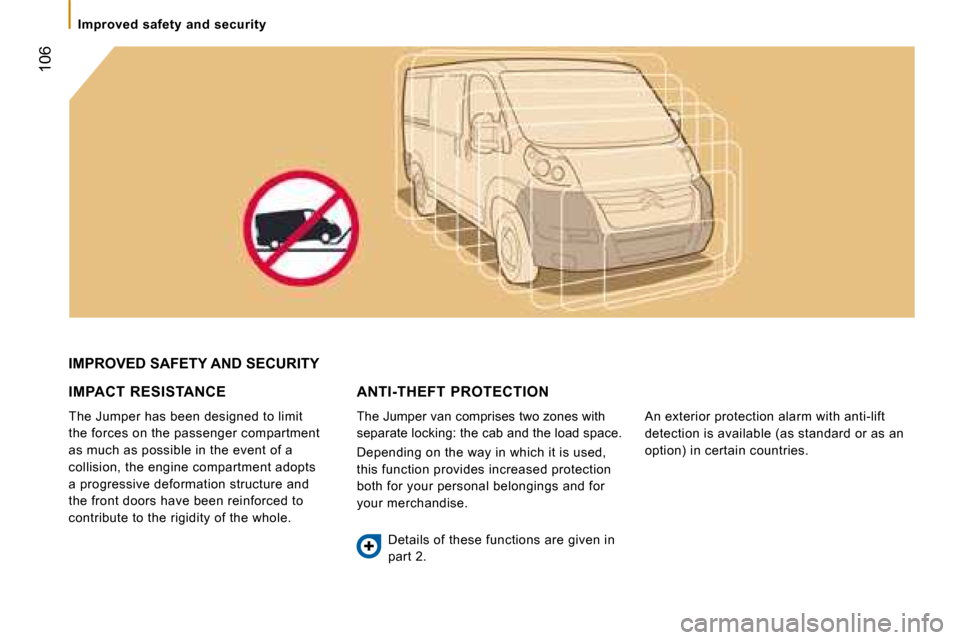
IMPROVED SAFETY AND SECURITY
IMPACT RESISTANCE
The Jumper has been designed to limit
the forces on the passenger compartment
as much as possible in the event of a
collision, the engine compartment adopts
a progressive deformation structure and
the front doors have been reinforced to
contribute to the rigidity of the whole.
ANTI-THEFT PROTECTION
The Jumper van comprises two zones with
separate locking: the cab and the load space.
Depending on the way in which it is used,
this function provides increased protection
both for your personal belongings and for
your merchandise. Details of these functions are given in
part 2. An exterior protection alarm with anti-lift
detection is available (as standard or as an
option) in certain countries.
Page 112 of 163
111
5
SAFETY
Child safety
The child seats function is shared by
the entire CITROËN range. However,
each individual model has its own special
features. "ISOFIX" MOUNTINGS
These seats are fitted with
ISOFIX mountings.
If your vehicle is fitted with this function, the
passenger air bag must be disarmed using
the trip computer MODE button.
The intermediate longitudinal position is not
adjustable with the 2-seat bench.
The passenger must not travel with a child
on his lap.
This ISOFIX mounting system guarantees
reliable, safe and fast fitting of the child seat
in your vehicle.
These are two rings located between the
seat back and the seat cushion .
The ISOFIX child seats are fitted with two
locks which are secured easily on these
rings.