Page 51 of 114
7-6
1
2
3
4
5
67
8
9
10
11
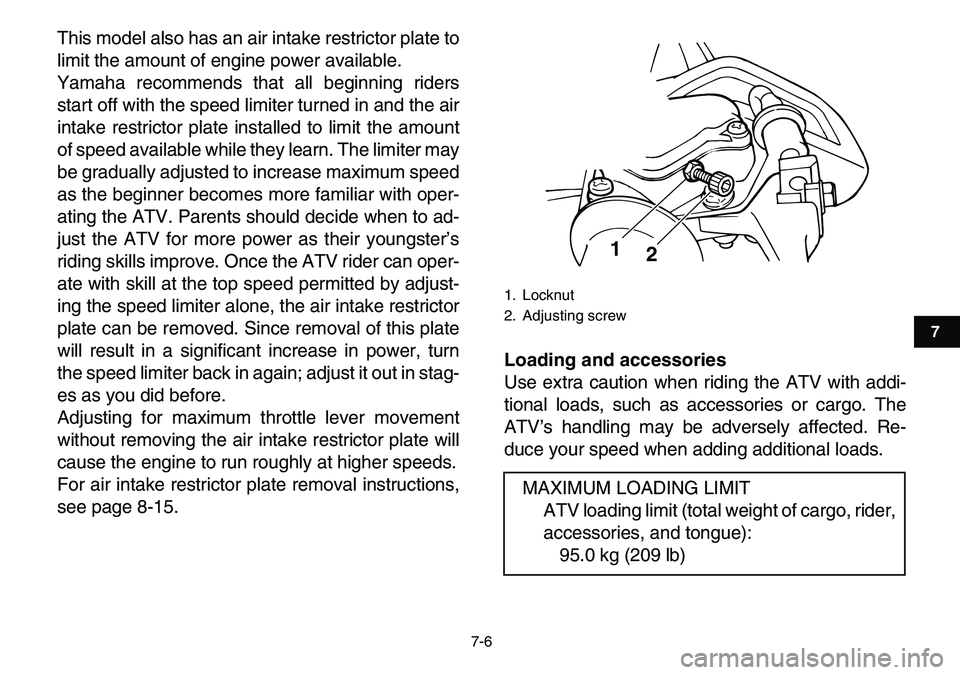
This model also has an air intake restrictor plate to
limit the amount of engine power available.
Yamaha recommends that all beginning riders
start off with the speed limiter turned in and the air
intake restrictor plate installed to limit the amount
of speed available while they learn. The limiter may
be gradually adjusted to increase maximum speed
as the beginner becomes more familiar with oper-
ating the ATV. Parents should decide when to ad-
just the ATV for more power as their youngster’s
riding skills improve. Once the ATV rider can oper-
ate with skill at the top speed permitted by adjust-
ing the speed limiter alone, the air intake restrictor
plate can be removed. Since removal of this plate
will result in a significant increase in power, turn
the speed limiter back in again; adjust it out in stag-
es as you did before.
Adjusting for maximum throttle lever movement
without removing the air intake restrictor plate will
cause the engine to run roughly at higher speeds.
For air intake restrictor plate removal instructions,
see page 8-15.
Loading and accessories
Use extra caution when riding the ATV with addi-
tional loads, such as accessories or cargo. The
ATV’s handling may be adversely affected. Re-
duce your speed when adding additional loads.
1. Locknut
2. Adjusting screw
MAXIMUM LOADING LIMIT
ATV loading limit (total weight of cargo, rider,
accessories, and tongue):
95.0 kg (209 lb)
1
2
Page 61 of 114

7-16
1
2
3
4
5
67
8
9
10
11
If your ATV has stalled or stopped and you believe
you can continue up the hill, restart carefully to
make sure you do not lift the front wheels which
could cause you to lose control. If you are unable
to continue up the hill, dismount the ATV on the up-
hill side. Physically turn the ATV around and then
descend the hill.
If you start to roll backwards, DO NOT apply the
rear brake to stop or try to put the ATV in gear. The
ATV could easily tip over backwards. Instead, ap-
ply the front brake gradually, or dismount the ATV
immediately on the uphill side.
WARNING
EWB01711
Use the proper gear and maintain a steady
speed when climbing a hill.
If you lose all forward speed:
�
Keep weight uphill.
�
Apply the brakes.
�
Lock the parking brake after you are
stopped.
If you begin rolling backwards:
�
Keep weight uphill.
�
Never apply the rear brake while rolling
backwards. Apply the front brake.
�
When fully stopped, apply the rear brake as
well, and then lock the parking brake.
Dismount on uphill side or to a side if pointed
straight uphill. Turn the ATV around and re-
mount, following the procedure described in
the Owner’s Manual.
OK
Page 89 of 114
8-21
1
2
3
4
5
6
78
9
10
11
12.0 mm (0.39–0.47 in) as shown. If the free play
is incorrect, adjust it as follows.
1. Loosen the upper locknut and fully turn in the
upper adjusting bolt.
2. Loosen the lower locknut.
3. Turn the lower adjusting bolt in direction (a) to
increase the free play, and in direction (b) to
decrease it.4. Tighten the lower locknut.
5. While applying the front brake, turn out the up-
per adjusting bolt until the upper and lower ca-
ble lengths are equal. The cable joint will
become vertical.
1. Brake lever free play
1
1. Upper locknut
2. Upper adjusting bolt
3. Lower locknut
4. Lower adjusting bolt
1
2
4
3(a)(b)(a)
(b)
Page 90 of 114

8-22
1
2
3
4
5
6
78
9
10
11
6. Tighten the upper locknut.
WARNING
EWB02080
Operating with improperly serviced or adjust-
ed brakes could cause loss of braking ability,
which could lead to an accident.
After servicing:
�
Make sure the brakes operate smoothly and
that the free play is correct.
�
Make sure the brakes do not drag.
Replacement of brake components requires
professional knowledge. These procedures
should be performed by a Yamaha dealer.
EBU24473
Adjusting the rear brake lever and
brake pedal free play
The brake lever and brake pedal free play must be
checked and, if necessary, adjusted at the inter-
vals specified in the periodic maintenance and lu-
brication chart.
NOTE:
�
Always perform this maintenance completely in
the following order whenever adjusting the rear
brake.
�
Before adjusting the brake lever and brake pedal
free play, check the rear brake shoes for wear.
Adjusting the brake lever free play
The brake lever free play should measure 5.0–8.0
mm (0.20–0.31 in) as shown. If the free play is in-
correct, adjust it as follows.
1. Cable joint
1
Page 91 of 114

8-23
1
2
3
4
5
6
78
9
10
11
1. Loosen the locknut at the brake lever.
2. Turn the brake lever free play adjusting bolt at
the brake lever in direction (a) to increase the
free play, and in direction (b) to decrease it.
3. Tighten the locknut at the brake lever.
If the specified free play cannot be obtained,
proceed with the following steps.
4. Loosen the locknut at the brake lever.
5. Fully turn the adjusting bolt at the brake lever
in direction (a) to loosen the brake cable.
6. To increase the brake lever free play, turn theadjusting nut on the brake cable at the rear
wheel hub in direction (a), and to decrease it,
turn the nut in direction (b).
7. Tighten the locknut at the crankcase and the
brake lever.NOTE:
If the specified free play cannot be obtained as de-
scribed above or if the rear brake does not operate
correctly, have a Yamaha dealer check the internal
rear brake mechanism.
When adjusting the rear brake lever free play:
�
Be sure not to step on the brake pedal.
1. Locknut
2. Brake lever free play adjusting bolt
3. Brake lever free play
312
(a)
(b)
1. Brake lever free play adjusting nut
1
(a)
(b)
Page 93 of 114

8-25
1
2
3
4
5
6
78
9
10
11
EBU24781
Adjusting the clutch free play
The clutch free play must be adjusted periodically.
Adjust the free play as follows.
1. Remove the rubber cap.
2. Loosen the locknut.
3. Slowly turn the adjusting bolt clockwise until
resistance is felt, and then turn it 1/8 counter-
clockwise.
NOTE:
Turning the adjusting bolt in decreases clutch free
play and turning it out increases clutch free play.
4. Tighten the locknut to the specified torque.
NOTE:
When tightening the locknut, hold the adjusting
bolt with a screwdriver so that the adjusting bolt
does not turn together with the locknut.
5. Install the rubber cap securely.
EBU24900
Checking and lubricating the cables
The operation and the condition of all control ca-
bles should be checked before each ride, and the
cables and cable ends should be lubricated if nec-
essary. If a cable is damaged or does not move
smoothly, have a Yamaha dealer check or replace
it.
1. Rubber cap
2. Locknut
3. Adjusting bolt
1
2
3
Tightening torque:
Locknut:
8 Nm (0.8 m·kgf, 5.8 ft·lbf)
Recommended lubricant:
Engine oil
Page 103 of 114

9-1
1
2
3
4
5
6
7
89
10
11
EBU25860
CLEANING AND STORAGE
EBU25880
Cleaning
Frequent, thorough cleaning of your ATV will not
only enhance its appearance but will improve its
general performance and extend the useful life of
many components.
1. Before cleaning the ATV:
a. Block off the end of the exhaust pipe to
prevent water entry. A plastic bag and
strong rubber band may be used.
b. Make sure the spark plug and all filler caps
are properly installed.
2. If the engine case is excessively greasy, apply
degreaser with a paint brush. Do not apply de-
greaser to the wheel axles.
3. Rinse the dirt and degreaser off with a garden
hose. Use only enough pressure to do the job.
CAUTION:
ECB00710
Excessive water pressure may cause water
seepage and deterioration of wheel bearings,
brakes, transmission seals and electrical de-
vices. Many expensive repair bills have result-
ed from improper high-pressure detergentapplications such as those available in coin-
operated car washers.
4. Once most of the dirt has been hosed off,
wash all surfaces with warm water and mild,
detergent-type soap. An old toothbrush or bot-
tle brush is handy for hard-to-reach places.
5. Rinse the ATV off immediately with clean wa-
ter and dry all surfaces with a chamois, clean
towel or soft absorbing cloth.
6. Clean the seat with a vinyl upholstery cleaner
to keep the cover pliable and glossy.
7. Automotive type wax may be applied to all
painted and chrome plated surfaces. Avoid
combination cleaner-waxes. Many contain
abrasives which may mar the paint or protec-
tive finish. When finished cleaning, start the
engine and let it idle for several minutes.WARNING
EWB02310
Wet brakes may have reduced stopping ability,
increasing the chance of an accident. Test the
brakes after washing. Apply the brakes several
times at slow speeds to let friction dry out the
Page 105 of 114
9-3
1
2
3
4
5
6
7
89
10
11
the spark plug cap.
6. Lubricate all control cables and the pivoting
points of all levers and pedals.
7. Check and, if necessary, correct the tire air
pressure, and then block up the ATV so that
all of its wheels are off the ground. Alternative-
ly, turn the wheels a little every month in order
to prevent the tires from becoming degraded
in one spot.
8. Cover the muffler outlet with a plastic bag to
prevent moisture from entering it.
9. Remove the battery and fully charge it. Store
it in a cool, dry place and charge it once a
month. Do not store the battery in an exces-
sively cold or warm place [less than 0 °C (30
°F) or more than 30 °C (90 °F)]. For more in-
formation on storing the battery, see page 8-
28.
NOTE:
Make any necessary repairs before storing the
ATV.

