Page 10 of 142

Adjusting the rear brake lever free play
and checking the brake pedal position ... 8-40
Axle boots ................................................ 8-42
Brake light switches ................................. 8-43
Checking and lubricating the cables ........ 8-43
Checking and lubricating the front and
rear brake levers .................................... 8-44
Checking and lubricating the brake
pedal ...................................................... 8-44
Checking the wheel bearings ................... 8-45
Lubricating the drive shaft universal
joint ......................................................... 8-45
Lubricating the steering shaft ................... 8-45
Battery ...................................................... 8-45
Replacing a fuse ...................................... 8-47
Replacing a headlight bulb ....................... 8-49
Adjusting a headlight beam ...................... 8-51
Replacing the tail/brake light bulb ............ 8-51
Removing a wheel .................................... 8-52
Installing a wheel ...................................... 8-53
Troubleshooting ....................................... 8-54
Troubleshooting charts ............................. 8-55
CLEANING AND STORAGE .......................... 9-1
Cleaning ..................................................... 9-1
Storage ....................................................... 9-2SPECIFICATIONS .......................................10-1
CONSUMER INFORMATION.......................11-1
Identification numbers ...............................11-1
U3C261E0.book Page 3 Thursday, June 29, 2006 4:15 PM
Page 18 of 142
3-1
3
EBU17680
DESCRIPTION
EBU17690Left view
EBU17700Right view
1. Front shock absorber assembly spring preload adjusting
ring
2. Fuel cock
3. Air filter case
4. Fuses
5. Storage compartment and tool kit
6. Seat lock lever
7. Rear shock absorber assembly spring preload adjusting
ring
8. Engine oil filler cap
9. Oil filter cartridge
10.Coolant reservoir
11.V-belt cooling duct check hose
1. Spark arrester
2. Tail/brake light
3. Battery
4. Spark plug
5. Rear brake fluid reservoir
6. Radiator cap
7. Front shock absorber assembly spring preload adjusting
ring
8. Brake light switch
9. Brake pedal
10.V-belt case drain plug
U3C261E0.book Page 1 Thursday, June 29, 2006 4:15 PM
Page 23 of 142

4-4
4
EBU18061Handlebar switches EBU18080Engine stop switch “/”
Set this switch to “” before starting the engine.
The engine stop switch controls the ignition and
stops the engine when it is running. Use this switch
to stop the engine in an emergency situation. The
engine will not start or run when this switch is set
to “”.
EBU18100Start switch “”
Push this switch to crank the engine with the start-
er.CAUTION:ECB00050See the starting instructions on page 6-1 priorto starting the engine.EBU18151Light switch “//OFF”
Set this switch to “” to turn on the low beams
and the taillight. Set the switch to “” to turn on
the high beams and the taillight. Set the switch to
“OFF” to turn off all the lights.CAUTION:ECB00040Do not use the headlights with the engine
turned off for an extended period of time, oth-
erwise the battery may discharge to the point
that the starter motor will not operate properly.
If this should happen, remove the battery andrecharge it.
1. Light switch “//OFF”
2. Engine stop switch “/”
3. Start switch “”U3C261E0.book Page 4 Thursday, June 29, 2006 4:15 PM
Page 44 of 142
6-2
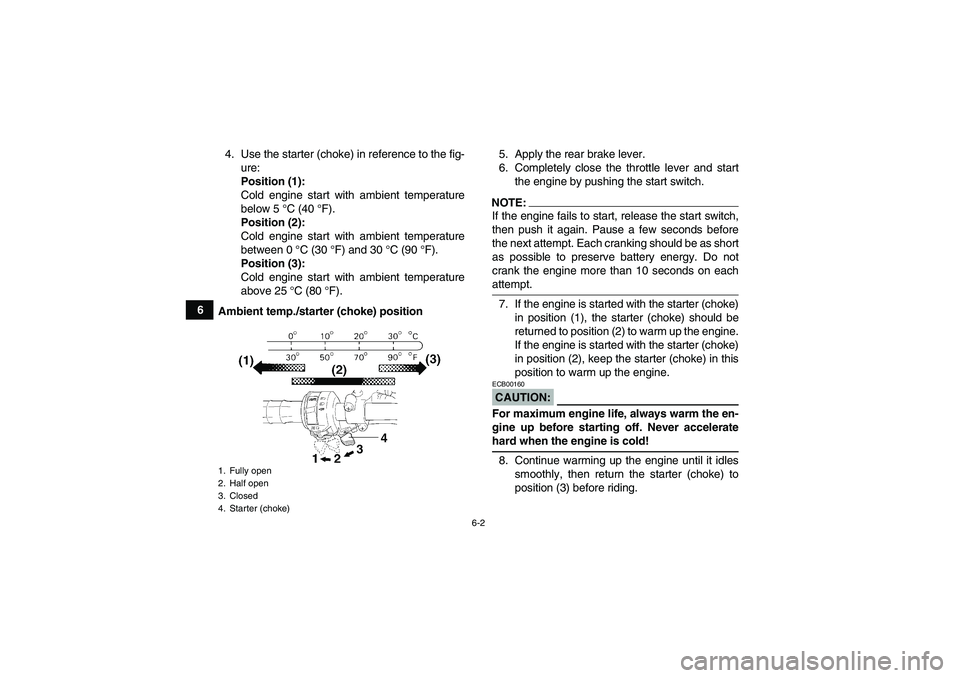
64. Use the starter (choke) in reference to the fig-
ure:
Position (1):
Cold engine start with ambient temperature
below 5 °C (40 °F).
Position (2):
Cold engine start with ambient temperature
between 0 °C (30 °F) and 30 °C (90 °F).
Position (3):
Cold engine start with ambient temperature
above 25 °C (80 °F).
Ambient temp./starter (choke) position5. Apply the rear brake lever.
6. Completely close the throttle lever and start
the engine by pushing the start switch.
NOTE:If the engine fails to start, release the start switch,
then push it again. Pause a few seconds before
the next attempt. Each cranking should be as short
as possible to preserve battery energy. Do not
crank the engine more than 10 seconds on eachattempt.
7. If the engine is started with the starter (choke)
in position (1), the starter (choke) should be
returned to position (2) to warm up the engine.
If the engine is started with the starter (choke)
in position (2), keep the starter (choke) in this
position to warm up the engine.CAUTION:ECB00160For maximum engine life, always warm the en-
gine up before starting off. Never acceleratehard when the engine is cold!
8. Continue warming up the engine until it idles
smoothly, then return the starter (choke) to
position (3) before riding.
1. Fully open
2. Half open
3. Closed
4. Starter (choke)U3C261E0.book Page 2 Thursday, June 29, 2006 4:15 PM
Page 119 of 142

8-45
8
EBU24961Checking the wheel bearings The front and rear wheel bearings must be
checked at the intervals specified in the periodic
maintenance and lubrication chart. If there is play
in a wheel hub or if a wheel does not turn smoothly,
have a Yamaha dealer check the wheel bearings.EBU24980Lubricating the drive shaft universal
joint The drive shaft universal joint must be lubricated at
the intervals specified in the periodic maintenance
and lubrication chart.
EBU25100Lubricating the steering shaft The steering shaft must be lubricated at the inter-
vals specified in the periodic maintenance and lu-
brication chart.EBU25222Battery This model is equipped with a sealed-type (MF)
battery, which does not require any maintenance.
There is no need to check the electrolyte or to add
distilled water. Check and, if necessary, tighten the
battery lead connections.CAUTION:ECB00620Never attempt to remove the battery cell seals,as this would permanently damage the battery.Recommended lubricant:
Lithium-soap-based grease
Recommended lubricant:
Lithium-soap-based grease
U3C261E0.book Page 45 Thursday, June 29, 2006 4:15 PM
Page 120 of 142

8-46
8
WARNING
EWB02160Battery electrolyte is poisonous and danger-
ous, as it contains sulfuric acid, which can
cause severe burns. Avoid contact with skin,
eyes or clothing. Always shield your eyes
when working near batteries.
Antidote:
EXTERNAL: Flush with water.
INTERNAL: Drink large quantities of water or
milk. Follow with milk of magnesia, beaten egg
or vegetable oil. Call a physician immediately.
EYES: Flush with water for 15 minutes and get
prompt medical attention.
Batteries produce explosive gases. Keep
sparks, flame, cigarettes or other sources of ig-
nition away. Ventilate when charging or using
in an enclosed space.KEEP OUT OF REACH OF CHILDREN.
To charge the battery
Have a Yamaha dealer charge the battery as soon
as possible if it seems to have discharged. Keep in
mind that the battery tends to discharge more
quickly if the ATV is equipped with optional electri-
cal accessories.To store the battery
1. If the ATV will not be used for more than one
month, remove the battery, fully charge it, and
then place it in a cool, dry place.
2. If the battery will be stored for more than two
months, check it at least once a month and ful-
ly charge it if necessary.
To install the battery
NOTE:Be sure the battery is fully charged.
1. Place the battery in its compartment.
2. Make sure to properly connect the battery
leads to the battery terminals.
U3C261E0.book Page 46 Thursday, June 29, 2006 4:15 PM
Page 121 of 142
8-47
8
CAUTION:ECB00630�Always keep the battery charged. Storing a
discharged battery can cause permanent
battery damage.�To charge a sealed-type (MF) battery, a spe-
cial constant-voltage battery charger is re-
quired. Using a conventional battery charger
will damage the battery. If you do not have
access to a constant-voltage battery charg-
er, have a Yamaha dealer charge your bat-tery.
EBU25323Replacing a fuse
1. Positive battery terminal
2. Negative battery terminal
1. Main fuse
2. Spare main fuse
3. Fuse box
U3C261E0.book Page 47 Thursday, June 29, 2006 4:15 PM
Page 129 of 142

8-55
8
EBU25781Troubleshooting charts Starting problems or poor engine performance
Check the fuel level in
the fuel tank.1. Fuel
There is enough fuel.
There is no fuel.
Check the compression.
Supply fuel.
The engine does not start.
Check the compression.
Operate the electric starter.2. Compression
There is compression.
There is no compression.
Check the ignition.
Have a Yamaha dealer
check the ATV.
Remove the spark plug
and check the electrodes.3. Ignition
Wipe off with a dry cloth and correct the
spark plug gap, or replace the spark plug.
Have a Yamaha dealer check the ATV.
The engine does not start.
Have a Yamaha dealer
check the ATV.
The engine does not start.
Check the battery.
Operate the electric starter.4. Battery
The engine turns over
quickly.
The engine turns over
slowly.
The battery is good.Check the battery lead connections,
and charge the battery if necessary.
DryWet
Open the throttle halfway and operate
the electric starter.
U3C261E0.book Page 55 Thursday, June 29, 2006 4:15 PM

