Page 88 of 124
8-17
83. Pull the air filter element out of the air filter
case.4. Pull off the lock plate, and then remove the
sponge material from the air filter element
frame.
1. Air filter case holder
2. Air filter case cover
1. Air filter element
U3D561E0.book Page 17 Thursday, June 29, 2006 11:03 AM
Page 89 of 124

8-18
8 5. Wash the sponge material gently but thor-
oughly in solvent.
WARNING
EWB01940Always use parts cleaning solvent to clean the
sponge material. Never use low-flash-point
solvents or gasoline to clean the sponge mate-
rial because the engine could catch fire or ex-plode.
6. Squeeze the excess solvent out of the sponge
material and let it dry.
CAUTION:ECB00440Do not twist the sponge material when squeez-ing it.
7. Check the sponge material and replace it if
damaged.
8. Apply a quality foam air filter oil to the sponge
material.NOTE:The sponge material should be wet but not drip-ping.
9. Pull the sponge material over the air filter ele-
ment frame, and then install the lock plate.
10. Insert the air filter element into the air filter
case, and then install the air filter case cover
by hooking the holders onto the air filter case.
11. Install the seat.NOTE:The air filter element should be cleaned every 20–
40 hours. It should be cleaned and lubricated more
often if the ATV is operated in extremely dusty ar-
eas. Each time the air filter element maintenance
is performed, check the air inlet of the air filter case
for obstructions. Check the air filter case rubber
joint to the carburetor fittings and the rubber joint
1. Air filter element frame
2. Sponge material
3. Air filter element lock plateU3D561E0.book Page 18 Thursday, June 29, 2006 11:03 AM
Page 93 of 124

8-22
8 crease the engine idling speed, turn the throt-
tle stop screw in direction (a), and to decrease
it, turn the screw in direction (b).
NOTE:If the specified idling speed cannot be obtained as
described above, have a Yamaha dealer make theadjustment.
EBU24043Adjusting the throttle cable free play The throttle cable free play should be checked
and, if necessary, adjusted at the intervals speci-
fied in the periodic maintenance and lubrication
chart.
The throttle cable free play should measure 3.0–
5.0 mm (0.12–0.20 in) at the throttle lever. Period-
ically check the throttle cable free play and, if nec-
essary, adjust it as follows.NOTE:The engine idling speed must be checked, and ad-
justed if necessary, before adjusting the throttle ca-ble free play.
1. Loosen the locknut.
2. To increase the throttle cable free play, turn
the adjusting bolt in direction (a). To decrease
the throttle cable free play, turn the adjusting
bolt in direction (b).
1. Throttle stop screwEngine idling speed:
1450–1550 r/min
U3D561E0.book Page 22 Thursday, June 29, 2006 11:03 AM
Page 94 of 124

8-23
83. Tighten the locknut.
EBU24060Valve clearance The valve clearance changes with use, resulting in
improper air-fuel mixture and/or engine noise. To
prevent this from occurring, the valve clearance
must be adjusted by a Yamaha dealer at the inter-
vals specified in the periodic maintenance and lu-
brication chart.
EBU24070Adjusting the drive select lever safety
system cable The drive select lever safety system cable stretch-
es with use, which can result in improper function.
Therefore, the safety system cable should be
checked and adjusted at the intervals specified in
the periodic maintenance and lubrication chart.EBU24120Checking the front brake pads and rear
brake shoes The front brake pads and the rear brake shoes
must be checked for wear at the intervals specified
in the periodic maintenance and lubrication chart.EBU24171Front brake pads
Check each front brake pad for damage and mea-
sure the lining thickness. If a brake pad is dam-
aged or if the lining thickness is less than 1.0 mm
(0.04 in), have a Yamaha dealer replace the brake
pads as a set.
1. Locknut
2. Throttle cable free play adjusting bolt
3. Throttle cable free playU3D561E0.book Page 23 Thursday, June 29, 2006 11:03 AM
Page 96 of 124

8-25
8Observe these precautions:
�When checking the fluid level, make sure that
the top of the brake fluid reservoir is level.�Use only the recommended quality brake fluid,
otherwise the rubber seals may deteriorate,
causing leakage and poor braking performance.�Refill with the same type of brake fluid. Mixing
fluids may result in a harmful chemical reaction
and lead to poor braking performance.
�Be careful that water does not enter the brake
fluid reservoir when refilling. Water will signifi-
cantly lower the boiling point of the fluid and may
result in vapor lock.�Brake fluid may deteriorate painted surfaces or
plastic parts. Always clean up spilled fluid imme-
diately.�As the brake pads wear, it is normal for the brake
fluid level to gradually go down. However, if the
brake fluid level goes down suddenly, have a
Yamaha dealer check the cause.EBU24280Changing the brake fluid Have a Yamaha dealer change the brake fluid at
the intervals specified in the NOTE after the peri-
odic maintenance and lubrication chart. In addi-
tion, have the oil seals of the brake master cylinder
and calipers as well as the brake hoses replaced at
the intervals listed below or whenever they are
damaged or leaking.�Oil seals: Replace every two years.�Brake hoses: Replace every four years.
1. Minimum level markRecommended brake fluid:
DOT 4
U3D561E0.book Page 25 Thursday, June 29, 2006 11:03 AM
Page 99 of 124
8-28
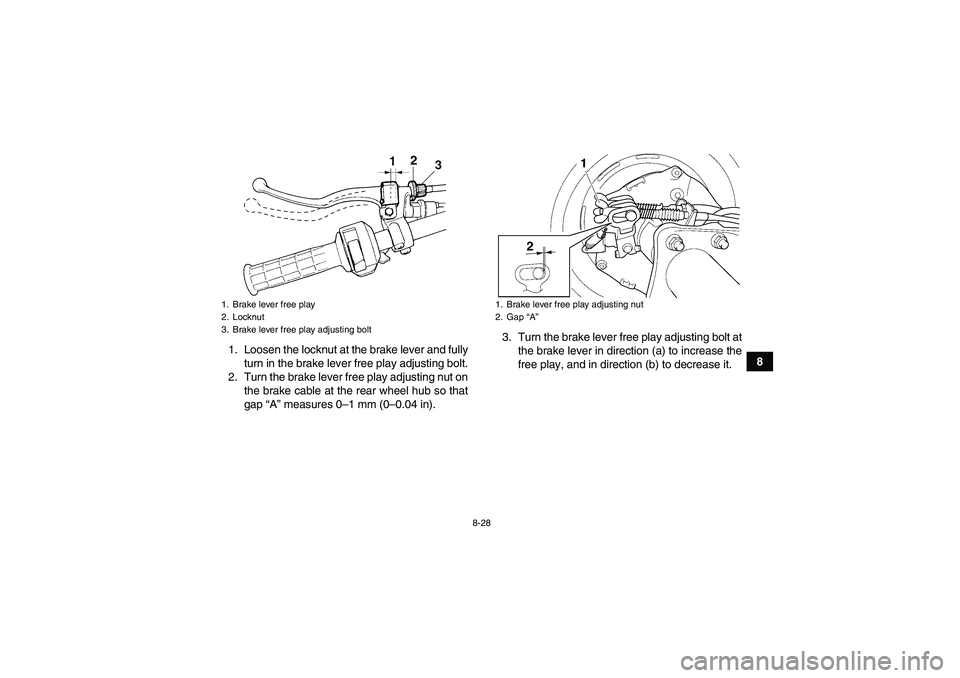
8 1. Loosen the locknut at the brake lever and fully
turn in the brake lever free play adjusting bolt.
2. Turn the brake lever free play adjusting nut on
the brake cable at the rear wheel hub so that
gap “A” measures 0–1 mm (0–0.04 in).3. Turn the brake lever free play adjusting bolt at
the brake lever in direction (a) to increase the
free play, and in direction (b) to decrease it.
1. Brake lever free play
2. Locknut
3. Brake lever free play adjusting bolt
1. Brake lever free play adjusting nut
2. Gap “A”
U3D561E0.book Page 28 Thursday, June 29, 2006 11:03 AM
Page 100 of 124
8-29
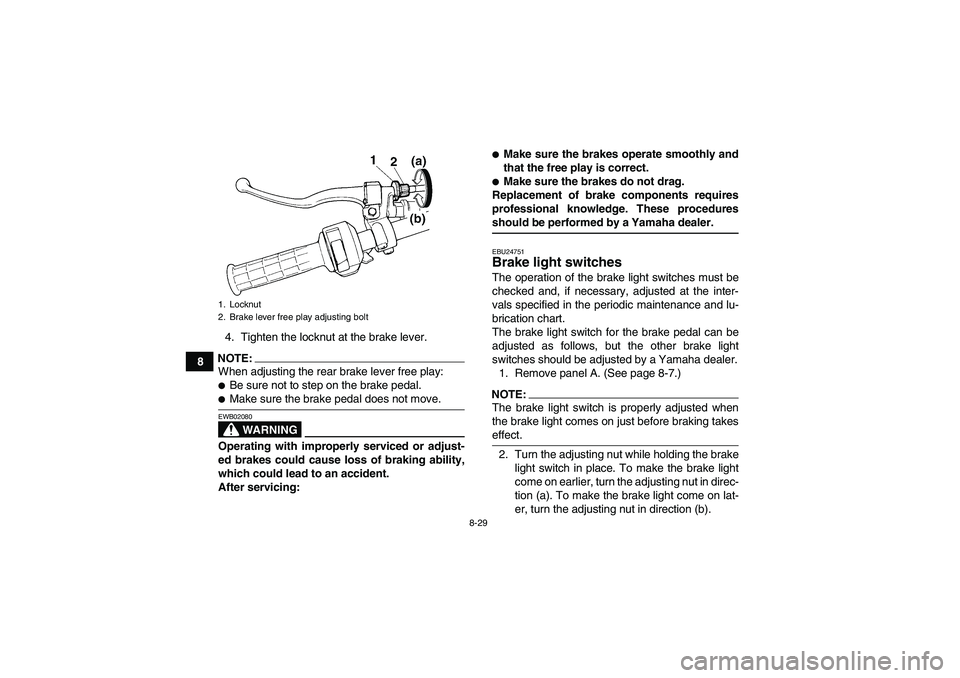
84. Tighten the locknut at the brake lever.
NOTE:When adjusting the rear brake lever free play:�Be sure not to step on the brake pedal.�Make sure the brake pedal does not move.
WARNING
EWB02080Operating with improperly serviced or adjust-
ed brakes could cause loss of braking ability,
which could lead to an accident.
After servicing:
�Make sure the brakes operate smoothly and
that the free play is correct.�Make sure the brakes do not drag.
Replacement of brake components requires
professional knowledge. These proceduresshould be performed by a Yamaha dealer.EBU24751Brake light switches The operation of the brake light switches must be
checked and, if necessary, adjusted at the inter-
vals specified in the periodic maintenance and lu-
brication chart.
The brake light switch for the brake pedal can be
adjusted as follows, but the other brake light
switches should be adjusted by a Yamaha dealer.
1. Remove panel A. (See page 8-7.)NOTE:The brake light switch is properly adjusted when
the brake light comes on just before braking takeseffect.
2. Turn the adjusting nut while holding the brake
light switch in place. To make the brake light
come on earlier, turn the adjusting nut in direc-
tion (a). To make the brake light come on lat-
er, turn the adjusting nut in direction (b).
1. Locknut
2. Brake lever free play adjusting boltU3D561E0.book Page 29 Thursday, June 29, 2006 11:03 AM
Page 106 of 124
8-35
82. Remove the blown fuse, and then install a
new fuse of the specified amperage.
WARNING
EWB02171Always use a fuse of the specified rating, and
never use a substitute object in place of the
proper fuse. An improper fuse or a substitute
object can cause damage to the electrical sys-tem, which could lead to a fire.
3. Turn the key to “ON” and turn on the electrical
circuits to check if the devices operate.
4. If the fuse immediately blows again, have a
Yamaha dealer check the electrical system.
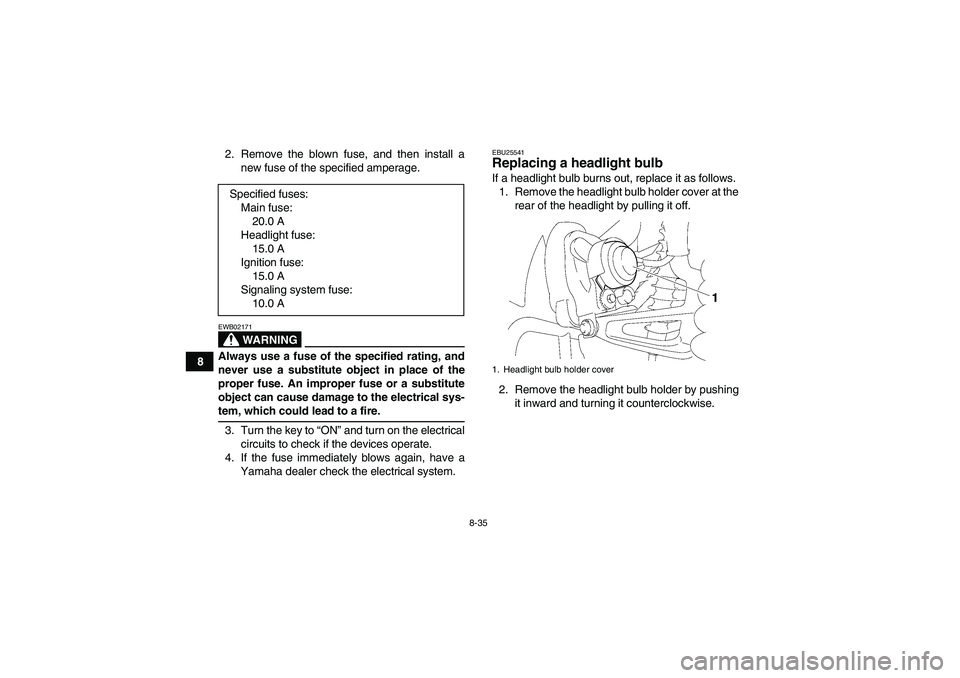
EBU25541Replacing a headlight bulb If a headlight bulb burns out, replace it as follows.
1. Remove the headlight bulb holder cover at the
rear of the headlight by pulling it off.
2. Remove the headlight bulb holder by pushing
it inward and turning it counterclockwise. Specified fuses:
Main fuse:
20.0 A
Headlight fuse:
15.0 A
Ignition fuse:
15.0 A
Signaling system fuse:
10.0 A1. Headlight bulb holder cover
U3D561E0.book Page 35 Thursday, June 29, 2006 11:03 AM