Page 56 of 78

Maintenance and care
49
EJU33760
Maintenance and adjustments
Periodic inspection, adjustment, and lubrica-
tion will keep your watercraft in the safest and
most efficient condition possible. Safety is an
obligation of the watercraft owner. Proper
maintenance must be carried out to keep the
exhaust emission and sound levels within the
regulated limits. The most important points of
watercraft inspection, adjustment, and lubri-
cation are explained on the following pages.
See a Yamaha dealer for genuine Yamaha re-
placement parts and optional accessories de-
signed for your watercraft.
Remember, failures that are the result of the
installation of parts or accessories which are
not qualitatively equivalent to genuine
Yamaha parts are not covered by the limited
warranty.
Maintenance, replacement, or repair of the
emission control devices and system may
be performed by any marine SI engine re-
pair establishment or individual. Warranty
repair, however, must be performed at an
authorized Yamaha marine dealership.
WARNING
EWJ00310
�Be sure to shut the engine off when you
perform maintenance unless otherwise
specified, otherwise an accident or inju-
ry could result from unexpected opera-
tion, moving parts, or electric shock. If
the owner is not familiar with watercraft
servicing, this work should be done by a
Yamaha dealer. Improperly serviced
components could fail or stop operating
correctly, which could result in an acci-
dent.
�Modifications to this watercraft not ap-
proved by Yamaha may cause loss of
performance or excessive noise and ex-
haust emissions, or render it unsafe foruse. Consult a Yamaha dealer before at-
tempting any modifications.
EJU33780Owner’s/operator’s manual and tool
kit
It is advisable to always carry the owner’s/op-
erator’s manual and tool kit with you whenev-
er you use the watercraft. For your
convenience, a storage pouch is provided on
the watercraft for the manual and tool kit.
NOTE:
To protect these materials from water dam-
age, it would be a good idea to put them in a
waterproof bag.
The service information included in this man-
ual is intended to provide you, the owner, with
the necessary information for completing your
own preventive maintenance and minor re-
pairs. The tools provided in the tool kit are suf-
ficient for this purpose, except that a torque
1Storage pouch
UF1N75E0.book Page 49 Tuesday, May 16, 2006 9:53 AM
Page 60 of 78
Maintenance and care
53
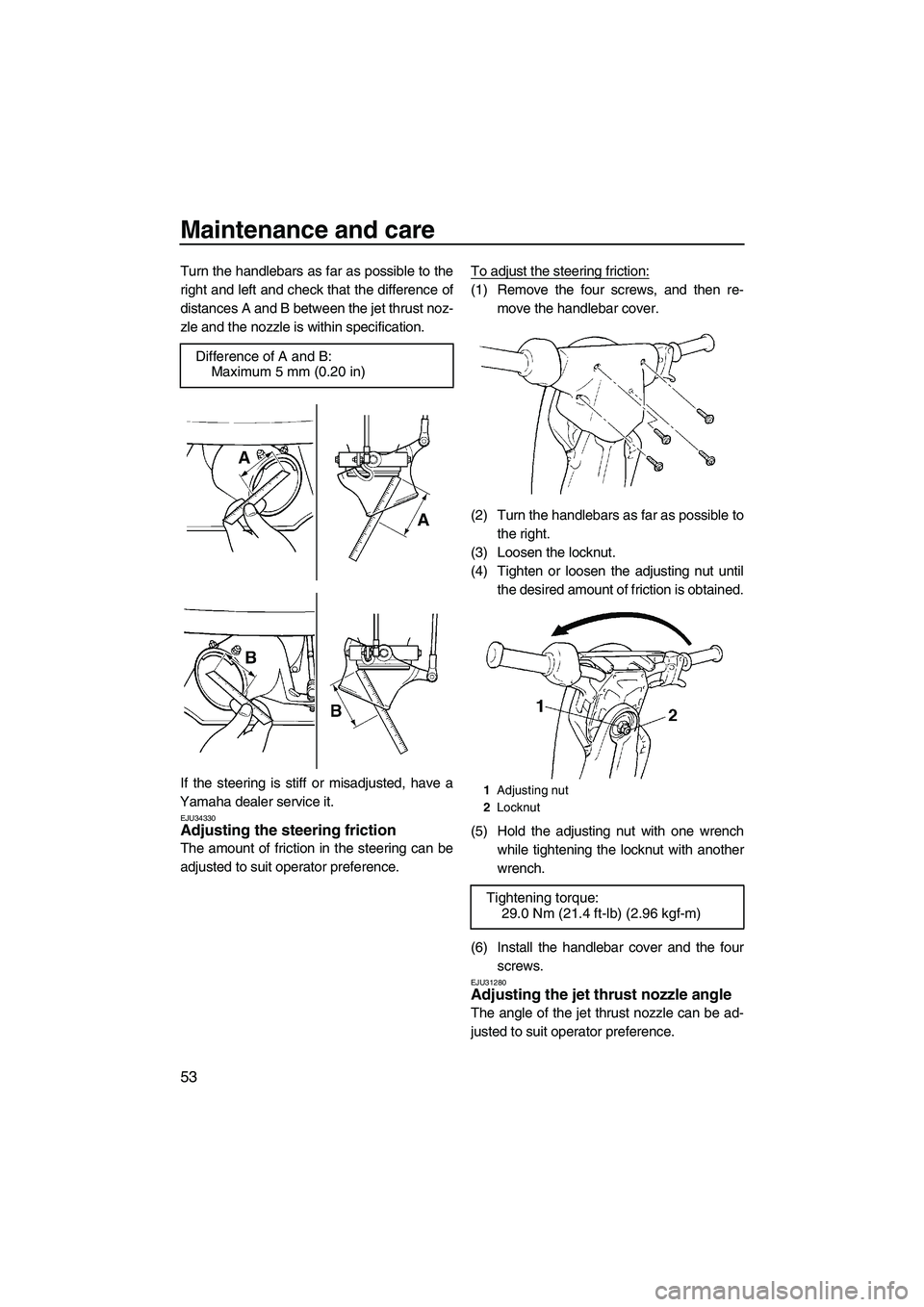
Turn the handlebars as far as possible to the
right and left and check that the difference of
distances A and B between the jet thrust noz-
zle and the nozzle is within specification.
If the steering is stiff or misadjusted, have a
Yamaha dealer service it.
EJU34330Adjusting the steering friction
The amount of friction in the steering can be
adjusted to suit operator preference.To adjust the steering friction:
(1) Remove the four screws, and then re-
move the handlebar cover.
(2) Turn the handlebars as far as possible to
the right.
(3) Loosen the locknut.
(4) Tighten or loosen the adjusting nut until
the desired amount of friction is obtained.
(5) Hold the adjusting nut with one wrench
while tightening the locknut with another
wrench.
(6) Install the handlebar cover and the four
screws.
EJU31280Adjusting the jet thrust nozzle angle
The angle of the jet thrust nozzle can be ad-
justed to suit operator preference. Difference of A and B:
Maximum 5 mm (0.20 in)
1Adjusting nut
2Locknut
Tightening torque:
29.0 Nm (21.4 ft-lb) (2.96 kgf-m)
UF1N75E0.book Page 53 Tuesday, May 16, 2006 9:53 AM
Page 62 of 78

Maintenance and care
55
To change the steering cable pivot bolt posi-
tion:
(1) Pull back the outer sleeve, and then dis-
connect the steering cable.
(2) Remove the steering cable joint from the
steering cable pivot bolt.
(3) Loosen the pivot bolt, install it with the
lock washer in the desired position (P1 or
P2), and then tighten it to the specified
torque.
(4) Install the steering cable joint on the
steering cable pivot bolt.
To change the handlebar stopper position:
(1) Loosen the handlebar stopper nut on the
operator’s side of the steering pole.(2) Lift and turn the handlebar stopper to the
desired position (S1 or S2), and then
tighten the handlebar stopper nut to the
specified torque.
(3) Install the steering pole cover securely.
EJU34360Checking and adjusting the throttle
cable
Check that the throttle cable moves back to
the set position smoothly and that the throttle
lever free play is within specification.
(1) Squeeze and release the throttle lever. If
the throttle lever does not return smooth-
ly, have a Yamaha dealer service it.
1Steering cable pivot bolt
Tightening torque:
Steering cable pivot bolt:
5.4 Nm (4.0 ft-lb) (0.55 kgf-m)
1Handlebar stopper nut
Tightening torque:
Handlebar stopper nut:
31.0 Nm (22.9 ft-lb) (3.16 kgf-m)
UF1N75E0.book Page 55 Tuesday, May 16, 2006 9:53 AM
Page 63 of 78

Maintenance and care
56
(2) Adjust the free play by loosening the lock-
nut and turning the adjuster.
EJU34370Cleaning and adjusting the spark
plugs
The spark plug is an important engine compo-
nent and is easy to inspect. The condition of
the spark plug can indicate something about
the condition of the engine. For example, if the
center electrode porcelain is very white, this
could indicate an intake air leak or carburetion
problem in that cylinder. Do not attempt to di-
agnose any problems yourself. Have a
Yamaha dealer service the watercraft.
Remove and inspect the spark plugs periodi-
cally; heat and deposits will cause the spark
plugs to slowly break down and erode. If elec-
trode erosion becomes excessive, or if carbon
and other deposits are excessive, replace the
spark plug with the specified plug.Measure the spark plug gap with a wire thick-
ness gauge. Replace the spark plugs or ad-
just the gap to specification if necessary.
To install a spark plug:
(1) Clean the gasket surface.
(2) Wipe any dirt from the threads of the
spark plug.
(3) Install the spark plug, and then tighten it
to the specified torque.
(4) Install the spark plug cap.
NOTE:
�Wipe off any water on the spark plug or in-
side the spark plug cap before installing the
cap. Push the spark plug cap down until it is
securely installed.
�If a torque wrench is not available when you
are installing a spark plug, a good estimate
of the correct torque is 1/4 turn to 1/2 turn
past finger tight using the spark plug
wrench included in the tool kit. Have the
spark plug adjusted to the correct torque
with a torque wrench as soon as possible.
1Locknut
2Adjuster
3Throttle lever free play
Throttle lever free play:
7.0–10.0 mm (0.28–0.39 in)
Specified spark plug:
BR7HS
1Spark plug gap
Spark plug gap:
0.6–0.7 mm (0.024–0.028 in)
Spark plug tightening torque:
25.0 Nm (18.4 ft-lb) (2.55 kgf-m)
UF1N75E0.book Page 56 Tuesday, May 16, 2006 9:53 AM