Page 60 of 78
Maintenance and care
53
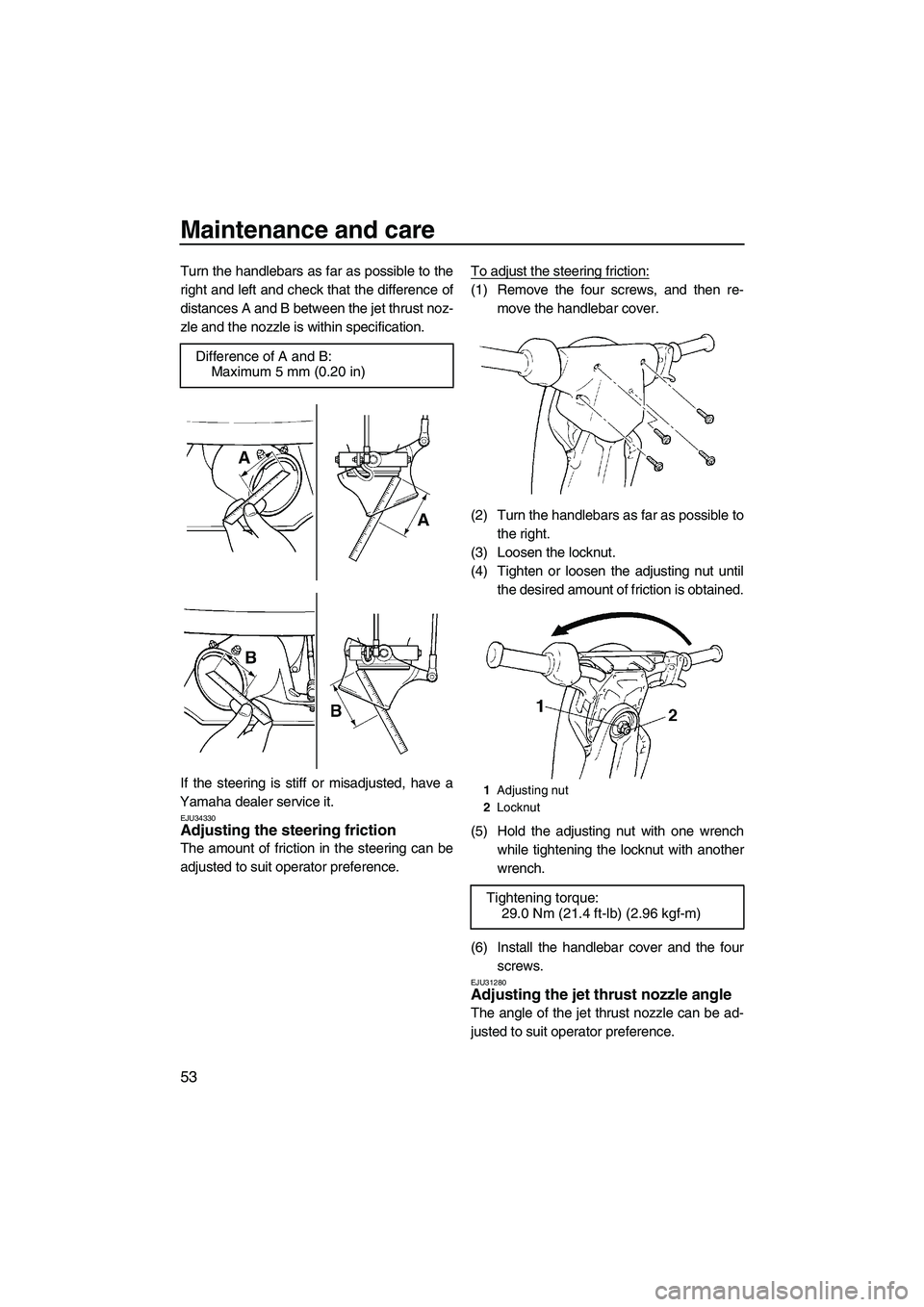
Turn the handlebars as far as possible to the
right and left and check that the difference of
distances A and B between the jet thrust noz-
zle and the nozzle is within specification.
If the steering is stiff or misadjusted, have a
Yamaha dealer service it.
EJU34330Adjusting the steering friction
The amount of friction in the steering can be
adjusted to suit operator preference.To adjust the steering friction:
(1) Remove the four screws, and then re-
move the handlebar cover.
(2) Turn the handlebars as far as possible to
the right.
(3) Loosen the locknut.
(4) Tighten or loosen the adjusting nut until
the desired amount of friction is obtained.
(5) Hold the adjusting nut with one wrench
while tightening the locknut with another
wrench.
(6) Install the handlebar cover and the four
screws.
EJU31280Adjusting the jet thrust nozzle angle
The angle of the jet thrust nozzle can be ad-
justed to suit operator preference. Difference of A and B:
Maximum 5 mm (0.20 in)
1Adjusting nut
2Locknut
Tightening torque:
29.0 Nm (21.4 ft-lb) (2.96 kgf-m)
UF1N75E0.book Page 53 Tuesday, May 16, 2006 9:53 AM
Page 61 of 78
Maintenance and care
54
(1) Loosen the two screws, and then remove
the steering pole cover.
(2) Select the desired nozzle angle. Chang-
ing the positions of the handlebar stopper
and/or steering cable pivot bolt changesthe nozzle angle as shown in the follow-
ing chart.
1Steering pole cover1Nozzle angles
1Nozzle angles
2Handlebar stopper and steering cable pivot
bolt positions
UF1N75E0.book Page 54 Tuesday, May 16, 2006 9:53 AM
Page 62 of 78

Maintenance and care
55
To change the steering cable pivot bolt posi-
tion:
(1) Pull back the outer sleeve, and then dis-
connect the steering cable.
(2) Remove the steering cable joint from the
steering cable pivot bolt.
(3) Loosen the pivot bolt, install it with the
lock washer in the desired position (P1 or
P2), and then tighten it to the specified
torque.
(4) Install the steering cable joint on the
steering cable pivot bolt.
To change the handlebar stopper position:
(1) Loosen the handlebar stopper nut on the
operator’s side of the steering pole.(2) Lift and turn the handlebar stopper to the
desired position (S1 or S2), and then
tighten the handlebar stopper nut to the
specified torque.
(3) Install the steering pole cover securely.
EJU34360Checking and adjusting the throttle
cable
Check that the throttle cable moves back to
the set position smoothly and that the throttle
lever free play is within specification.
(1) Squeeze and release the throttle lever. If
the throttle lever does not return smooth-
ly, have a Yamaha dealer service it.
1Steering cable pivot bolt
Tightening torque:
Steering cable pivot bolt:
5.4 Nm (4.0 ft-lb) (0.55 kgf-m)
1Handlebar stopper nut
Tightening torque:
Handlebar stopper nut:
31.0 Nm (22.9 ft-lb) (3.16 kgf-m)
UF1N75E0.book Page 55 Tuesday, May 16, 2006 9:53 AM
Page 64 of 78

Maintenance and care
57
WARNING
EWJ00350
Be careful not to damage the insulator
when removing or installing a spark plug.
A damaged insulator could allow sparks to
escape, which could result in a fire or ex-
plosion.
EJU34400Lubrication points
To keep moving parts sliding or rotating
smoothly, coat them with water-resistant
grease.
�Throttle cable (carburetor end)
�Choke cable (carburetor end)
�Throttle cable (handlebar end)
Squeeze the throttle lever and remove the
seal. Spray a rust inhibitor into the outer ca-
ble. Refit the seal securely.
�Steering cable ball joint (handlebar end)
�Steering cable inner wire (handlebar end)
(1) To access the steering cable and ball
joint, remove the steering pad by re-
moving the two bolts.
(2) Grease the steering cable ball joints,
both at the handlebar end of the cable
and at the jet thrust nozzle end.
(3) Extend the steering cable inner wire,
and then apply a thin coat of grease to
the inner wire, both at the handlebar
end of the cable and at the jet thrust
nozzle end.
�Steering cable ball joint (jet thrust nozzle
end) Recommended water-resistant grease:
Yamaha Marine Grease/Yamaha
Grease A
1Seal
UF1N75E0.book Page 57 Tuesday, May 16, 2006 9:53 AM
Page 65 of 78
Maintenance and care
58
�Steering cable inner wire (jet thrust nozzle
end)
�Handlebar pivot shaft
Lubrication of the handlebar pivot shaft re-
quires disassembly of steering compo-
nents. Have a Yamaha dealer lubricate the
handlebar pivot shaft.
�Jet thrust nozzle pivot bolts (collars)
�Intermediate housing
Fill the intermediate housing with water-re-
sistant grease through the grease nipple
using a grease gun.
EJU34440Adjusting the choke cable
Check that the choke cable is properly adjust-
ed.
(1) Pull the choke knob out until it stops, and
then release the knob. The knob should
not move.
(2) If the choke knob moves back on its own,
tighten the choke knob adjusting nut
Grease quantity:
Initial 10 hours or 1 month:
20.0–22.0 cm³ (0.68–0.74 US oz)
(0.71–0.78 Imp.oz)
Every 100 hours or 12 months:
3.0–5.0 cm³ (0.10–0.17 US oz)
(0.11–0.18 Imp.oz)
UF1N75E0.book Page 58 Tuesday, May 16, 2006 9:53 AM
Page 74 of 78

Trouble recovery
67
�The bow must be kept up out of the wa-
ter during towing to prevent water from
entering the engine compartment.
WARNING
EWJ00810
�The watercraft should only be towed in
an emergency.
�The towline should be long enough so
that the watercraft will not collide with
the towing boat when slowing down. A
good rule of thumb is a towline that is
three times the combined length of the
towing boat and the watercraft.
�The operator of the towing boat must
keep speed to a minimum and avoid traf-
fic or obstacles which could be a hazard
to the rider on the watercraft.
EJU34730Submerged watercraft
If the watercraft is submerged or flooded with
water, follow the procedure below and consult
a Yamaha dealer as soon as possible. Failure
to do so could result in serious engine dam-
age!
In an emergency:
(1) Beach the watercraft and remove the
hood. Turn the watercraft over far enough
to drain the water from the engine com-
partment.
CAUTION:
ECJ00700
Turning the watercraft on its side with the
hood removed could cause damage to the
steering pole. Use two people to provide
enough support to make sure that the
steering pole is not damaged.
(2) Turn the watercraft upright again.
(3) Turn the fuel cock knob to “OFF”.
(4) Remove the spark plugs and dry them
with a cloth.
(5) Without reinstalling the spark plugs,
crank the engine until all of the water in
the cylinders has been drained.
(6) Install the spark plugs and the hood.
(7) Turn the fuel cock knob to “ON”.
(8) Launch the watercraft into the water, and
then run the engine for at least 10 min-
utes. If the engine does not start, repeat
steps 3–8.
(9) Shut the engine off.
(10) Turn the fuel cock knob to “OFF”, remove
the silencer cap, and then spray a rust in-
hibitor into the carburetor while cranking
the engine.
(11) Have the watercraft inspected by a
Yamaha dealer as soon as possible.
1Bow rope hole
UF1N75E0.book Page 67 Tuesday, May 16, 2006 9:53 AM
Page 76 of 78

Index
Pre-operation checks ............................... 27
Primary Identification (PRI-ID) number ...... 1
R
Recommended equipment ....................... 12
Rough water operation ............................. 43
S
Safe boating rules .................................... 14
Spark plugs, cleaning and adjusting ........ 56
Standing ................................................... 38
Start switch............................................... 20
Starting the engine ................................... 33
Starting the watercraft .............................. 38
Steering friction, adjusting ........................ 53
Steering pole ...................................... 22, 30
Steering system ................................. 22, 30
Stern rope hole......................................... 23
Stopping the engine ................................. 35
Stopping the watercraft ............................ 43
Storage..................................................... 46
Storage pouch .......................................... 24
Submerged watercraft .............................. 67
Switches ................................................... 32
T
Throttle cable, checking and adjusting ..... 55
Throttle lever ...................................... 21, 30
Towing the watercraft ............................... 66
Transporting ............................................. 45
Trolling speed, adjusting .......................... 60
Troubleshooting ....................................... 62
Troubleshooting chart .............................. 62
Turning the watercraft .............................. 41
W
Water separator ....................................... 28
Watercraft characteristics......................... 13
UF1N75E0.book Page 2 Tuesday, May 16, 2006 9:53 AM
Page:
< prev 1-8 9-16 17-24

