5-1
2
3
4
56
7
8
9
OPERATION AND IMPORTANT RIDING POINTS
EAU40771
WARNING
EWA14531
�
This model is designed for
off-road use only. Become thor-
oughly familiar with all operat-
ing controls and their functions
before riding. Consult a Yamaha
dealer regarding any control or
function that you do not thor-
oughly understand.
�
Never start the engine or oper-
ate it in a closed area for any
length of time. Exhaust fumes
are poisonous, and inhaling
them can cause loss of con-
sciousness and death within a
short time. Always make sure
that there is adequate ventila-
tion.
EAU40882
Starting and warming up a
cold engine
1. Turn the fuel cock lever to “O” (on).
2. Set the engine stop switch to
“START”.
3. Turn the starter (choke) on and
completely close the throttle. (See
page 3-6.)
4. While applying the front or rear
brake, start the engine by pushing
the kickstarter lever down.
5. After starting the engine, move the
starter (choke) back halfway.
CAUTION:
ECA11130
For maximum engine life, always
warm the engine up before starting
off. Never accelerate hard when the
engine is cold!
6. When the engine is warm, turn the
starter (choke) off and set the en-
gine stop switch to “RUN”.
NOTE:
The engine is warm when it responds
normally to the throttle with the starter
(choke) turned off.
EAU16660
Starting a warm engine
Follow the same procedure as for start-
ing a cold engine with the exception
that the starter (choke) is not required
when the engine is warm. Instead, start
the engine with the throttle slightly
open.
NOTE:
If the engine does not start after sever-
al kicks, try again with the throttle 1/4
to 1/2 open.
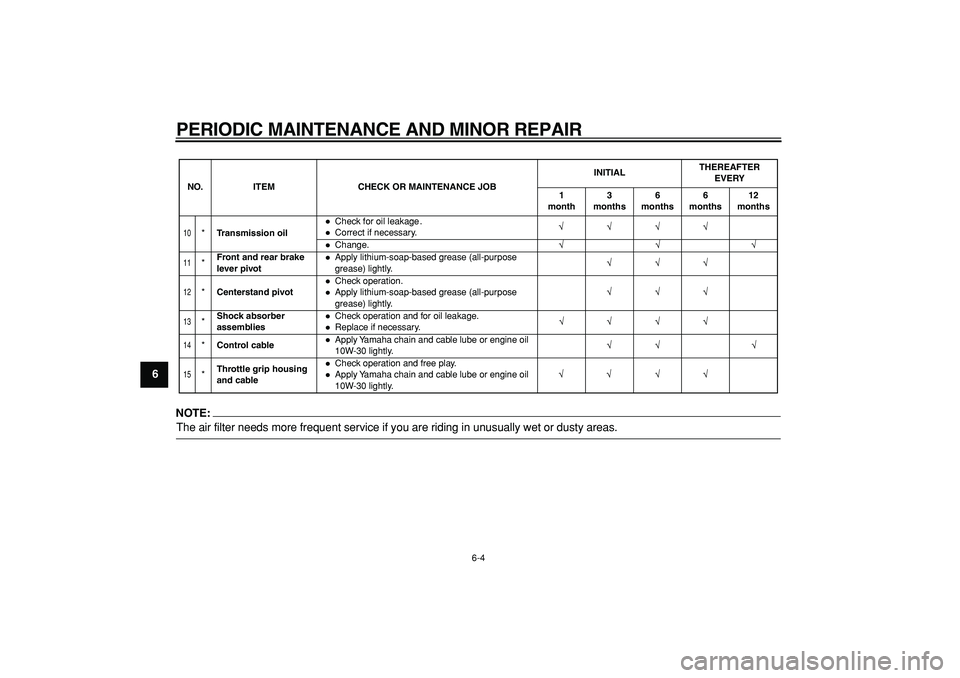
PERIODIC MAINTENANCE AND MINOR REPAIR
6-4
1
2
3
4
5
6
7
8
9
NOTE:
The air filter needs more frequent service if you are riding in unusually wet or dusty areas.
10
*Transmission oil
Check for oil leakage .Correct if necessary.Change.
11
*Front and rear brake
lever pivot
Apply lithium-soap-based grease (all-purpose
grease) lightly.
12
*Centerstand pivot
Check operation.Apply lithium-soap-based grease (all-purpose
grease) lightly.
13
*Shock absorber
assemblies
Check operation and for oil leakage.Replace if necessary.
14
*Control cable
Apply Yamaha chain and cable lube or engine oil
10W-30 lightly.
15
*Throttle grip housing
and cable
Check operation and free play.Apply Yamaha chain and cable lube or engine oil
10W-30 lightly. NO. ITEM CHECK OR MAINTENANCE JOBINITIALTHEREAFTER
EVERY
1
month3
months6
months6
months12
months
PERIODIC MAINTENANCE AND MINOR REPAIR
6-22
1
2
3
4
5
6
7
8
9
10. Pull the wheel to the right to sepa-
rate it from the final gear case, and
then remove the wheel.
EAU41521
To install the rear wheel
1. Apply a light coating of lithi-
um-soap-based grease to the
splines of the final gear case and
wheel hub.
2. Install the wheel by inserting it into
the wheel hub.
3. Install the rear arm by installing the
washers and nuts.
4. Install the axle nut.
5. Install the right-side rear shock ab-sorber by installing the mounting
bolt.
6. While applying the rear brake,
tighten the axle nut to the specified
torque.
7. Tighten the rear arm nuts and rear
shock absorber mounting bolt to
the specified torques.
8. Install the exhaust chamber and
then install the exhaust manifold
bolts.
9. Install the washers and exhaust
chamber bolt.
10. Tighten the exhaust manifold bolts
and exhaust chamber bolt to the
specified torques.11. Install the muffler by sliding the
spring clamp up to its original posi-
tion, and then installing the wash-
ers and muffler bolt.
NOTE:
Make sure that the spring clamp is po-
sitioned with the projection side facing
inward.
12. Tighten the muffler bolt to the
specified torque.
1. Rear arm
2. Washer
3. Rear arm nut
1
2
3
Tightening torques:
Axle nut:
60 Nm (6.0 m·kgf, 43.4 ft·lbf)
Rear arm nut:
28.5 Nm (2.9 m·kgf, 20.6 ft·lbf)
Rear shock absorber mounting bolt:
22.5 Nm (2.3 m·kgf, 16.3 ft·lbf)
Tightening torques:
Exhaust manifold bolt:
8.5 Nm (0.9 m·kgf, 6.1 ft·lbf)
Exhaust chamber bolt:
17.5 Nm (1.8 m·kgf, 12.7 ft·lbf)
1. Exhaust chamber
2. Spring clamp
3. Muffler
Tightening torque:
Muffler bolt:
17.5 Nm (1.8 m·kgf, 12.7 ft·lbf)
1
2
3
7-1
2
3
4
5
6
78
9
MOTORCYCLE CARE AND STORAGE
EAU40631
Care
While the open design of a motorcycle
reveals the attractiveness of the tech-
nology, it also makes it more vulnera-
ble. Rust and corrosion can develop
even if high-quality components are
used. A rusty exhaust pipe may go un-
noticed on a car, however, it detracts
from the overall appearance of a motor-
cycle. Frequent and proper care does
not only comply with the terms of the
warranty, but it will also keep your mo-
torcycle looking good, extend its life
and optimize its performance.
Before cleaning
1. Cover the muffler outlet with a
plastic bag after the engine has
cooled down.
2. Make sure that all caps and covers
as well as all electrical couplers
and connectors, including the
spark plug cap, are tightly in-
stalled.
3. Remove extremely stubborn dirt,
like oil burnt onto the crankcase,
with a degreasing agent and a
brush, but never apply such prod-ucts onto seals, gaskets and wheel
axles. Always rinse the dirt and de-
greaser off with water.
Cleaning
CAUTION:
ECA10770
�
Avoid using strong acidic wheel
cleaners, especially on spoked
wheels. If such products are
used on hard-to-remove dirt, do
not leave the cleaner on the af-
fected area any longer than in-
structed. Also, thoroughly rinse
the area off with water, immedi-
ately dry it, and then apply a cor-
rosion protection spray.
�
Improper cleaning can damage
windshields, cowlings, panels
and other plastic parts. Use only
a soft, clean cloth or sponge
with mild detergent and water to
clean plastic.
�
Do not use any harsh chemical
products on plastic parts. Be
sure to avoid using cloths or
sponges which have been in
contact with strong or abrasive
cleaning products, solvent orthinner, fuel (gasoline), rust re-
movers or inhibitors, brake flu-
id, antifreeze or electrolyte.
�
Do not use high-pressure wash-
ers or steam-jet cleaners since
they cause water seepage and
deterioration in the following ar-
eas: seals (of wheel and swing-
arm bearings, fork and brakes),
electric components (couplers,
connectors, instruments,
switches and lights), breather
hoses and vents.
�
For motorcycles equipped with
a windshield: Do not use strong
cleaners or hard sponges as
they will cause dulling or
scratching. Some cleaning com-
pounds for plastic may leave
scratches on the windshield.
Test the product on a small hid-
den part of the windshield to
make sure that it does not leave
any marks. If the windshield is
scratched, use a quality plastic
polishing compound after
washing.