Page 66 of 96

PERIODIC MAINTENANCE AND MINOR REPAIR
6-23
1
2
3
4
5
6
7
8
9
edge and experience.
EAU21992
Cast wheels
To maximize the performance, durabil-
ity, and safe operation of your vehicle,
note the following points regarding the
specified wheels.
�
The wheel rims should be checked
for cracks, bends, warpage or
damage before each ride. If any
damage is found, have a Yamaha
dealer replace the wheel. Do not
attempt even the smallest repair to
the wheel. A deformed or cracked
wheel must be replaced.
�
The wheel should be balanced
whenever either the tire or wheel
has been changed or replaced. An
unbalanced wheel can result in
poor performance, adverse han-
dling characteristics, and a short-
ened tire life.
�
Ride at moderate speeds after
changing a tire since the tire sur-
face must first be “broken in” for it
to develop its optimal characteris-
tics.
�
After repairing or replacing the rear
tire, tighten the valve stem nut and
locknut to the specified torques.
1. Valve stem nut
2. Valve stem locknut
Tightening torques:
Valve stem nut:
2.0 Nm (0.2 m·kgf, 1.4 ft·lbf)
Valve stem locknut:
3.0 Nm (0.3 m·kgf, 2.2 ft·lbf)
1
2
Page 67 of 96
PERIODIC MAINTENANCE AND MINOR REPAIR
6-24
2
3
4
5
67
8
9
EAU33453
Front and rear brake lever free
play
Front
Rear
There should be no free play at the
brake lever ends. If there is free play,
have a Yamaha dealer inspect thebrake system.
WARNING
EWA14211
A soft or spongy feeling in the brake
lever can indicate the presence of air
in the hydraulic system. If there is air
in the hydraulic system, have a
Yamaha dealer bleed the system be-
fore operating the vehicle. Air in the
hydraulic system will diminish the
braking performance, which may re-
sult in loss of control and an acci-
dent.
EAU33473
Adjusting the rear brake lock
lever cable
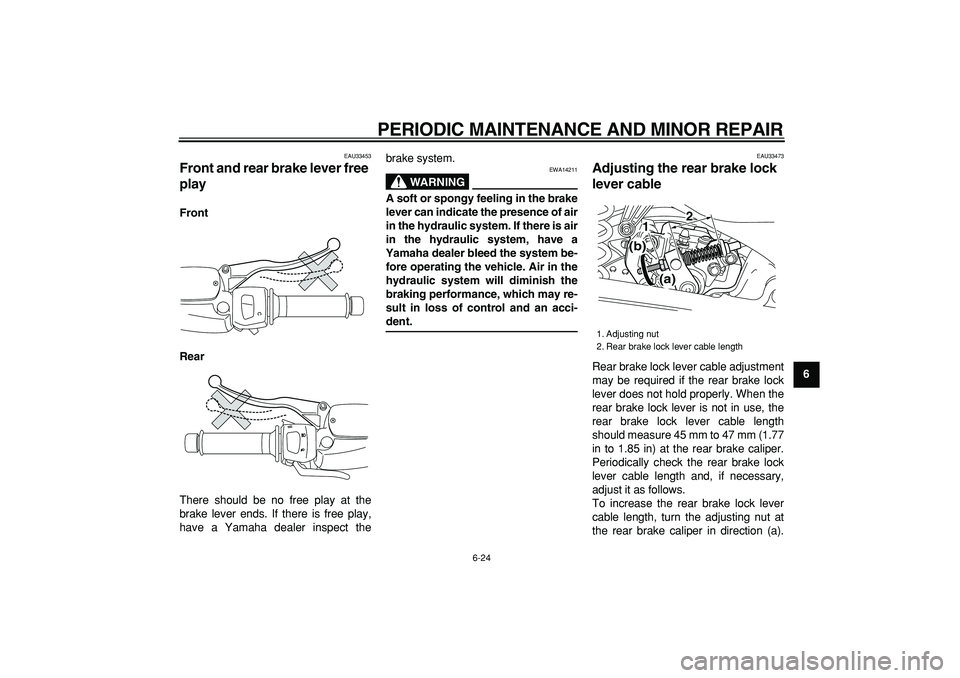
Rear brake lock lever cable adjustment
may be required if the rear brake lock
lever does not hold properly. When the
rear brake lock lever is not in use, the
rear brake lock lever cable length
should measure 45 mm to 47 mm (1.77
in to 1.85 in) at the rear brake caliper.
Periodically check the rear brake lock
lever cable length and, if necessary,
adjust it as follows.
To increase the rear brake lock lever
cable length, turn the adjusting nut at
the rear brake caliper in direction (a).
1. Adjusting nut
2. Rear brake lock lever cable length
1
2
(a) (b)
Page 68 of 96

PERIODIC MAINTENANCE AND MINOR REPAIR
6-25
1
2
3
4
5
6
7
8
9
To decrease the rear brake lock lever
cable length, turn the adjusting nut in
direction (b).
WARNING
EWA10650
If proper adjustment cannot be ob-
tained as described, have a Yamaha
dealer make this adjustment.
EAU22390
Checking the front and rear
brake pads
The front and rear brake pads must be
checked for wear at the intervals spec-
ified in the periodic maintenance and
lubrication chart.
EAU22430
Front brake pads
Each front brake pad is provided with
wear indicator grooves, which allow
you to check the brake pad wear with-
out having to disassemble the brake.
To check the brake pad wear, check
the wear indicator grooves. If a brake
pad has worn to the point that the wearindicator grooves have almost disap-
peared, have a Yamaha dealer replace
the brake pads as a set.
EAU34210
Rear brake pads
Have a Yamaha dealer check each
rear brake pad for damage and mea-
sure the lining thickness and if neces-
sary, replace them as a set.
1. Wear indicator groove
11
Page 69 of 96

PERIODIC MAINTENANCE AND MINOR REPAIR
6-26
2
3
4
5
67
8
9
EAU22580
Checking the brake fluid level
Front brake
Rear brake
Insufficient brake fluid may allow air toenter the brake system, possibly caus-
ing it to become ineffective.
Before riding, check that the brake fluid
is above the minimum level mark and
replenish if necessary. A low brake fluid
level may indicate worn brake pads
and/or brake system leakage. If the
brake fluid level is low, be sure to check
the brake pads for wear and the brake
system for leakage.
Observe these precautions:
�
When checking the fluid level,
make sure that the top of the brake
fluid reservoir is level.
�
Use only the recommended quality
brake fluid, otherwise the rubber
seals may deteriorate, causing
leakage and poor braking perfor-
mance.
�
Refill with the same type of brake
fluid. Mixing fluids may result in a
harmful chemical reaction and
lead to poor braking performance.
�
Be careful that water does not en-
ter the brake fluid reservoir whenrefilling. Water will significantly
lower the boiling point of the fluid
and may result in vapor lock.
�
Brake fluid may deteriorate paint-
ed surfaces or plastic parts. Al-
ways clean up spilled fluid
immediately.
�
As the brake pads wear, it is nor-
mal for the brake fluid level to grad-
ually go down. However, if the
brake fluid level goes down sud-
denly, have a Yamaha dealer
check the cause.
1. Minimum level mark
1. Minimum level mark
1
1
Recommended brake fluid:
DOT 4
Page 76 of 96
PERIODIC MAINTENANCE AND MINOR REPAIR
6-33
1
2
3
4
5
6
7
8
9(for non-ABS models) (for ABS models)
CAUTION:
ECA10640
Do not use a fuse of a higher amper-
age rating than recommended to
avoid causing extensive damage to
the electrical system and possibly a
fire.
3. Turn the key to “ON” and turn on
the electrical circuit in question to
1. Ignition fuse
2. Signaling system fuse
3. Headlight fuse
4. Radiator fan fuse
5. Backup fuse (for odometer and clock)
6. Fuel injection system fuse
7. Spare fuse
7
123456
1. Ignition fuse
2. Signaling system fuse
3. Headlight fuse
4. Radiator fan fuse
5. Backup fuse (for odometer and clock)
6. Fuel injection system fuse
7. Spare fuse
7
123456
Specified fuses:
Main fuse:
40.0 A
Ignition fuse:
10.0 A
Signaling system fuse:
10.0 A
Headlight fuse:
25.0 A
Hazard fuse:
10.0 A
Radiator fan fuse:
10.0 A
Fuel injection system fuse:
10.0 A
ABS control unit fuse:
YP400A 10.0 A
ABS motor fuse:
YP400A 30.0 A
Backup fuse:
10.0 A
Page 78 of 96
PERIODIC MAINTENANCE AND MINOR REPAIR
6-35
1
2
3
4
5
6
7
8
9
EAU36122
Replacing a front turn signal
light bulb
1. Place the scooter on the center-
stand.
2. Remove panel A. (See page 6-6.)
3. Remove the windshield by remov-
ing the screws.
4. Remove the front turn signal light
unit by removing the screws.5. Remove the socket (together with
the bulb) by turning it counter-
clockwise.
6. Remove the defective bulb by
pushing it in and turning it counter-clockwise.
7. Insert a new bulb into the socket,
push it in, and then turn it clock-
wise until it stops.
8. Install the socket (together with the
bulb) by turning it clockwise.
9. Place the turn signal light unit in
the original position, and then in-
stall the screws.
10. Install the windshield by installing
the screws.
11. Install panel A.
1. Screw
2. Windshield
1
2
1. Screw
2. Front turn signal light unit
1. Turn signal light bulb socket
1
2
1
Page 79 of 96

PERIODIC MAINTENANCE AND MINOR REPAIR
6-36
2
3
4
5
67
8
9
EAU34260
Replacing a rear turn signal
light bulb
1. Place the scooter on the center-
stand.
2. Remove cowling C for replacing
the left turn signal light bulb or
cowling D for replacing the right
turn signal light bulb. (See
page 6-6.)
3. Remove the socket (together with
the turn signal light bulb) by turning
it counterclockwise.
4. Remove the defective bulb by
pushing it in and turning it counter-
clockwise.
5. Insert a new bulb into the socket,push it in, and then turn it clock-
wise until it stops.
6. Install the socket (together with the
bulb) by turning it clockwise.
7. Install the cowling removed.
EAU34270
Replacing the license plate
light bulb
1. Remove cowling B. (See
page 6-6.)
2. Remove the license plate light cov-
er and license plate light lens by
removing the screws.
3. Remove the defective bulb by
pushing it in and turning it counter-
clockwise.
1. Turn signal light bulb socket
1
1. License plate light lens
2. License plate light cover
3. Screw
1
23
Page 80 of 96
PERIODIC MAINTENANCE AND MINOR REPAIR
6-37
1
2
3
4
5
6
7
8
9
4. Insert a new bulb into the socket,
push it in, and then turn it clock-
wise until it stops.
5. Install the license plate light lens
and license plate light cover by in-
stalling the screws.
6. Install the cowling.
EAU42800
Replacing an auxiliary light
bulb
1. Place the scooter on the center-
stand.
2. Remove panel A. (See page 6-6.)
3. Remove the windshield by remov-
ing the screws.
4. Remove the front turn signal light
unit by removing the screws.5. Remove the auxiliary light bulb
socket (together with the bulb) by
turning it counterclockwise.
6. Remove the defective bulb by pull-
ing it out.
1. Bulb
1
1. Screw
2. Windshield1
2
1. Screw
2. Front turn signal light unit
1. Auxiliary light bulb socket
1
2
1


