Page 32 of 100

INSTRUMENT AND CONTROL FUNCTIONS
3-18
3
NOTE:The fuel tank cap cannot be closed un-
less the key is in the lock. In addition,
the key cannot be removed if the cap isnot properly closed and locked.
WARNING
EWA11090
Make sure that the fuel tank cap isproperly closed before riding.
EAU13220
Fuel Make sure that there is sufficient fuel in
the tank. When refueling, be sure to in-
sert the pump nozzle into the fuel tank
filler hole and to fill the tank to the bot-
tom of the filler tube as shown.
WARNING
EWA10880
�
Do not overfill the fuel tank, oth-
erwise it may overflow when the
fuel warms up and expands.
�
Avoid spilling fuel on the hot en-gine.
CAUTION:
ECA10070
Immediately wipe off spilled fuel
with a clean, dry, soft cloth, since
fuel may deteriorate painted surfac-es or plastic parts.
EAU13320
CAUTION:
ECA11400
Use only unleaded gasoline. The use
of leaded gasoline will cause severe
damage to internal engine parts,
such as the valves and piston rings,as well as to the exhaust system.
Your Yamaha engine has been de-
signed to use regular unleaded gaso-
line with a research octane number of
91 or higher. If knocking (or pinging) oc-
curs, use a gasoline of a different brand
1. Fuel tank filler tube
2. Fuel level
Recommended fuel:
REGULAR UNLEADED GASOLINE
ONLY
Fuel tank capacity:
25.0 L (6.61 US gal) (5.50 Imp.gal)
Fuel reserve amount:
5.5 L (1.45 US gal) (1.21 Imp.gal)
U3P6E1E0.book Page 18 Thursday, October 5, 2006 10:13 AM
Page 33 of 100

INSTRUMENT AND CONTROL FUNCTIONS
3-19
3 or premium unleaded fuel. Use of un-
leaded fuel will extend spark plug life
and reduce maintenance costs.
EAU39450
Fuel tank breather/overflow
hose Before operating the motorcycle:�
Check the fuel tank breather/over-
flow hose connection.
�
Check the fuel tank breather/over-
flow hose for cracks or damage,
and replace it if damaged.
�
Make sure that the end of the fuel
tank breather/overflow hose is not
blocked, and clean it if necessary.
EAU13441
Catalytic converter This vehicle is equipped with catalytic
converters in the exhaust system.
WARNING
EWA10860
The exhaust system is hot after op-
eration. Make sure that the exhaust
system has cooled down before do-ing any maintenance work.CAUTION:
ECA10700
The following precautions must be
observed to prevent a fire hazard or
other damages.�
Use only unleaded gasoline.
The use of leaded gasoline will
cause unrepairable damage to
the catalytic converter.
�
Never park the vehicle near pos-
sible fire hazards such as grass
or other materials that easily
burn.
�
Do not allow the engine to idletoo long.
1. Fuel tank breather/overflow hose
U3P6E1E0.book Page 19 Thursday, October 5, 2006 10:13 AM
Page 34 of 100

INSTRUMENT AND CONTROL FUNCTIONS
3-20
3
EAU39491
Seats Passenger seat
To remove the passenger seat1. Insert the key into the seat lock,
and then turn it counterclockwise.
2. Lift the front of the passenger seat
and pull it forward.
To install the passenger seat1. Insert the projections on the rear of
the passenger seat into the seat
holders as shown, and then push
the front of the seat down to lock it
in place.2. Remove the key.
Rider seat
To remove the rider seat
1. Remove the passenger seat.
2. Push the rider seat lock lever, lo-
cated under the back of the rider
seat, to the left as shown, and then
pull the seat off.To install the rider seat
1. Insert the projection on the front of
the rider seat into the seat holder
as shown, and then push the rear
of the seat down to lock it in place.
1. Passenger seat lock
2. Unlock.
1. Projection
2. Seat holder
1. Rider seat lock lever
2. Rider seat
1. Projection
2. Seat holder
U3P6E1E0.book Page 20 Thursday, October 5, 2006 10:13 AM
Page 36 of 100
INSTRUMENT AND CONTROL FUNCTIONS
3-22
3
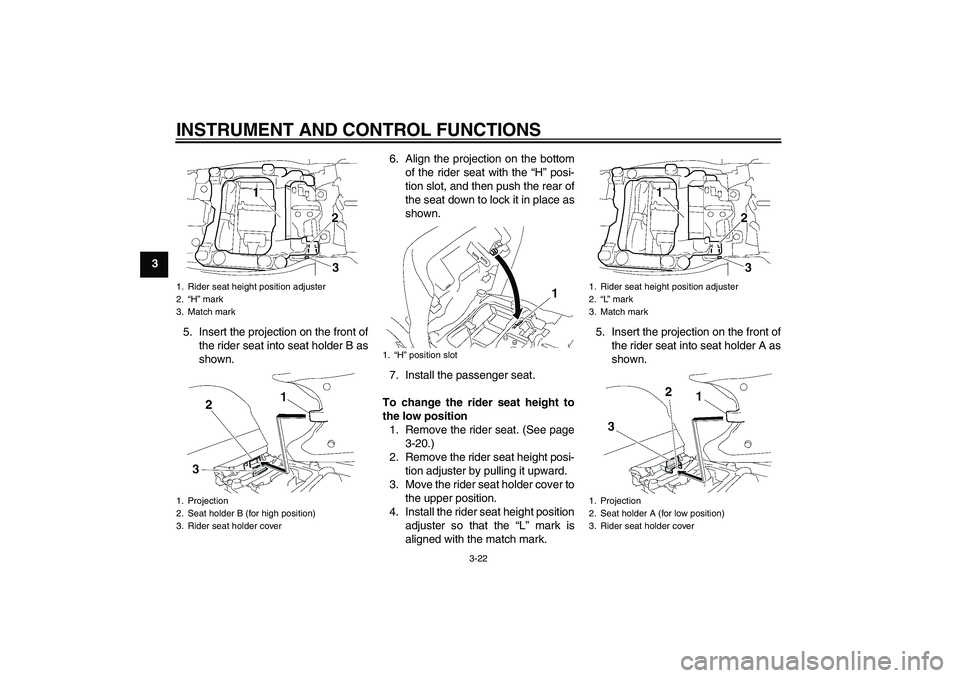
5. Insert the projection on the front of
the rider seat into seat holder B as
shown.6. Align the projection on the bottom
of the rider seat with the “H” posi-
tion slot, and then push the rear of
the seat down to lock it in place as
shown.
7. Install the passenger seat.
To change the rider seat height to
the low position
1. Remove the rider seat. (See page
3-20.)
2. Remove the rider seat height posi-
tion adjuster by pulling it upward.
3. Move the rider seat holder cover to
the upper position.
4. Install the rider seat height position
adjuster so that the “L” mark is
aligned with the match mark.5. Insert the projection on the front of
the rider seat into seat holder A as
shown.
1. Rider seat height position adjuster
2.“H” mark
3. Match mark
1. Projection
2. Seat holder B (for high position)
3. Rider seat holder cover
1.“H” position slot
1. Rider seat height position adjuster
2.“L” mark
3. Match mark
1. Projection
2. Seat holder A (for low position)
3. Rider seat holder cover
U3P6E1E0.book Page 22 Thursday, October 5, 2006 10:13 AM
Page 37 of 100
INSTRUMENT AND CONTROL FUNCTIONS
3-23
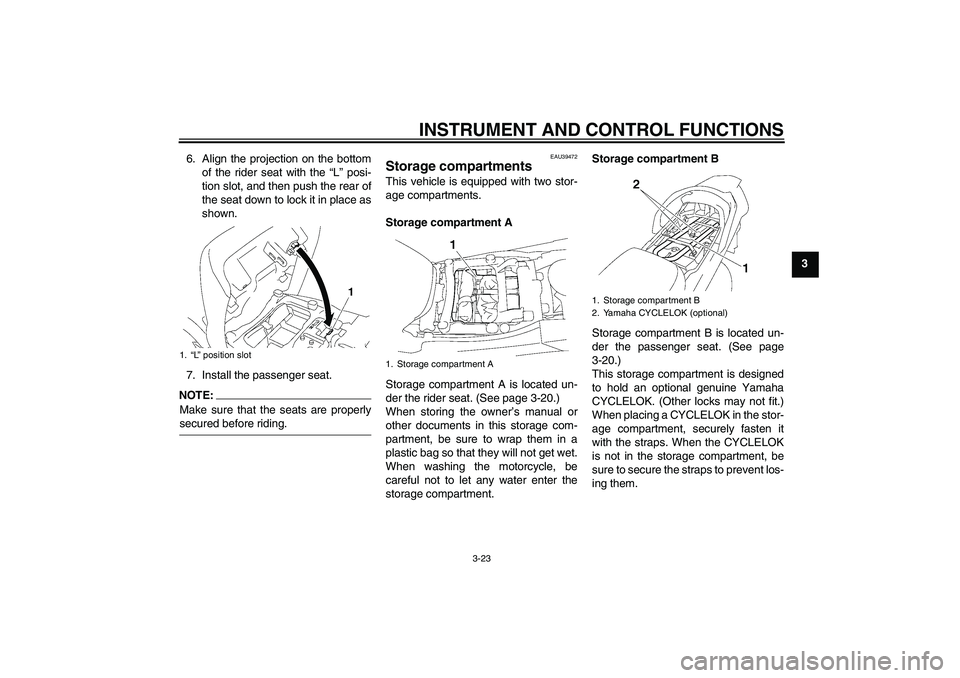
3 6. Align the projection on the bottom
of the rider seat with the “L” posi-
tion slot, and then push the rear of
the seat down to lock it in place as
shown.
7. Install the passenger seat.
NOTE:
Make sure that the seats are properlysecured before riding.
EAU39472
Storage compartments This vehicle is equipped with two stor-
age compartments.
Storage compartment A
Storage compartment A is located un-
der the rider seat. (See page 3-20.)
When storing the owner’s manual or
other documents in this storage com-
partment, be sure to wrap them in a
plastic bag so that they will not get wet.
When washing the motorcycle, be
careful not to let any water enter the
storage compartment.Storage compartment B
Storage compartment B is located un-
der the passenger seat. (See page
3-20.)
This storage compartment is designed
to hold an optional genuine Yamaha
CYCLELOK. (Other locks may not fit.)
When placing a CYCLELOK in the stor-
age compartment, securely fasten it
with the straps. When the CYCLELOK
is not in the storage compartment, be
sure to secure the straps to prevent los-
ing them.
1.“L” position slot
1. Storage compartment A
1. Storage compartment B
2. Yamaha CYCLELOK (optional)
U3P6E1E0.book Page 23 Thursday, October 5, 2006 10:13 AM
Page 75 of 100
PERIODIC MAINTENANCE AND MINOR REPAIR
6-21
6
�
When checking the fluid level,
make sure that the top of the brake
or clutch fluid reservoir is level.
�
Use only the recommended quality
brake fluid, otherwise the rubber
seals may deteriorate, causing
leakage and poor braking or clutch
performance.
�
Refill with the same type of brake
fluid. Mixing fluids may result in a
harmful chemical reaction and
lead to poor braking or clutch per-
formance.
�
The brake or clutch fluid reservoir
diaphragm will lose its shape from
the negative pressure if the fluid
level goes down too far. Be sure to
return the diaphragm to its original
shape before installing it into the
brake or clutch fluid reservoir.
�
Be careful that water or dust does
not enter the brake or clutch fluid
reservoir when refilling. Water will
significantly lower the boiling pointof the fluid and may result in vapor
lock, and dirt may clog the ABS hy-
draulic unit valves.
�
Brake fluid may deteriorate paint-
ed surfaces or plastic parts. Al-
ways clean up spilled fluid
immediately.
�
As the brake pads wear, it is nor-
mal for the brake fluid level to grad-
ually go down. However, if the
brake fluid level goes down sud-
denly, have a Yamaha dealer
check the cause.
EAU22750
Changing the brake and
clutch fluids Have a Yamaha dealer change the
brake and clutch fluids at the intervals
specified in the NOTE after the periodic
maintenance and lubrication chart. In
addition, have the oil seals of the brake
and clutch master cylinders and cali-
pers as well as the brake and clutch
hoses replaced at the intervals listed
below or whenever they are damaged
or leaking.�
Oil seals: Replace every two
years.
�
Brake and clutch hoses: Replace
every four years.
Recommended brake and clutch flu-
id:
DOT 4 brake fluid
U3P6E1E0.book Page 21 Thursday, October 5, 2006 10:13 AM
Page 82 of 100

PERIODIC MAINTENANCE AND MINOR REPAIR
6-28
6
EAU23657
Replacing the fuses The main fuse, the fuse boxes and the
ABS motor fuse are located under pan-
el A. (See page 6-5.)
If a fuse is blown, replace it as follows.
1. Turn the key to “OFF” and turn off
the electrical circuit in question.
2. Remove the blown fuse, and then
install a new fuse of the specified
amperage.
CAUTION:
ECA10640
Do not use a fuse of a higher amper-
age rating than recommended to
avoid causing extensive damage to
the electrical system and possibly afire.
1. Main fuse
2. Fuse box
3. ABS motor fuse
4. ABS motor spare fuse
1. Fuse box
2. Right radiator fan fuse
3. Left radiator fan fuse
4. Hazard fuse
5. Backup fuse (for odometer, clock and immo-
bilizer system)
6. Headlight fuse
7. Signaling system fuse
8. ABS control unit fuse
9. Ignition fuse
10.Fuel injection system fuse
11.Auxiliary DC jack fuse
12.Spare fuse
Specified fuses:
Main fuse:
50.0 A
Headlight fuse:
25.0 A
Signaling system fuse:
15.0 A
Ignition fuse:
10.0 A
Radiator fan fuse:
15.0 A × 2
Backup fuse:
10.0 A
Hazard fuse:
10.0 A
Fuel injection system fuse:
15.0 A
ABS control unit fuse:
10.0 A
Auxiliary DC jack fuse:
3.0 A
ABS motor fuse:
30.0 A
U3P6E1E0.book Page 28 Thursday, October 5, 2006 10:13 AM
Page 84 of 100
PERIODIC MAINTENANCE AND MINOR REPAIR
6-30
6
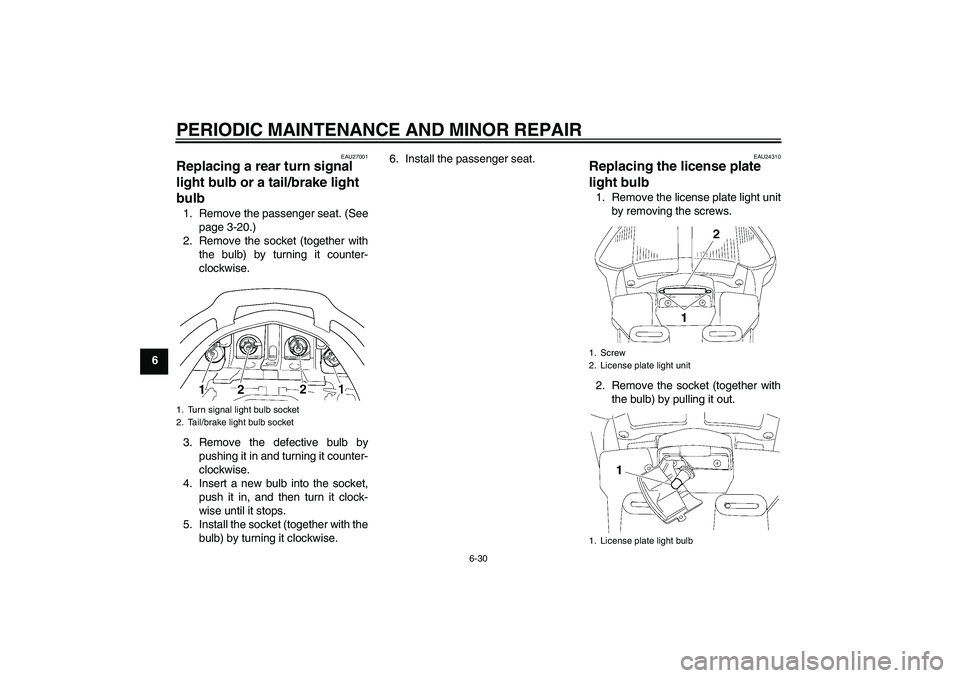
EAU27001
Replacing a rear turn signal
light bulb or a tail/brake light
bulb 1. Remove the passenger seat. (See
page 3-20.)
2. Remove the socket (together with
the bulb) by turning it counter-
clockwise.
3. Remove the defective bulb by
pushing it in and turning it counter-
clockwise.
4. Insert a new bulb into the socket,
push it in, and then turn it clock-
wise until it stops.
5. Install the socket (together with the
bulb) by turning it clockwise.6. Install the passenger seat.
EAU24310
Replacing the license plate
light bulb 1. Remove the license plate light unit
by removing the screws.
2. Remove the socket (together with
the bulb) by pulling it out.
1. Turn signal light bulb socket
2. Tail/brake light bulb socket
1. Screw
2. License plate light unit
1. License plate light bulb
U3P6E1E0.book Page 30 Thursday, October 5, 2006 10:13 AM