2007 VOLVO XC90 tow
[x] Cancel search: towPage 139 of 268

2007 Volvo XC90
When the system "senses" impending lockup, braking pressure is automatic\
ally modulated in order to help prevent lockup,
which could lead to a skid.
The system performs a self-diagnostic test when the engine is started an\
d when the vehicle first reaches a speed of
approximately 12 mph (20 km/h). The brake pedal will pulsate several times and a sound may be audible f\
rom the ABS
control module. This is normal.
To obtain optimal effect from the ABS system, constant pressure should b\
e kept on the brake pedal. Do not pump the
brake pedal.
The switching of the ABS modulator will be audible and the brake pedal w\
ill pulsate during braking. Please be aware that
ABS does not increase the absolute braking potential of the vehicle. Whi\
le control will be enhanced, ABS will not shorten
stopping distances on slippery surfaces.
ABS with EBD (Electronic Brake Force Distribution)
EBD is an integrated part of the ABS system. EBD regulates the hydraulic\
pressure to the rear brakes to help provide
optimal braking capacity. The brake pedal will pulsate during braking, w\
hich is normal.
If the BRAKE and ABS warning lights come on at the same time, this could\
indicate a fault in the brake system.
- Stop the vehicle in a suitable place and switch off the engine.
- Restart the engine.
- If both warning lights go off, no further action is required.
- If both lights are still on after the engine has been restarted, switc\
h off the engine again and check the brake fluid level
(see
page 185 for the location of the brake fluid reservoir).
WARNING!
If the fluid level is below the MIN mark in the reservoir or if a "Brake\
failure - Service urgent" message is displayed in
the text window: DO NOT DRIVE. Have the vehicle towed to a Volvo retaile\
r and have the brake system inspected.
- If the brake fluid level is above the MIN mark, drive carefully to an \
authorized Volvo retailer and have the brake system
inspected.
Emergency Brake Assistance (EBA)
The EBA function is designed to provide full brake effect immediately in\
the event of sudden, hard braking. The system is
activated by the speed with which you depress the brake pedal.
NOTE:
l When the EBA system is activated, the brake pedal will go down and press\
ure in the brake system immediately
increases to the maximum level. You must maintain full pressure on the b\
rake pedal in order
pg. 129 Starting and driving
Brake system
to utilize the system completely. There will be no braking effect if the\
pedal is released. EBA is automatically deactivated
when the brake pedal is released.
l When the vehicle has been parked for some time, the brake pedal may sink\
more than usual when the engine is started.
file:///K|/ownersdocs/2007/2007_XC90/07xc90_06.htm (15 of 32)12/30/200\
6 5:53:44 PM
Page 143 of 268
, the signal will become \
constant. If objects are close to both the front and
rear bumpers, the signal will alternate between th")
2007 Volvo XC90
l At a distance of approximately 1 foot (30 cm), the signal will become \
constant. If objects are close to both the front and
rear bumpers, the signal will alternate between the front and rear speak\
ers.
Deactivating the system(s)
- Press the Park assist button on the center console (see
page 52) to temporarily deactivate the system(s).
- The indicator light in the button will go out when the system(s) hav\
e been deactivated.
- If the vehicle is equipped with front and rear park assist, both syste\
ms will be deactivated by pressing the button.
Park assist will be automatically reactivated the next time the engine i\
s started.
NOTE: It may be necessary to deactivate one or both of the park assist system\
s in certain cases.
l Rear park assist: towing a trailer, carrying bicycles in a rear-mounted carrier, etc, co\
uld trigger the rear park assist
system's sensors.
l Front park assist: it may not be possible to combine auxiliary headlights and front park \
assist since these lights could
trigger the system's sensors.
pg. 133 Starting and driving
Front/rear park assist (accessory/option)
Faults in the system
If the yellow warning symbol illuminates and a message is shown in the i\
nformation display, the system is not
functioning properly. Consult a Volvo retailer or authorized service tec\
hnician.
Cleaning the sensors
For the system to function properly, the sensors in the front and/or rea\
r bumpers should be kept clean. They can be cleaned
with car washing detergent and a sponge.
WARNING!
These systems are designed to be a supplementary aid when parking the ve\
hicle. They are not, however, intended to
replace the driver's attention and judgement.
CAUTION!
In certain circumstances, the park assist system may give unexpected war\
ning signals that can be caused by external
sound sources that use the same ultrasound frequencies as the system. Th\
is may include such things as the horns of
other vehicles, wet tires on asphalt, pneumatic brakes, motorcycle exhau\
st pipes, etc. This does not indicate a fault in
the system.
pg. 134 Starting and driving
Towing
file:///K|/ownersdocs/2007/2007_XC90/07xc90_06.htm (19 of 32)12/30/200\
6 5:53:44 PM
Page 144 of 268

2007 Volvo XC90
Emergency towing
The towing eyelet is located in the tool bag, under the floor of the car\
go area. This eyelet must be screwed into the
positions provided on the right sides of either the front or rear bumper\
(see illustrations).
To attach the towing eyelet:
A. Use a coin to pry open the lower edge of the cover (A).
B. Screw the towing eyelet (C) in place (B), first by hand and then \
using the tire iron until it is securely in place.
After the vehicle has been towed, the eyelet should be removed and retur\
ned to the tool bag. Press the cover back into
position.
Precautions when the vehicle is in tow
l The steering wheel must be unlocked. Turn the ignition key to position I\
or II.
l The gear selector must be in position N.
l Maximum speed: 50 mph (80 km/h). Do not exceed the maximum allowable t\
owing speed.
l Maximum distance with front wheels on ground: 50 miles (80 km).
l While the vehicle is being towed, try to keep the tow rope taut at all t\
imes.
l The vehicle should only be towed in forward direction.
CAUTION!
- Please check with state and local authorities before attempting this t\
ype of towing, as vehicles being towed are subject
to regulations regarding maximum towing speed, length and type of towing\
device, lighting, etc.
- If the vehicle's battery is dead, do not attempt to start the vehicle \
by pushing or pulling it as this will damage the three-
way catalytic converter(s). The engine must be jump started using an a\
uxiliary battery (see
page 136).
- If the vehicle is being towed on a flat bed truck, the towing eyelets \
must not be used to secure the vehicle on the flat
bed. Consult the tow truck operator.
pg. 135 Starting and driving
Towing
file:///K|/ownersdocs/2007/2007_XC90/07xc90_06.htm (20 of 32)12/30/200\
6 5:53:44 PM
Page 145 of 268

2007 Volvo XC90
WARNING!
l Remember that the power brakes and power steering will not function when\
engine is not running. The braking and
steering systems will function but the brake pedal pressure required is \
3 - 4 times above normal and greater steering
effort must be exerted.
l The towing eyelets must not be used for pulling another vehicle out of a\
ditch or for any similar purpose involving
severe strain.
l Do not use the towing eyelets to pull the vehicle up onto a flat bed tow\
truck.
Towing vehicles with front wheel drive/All Wheel Drive
Volvo recommends the use of flat bed equipment.
If wheel lift equipment must be used, please use extreme caution to help\
avoid damage to the vehicle. In this case, the
vehicle should be towed with the rear wheels on the ground if at all pos\
sible.
If it is absolutely necessary to tow the vehicle with the front wheels o\
n the ground, please refer to the towing information
on the previous page.
CAUTION!
Sling-type equipment applied at the front will damage radiator and air c\
onditioning lines.
It is equally important not to use sling-type equipment at the rear or a\
pply lifting equipment inside the rear wheels;
serious damage to the rear axle may result.
If the vehicle is being towed on a flat bed truck, the towing eyelets mu\
st not be used to secure the vehicle on the flat
bed. Consult the tow truck operator.
WARNING!
Do not use the towing eyelets to pull the vehicle up onto a flat bed tow\
truck.
pg. 136 Starting and driving
Jump starting
file:///K|/ownersdocs/2007/2007_XC90/07xc90_06.htm (21 of 32)12/30/200\
6 5:53:44 PM
Page 147 of 268

2007 Volvo XC90
Towing a trailer
The maximum weights recommended by Volvo for trailers with brakes are shown in the table below.
NOTE:
l Recommended hitch tongue load: not more than 10% of the trailer's weight\
. The trailer load should be positioned
so that it does not shift and the tongue load should be 10% of the trail\
er's weight. However, the tongue load should not
exceed the maximum permissible weights indicated in the table above.
l When towing trailers without brakes, the maximum permissible trailer weight is 1,700 lbs (750 kg).\
l If necessary, redistribute the weight of any cargo in the trailer to avo\
id excessive weight on the trailer hitch.
l The maximum trailer weight listed in the table for All Wheel Drive model\
s, 5,000 lbs (2250 kg) is only applicable when
there are not more than two occupants in the vehicle, in the front seats\
, with a combined weight of 300 lbs (135 kg), with
no other cargo in the vehicle.
l The maximum weight listed for Front Wheel Drive models, 4,000 lbs (1800\
kg) is only applicable when there are not
more than four occupants in the vehicle, in the front seats and second r\
ow of seats, with a combined weight of 600 lbs (270
kg), with no other cargo in the vehicle.
pg. 138 Starting and driving
Towing a trailer
l Please be aware that the load on the trailer hitch is part of the vehicl\
e's total load carrying capacity. The amount of cargo
in the vehicle and the trailer must be limited so that the gross vehicle\
weight and maximum permissible rear axle weight
(see
page 209) are not exceeded.
l Vehicles used for towing a trailer on a regular basis, or for long-dista\
nce highway towing should be equipped with an
automatic transmission oil cooler and Volvo's automatic self-leveling sy\
stem for the rear suspension. Consult your Volvo
retailer.
l Volvo recommends the use of Volvo trailer hitches that are specially des\
igned for the vehicle.
l All Volvo models are equipped with energy-absorbing shock-mounted bumper\
s. Trailer hitch installation should not
interfere with the proper operation of this bumper system.
l Increase tire pressure to recommended full inflation pressure. See chapt\
er "Wheels and tires."
l When your vehicle is new, avoid towing heavy trailers during the first 6\
20 miles (1,000 km).
l Engine and transmission are subject to increased loads. Therefore, engin\
e coolant temperature should be closely
file:///K|/ownersdocs/2007/2007_XC90/07xc90_06.htm (23 of 32)12/30/200\
6 5:53:44 PM
Page 148 of 268

2007 Volvo XC90
watched when driving in hot climates or hilly terrain. Use a lower gear \
and turn off the air conditioner if the temperature
gauge needle enters the red range.
l If the automatic transmission begins to overheat, a message will be disp\
layed in the text window.
l Hauling a trailer affects handling, durability, and economy.
l It is necessary to balance trailer brakes with the towing vehicle brakes\
to provide a safe stop (check and observe state/
local regulations).
l Do not connect the trailer's brake system directly to the vehicle's brak\
e system.
l Remove the ball and drawbar assembly when the hitch is not being used.
l Volvo recommends the use of synthetic engine oil when towing a trailer o\
ver long distances or in mountainous areas.
NOTE:
l When parking the vehicle with a trailer on a hill, apply the parking bra\
ke before putting the gear selector in (P)ark.
When starting on a hill, put the gear selector in (D)rive before relea\
sing the parking brake. Always follow the trailer
manufacturer's recommendations for wheel chocking.
l If you use the manual (Geartronic) shift positions while towing a trai\
ler, make sure the gear you select does not put too
much strain on the engine (using too high a gear).
WARNING!
l Bumper-attached trailer hitches must not be used on Volvos, nor should s\
afety chains be attached to the bumper.
l Trailer hitches attaching to the vehicle rear axle must not be used.
l Never connect a trailer's hydraulic brake system directly to the vehicle\
brake system, nor a trailer's lighting system
directly to the vehicle lighting system. Consult your nearest authorized\
Volvo retailer for correct installation.
l When towing a trailer, the trailer's safety wire must be correctly faste\
ned to the hole or hook provided in the trailer
hitch on the vehicle. The safety wire should never be fastened to or wou\
nd around the drawbar ball.
pg. 139 Starting and driving
Towing a trailer
Smoother starts with a trailer
Models equipped with the V8-engine and the 6-speed automatic transmissio\
n have a built-in function that reduces
acceleration slightly in first gear when the vehicle is towing a trailer\
. This is done to help avoid wheel spin and to make
starting off smoother.
l This function is activated when the trailer's electrical connector is pl\
ugged into the electrical socket mounted near the
trailer hitch.
l The function is automatically deactivated when the trailer's wiring is d\
isconnected from the socket. The vehicle will
then accelerate normally.
NOTE: Since this function is activated when a connector is plugged into the e\
lectrical socket near the trailer hitch, it will
be activated by any electrical equipment (e.g. bicycle racks with light\
ing, etc) that is plugged in, and will remain active
until the equipment is unplugged from the socket.
Leveling
If your vehicle is equipped with automatic leveling, the rear suspension\
always retains the correct ride height regardless of
the load.
l The system adjusts the rear suspension to the correct level after the ve\
hicle has been driven a short distance.
file:///K|/ownersdocs/2007/2007_XC90/07xc90_06.htm (24 of 32)12/30/200\
6 5:53:44 PM
Page 154 of 268
2007 Volvo XC90
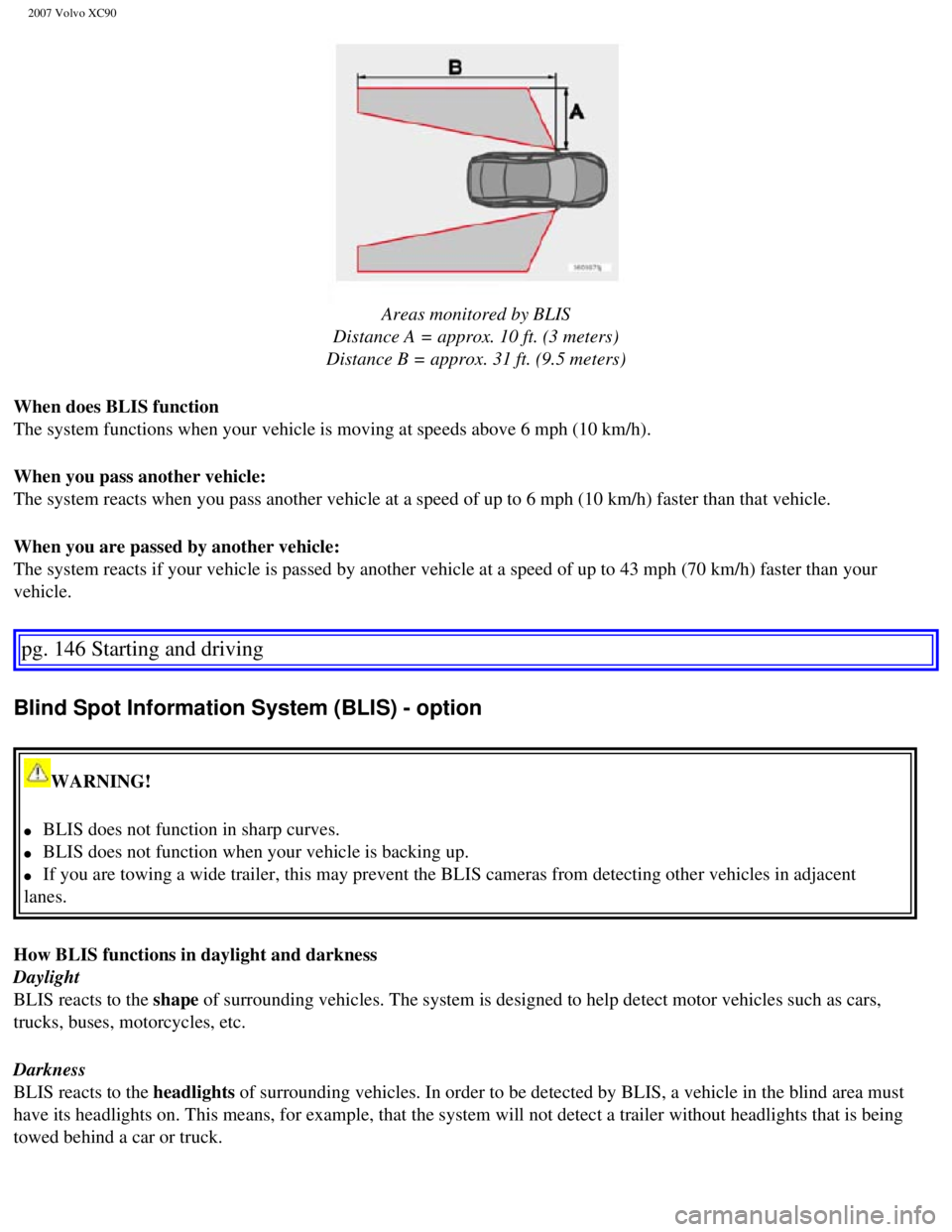
Areas monitored by BLIS
Distance A = approx. 10 ft. (3 meters)
Distance B = approx. 31 ft. (9.5 meters)
When does BLIS function
The system functions when your vehicle is moving at speeds above 6 mph (\
10 km/h).
When you pass another vehicle:
The system reacts when you pass another vehicle at a speed of up to 6 mp\
h (10 km/h) faster than that vehicle.
When you are passed by another vehicle:
The system reacts if your vehicle is passed by another vehicle at a spee\
d of up to 43 mph (70 km/h) faster than your
vehicle.
pg. 146 Starting and driving
Blind Spot Information System (BLIS) - option
WARNING!
l BLIS does not function in sharp curves.
l BLIS does not function when your vehicle is backing up.
l If you are towing a wide trailer, this may prevent the BLIS cameras from\
detecting other vehicles in adjacent
lanes.
How BLIS functions in daylight and darkness
Daylight
BLIS reacts to the shape of surrounding vehicles. The system is designed to help detect motor ve\
hicles such as cars,
trucks, buses, motorcycles, etc.
Darkness
BLIS reacts to the headlights of surrounding vehicles. In order to be detected by BLIS, a vehicle in \
the blind area must
have its headlights on. This means, for example, that the system will no\
t detect a trailer without headlights that is being
towed behind a car or truck.
file:///K|/ownersdocs/2007/2007_XC90/07xc90_06.htm (30 of 32)12/30/200\
6 5:53:44 PM
Page 169 of 268

2007 Volvo XC90
Properly loading your vehicle will provide maximum return of vehicle des\
ign performance.
Before loading your vehicle, familiarize yourself with the following ter\
ms for determining your vehicle's
weight ratings, with or without a trailer, from the vehicle's Federal/ C\
anadian Motor Vehicle Safety
Standards (FMVSS/CMVSS) label, and the vehicle's tire information plac\
ard.
Curb weight
The weight of the vehicle including a full tank of fuel and all standard\
equipment. It does not include
passengers, cargo, or optional equipment.
Capacity weight
All weight added to the curb weight, including cargo and optional equipm\
ent. When towing, trailer hitch
tongue load is also part of cargo weight.
NOTE: For trailer towing information, please refer to the section "Towing a t\
railer" on
page 137.
Permissible axle weight
The maximum allowable weight that can be carried by a single axle (fron\
t or rear). These numbers are
shown on the Federal/Canadian Motor Vehicle Safety Standards (FMVSS/ CM\
VSS) label. The total
load on each axle must never exceed its maximum permissible weight.
Gross vehicle weight (GVW)
The vehicle's curb weight + cargo + passengers.
NOTE:
l The location of the various labels in your vehicle can be found on page 208.
l A table listing important weight limits for your vehicle can be found on\
page 209.
Steps for Determining Correct Load Limit
- Locate the statement "the combined weight of occupants and cargo shoul\
d never exceed XXX pounds''
on your vehicle's placard.
- Determine the combined weight of the driver and passengers that will b\
e riding in your vehicle.
- Subtract the combined weight of the driver and passengers from XXX kil\
ograms or XXX pounds.
- The resulting figure equals the available amount of cargo and luggage \
load capacity. For example, if
the "XXX'' amount equals 1400 lbs. and there will be five 150 lb. passen\
gers in your vehicle, the amount
of available cargo and luggage load capacity is 650 lbs. (1400- 750 (5\
x 150) = 650 lbs.)
- Determine the combined weight of luggage and cargo being loaded on the\
vehicle. That weight may
not safely exceed the available cargo and luggage load capacity calculat\
ed in Step 4.
- If your vehicle will be towing a trailer, load from your trailer will \
be transferred to your vehicle.
Consult this manual
1 to determine how this reduces the available cargo and luggage load capa\
city of
your vehicle.
file:///K|/ownersdocs/2007/2007_XC90/07xc90_07.htm (13 of 23)12/30/200\
6 5:53:47 PM