2007 VOLVO XC90 warning lights
[x] Cancel search: warning lightsPage 152 of 268

2007 Volvo XC90
W - Winter/Wet driving mode - enhanced vehicle traction
l Mode W will only function if the gear selector is in the (D)rive position.
l Press the button at the base of the gear selector to engage/disengage th\
is driving mode.
l An LED in the button will light up to indicate that W is engaged and thi\
s will also be displayed in the instrument panel
(see
page 46).
l This mode may be selected for starting/ moving off on slippery roads.
1. Synthetic oil is not used when the oil is changed at the normal maint\
enance service intervals except at owner request and at
additional charge. Please consult your Volvo retailer.
pg. 144 Starting and driving
Before a long distance trip
It is always worthwhile to have your vehicle checked at a Volvo retailer\
before driving long distances. Your retailer will
also be able to supply you with bulbs, fuses, spark plugs and wiper blad\
es for your use in the event that problems occur.
As a minimum, the following items should be checked before any long trip\
:
l Check that engine runs smoothly and that fuel consumption is normal.
l Check for fuel, oil, and fluid leakage.
l Check transmission oil level1.
l Check condition of drive belts.
l Check state of the battery's charge.
l Examine tires carefully (the spare tire as well), and replace those th\
at are worn. Check tire pressures.
l The brakes, front wheel alignment, and steering gear should be checked b\
y your Volvo retailer only.
l Check all lights, including high beams.
l Reflective warning triangles are legally required in some states/provinc\
es.
l Have a word with your Volvo retailer if you intend to drive in countries\
where it may be difficult to obtain the correct
fuel.
l Consider your destination. If you will be driving through an area where \
snow or ice are likely to occur, consider snow
tires.
1. To prevent injury from contact with hot surfaces, do not inspect your\
vehicle's transmission fluid yourself. Have your vehicle's
transmission fluid level inspected by a qualified Volvo service technici\
an.
pg. 145 Starting and driving
Blind Spot Information System (BLIS) - option
file:///K|/ownersdocs/2007/2007_XC90/07xc90_06.htm (28 of 32)12/30/200\
6 5:53:44 PM
Page 153 of 268

2007 Volvo XC90
BLIS is an information system that indicates the presence of another veh\
icle moving in the same direction as your vehicle
in the sideview mirror's "blind area."
The system is based on digital camera technology. The cameras (1) are \
located beneath the side-view mirrors.
When one (or both) of the cameras have detected a vehicle in the blind\
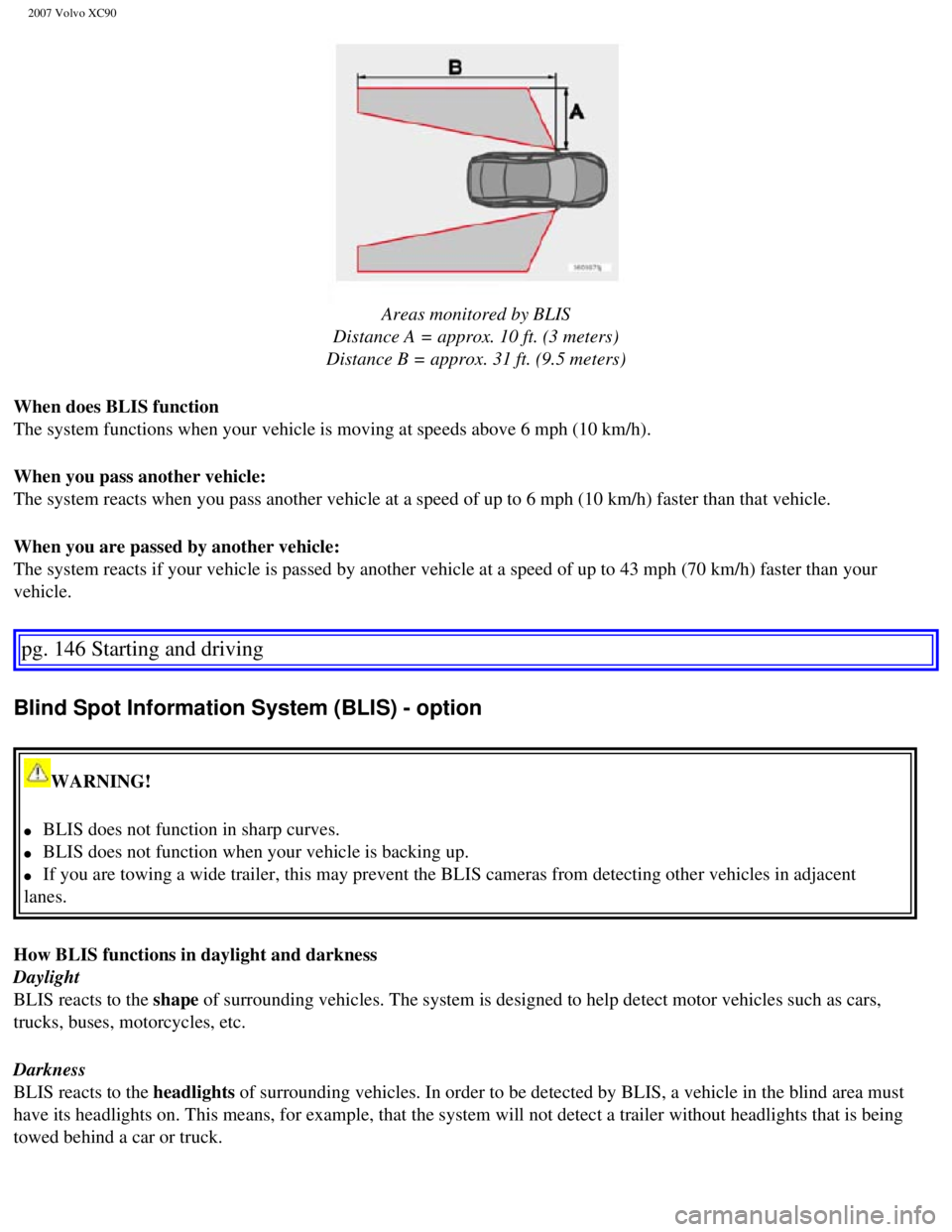
area (up to approximately 10 ft. (3 meters) from the
side of your vehicle, and up to approximately 31 ft. (9.5 meters) behi\
nd the side-view mirror), see the illustration in the
right column, the indicator light in the door panel (2) illuminates.
WARNING!
l BLIS is an information system, NOT a warning or safety system.
l BLIS does not eliminate the need for you to visually confirm the conditi\
ons around you, and the need for you to turn
your head and shoulders to make sure that you can safely change lanes.
l As the driver, you have full responsibility for changing lanes in a safe\
manner.
The light will glow continuously to alert the driver of the vehicle in t\
he blind area.
NOTE: The door panel indicator light illuminates on the side of the vehicle wh\
ere the system has detected another vehicle.
If your vehicle is passed on both sides at the same time, both lights wi\
ll illuminate.
BLIS has an integrated function that alerts the driver if a fault should\
occur with the system. For example, if one or both of
the system's cameras are obscured, a message (see the table on
page 147) will appear in the information display in the
instrument panel. If this occurs, clean the camera lenses. If necessary,\
the system can be temporarily switched off (for
instructions, see
page 147).
file:///K|/ownersdocs/2007/2007_XC90/07xc90_06.htm (29 of 32)12/30/200\
6 5:53:44 PM
Page 154 of 268
2007 Volvo XC90
Areas monitored by BLIS
Distance A = approx. 10 ft. (3 meters)
Distance B = approx. 31 ft. (9.5 meters)
When does BLIS function
The system functions when your vehicle is moving at speeds above 6 mph (\
10 km/h).
When you pass another vehicle:
The system reacts when you pass another vehicle at a speed of up to 6 mp\
h (10 km/h) faster than that vehicle.
When you are passed by another vehicle:
The system reacts if your vehicle is passed by another vehicle at a spee\
d of up to 43 mph (70 km/h) faster than your
vehicle.
pg. 146 Starting and driving
Blind Spot Information System (BLIS) - option
WARNING!
l BLIS does not function in sharp curves.
l BLIS does not function when your vehicle is backing up.
l If you are towing a wide trailer, this may prevent the BLIS cameras from\
detecting other vehicles in adjacent
lanes.
How BLIS functions in daylight and darkness
Daylight
BLIS reacts to the shape of surrounding vehicles. The system is designed to help detect motor ve\
hicles such as cars,
trucks, buses, motorcycles, etc.
Darkness
BLIS reacts to the headlights of surrounding vehicles. In order to be detected by BLIS, a vehicle in \
the blind area must
have its headlights on. This means, for example, that the system will no\
t detect a trailer without headlights that is being
towed behind a car or truck.
file:///K|/ownersdocs/2007/2007_XC90/07xc90_06.htm (30 of 32)12/30/200\
6 5:53:44 PM
Page 155 of 268

2007 Volvo XC90
WARNING!
l BLIS does not react to cyclists or mopeds.
l BLIS does not react to vehicles that are standing still.
l The function of the BLIS cameras may be affected by intense light, or wh\
en driving at night in areas where there are
no external sources of light (e.g., street lights, other vehicles, etc.\
). In such cases, the system may react as if the cameras
were obscured.
In both of the above mentioned conditions, a message will appear in the \
information display.
When driving in such conditions, the system can be temporarily switched \
off. See
page 147 for instructions.
When the message is no longer displayed, BLIS will return to normal func\
tion.
l The BLIS cameras have the same limitation as the human eye. In other wor\
ds, their "vision is impaired" by adverse
weather conditions such as heavy snowfall, dense fog, etc.
Cleaning the BLIS camera lenses
In order to function optimally, the BLIS camera lenses must be kept clea\
n. They can be wiped clean with a soft cloth or
wet sponge. CAUTION!
Clean the lenses carefully to avoid scratching.
The lenses are electrically heated to help melt ice or snow. If necessar\
y, gently brush away snow from the
lenses.
pg. 147 Starting and driving
Blind Spot Information System (BLIS) - option
Switching BLIS on and off
BLIS is automatically activated when the ignition is switched on. The in\
dicator lights will provide confirmation by
flashing 3 times.
l The system can be switched off by pressing the BLIS button in the center\
console (see the illustration above). The
indicator light in the button goes out when the system is switched off, \
and a text message is displayed.
l BLIS can be switched on again by pressing the button. The indicator ligh\
t in the button will illuminate and a new text
message will be displayed. Press the READ button (see
page 50) to erase the message.
file:///K|/ownersdocs/2007/2007_XC90/07xc90_06.htm (31 of 32)12/30/200\
6 5:53:44 PM
Page 182 of 268

2007 Volvo XC90
WARNING!
l When the vehicle is driven immediately after being washed, apply the bra\
kes several times in order
to remove any moisture from the brake linings.
l Engine cleaning agents should not be used when the engine is warm. This \
constitutes a fire risk.
Automatic washing - simple and quick
l We do NOT recommend washing your vehicle in an automatic wash during the\
first six months
(because the paint will not have hardened sufficiently).
l An automatic wash is a simple and quick way to clean your vehicle, but i\
t is worth remembering that
it may not be as thorough as when you yourself go over the vehicle with \
sponge and water. Keeping the
underbody clean is most important, especially in the winter. Some automa\
tic washers do not have
facilities for washing the underbody.
l Before driving into an automatic car wash, make sure that side view mirr\
ors, auxiliary lamps, etc, are
secure, and that any antenna(s) are retracted or removed. Otherwise th\
ere is risk of the machine
dislodging them.
Exterior lighting
Condensation may form temporarily on the inside of the lenses of exterio\
r lights such as headlights, fog
lights, or tail lights. This is normal and the lights are designed to wi\
thstand moisture. Normally,
condensation will dissipate after the lights have been on for a short ti\
me.
Polishing and waxing
l Normally, polishing is not required during the first year after delivery\
, however, waxing may be
beneficial.
l Before applying polish or wax the vehicle must be washed and dried. Tar \
spots can be removed with
kerosene or tar remover. Difficult spots may require a fine rubbing comp\
ound.
l After polishing use liquid or paste wax.
l Several commercially available products contain both polish and wax.
l Waxing alone does not substitute for polishing a dull surface.
l A wide range of polymer-based car waxes can be purchased today. These wa\
xes are easy to use and
produce a long-lasting, high-gloss finish that protects the bodywork aga\
inst oxidation, road dirt and
fading.
l Do not polish or wax your vehicle in direct sunlight (the surface of th\
e vehicle should not be warmer
than 113° F (45° C).
file:///K|/ownersdocs/2007/2007_XC90/07xc90_08.htm (3 of 7)12/30/2006 \
5:53:48 PM
Page 205 of 268

2007 Volvo XC90
NOTE: After the battery has been disconnected or replaced, lock and unlock th\
e vehicle with the central
locking system's remote control to reactivate such features as the power\
windows, moonroof, courtesy
lighting, etc.
WARNING!
Ventilation hose:
l The battery generates hydrogen gas, which is flammable and explosive. Th\
e battery is fitted with a
ventilation hose which vents hydrogen gas out of the battery compartment\
through a ventilation
opening in the bottom of this compartment. If the battery must be replac\
ed, it is essential that the
ventilation hose is properly connected to the battery and that it is rou\
ted through the ventilation
opening provided (see illustration).
l Be sure the ventilation hose is free of debris.
l Only use replacement batteries equipped with a ventilation hose. Consult\
your Volvo retailer.
pg. 194 Maintenance
Replacing bulbs
When replacing bulbs, keep the following points in mind:
l Never touch the glass of bulbs with your fingers. Grease and oils from y\
our fingers vaporize in the
heat and will leave a deposit on the reflector, which will damage it.
l The optional Active Bi-Xenon headlight bulbs contain trace amounts of me\
rcury. These bulbs should
always be disposed of by an authorized Volvo retailer.
l The following bulbs should only be replaced by a trained and qualified V\
olvo service technician:
- Active Bi-Xenon headlights,
- Courtesy (dome) lighting,
- Reading lights,
- Glove compartment lights
- Turn signals and courtesy lights in the side door mirrors
- High-mounted brake lights
file:///K|/ownersdocs/2007/2007_XC90/07xc90_09.htm (19 of 37)12/30/200\
6 5:53:50 PM
Page 206 of 268

2007 Volvo XC90
Replacing high/low beams/turn signal/parking light bulbs
The entire lamp housing must be lifted out when replacing these bulbs.
To lift out the lamp housing:
- Switch off the ignition.
- Open the hood.
- Pull up the retaining pins (see the illustration above).
- Lift out the lamp housing.
WARNING!
Active Bi-Xenon headlights (option) - due to the high voltage used by \
these headlights, these bulbs
should only be replaced by an authorized Volvo service technician.
pg. 195 Maintenance
Replacing bulbs
file:///K|/ownersdocs/2007/2007_XC90/07xc90_09.htm (20 of 37)12/30/200\
6 5:53:50 PM
Page 229 of 268
2007 Volvo XC90
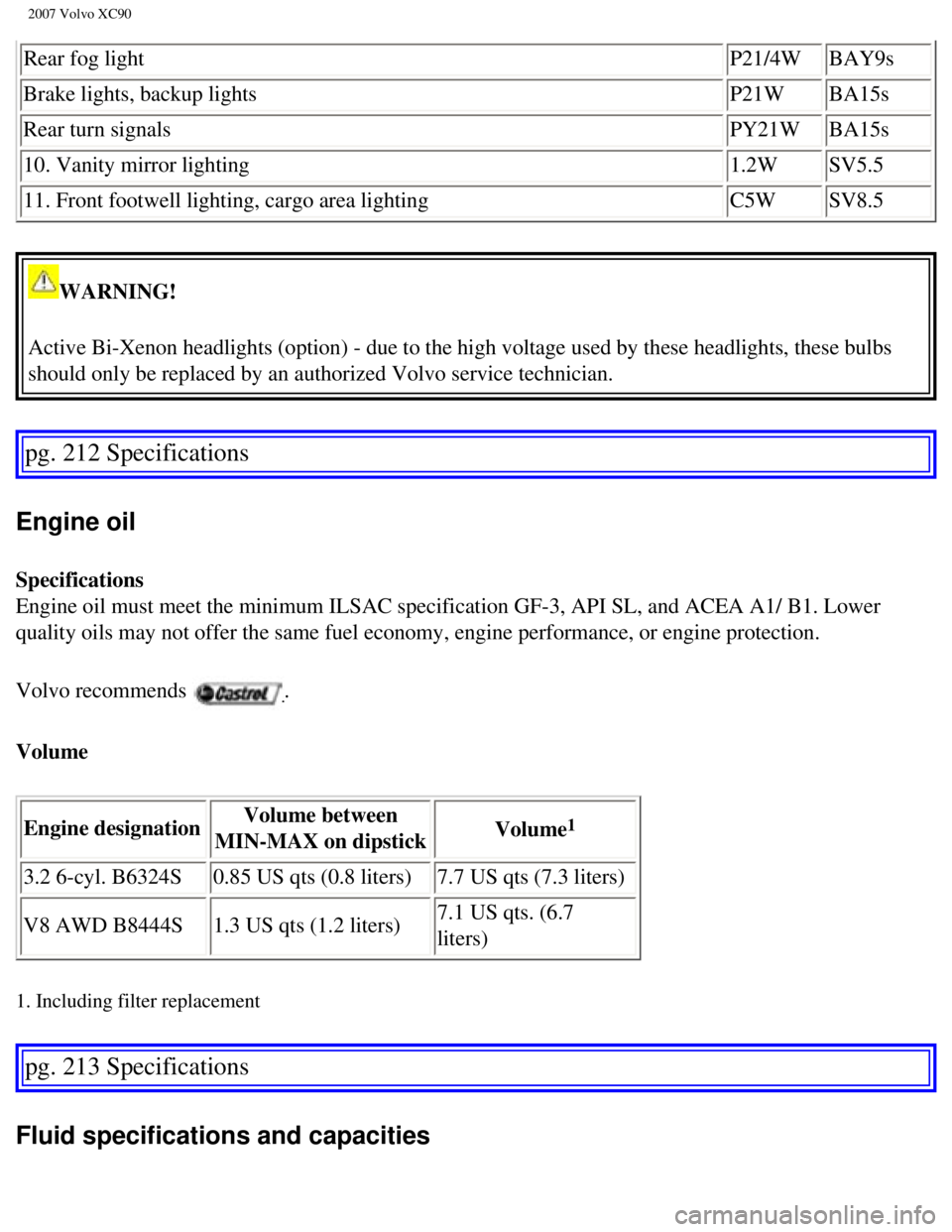
Rear fog lightP21/4W BAY9s
Brake lights, backup lights P21W BA15s
Rear turn signals PY21W BA15s
10. Vanity mirror lighting 1.2W SV5.5
11. Front footwell lighting, cargo area lighting C5W SV8.5
WARNING!
Active Bi-Xenon headlights (option) - due to the high voltage used by \
these headlights, these bulbs
should only be replaced by an authorized Volvo service technician.
pg. 212 Specifications
Engine oil
Specifications
Engine oil must meet the minimum ILSAC specification GF-3, API SL, and A\
CEA A1/ B1. Lower
quality oils may not offer the same fuel economy, engine performance, or\
engine protection.
Volvo recommends
.
Volume
Engine designation Volume between
MIN-MAX on dipstick Volume
1
3.2 6-cyl. B6324S
0.85 US qts (0.8 liters) 7.7 US qts (7.3 liters)
V8 AWD B8444S 1.3 US qts (1.2 liters) 7.1 US qts. (6.7
liters)
1. Including filter replacement
pg. 213 Specifications
Fluid specifications and capacities
file:///K|/ownersdocs/2007/2007_XC90/07xc90_10.htm (6 of 10)12/30/2006\
5:53:52 PM