Page 229 of 251
2 0 0 7
VOLVO S80
236 06 Maintenance and specifications
Vehicle care
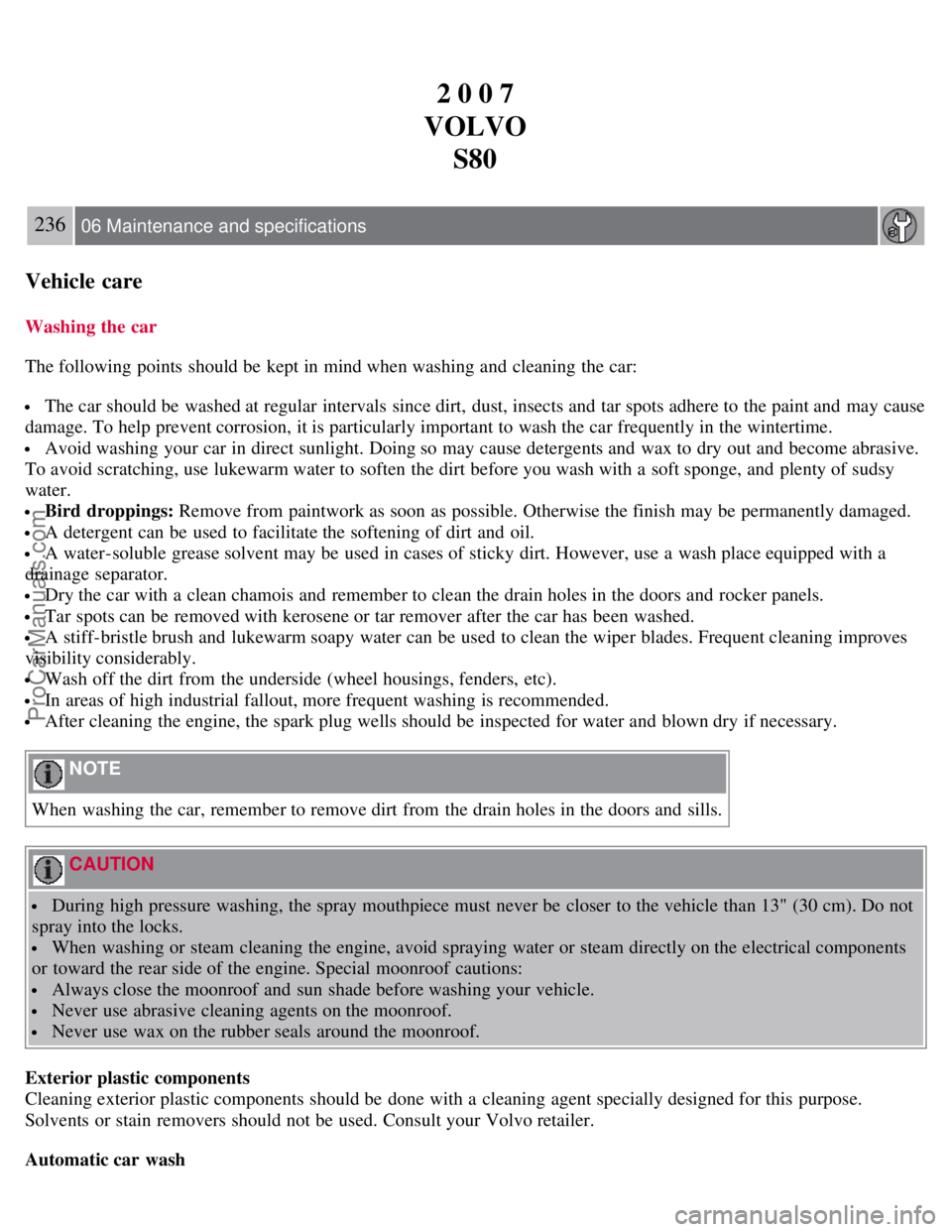
Washing the car
The following points should be kept in mind when washing and cleaning the car:
The car should be washed at regular intervals since dirt, dust, insects and tar spots adhere to the paint and may cause
damage. To help prevent corrosion, it is particularly important to wash the car frequently in the wintertime.
Avoid washing your car in direct sunlight. Doing so may cause detergents and wax to dry out and become abrasive.
To avoid scratching, use lukewarm water to soften the dirt before you wash with a soft sponge, and plenty of sudsy
water.
Bird droppings: Remove from paintwork as soon as possible. Otherwise the finish may be permanently damaged.
A detergent can be used to facilitate the softening of dirt and oil.
A water-soluble grease solvent may be used in cases of sticky dirt. However, use a wash place equipped with a
drainage separator.
Dry the car with a clean chamois and remember to clean the drain holes in the doors and rocker panels.
Tar spots can be removed with kerosene or tar remover after the car has been washed.
A stiff-bristle brush and lukewarm soapy water can be used to clean the wiper blades. Frequent cleaning improves
visibility considerably.
Wash off the dirt from the underside (wheel housings, fenders, etc).
In areas of high industrial fallout, more frequent washing is recommended.
After cleaning the engine, the spark plug wells should be inspected for water and blown dry if necessary.
NOTE
When washing the car, remember to remove dirt from the drain holes in the doors and sills.
CAUTION
During high pressure washing, the spray mouthpiece must never be closer to the vehicle than 13" (30 cm). Do not
spray into the locks.
When washing or steam cleaning the engine, avoid spraying water or steam directly on the electrical components
or toward the rear side of the engine. Special moonroof cautions:
Always close the moonroof and sun shade before washing your vehicle.
Never use abrasive cleaning agents on the moonroof.
Never use wax on the rubber seals around the moonroof.
Exterior plastic components
Cleaning exterior plastic components should be done with a cleaning agent specially designed for this purpose.
Solvents or stain removers should not be used. Consult your Volvo retailer.
Automatic car wash
ProCarManuals.com
Page 232 of 251
CAUTION
Under no circumstances should gasoline, naphtha or similar cleaning agents be used on the plastic or the leather
since these can cause damage.
Take extra care when removing stains such as ink or lipstick since the coloring can spread.
Use solvents sparingly. Too much solvent can damage the seat padding.
Start from the outside of the stain and work toward the center.
Sharp objects (e.g. pencils or pens in a pocket) or Velcro fasteners on clothing may damage the textile upholstery.
Clothing that is not colorfast, such as new jeans or suede garments, may stain the upholstery.
Cleaning the seat belts
Clean only with lukewarm water and a mild soap solution.
Cleaning floor mats
The floor mats should be vacuumed or brushed clean regularly, especially during winter when they should be taken out
for drying. Spots on textile mats can be removed with a mild detergent. For best protection in winter, Volvo
recommends the use of Volvo rubber floor mats. Consult your Volvo retailer.
Spots on interior plastic parts and surfaces
Cleaning interior plastic components should be done with a cleaning agent specially designed for this purpose. Consult
your Volvo retailer.
240 06 Maintenance and specifications
Vehicle care
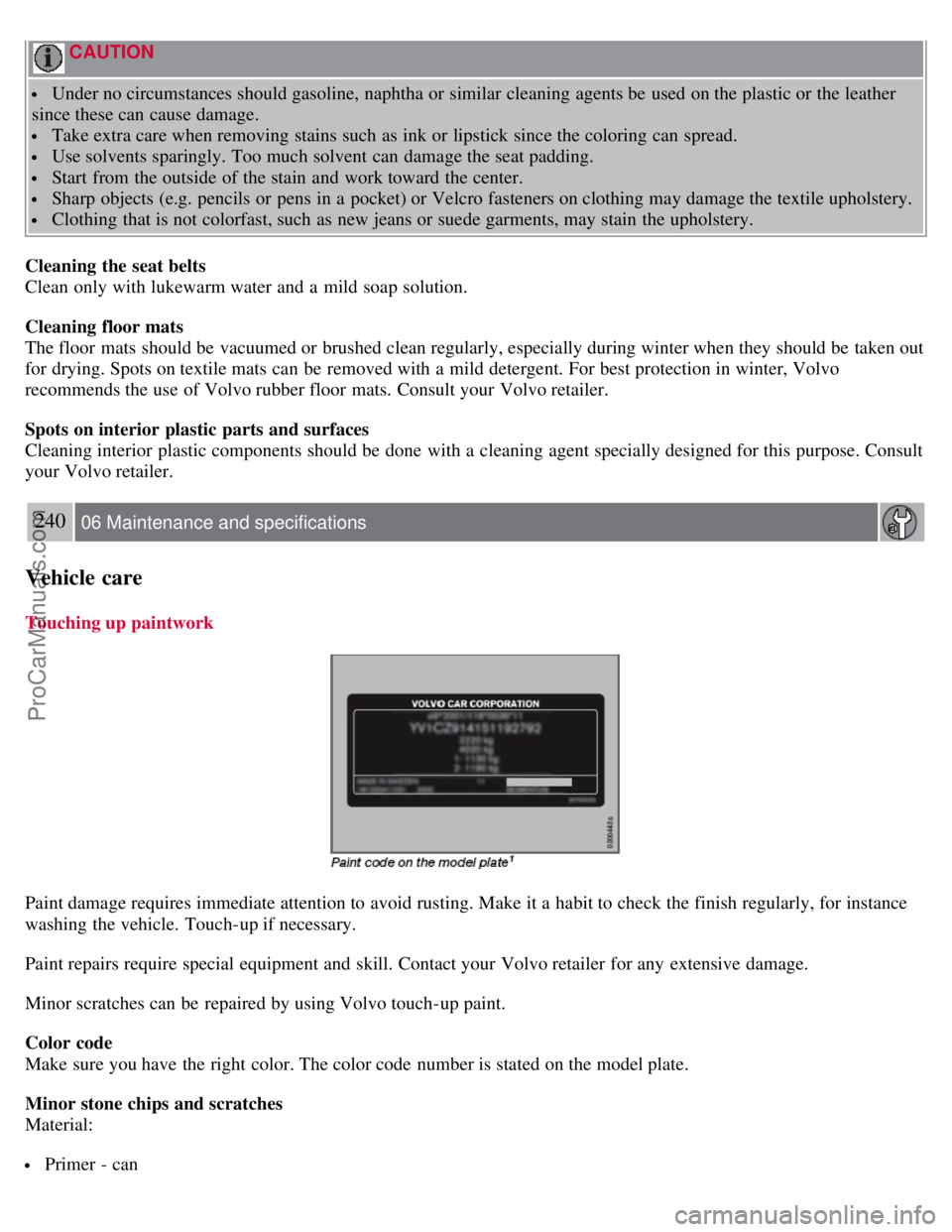
Touching up paintwork
Paint damage requires immediate attention to avoid rusting. Make it a habit to check the finish regularly, for instance
washing the vehicle. Touch-up if necessary.
Paint repairs require special equipment and skill. Contact your Volvo retailer for any extensive damage.
Minor scratches can be repaired by using Volvo touch-up paint.
Color code
Make sure you have the right color. The color code number is stated on the model plate.
Minor stone chips and scratches
Material:
Primer - can
ProCarManuals.com
Page 237 of 251
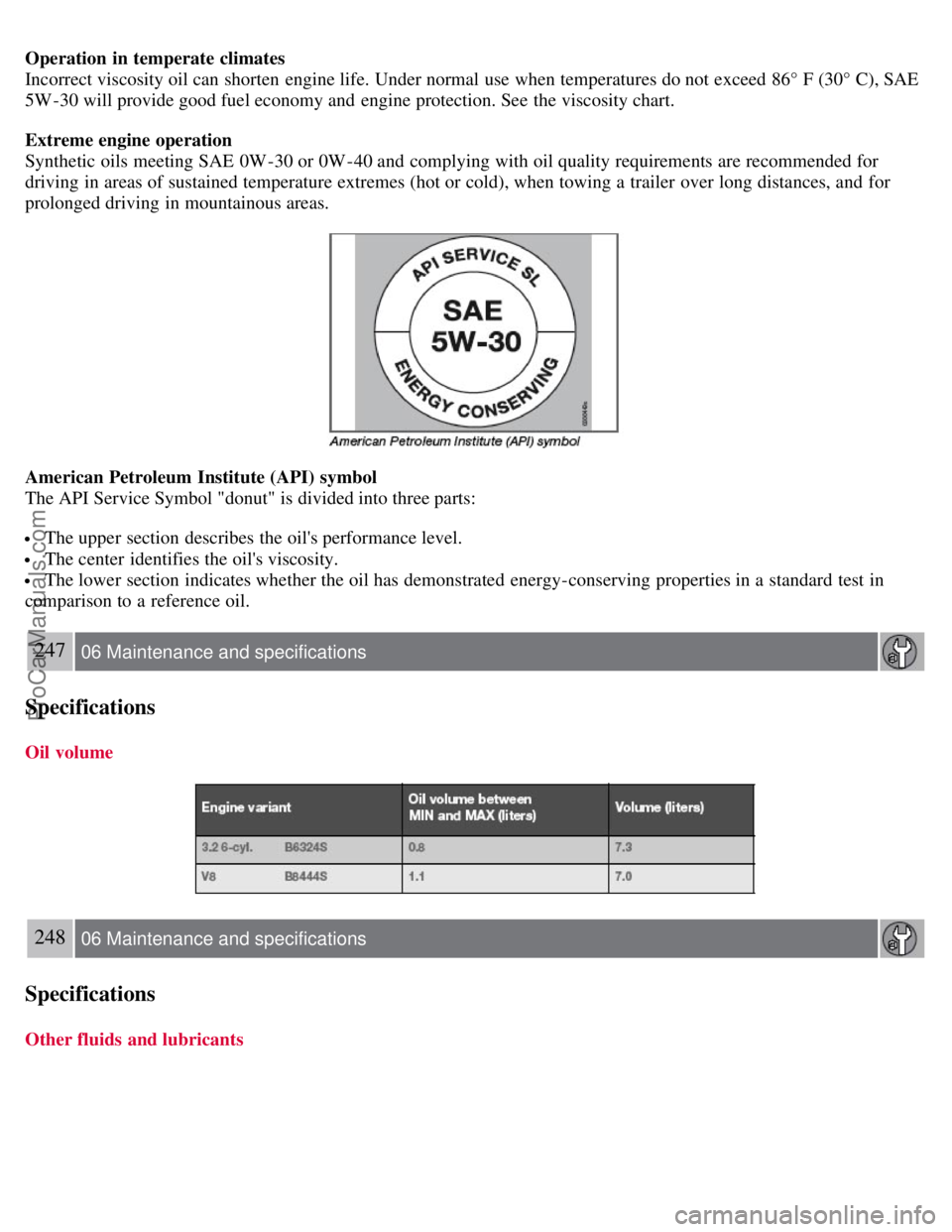
Operation in temperate climates
Incorrect viscosity oil can shorten engine life. Under normal use when temperatures do not exceed 86° F (30° C), SAE
5W -30 will provide good fuel economy and engine protection. See the viscosity chart.
Extreme engine operation
Synthetic oils meeting SAE 0W -30 or 0W -40 and complying with oil quality requirements are recommended for
driving in areas of sustained temperature extremes (hot or cold), when towing a trailer over long distances, and for
prolonged driving in mountainous areas.
American Petroleum Institute (API) symbol
The API Service Symbol "donut" is divided into three parts:
The upper section describes the oil's performance level.
The center identifies the oil's viscosity.
The lower section indicates whether the oil has demonstrated energy-conserving properties in a standard test in
comparison to a reference oil.
247 06 Maintenance and specifications
Specifications
Oil volume
248 06 Maintenance and specifications
Specifications
Other fluids and lubricants
ProCarManuals.com
Page 243 of 251
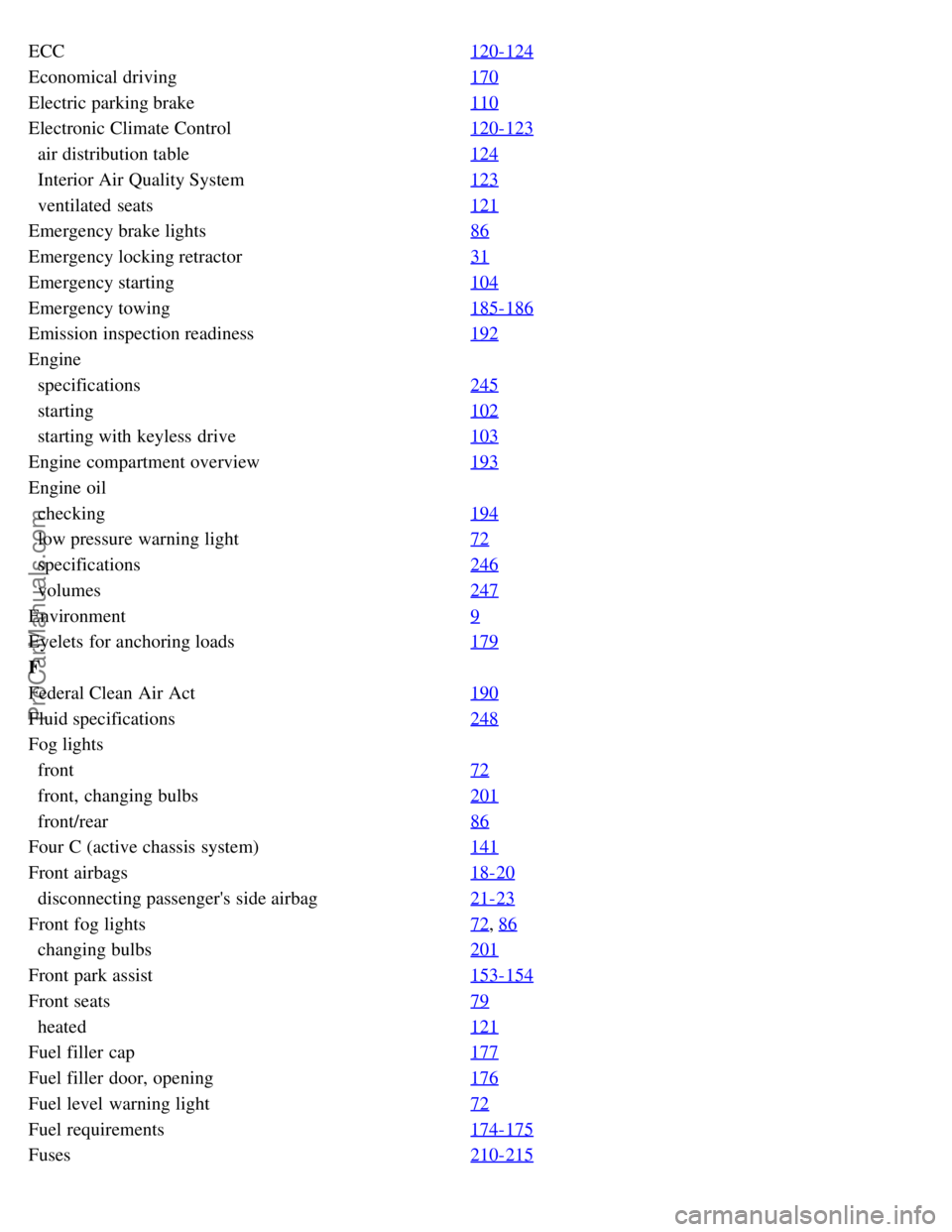
ECC120-124
Economical driving170
Electric parking brake110
Electronic Climate Control120-123
air distribution table124
Interior Air Quality System123
ventilated seats121
Emergency brake lights86
Emergency locking retractor31
Emergency starting104
Emergency towing185-186
Emission inspection readiness192
Engine
specifications245
starting102
starting with keyless drive103
Engine compartment overview193
Engine oil
checking194
low pressure warning light72
specifications246
volumes247
Environment9
Eyelets for anchoring loads179
F
Federal Clean Air Act190
Fluid specifications248
Fog lights
front72
front, changing bulbs201
front/rear86
Four C (active chassis system)141
Front airbags18-20
disconnecting passenger's side airbag21-23
Front fog lights72, 86
changing bulbs201
Front park assist153-154
Front seats79
heated121
Fuel filler cap177
Fuel filler door, opening176
Fuel level warning light72
Fuel requirements174-175
Fuses210-215
ProCarManuals.com
Page 249 of 251
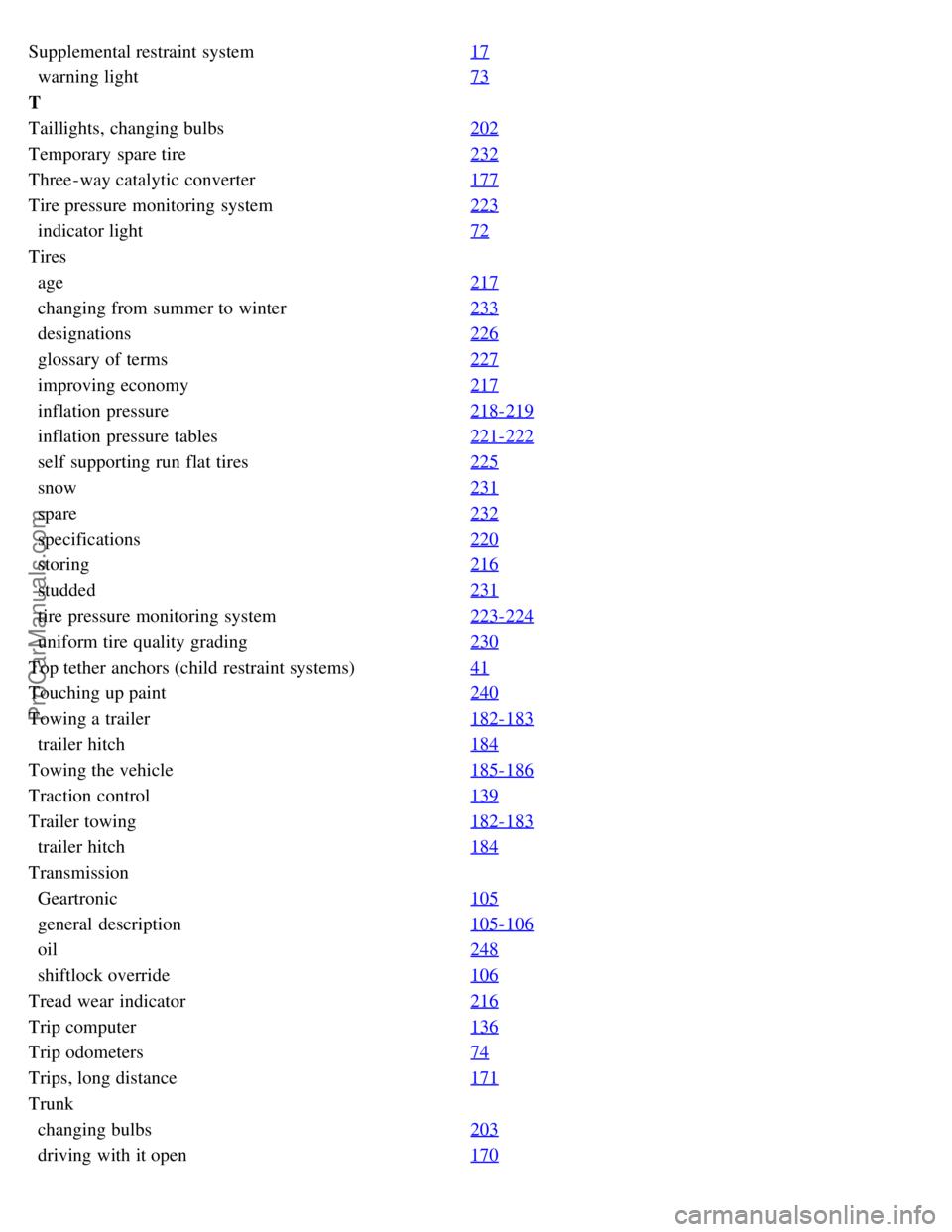
Supplemental restraint system17
warning light73
T
Taillights, changing bulbs202
Temporary spare tire232
Three-way catalytic converter177
Tire pressure monitoring system223
indicator light72
Tires
age217
changing from summer to winter233
designations226
glossary of terms227
improving economy217
inflation pressure218-219
inflation pressure tables221-222
self supporting run flat tires225
snow231
spare232
specifications220
storing216
studded231
tire pressure monitoring system223-224
uniform tire quality grading230
Top tether anchors (child restraint systems)41
Touching up paint240
Towing a trailer182-183
trailer hitch184
Towing the vehicle185-186
Traction control139
Trailer towing182-183
trailer hitch184
Transmission
Geartronic105
general description105-106
oil248
shiftlock override106
Tread wear indicator216
Trip computer136
Trip odometers74
Trips, long distance171
Trunk
changing bulbs203
driving with it open170
ProCarManuals.com