2007 VOLKSWAGEN JETTA between
[x] Cancel search: betweenPage 293 of 477
Booklet 3.1 Controls and Equipment
Driving
Steering
Applies lo vehicles: with manually adju stab le steering column
Adjusting the steering wheel position manually
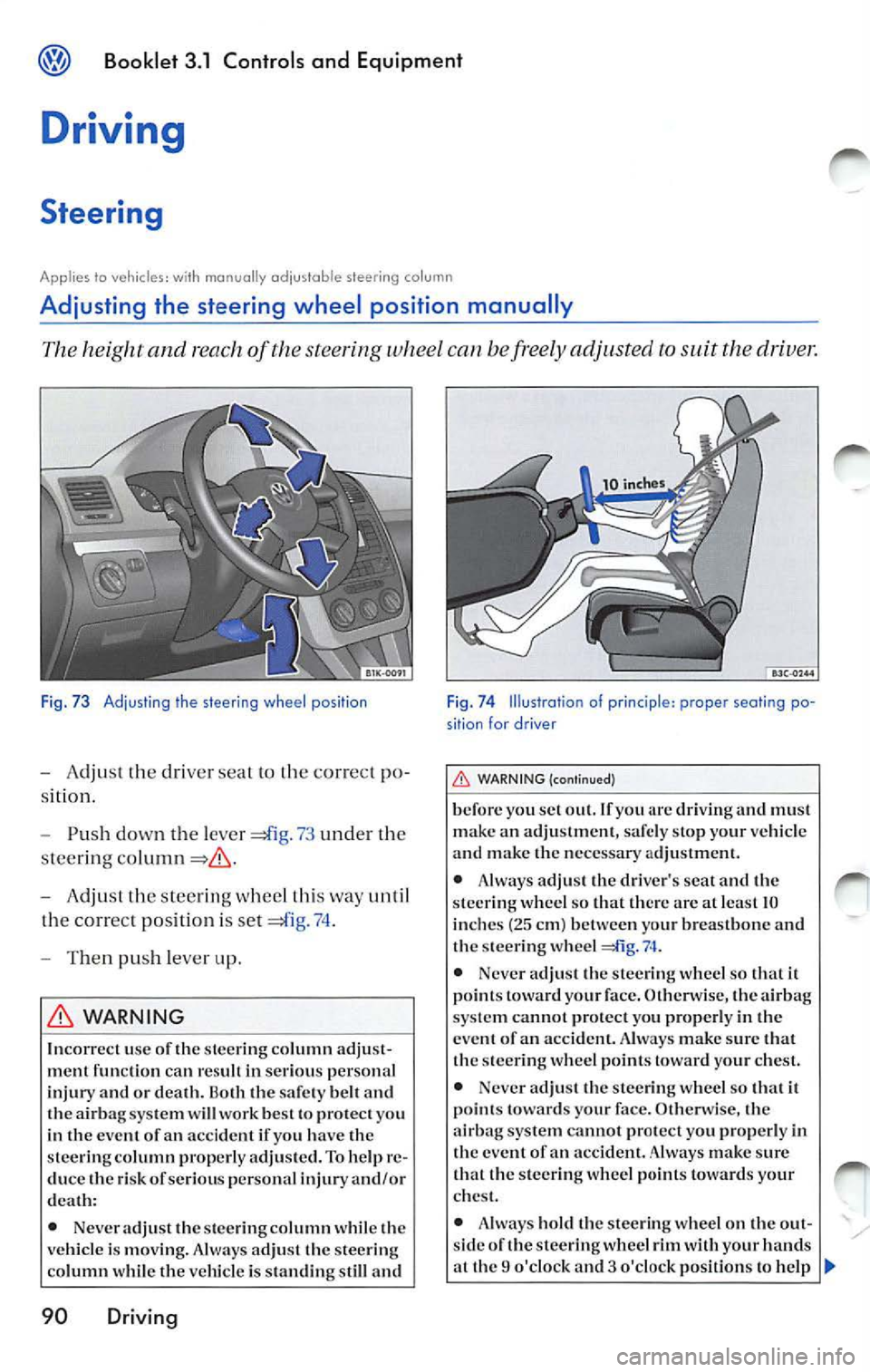
The and reach of the steering whe el can be freely adjusted to suit the driver.
Fi g. 73 Adjusting the stee ring wheel position
- Adj ust the d river sea t to th e cor rect po
s it ion.
- Push dow n the leve r
73 und er th e
s tee rin g
- Adju st th e s teerin g w hee l thi s way until
the corre ct po siti on is se t
74 .
- Then push le ver up .
WARNING
Incorrect use of the steer ing co lumn adjust
ment function can in seriou s per sonal
in ju ry and or death. the sa fety bell and sys tem w ill work best to protec t yo u
in the event of an accident if yo u have the
s teering column properly adjusted. To help re
duce
ri sk of seriou s perso nal injury and /or
death:
• Neve r adjust
steering column whil e vehicle i s moving. Always ad just steering
co lumn whil e the vehicle is standing still and
90 Driving
Fig. 74 Illustratio n of prin ciple: proper seating po
sition for d river
WARN ING (continu ed)
b efore you se t out . If yo u are driving and must
ma ke an adju stment, safely slop your vehicl e
and make
necessary adjustment.
• Always adjust the dri ver 's s cat and the
s teer ing wheel so that there are at leas t 10
in che s (2 5 cm) between your brea stb one and
ste ering whee l
• Neve r adjust the stee ring wheel so Iha! ii points toward your face. Otherw ise, the a irb ag
syste m cann ot prote ct yo u proper ly in
eve nt of an accident. A lway s make sure that steer ing wh eel point s toward your chest .
• Neve r ad just the stee ring whee l so
points towards your face. O then vise, airbag system canno t p ro tect you properl y in eve nt of an accid ent . Always make sure
that the steerin g whe el po int s toward s your
c h es t.
• Alw ays hold
stee ring w heel on out
s id e of steering wheel rim with your hands
a t th e 9 o 'clock 3 o'clock posit ions to help
Page 302 of 477

Booklet 3.1 Controls and Equipment
Applies lo vehicles: with on oulomolic transmission
Selector lever lock
Releasing the selector lever lock
-Depress and hold th e brake pedal and
pres s the release button in the selector
le ver handle at the same time.
The selecto r lever is lo cked whe n:
•
se lec to r lever is in P.
Applies to vehicles: with 6 -speed oulomolic transmission
• The selector lever is in N for more than about l second and you are driving slowe r than 3 mph (5 km/h}.
The selec tor lever lock will not enga ge if yo u
qu ickly move the selecto r leve r through p osition
N whe n shift ing between
and D. This makes it
p ossibl e, to "rock" the vehicl e backward and for
ward if it is stuck in snow or
Driving with an automatic transmission
The transmission upshifts and down.shifts automatically.
Fig. 80 Section of center console : selector lever
with lock button
Starting the engine
-Start the engine with the selector leve r
in po siti on P or N . Fo r m ore in formation
,iage95 .
Driving
-Dep ress and hold the brake pedal.
- Relea se the parkin g brake.
- Press and hold the release
in the
se lec to r leve r handl e.
- Move the selecto r leve r to
R (R everse), D
(D riv e) or S (Spo rt}. -
Relea se the lo ck button and wait for the
tr ansmission to en gage the gear (a s light
movement can be felt).
- Release the brake and depress the ac
Stopping briefly
-Always use the foot brak e to pr eve nt th e
ve hicl e fro m cre ep ing forward, for ex
amp le at a
lig ht. You do not need to
mo ve the selec tor leve r to
P (Park) or N
(Ne utral).
- Do not dep ress the acce le rator.
Parking
- Depress and hold the brake ped al until
th e ve hicle co mes to a full
- Apply the parking brake
104.
-Move the se lec tor lever to P with the re
l ease button press ed.
Driving down hills
- Se lect the "T iptroni c position.
- Pull th e leve r to th e"-" minus pos ition
to clo wnsh if t. ._
Driving 99
Page 307 of 477
@ Booklet 3.1 Controls and Equipment
Parking brake
Applying the parking brake
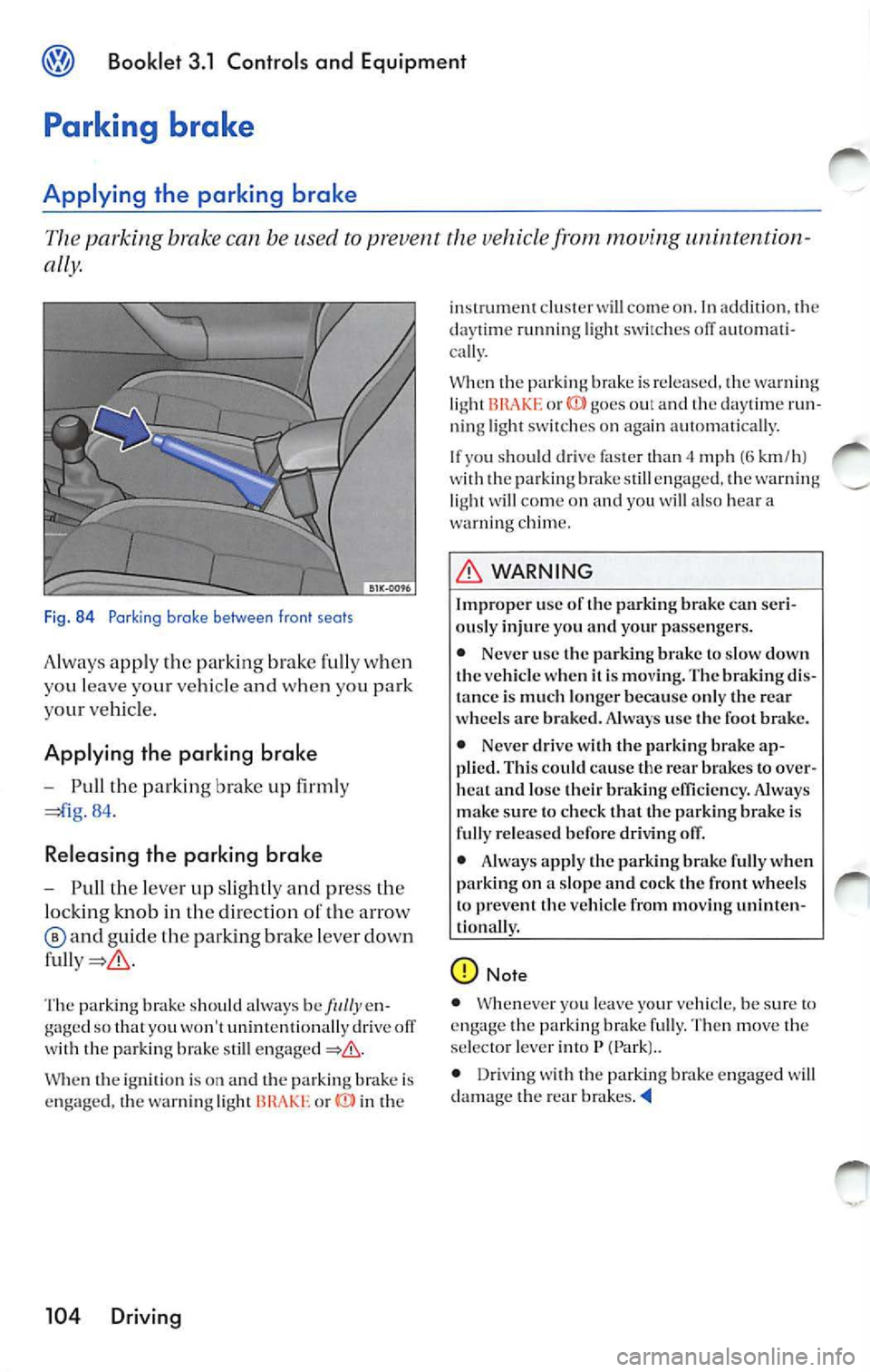
pa rking brake can b e use d to prevent the uehicle from moving
ally .
Fig . 84 Parking brake between front seats
Always app ly th e par kin g brak e fu lly w hen
you le ave your ve hicle w hen yo u pa rk
yo ur ve hicle.
Applying the parking brake
- Pull the parking brak e up firm ly
84 .
Rele a sing th e parking bra ke
-Pull the leve r up slig htly and pre ss the
lo cki ng kn ob in the dir ec tion of the arrow
a nd guide th e park ing brak e leve r down
T he park ing bra ke sh ou ld always be /111/ yen
gage d so that you won' t u ni nt enti ona lly dr ive off
wit h th e pa rk in g brake sti ll
W hen th e ignition is on t h e parking brake is
e n gaged, th e wa rnin g ligh t or in th e
104 Driving
instrum ent clust er w ill co me o n. In addit ion. the
daytime running light swi tch es olT a utomati
ca lly.
When the park ing brake is re leased, th e wa rning
li g h t
or goes o ut and the da ytim e run
ning ligh t sw itch es on again automatica lly.
If yo u shou ld dr ive faste r than 4 mph (6 k m/h )
w ith th e parkin g brak e still engaged, th e wa rning
lig ht will co me on
you w ill also hea r a
wa rnin g chim e.
WARNING
Imprope r use of the parki ng brak e ca n se ri
ou sly in jur e yo u and yo ur passe ngers.
• Never use th e parki ng brake to slow down
t h e veh icle when it is mov ing. T he braking dis
tanc e is mu ch l on ge r because on ly th e rea r
whee ls arc brak ed . A lways use the foo t brak e.
• Neve r drive with th e parki ng bra ke ap
pl ied. This cou ld cause t he rear brakes to o ver
h eat and l ose their b raking e fficie ncy . A lways
m ake sure to ch eck th at the parki ng bra ke is
f ull y re lea sed befo re dri ving olT.
• Alwa ys app ly th e par king brake f ully w hen
p arki ng o n a s lope and coc k the fron t w hee ls
to prevent t he ve hicle fro m movin g unin ten
ti onall y.
N ote
• Wheneve r yo u lea ve you r ve hicle, be sur e to
e ngage th e park in g b rake full y. Th en m ove the
lever int o P (Park ) ..
• Drivi ng wi th the parking brak e engaged will
damage the rear
Page 330 of 477
Operate your vehicle safely
For drivin g safely, alwa ys follow t he speci fied
maint enance interva ls in your maint enan ce
bo okle t =boo klet
I.I "M aint en an ce" -es peci ally
fo r chan ging brake fluid. H ard use , pri marily
s top and go dr iv in g, o perat io n in very dusty
areas, t ra ile r towi ng as we ll as other con dition s
m ay make
neces sary maint enance
im erva ls -see your authorize d Vo lksw agen
d ea ler.
Your vehicle 's condition is dir ect ly relot ed to
driving safety
Th erefo re, always be sur e
ob serve fol
l ow ing points before yo u dr ive off:
• Check l ig ht s an d turn sig nals.
• Check f uel l eve l.
• Make sure
a ll ligh ts a nd all wi ndows are
clea n.
• Adjust
mirr ors .
• Make s ure
air intak e slo ts betwee n en gin e hood a nd wind shi eld are free of
l eaves, sn ow a nd ice.
• Check warning a nd indicato r light s when
s tarli ng the en g in e.
Your personal d riving style and attitude have a
lot to do with safety ..
T here fore , for you r ow n sa fe ty:
• Wear your safety bells a nd wear
pro p
er ly , ev en if you ar e just driv in g in city o r lo
th e co rner =book le t 2 .1 "Sa fe ty first",
c h apt er "Safet y
• Make sur e th at all passe ngers wear their
sa fe ty belt s proper ly. even those in rea r 2.1 "Sa fe ty chapter "Safety
belt s." Pa sse ngers wea ring en
danger not onl y th em selves in cra sh, but al so dri ver and oth er passengers .
• Make su re th at children a lwa ys
on rear
sea t prop erl y res tra in ed by a res traint system a p
propri ate for th eir size and age.
• Never tra nsp ort a child in a rear
c hild
or infant seat on the front passe nger seat
= bo oklet 2.1 "Safety
• Adju st yo ur sea t so that yo u ca n eas ily reac h
a ll co ntrol s whil e yo u are as from
Booklet 3.2 Tips and Advice
airb ag as pos sible but close r th an 10 inches
(25 cm ) = book let 2. 1 an d 3.1.
• The sea ting positi on is ve ry important for the
a irb ag perfo rm ance
2.l "S afety first",
cha pter "Air bag syste m.''
• Always a djust th e hea d res traints to
cor
r ec t h eig ht . For maximum pro tec tion , ad just the
h ead res trai nt so that the upp er edge is as eve n
w ith the top of yo ur hea d as possi ble,
no
l owe r than eye le v el a nd so that is as close to
th e ba ck of your head as possib le = bo okle t 2. 1
"Safe ty
• Alw ays make s ure that the mov ement of peda ls is no t res tri cte d in an y way 3. 1,
c h ap te r " Peda ls ."
• Store luggage an d light it em s prop erl y in
luggage compartme nt and on roo f
=book let 3. 1, c hap ter" Luggage compa rtment "
an d
3.1, cha pter rack."
If you drink, do not drive !
T he use of a lco hol, dru gs a nd certain medi ca
ti ons w ill seriously impa ir percept io n , reac tions
a nd dri vin g a bility ,
increa sin g th e
ri sk of an acci dent, cras h an d pe rso nal injury.
Do not drive if you are tired.
Make frequ ent rest stops , at le ast aft er every two
hours of dri ving.
Al ways adapt vehicle speed to traffic, road and
weather conditions.
H em ember , th at
o n sm ooth, slipp ery
roa ds, ve hicle han dling and br aking dep end a
d ea l on tire ad hes ion. On wet roa ds, the
front whee ls c an h ydrop lane, especi ally at
h ig her sp ee ds. If thi s hap pe ns, yo u will then no
l o nge r b e ab le to ste er or brak e prop erl y.
WARNING
• Alw ays observe the po sted spe ed Ii mils and
common sense. Your good judgment can
mean
diff ere n ce between arr iving safely at
your destination and being ser iously injur ed
in
crash or other kind of accide nt.
• Alway s rea d and hee d all WARNI NGS and
a dditi on al inform ation rega rding safety
= bookl et 2.1 "Safe ty
Driving and protecting the environment 9
Page 334 of 477

WARN ING (continu ed)
• Exceed ing permi ssibl e weig ht ratings can
r es ult in ve hicl e da m age, accide nts, and per
sona l
Driving tips
For th e best handlin g of ve hicle and trailer,
p lease note th e fo llowing:
• A "bala nce d" rig is easie r
operate and con
trol. This m ean s th a t th e tow vehicl e should b e
loaded to th e extent p ossible and p ermi ssible
whil e keep ing th e trailer as light as po ssibl e
und er th e circum stanc es. Wh eneve r po ssib le,
tran sfe r som e cargo to the
co mpar tment
of the tow vehicl e w hile obs ervin g tongu e loa d
req uirem ents and vehicle loa ding consid er
a tion s.
• The high er th e s pee d, the more
it be
come s fo r the drive r to control th e rig. Do not
dr ive at the maximum permis sibl e
• Always appl y br akes earl y. When driving
d ow nhill, d ownshi ft into a lower gear to u se the
e ng in e brak in g eff ec t to slo w down the ve hicle.
U se of the brake s alo ne ca n ca use them to ove r
h ea t an d fail.
• The coo ling effect of the rad iator fan cann ot
b e in crease d by dow nsh ifti ng beca use fan sp ee d
i s ind epend ent of engine sp ee d. The re for e,
Trailer towing tips
Your vehicle handles diff ere nt ly wh en t ow in g a
t ra iler b ecause of the a ddit io na l weight and
weig ht d is tribut ion. S af ety. perform ance and
e conomy will gr ea tly depend on how car efull y
yo u load your tra iler
yo ur rig.
B efor e y ou actua lly
your tra iler, practice
t urn ing. stoppin g and backing up in an ar ea
away from
until yo u l earn the feel of your
ve hicle and trailer unit.
Backing up is
r e quir es prac tice .
S teer ing w hile backing up is generall y opposite
of th at wh en backing your vehicl e w ith out a
tra iler.
Booklet 3.2 Tip s and Advice
wh en dr iving uphill , yo u can alwa ys dri ve in the
hi gh est po ssible gea r wit h low e ngin e sp ee d. If
th e coo lant te mp erature warning light in the in
s trument cluste r start s fla shin g in red , p ull off
the road , stop and le t th e e ngin e id le for abou t
minute s to pre vent hea t bu ildup and engin e
damag e.
WARNING
• Reduce you r speed even more under unfa
vora ble load, wea ther or w ind condi tions
p artic ular ly w hen goi ng dow nhill.
• Be especia lly carefu l w hen passing o ther
veh icles. Redu ce ve hicle sp eed immediate ly if
the tra iler sh ow s the sli ghtest sig n of sway ing.
• Neve r try to stop the sway ing by acceler
ating.
• Always heed speed lim its. In some a reas
speed lim its for vehicl es tow ing tra ilers are
l ower than for reg ular
Keep more di stan ce between your vehicl e and
th e one in front of you. will nee d m ore roo m
to stop.
To compens ate fo r th e traile r, yo u w ill n eed a
l a rger than normal tu rning
When passing , reme mber that you can not acce l
erate as fast as you normall y wou ld because of
t h e added load. Make sur e yo u ha ve enough
room to pas s. After passing, allow plen ty of room
fo r yo ur tr aile r befor e changing la nes aga in.
Avoid jerk y s tart s, sharp turns or rapid lan e
c h ange s.
Driving and protecting the env ironment 13
Page 348 of 477
Booklet 3.2 Tips and Advice
Accessories, new parts, repairs and modifications
Accessories and parts
Always con sult an authori zed Volk swagen dealer before purchasing accessorie s
and parts for your vehicle.
Your vehicl e is des ign ed to offe r a hi gh stand ard
o f a cti ve an d pass ive sa fe ty.
Pl ease co nsult an author ize d Vo lkswagen deale r
for advice befo re insta llin g accessor ies, re pla ce
m en t part s or other e quipm en t.
Au thori zed Volk swage n dea le rs ha ve the la tes t
information fr om th e manuf actur er and can rec
ommend a ccessori es a nd part s
are suit abl e
fo r yo ur vehicle and perso nal r equir em ent s.
They can also help answer questions you mi ght
h ave reg arding official reg ulati ons.
We r ecommend you onl y use appro ved Volk
swage n accessories and genuine Volkswagen
part s® . Th ese part s and accessor ies have bee n
eva luate d b y Vo lkswage n for suit abilit y, reli
a bility and safet y. Th e Vo lksw age n d eal ers hip s
h ave the necess ary ex peri ence and faciliti es
ensure th at th e part s are prop erly .
Vo lkswage n ca nnot ass um e re spon sibili ty fo r
any after-ma rket n on -Vo lk swage n part s use d,
e ven if th ese parts have bee n app rove d by an of
fi ci al t es tin g age ncy or a rc cove re d by a n offici al
ce rtificat e or sea l of ap prov al.
WARNING
Improp er ve hicle equipm ent or mod ifica tions
ca n ca use damag e to th e vehicle and serious
personal injury.
fr, WARNING (continued)
• In th e intere st of safety, we urge you to u se
only authorized Volkswagen accessories and
genuine Volkswagen parts® that h ave been
designed to be used on your vehicle.
WARNING
I mp rop er ca re, servicing and repair proce
dure s can increase the risk of personal injury
and death by preventing an airbag from de
ploying when needed or deploying an airbag
unexpectedl y.
• Neve r place or attach accessories or other
objects (such as cup holders, telephone
brackets, no te pad s, large , h eavy or bul ky ob
je cts ) on the doors, on the windshield , o ve r or
near the area marked "AIRBAG" on the
s tee rin g w heel, in strum ent pane l, seat back
re sts or between those area s and your self.
• Object s on or near the surface s
air
ba gs are located can come loose and cause se
r iou s per sonal injury in a crash, especially
w hen the airbags inflate.
• Be sur e to r ead and h eed the inform ation
a nd all WA RN INGS
2.1 "Safety
fir st", chapt er "Airba g sys te m. ",..
Accessories, new parts, repairs and modifications 27
Page 374 of 477

Maximum (permissible) inflation pressure means the maximum cold inflation pressure to
which a tire may be inflated. Also called "max imum inflation pressure."
Normal occupant weight
means
150 lbs. (68 kilograms) times the number
of occupants seated in the vehicle up to the total seating capacity of your vehicle.
Outer diameter
means the overall diameter of an inflated new
tire.
Overall width means the linear distance between the exteriors
of the sidewalls of an inflated tire, including ele
vations due to labeling, decorations, or protec tive bands or ribs.
Ply
means a layer of rubber-coated parallel cords.
Radial ply tire
means a pneumatic tire in which the ply cords
that extend to the beads are laid at substantially
90 degrees to the centerline of the tread.
Recommended inflation pressure
see
52, "Cold tire inflation pressure".
Rim
means a metal support for a tire or a tire and
tube assembly upon which the tire beads are
seated.
Rim diameter
means nominal diameter of the bead seat . If you
change your wheel size, you will have to pur
chase new tires to match the new rim diameter.
Rim size designation
means rim diameter and width.
Rim width
means nominal distance between rim flanges.
Sidewall
means that portion of a tire between the tread
and bead.
Booklet 3.2 Tips and Advice
Speed rating (letter code) means the speed at which a tire is designed to be
driven for extended periods of time. The ratings range from 93 mph (150 km/h) to 186 mph
(298 km/h). These ratings are listed in the table
below 62. You may not find this informa
tion on all tires because it is not required by law.
The speed rating letter code, where applicable, is molded on the tire sidewall and indicates the
maximum permissible road speeds.
Tire pressure monitoring system
1 )
means a system that detects when one or more
of a vehicle's tires are underinflated and illumi nates a low tire pressure warning telltale.
Tread means that portion of a tire that comes into con
tact with the road.
Tread separation means pulling away of the tread from the tire
carcass.
Tread wear indicators (TWI) means the projections within the principal
grooves designed to give a visual indication of
the degrees of wear of the tread. See
59, "Tread Wear Indicator (TWI)" for more informa
tion on measuring tire wear.
Uniform Tire Quality Grading
is a tire information system developed by the United States National Highway Traffic Safety
Administration (NHTSA) that is designed to help buyers make relative comparisons among tires.
The UTQG is not a safety rating and not a guar antee that a tire
will last for a prescribed number
of miles or perform in a certain way. It simply
gives tire buyers additional information to com bine with other considerations, such as price,
brand loyalty and dealer recommendations .
Under UTQG, tires are graded by the tire manu
facturers in three areas: tread wear, traction and temperature resistance. The UTQG information
on the tires, molded into the sidewalls.
U.S. DOT Tire Identification Number (TIN)
This is the tire's "serial number."
It begins with
the letters "DOT" and indicates that the tire
meets all federal standards. The next two num-
Tire pressure monitoring system)
Checking and Filling 53
Page 378 of 477

"Tires and ve hicl e lo ad limit s" for more imporinfor mati on.
Vehicles
ha ve full hub caps have valve ex
tenders ins tead of du st caps. To ch eck tire pr es
s ur e or acid air. you do not n eed to re move the
ex te nd er. 13e s ure to rein sta ll va lve dust caps
ch eck ing or adjust ing tir e pr ess ure.
A lways use an
tir e pr ess ure gaug e w hen
c h eck ing and adju stin g i nfl atio n pr essu res .
C hec k all of the
and b e sure not l o forg et th e
s par e tire. If p ress ure in an y is too high
w hen the tire is "co ld," let o ur of the tir e
s lowly with th e of the tir e ga uge and kee p
c h eck ing th e press ure until you re ac h th e pr es
s ure that is correc t for th e loa d (pa sse nge rs and
l u gg age)
ki nd of dri ving yo u plan t o do .
I f th e pr ess ure in any tire is too low , n ote the dif
f e re n ce between the press ure in the co ld
a nd
th e pr ess ure yo u need and add air yo u
n eed to reac h th e co rrect press ure for the vehicle
load (pa sse nge rs and lu ggage) for th e tire s on
yo ur vehicle as listed o n the on yo ur vehicle a nd
in thi s man ual
th e kind of driv ing y ou p lan
t o do .
Neve r excee d th e maxi mum infl ati on pre ssure
li sted on the tir e sid ewa ll for any reason.
R em emb er th at the ve hicle manufac turer, not
t h e tir e man ufa ctur er, de te rmin es th e co rrec t
t ir e pr ess ure for th e tir es o n yo ur vehicle
I t i s imp ortant
ch ec k th e tir e pr ess ure when
the tires are cold.
Vehicle witho ut
• the re quir ed tire pressure from the tir e
pressu re lab el on the ope n edge of th e dri ver's
door .
• Place the a ir press ure gauge on the dust cap s
- th ere is no need
re m ove them.
• The tir e press ures s ho uld onl y be checked
tire s cold. The sli ghtl y pres
s ur es ofwann tires no t b e reduced.
•
th e tire press ure to the load you are
ca rrying.
Vehicle with
• the req uir ed tir e pr ess ure from the tir e
pressure label o n th e ope n edge of the dr ive r's
do or.
Booklet 3.2 Tips and Advice
• Turn th e va lve s tem cap counter-clockw ise to
r emove it from the tire valve.
•
th e ai r press ure on the valv e.
• The tir e pressures sh o uld onl y be ch ecke d
w hen th e tir es are cold. T he slig htly rai sed pres
s ur es of
tires not be redu ced.
• Adju st th e tir e pr ess ure to the load you are
carry ing.
• Reins tall the valv e ste m cap on the valve.
When should I ch eck the tire pressure?
Th e co rrec t tir e pr ess ure is especia lly import ant
a t hi gh speeds . Th e pre ssur e s ho uld th erefo re be
c h ecked at leas t once a month and alwa ys befo re
s ta rt in g a jo urn ey. D o not forget to ch eck the tire
pr ess ure on th e spare whee l
When shou ld
I adjust the tire press ures?
Ad just th e tire press ure to the loa d you are car
ry ing. After changin g
wheel or repl acing
w hee ls yo u have tu adj ust th e tir e press ures on
a ll whee ls. In ad ditio n on ve hicles wit h TPMS,
yo u sh oul d s pecify new tire pressures
=boo klet
WARNING
In co rrec t tire press ure ca n result in sudd en
ti re failur e Jo ss of co ntrol, collision , seriou s
perso nal injur y an d eve n dea th .
•
tire s to the re co mm end ed and
co rrec t tir e pre ssure before drivin g off.
• Driving with und erinfl atcd tires bend
m or e, le ttin g th em get too hot res ulting in
tr ead separatio n, s udd en tir e fai lure ti re
fa ilur e and Jo ss of control.
• Excess ive sp ee d and /or ove rload ing ca n
ca use hea t build -u p, su dden tire failure in
cludin g a bl owo ut an d su dden deflati on and
Jo ss o f co ntrol.
• If th e tire pr essure is to o low or too high,
th e tir es will wear prema turely and the ve hicl e
wi ll not handl e we ll.
Not e
Dr iv in g w ith out valve s te m caps ca n cau se
applicab le Tire pressure monitoring system)
Checking and Filling 57