2007 VOLKSWAGEN GOLF ECU
[x] Cancel search: ECUPage 133 of 444
replace any airbag in your vehicle and assure system effectiveness in a crash.
Booklet 2.1 Safety first
Never permit salvaged or recycled ai rb ags
to be installed in your
low ering th e veh icle, changing the
s tiffness of th e suspe nsion , including the spring s, suspe nsion struts, shock absorber s etc.
ca n change th e forces that are meas ured by th e
air bag senso rs and sen t to the electron ic control
unit. s u sp ensio n chang es for ample, increase the force level s m eas ured by the
sensors and make the airb ag system deploy in
cras hes in wh ic h it wou ld no t dep loy if th e
c h a nges had no t bee n made. kind s of ch a nges may reduce the force leve ls mea sured by the senso rs and preve nt the airbag from ploying whe n it should.
The Advanced Airbag will not work the
way it s houl d if th e o ptional safety belt exte nder is not removed from the safety belt latch when
the seat i s occup ie d and the sa fe ty belt is not bei ng used. Leaving th e extender attach ed to the safety belt buck le when the front seat is
s ig na l the airbag control unit that the front seat is occup ied and that the sa fety belt is being used. The elec tron ic co ntro l unit for the airbag system
will then rece ive incorrect information that will cause the safe ty belt pretens ioner to deploy
has deployed can not be re pair ed.
T he entir e safety belt must be rep laced . For that
rea son, a lways re move the sa fety belt exte nde r
w hen it is not nee ded and stow it sa fely
23. In ad d ition, the safet y belt extender must never be used to secure child rest raint s to
th e front passenge r seat.
T he se ns
ors in the safety belt buckle for the driver and front passenge r seat tell th e troni c control module if the safe ty belt is latc hed or If th e sa fe ty belt is being used, the front airbag
will deploy
at a sl ightly highe r rate of hi cle dece leration than if the sa fe ty belt is not
b eing used . Therefore , in a particular collision, it
i s possible that an airbag will not deplo y at a seatin g position where the safety belt is being
u sed but infla te at the position where the safe ty belt is not bei ng use d. It is important that n othing interfere with the safety belt buck les so
that the sensors can send the correct tion abou t safety belt use to the elec tron ic
C hanging the ve hicl e's suspension including
us e of unapproved tire-rim combinations ca n change Advanced Airbag performance and crease the risk of se rious personal injury in a
c ras h.
Never install s uspension components that do not h ave the same performance ist ics as th e components originally in stalled on your ve hicl e.
Never use tire-rim combin a ti o ns th at have not been approved by Volkswage n.
Leaving the optional safety belt extender tached to th e safety belt latch on the front senger seat when the safety belt is not being
u se d will prevent the Adva nced fro m functioning properl y and ca n in crease the risk of se riou s pe rso nal injury in a
Always remove the safety belt extende r
w hen it is not needed and stow it safely whe n
it is not bei ng used with the safety belt.
Never use th e safety belt exte nder to secure
a c hild restraint at any seating position.
buckle and the cente r conso le can cause the sensors
Airbag system 45
Page 152 of 444
child restrain! is in stalled with a
sa fety belt , th e safety belt must be locke d so
strained for th eir age and size.
colli sio n.
Always make sure th at the safety b elt tracto r is locke d w hen in stallin g
Always buckle the seat firml y in plac e
eve n if
can fly around during a sudden sto p or in
Always rest to whi ch the ce nter rear safety belt is tach ed i s sec ure ly la tc h ed wh eneve r th e rea r
cente r sa fety belt is being use d to secure a
c hild booklet 3.1 and
ward together with the backrest and w ill strik e
part s of th e ve hicl e int eri or. T he c hild can be seriou sly injure d or kill ed .
Never ins tall rearw ard -faci ng c hild scats or infant carri ers on the f ront passe nge r sc at. A
kill ed w hen the passe nge r airb ag inflates.
The inflatin g air bag will hit the child scat or infa nt carrier with great force and w ill
smas h th e child seat and child against the
b ackrest, ce nter armrest , d oo r or roof.
Always instal l rearward -faci ng c hild seats or infant carri ers on th e rear scat.
64 safety
Forward -facin g c hild seats o r infant ri ers insta ll ed on the fr ont passe nger' s sca t
m ay interfere with the de plo ym ent of the
a irba g cause seriou s injury to the c hild.
Alw ays read and hee d all whenever u sin g a c hild restrain ed in a vehicle
i s be in g page 53.
page
Rearward -fa cin g restrai nts:
child in a reanva rd-facin g c hild seat sta ll ed on the front p asse nger sea t will b e ously inju red and ca n be killed if the fro nt
a irbag infl ates eve n with an Advan ce d Airb a g
Syste m.
The inflatin g airbagwill hit the child seat or infant carrier with great force and w ill
smas h the c hild seat a nd child against the
b ackrest, ce nter armres t, d oor o r r oof.
Always be es peci all y care ful if yo u must s tall a reanvard faci ng seat on the front pa sse nge r seat in ex ce ptional circumsta nces.
A tight te th er strap on a rearward- fac ing
c hild restraint attache d to the front p asse nger
sca t can put too muc h pressure o n the mat in the seat and reg is ter a heav ie r weight in the A dva nce d Airb ag Sys te m. The hea vie r
w eig ht reg is te re d ca n mak e th e sys te m work
as
thoug h an adult were o n the scat and ploy the A dva nced Airba g wh en it must be suppresse d causing serio us or eve n fa ta l ju ry to the child .
Make sure that th e PASSENGER AIR BAG Light comes o n and s tays on all the tim e
wh en ever th e ig niti on is s wit ch ed on.
dealer o r
Page 156 of 444
to attach the Res tra int on th e veh icle seat. Fe deral regularions quire lower anchorage s in vehicle s and devices to attac h to th e ve hicle anc horages.
ch o rage s on their chi ld sea ts
They could come w ith :
Tether anchors
hook-on or pu sh- on con nec tors att ached to
adjustable straps, or
rigid latc hes on bars that exte nd out the back of the e ns and are re lease d with release butto ns at th e bo tto m of th e ens.
I n add
ition to the l ower anchorages,
bo th o f thes e child res traint use te th er
stra p s to help keep the e ns firml y in place
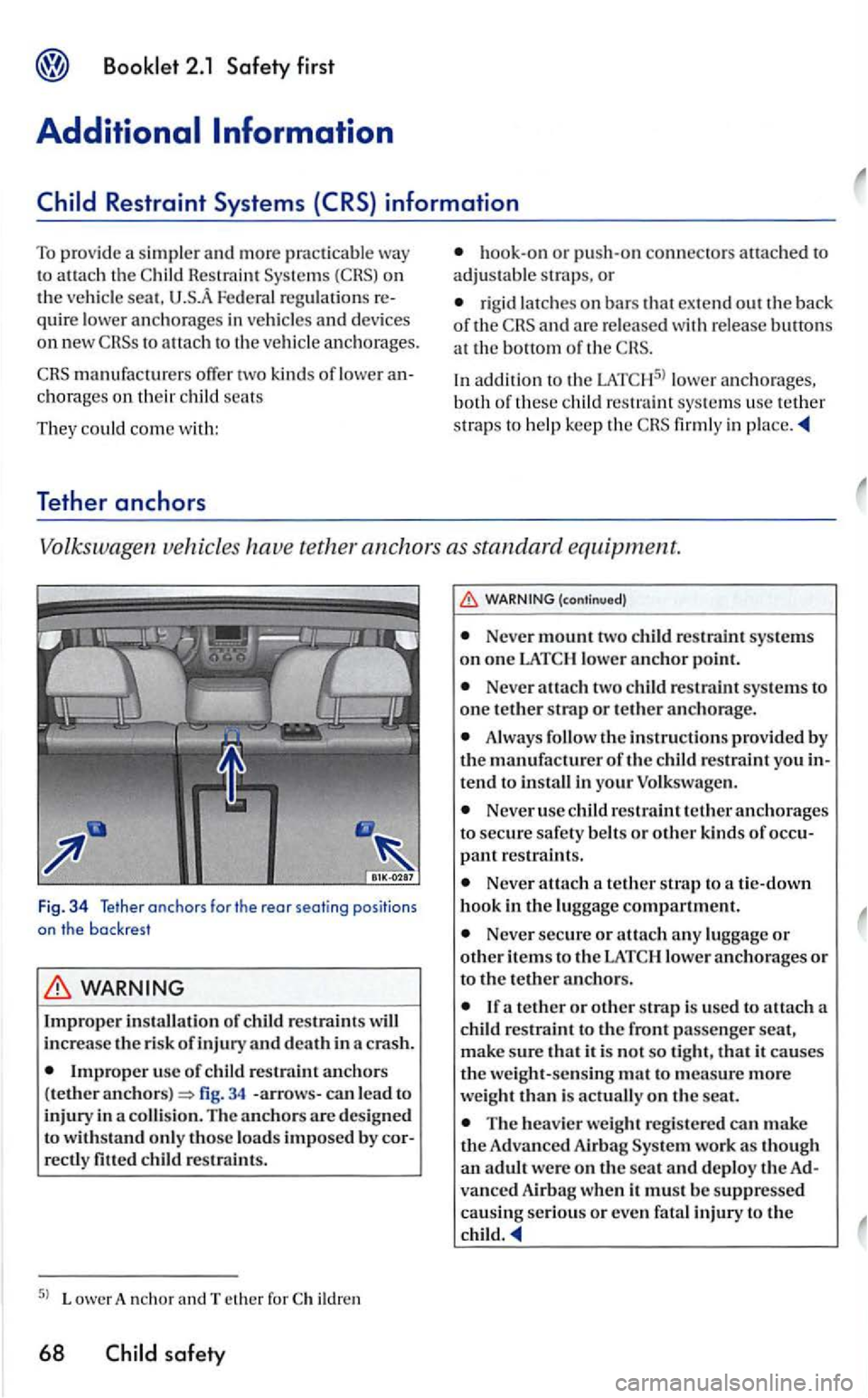
Volkswagen vehicles have tether anchors as standa rd equipment.
Fig. 34 Tether anchors for the rear seating positions on the backres t
Improper use of child restraint anchors
( tether fig . 34 -arrows -can lead to
injury in a collision. The an ch ors are de signed
to with stand only those loads impos ed by rectly fitted child restra int s.
Lower A nch o r and Teth er for ildr en
68 safety
(co ntinu ed)
Never mount tw o child re strain t systems on one
Never att ach two child re stra int sys tems to one tether strap or tether anchorage.
Always follow the instructions pro vided by tl1e manufacturer of the c hild restrain t yo u tend to install in your Volkswag en.
Neve r use child restra int tether anch o rages
to secure safety belt s or other kind s of
Never attach a te ther to a tie-d ow n
hook in th e lugga ge compartment .
Neve r secure or attach any lug gage or oth er it ems to th e lower anchorages or
to the tether anchor s.
If a te ther or other strap is used to attach a
c hild res traint to the front passeng er seat,
m ake s ure that it is not so tig ht, th at i t ca uses the weight- sensing mat to measure more
we ight than is actuall y on the seat.
Th e heav ie r weight registe red can make Advanced A irba g work as th ough an adult were on the sea t and deploy the vanced Airbag when it must be suppresse d
causing serious or even fatal injury to th e
c hild
Page 157 of 444
ward movem ent of the in a cras h, in order to h elp reduce the risk of head injury that could be caused by s triking the vehicl e interior.
Forward facing
manufactured after tember
Never attach a child seat tether strap to a
tie-down hook in the luggage compartment.
Never secure or attach any luggage or other items to the
tether or other strap is used to attach a
child restraint to the front passenger seat, make sure that it is not so tight, that it causes the weight-s ensing mat to measure more weight than is actually on the seat.
The heavier weight registered can make the system work as though an adult were on the seat and d eploy the Advanced Airbagwhen
it must be suppressed causing serious or even
fatal injury to the
f e w rearward- facing
turer's in struc tion s carefull y to determin e how
t o properly install the tether.
A child in stalled on the front passenger seat will be
The inflating airbag will hit the child seat or infant carrier with great force and will smash the child seat and child against the
backrest , center armrest, door or roof.
A tight tether or other strap on a facing child restraint attached to the front senger seat can put to o much pressure on the
Page 159 of 444
Booklet 2.1 Safety first
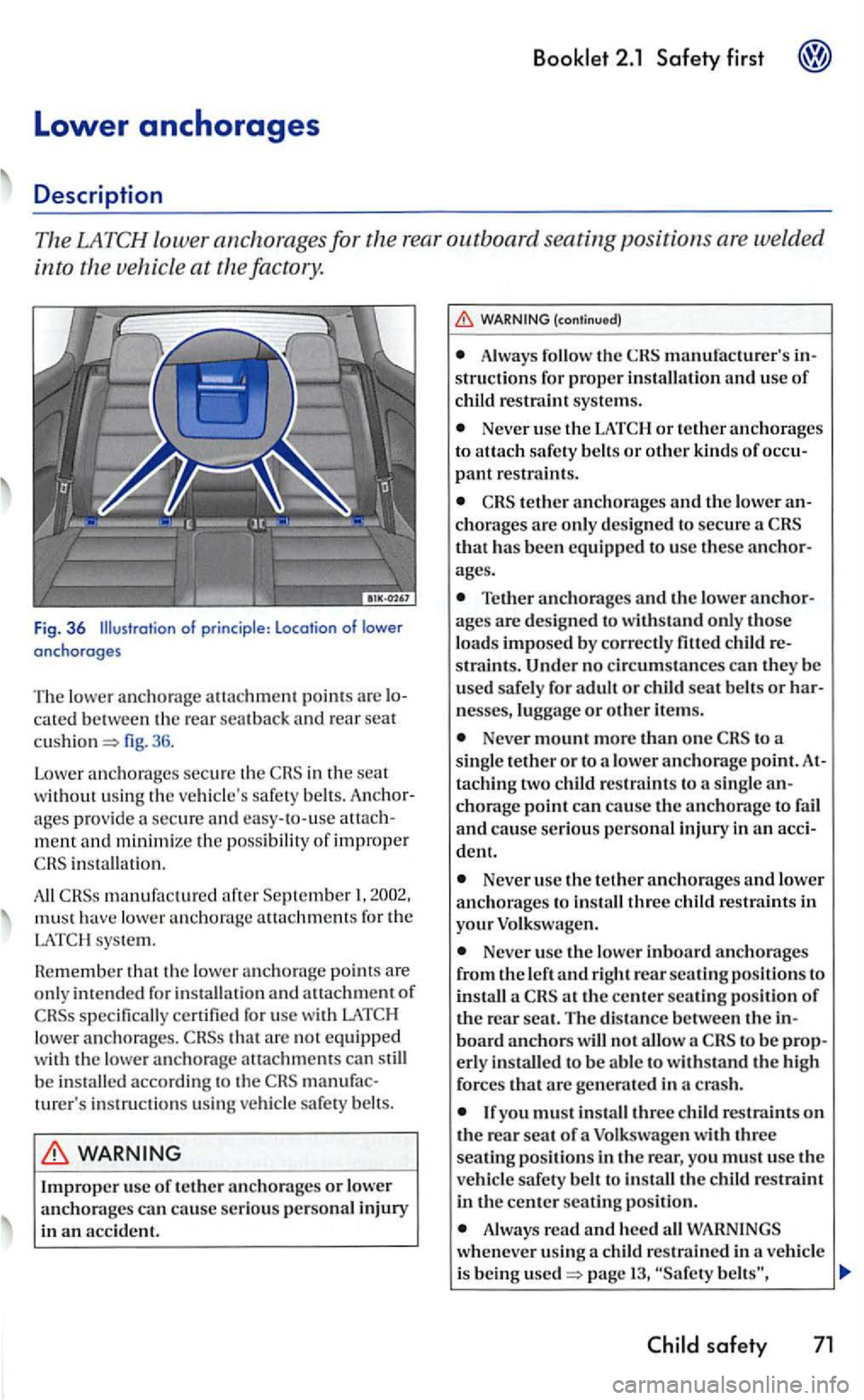
T he lower an chorage au ac hme nt poi nts are lo
ca ted between the rea r sea t ba ck and rear seat
cushion fig . 36 .
Lower anchor ages sec
ure the in the seat without using th e ve hicle's safety belts. Anc hor
ages provide a secure and easy- to-use attach
m ent and minimi ze the poss ibilit y of improper
manufa ctured after Sep te mber mu st lower allachment s fo r th e sys te m.
Hem ember th at th e lower anchorage points are
only intended for installation and all achment of
lowe r a nchorages. that are not equipped
w ith the lowe r a nchorage auachrnents can still be installed accord ing to the m anufac
turer' s inst ruc tion s using vehicle safe ty belts.
(continued)
Always foll ow the C HS m anufacturer's in
s tru ction s for prop er in sta llation and use of child restraint syste ms.
Never usc the or te ther an chorage s
to attac h safe ty belt s or other kinds of occupant restraint s.
tethe r anch ora ges and the lowe r anchorag es arc only des ig ned to sec ure has be en equipp ed to usc these anchor
a ges.
Tether anchorages and the lowe r an ch orage s are designed to withstand only those loads imposed by correc tly filled child re
straints.
Neve r mount more than one to a
single te ther or t o a lowe r a n chora ge point. Attaching two child restraint s to a sin gle an chorage point ca n cause the anchorage to fail and cause serious person al injury in an accident.
N eve r u sc the tether anch ora ges and lower anch orages to install three child restra ints in
you r Volkswag en.
Never use the low er inboard anchorages
from the left and right rear se ating position s to
in sta ll a at th e ce nter sea ting position of rear sea t. T he di stance between th e in board anchors w ill no t allow a to be prop
e rl y i nstall ed to be abl e to with stand the hi gh
f orces that are generated in a cras h.
you must in stall three child restra ints on the rea r seat o f a Volk swagen with three
seating positions in the rear, you must u se the vehicle safety belt to install th e c hild restraint in the center seating position.
Always read and heed all WAR NINGS
wh enever u sin g a c hild res train ed in a vehicl e
i s being used page
safety 71
Page 161 of 444
-both straps wit h hook-on con
n
ect ors on the secu re ly to the lower
a n ch orages.
- P ull str ap s tig
ht foll ow ing th e man
ufacturer's instr uctio ns.
-Release or deploy th e ch ild rest ra in t
tether strap.
- Guide th e
upper tether strap under th e
rea r
head restraint (ra ise the head restra int
if n ecessary).
- Att
ach th e te ther s trap anch orage hook
int o th e o pe
ning of th e te ther a n ch o rage.
- Pull on
both of the adjustable straps on
th e
to make cer
t ain it's secure a
nd properl y attached .
Relea sing
- Loose n th e te nsio n on the stra p f ol
l
owing t h e manufacturer's in stru c
t i
ons.
- Dep ress the sprin g catch on th e hoo k.
- Hold th e s prin g
catch in th e dep ressed
p os ition .
- Move th e h
ook in direct ion of th e ve
hicle floo r so that the re is en o ug h space to
r e lease th e co
nnecto r f ro m th e lowe r an
c h o rage.
Booklet 2.1 Safety first
-Release the te th er str ap
WARNING
Impro pe r u sc of th e sys te m can in
c re a se the risk of serio us personal inju ry and death in an accid ent.
Th ese anchors were developed sole ly fo r seats usin g the sys te m .
Neve r attac h oth er child seats,
A lways make sure th a t the yo u hear whe n l atc hin g th e seat in place.lfyou d o not
hear f orward and hit th e int erior of the ve hicle, or
b e e jecte d from the ve hicl e.
WARN ING
Im proper in sta ll ati on of restra in ts
A lways manufacturer's
as the
l o w er anch orages or safety belt s in your ve
Always read and heed th e i mportant infor
m ati on an d about safety and the in sta ll ati o n of
se lectio n, in stalla tion and
use:
N
HTSA advises that the best child safety seat is
t h e o ne that fits your c hil d and fits in your veand that you will use correct ly and consis
tent ly.
Try befo re you b uy!
Nat ional High way Traffi c Admini stration
Tel.: (888) www.nhtsa.do t.gov
Nati onal Tel.: (202) 662-0600
www.safekids.o rg
www.ca rseat.o rg
safety 73
Page 225 of 444
Booklet 3.1
passe nger's seat can
b e adju ste d in many ways to suit the physical
need s of the vehicl e occ upants. position is
very important for:
fast and easy operat ion of all control s on the instrument panel,
safe driving ,
optimum prote ction from the s afet y belts
and airb ag booklet 2.1
Driv ers or passengers who are unbelted, out of position or too close to the airb ag can be seri
ously injured or killed by an airbag as it unfolds. To help reduce the risk of serious personal injury:
Always adjust th e driver's seat and the steeri ng whe el so that there are a t lea st in ches (25 em) betwe en you r brea stbone and the ste erin g w heel.
Always hold the steering wheel on the out
s ide of th e s teering wheel rim with your hands at the 9 o'clock and 3 o'clock position s to he lp
reduce the risk of personal inju ry if the driver 's airbag inflates.
Never hold the steering wheel
Passengers must always sit in an upright position and never lean agains t or pl ace an y
(co ntinued)
part of their body too close to the area where the airbags are loca ted.
Alway s make sure there are at least inch es (25 em) between instrument panel.
Eac h passenger must always sit on a sea t of their own and prope rly fasten and wear the safety belt belon ging to that scat.
Before driving, always adjust the front
seats and head r estraints properly.
Never adju st th e sea ts while the vehicle is
moving. sea t may move unexpec tedly and yo u could lose control of the vehicle.
Always keep your feet on the floor in front of the sc at. Never rest on tl1e in strument panel, out of the window, etc. The airbag
s ystem and safety belt will not be able to pro
te ct you properly and can even increase the
ri sk of injury in
Never drive with backres t reclined or tilted far backJ The the backres ts are t ilted back, greater risk of injury due to
incorrect positioning ofthe safety belt and im
proper seating position.
b elts only offer maximu m prot ec
tion when the se atback is securely lat ch ed in
Children must alway s ride in child seats.
Seats and storage 55
Page 227 of 444
and Equipment
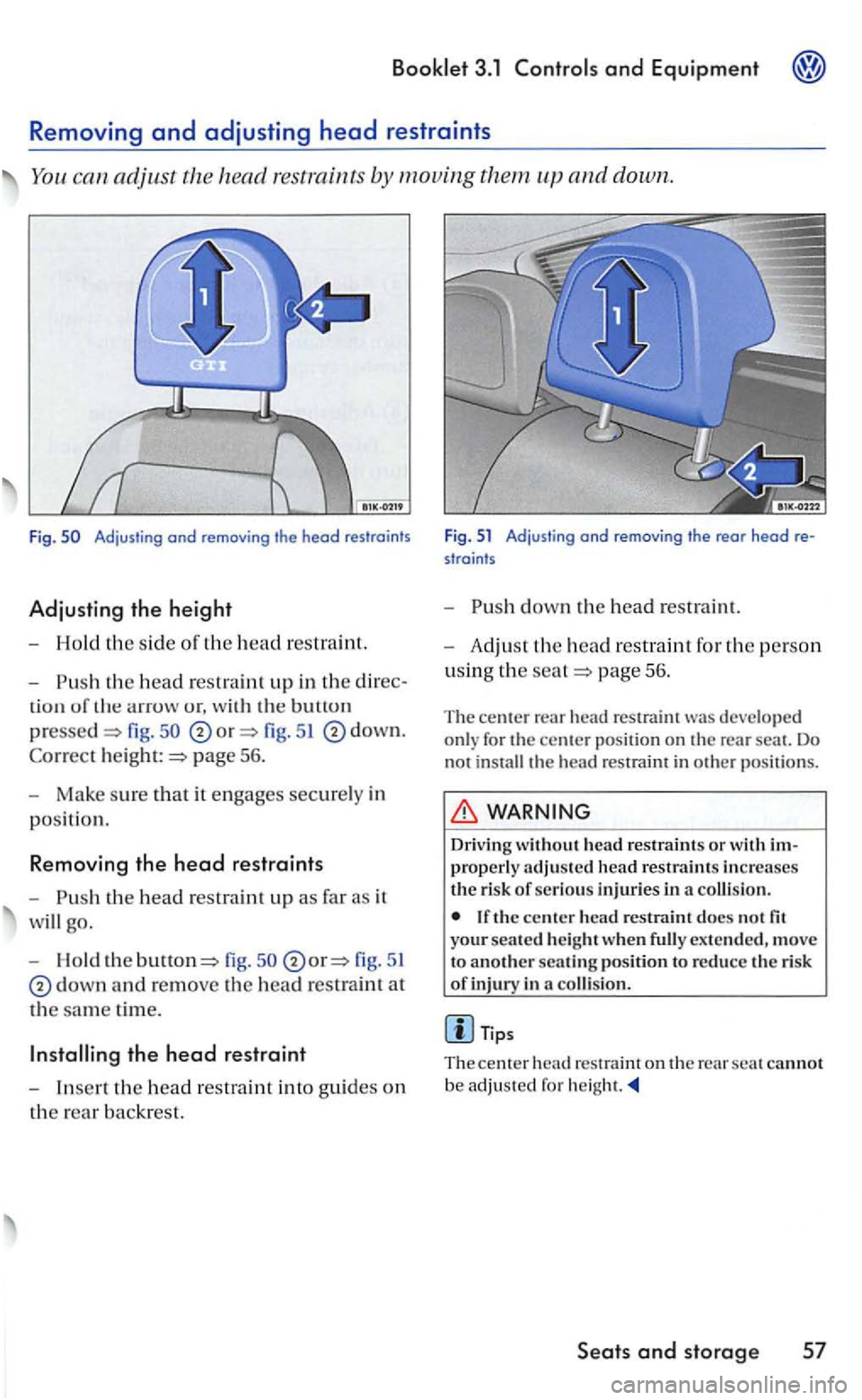
adjust the head by moving them
u r, w ith bullun
pressed fig. 51 down.
page 56.
- M ake sure tha t it engages securely in
position.
Removing the head restraint s
-
th e fig . fig. 51
down and remove th e head restraint at
the sam e time.
th e head restraint in to guides on
the rear backrest .
F ig. 51 Adjusting and removing the rear head re
straints
-
page 56.
T he ce nter r
ear h ead res train t deve lo p ed
o nly for the center p osition on th e rear seat. Do
not install the head restraint in oth er p ositio ns.
Driving without h ead restrain ts or
th e ce nter head restra int do cs not fit your seated h eig h t w he n full y exte nded, move
t o another s ea tin g posi tion to reduce the risk of inj ury in a collis ion.
Tips
The ce n te r h ead
res traint on the rear scat ca nn ot
b e a dju ste d fo r height.
Seats and storage 57