2007 VOLKSWAGEN GOLF light
[x] Cancel search: lightPage 375 of 444
-Place the flat blade of th e screwdri ver
into the fig. 42
the cover off care full y in the dir ec
tio n of the a rrow.
Replacing
th e ig nit ion off and remove th e
key fr
om the ig nitio n lock.
- T
urn the lamp holder upwards and pull
the lamp holder out alo ng w ith the lig ht
bulb.
- Rep l
ace th e light bulb.
- Install
the lamp h o lder w ith the new
light bulb.
-
Turn t h e lamp hold er against the direc
tio n of th e a rrow back to its o rigina l posi
tion until it e n gages.
Booklet 3.2 Tips and Advice
-Press on the cove r until it engages
firmly.
There are parts with sharp ed ges on the opening and on the lamp holder. h and protection when yo u replace bulbs .
authorized Volk
s w age n dealer or a qu alifi ed workshop. rious person al injury may
Do not touch glass bulb with hands. Fingerprints can cloud the outer s u rface of the bulb
w hen heated. thus affect ing th e reflection, th us reducing the power of illumin at io n .
A bulb can o nly be rep laced by a bulb of the sam e type. The model identificat io n i s ei ther on the bulb base or on the bulb
cables must h ave sufficient wire cross section.
the engine does not is
disch arged, your vehicle's can be connected the batt ery of another vehicle to start the engine.
Jumpe r cables
T he wi re cross section mu st be in2
(25 1111112
) fo r g asoli ne e ngines.
Do no t let the ve hicles each other, o therwise current could flow as soon as th e plus(+) terminals areconnected.lf necessary.use longer jumpe r cables.
T he discharged battery must be p roperly connected to th e ve hicle's
What do
Page 376 of 444
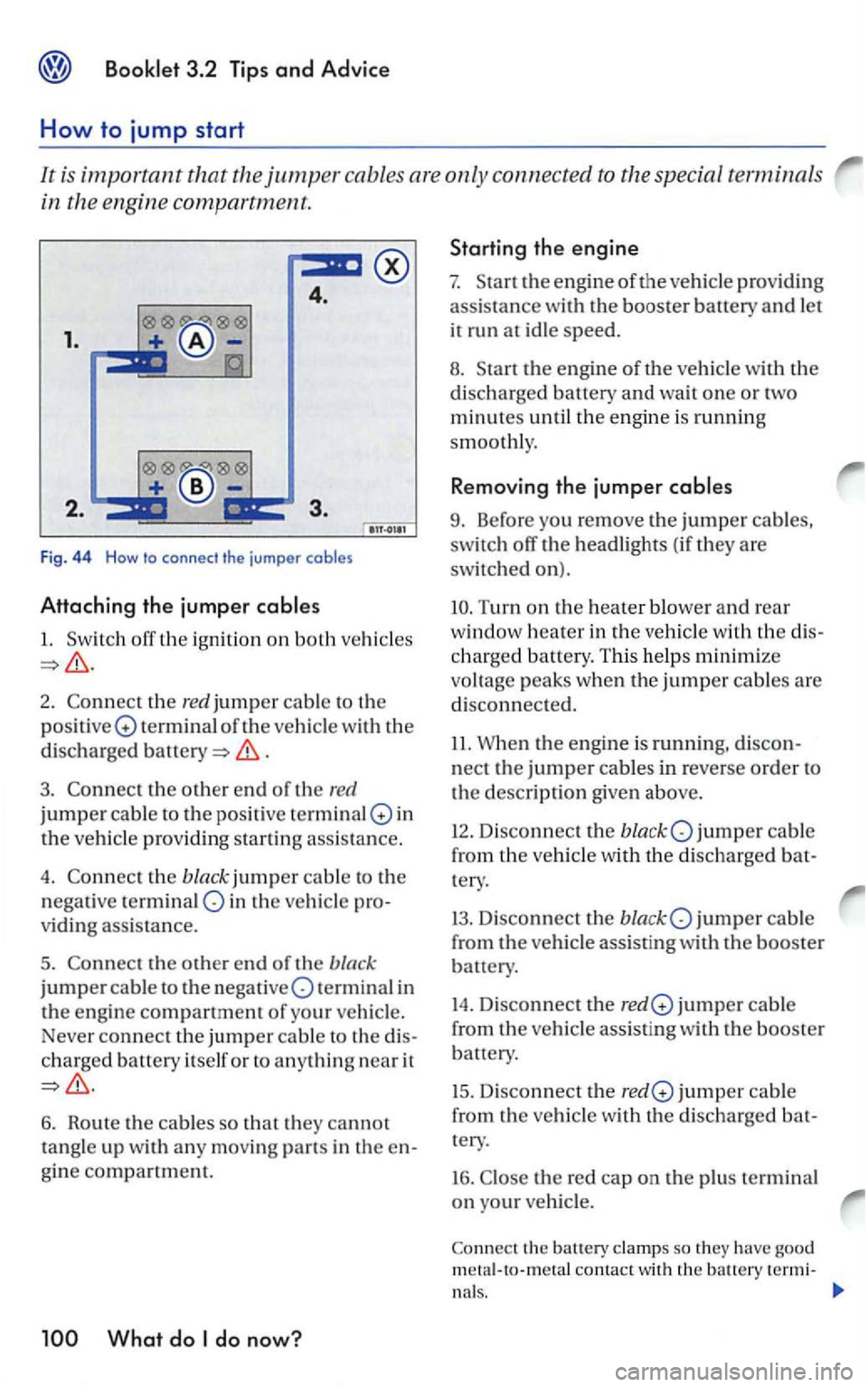
4.
1.
F ig. 44 How to connect the jumper cables
Attaching the jumper
1.
2. the red jumper cable to the
positi ve Q terminal of the vehicle with the
disch arg ed
.
3 . the other end of th e red
jumpe r cable to the posit ive terminal in
the veh icle providing startin g ass is ta n ce.
4. the black jumper ca ble to the
negative terminal in the vehic le
v idin g assistance.
5.
ch arged battery itself or to anything near it
6. Route the cables so that they cannot
tangle up with an y mo vin g parts in the
the engine of the vehicle with the
discharged battery and wait one or two
minutes until the engin e is running
s m
oothly.
Removing the jumper
9. Before you remove th e jumper cables,
switch off the headlights (if they are
switched on).
Turn on the heater blower and rear
window heater in the vehicl e with the
charged battery. This helps minimi ze
voltage peaks wh
en the jumper cables are
di sconnected.
11. Whe n the engine is running,
nect the jumper cables in r everse order to
the description given above.
12. Disconnect the jumper cable
fro m the vehicle with the di
scharged
jumper cable
from
the ve hicle assist ing with the booster
battery.
14. Disconn ect the jumper cabl e
from
the ve hicle assisting w ith the booste r
battery.
15. D isconnect the jumper ca ble
from the
vehicle with the discharged
th e re d cap on th e plu s te rminal
on your vehicle .
contact with the battery
Page 380 of 444
hicle yo u are tow ing. Brake earlier and
more gently than you wou ld normally
- Do not drive faster than mph
miles
-Turn on the emergency flasher.
-Move the se lecto r lever or gearshift
l eve r to
the neutral position (N).
- Make s
ure that the tow-rope is taut at all
Tow-rope or lo w-bar
bar. use a tow -rope if you do not have a
tow -bar.
A tow-ro pe s ho uld
be slightl y elastic to reduce the loading on both ve hicl es. Use a tow -rope made of synthetic fiber or similar ela stic
load ing and damaging the anchorage points.
T he ignition
of the vehicle bein g to we d must be switched on to ensure
will
hav e to apply considera bly more press ure to the brak e pedal than you would normally.
Move the selec tor leve r toN.
Do not drive fas te r than mph
Do not tow farth er than mil es km).
a tow truck is used, the vehicl e must be tow ed with all wheels the ground.
Tow starti ng
For technica l rea sons,
it is not pos sibl e to tow start you r vehicle, if the vehicl e is without trical power. The engine management systems may not operate prop erly.
Use jumper cables page
WARNING
Towing a ve hicle changes th e way your ve hicle
h an dles and brakes. To help reduce the risk of
a n accident lea ding to serio us personal i njury, note the fo ll owi ng:
T he drive r of the vehi cle t hat is being towed:
Will have to press the brake pedal
Will have to use considerably more force
to turn t h e s teering wheel, because th e
power s teerin g is no t ac tive.
The driver of the vehicle that is towing:
Must accelerate gradually and gently avoid jerking movements.
Mus t brake earlie r and more ge ntl y than you would normally.
Tips
For technical r easo ns, it is not possible to sta rt a ve hicle with an aut omati c transmission.
th ere is no fluid in the vehicle transmission because o f a defect. th e vehicle must be tow ed
w ith the dri ve whee ls t h e ground.
a veh icle with an automati c tra nsmission has to be towed more th an miles
Page 384 of 444
light 5
See Anti-lock brake
should want to add an acces-sor y to my ve hicl e?
Add ress of
Add ress of Transport
Afte r c hanging a w heel 87
Alloy
wheels
fe el a slight v i
b ration on the brake pedal? 4
Ant i-t h
eft alarm system
Linking your trailer
Anti-theft wheel bolts 84
A uto Safety Hotline
Automatic car wash 22
B
3
Batt ery
56
low often should replace m y engin e
battery? 56
Important informatio n t o know befo re
d isconnect the battery 55
Hcplac ing
56 yo u must do after reconnect the battery 55
is the correct brake nuidleve l?. 53
Brake syste m 53
light 2
B rak
es low docs mois ture or road salt affect the brakes? 13
does it mean when feel a slight vibra tion o n the brake pedal? 4
Br
aking distance 13
Break-in period
Engin e 12
is the right way to break-in my vehicle? 12
Br e
aking in
B r
ake pads 12
Ti r
es 12
Break ing in
tires 12
Bulb ch
ange 93
Bulb fa
ilure 93
65 39 , 55
22
ra di o 33
phone 33
phone 33
a bulb 93
a w heel 86
brake pads
fuel cap 36
engine oil leve l 44
26
Page 385 of 444
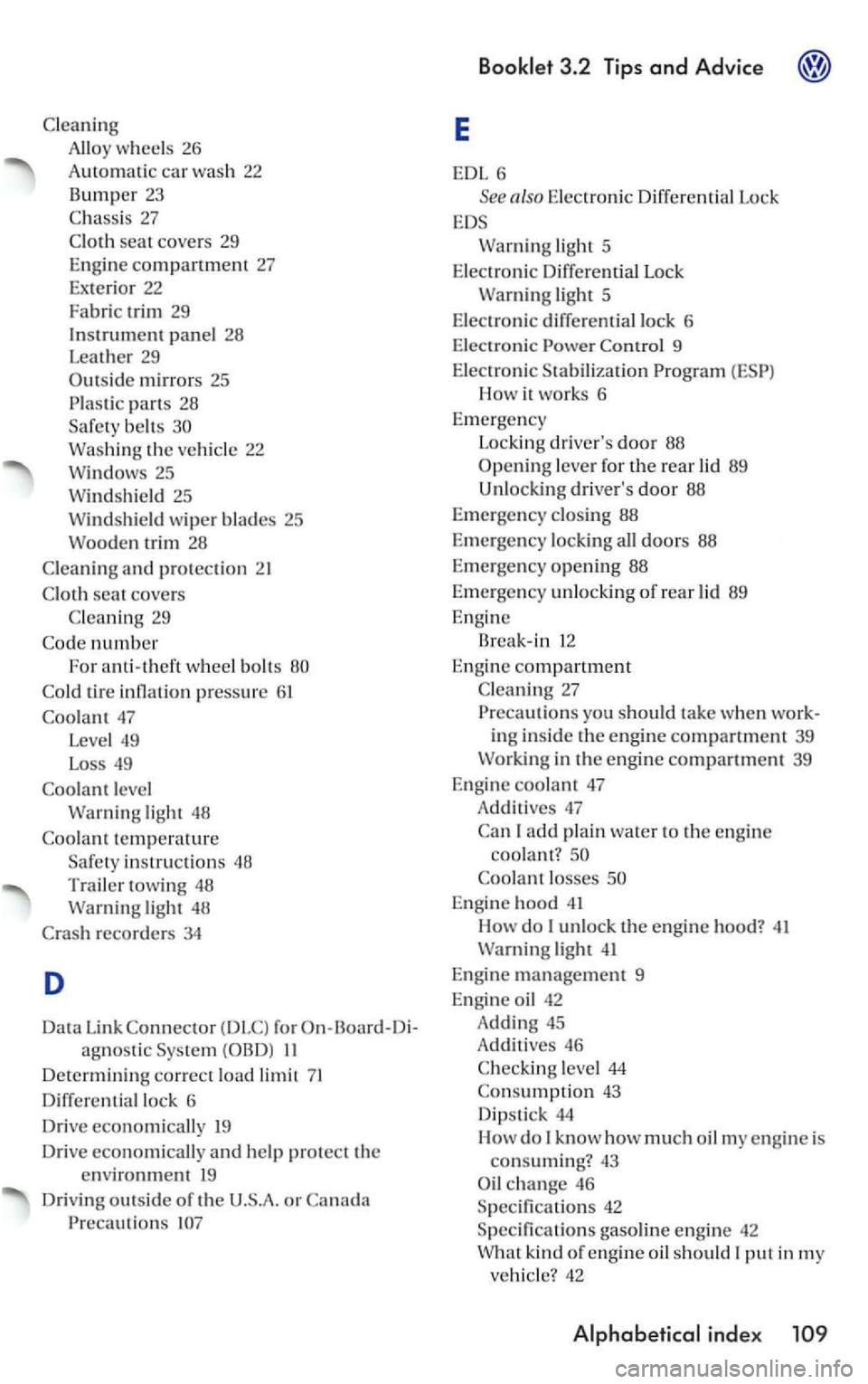
Allo y w heels 26
Auto m
atic car w as h 22
Bumper 23
27
seat cove rs 29
Engine
compartment 27 Exterior 22
Fabric
trim 29
Instrument panel 28
Leat her 29
Outside mirrors 25 part s 28
belt s th e ve hicl e 22
25
tri m 28
and protection 2 1
scat covers
29
numbe r
For anti -
theft wheel bolt s
pressure 6 1
47
L eve l 49
L
oss 49
light 48
temperature
in structions 48
Tr
ailer t o w in g 48 light 48
recorders 34
D
Da ta Link for agnosti c II
D etermin in g correct load limit 71
D ifferentia l lock 6
D rive
econom ically 19
D rive
economi cally and he lp protec t th e environment 19
D
riving o u ts id e of the or Precautions
3 .2 Tips and Advice
light 5
Elec tron ic di
fferential lock 6
Electroni c
Control 9
Electronic
Stabili zat ion
How it work s 6
Em erge ncy
Lockin g drive r's door 88
Opening leve r for the rear lid 89
Unlo ckin g
driver's door 88
Emergen cy clos ing 88
E m erg
ency locking doors 88
E m erge ncy op
ening 88
E m erge ncy
unlocking of rear lid 89
E ngin e
Break-in 12
E ngine
compartment
27
Pr eca utions yo u s ho ul d tak e when working inside th e engine compartment 39
I add pl ain water to the engin e
c o ol
ant?
losses
light 4 1
E n gin e m a
nagem ent 9
E n gin e oil 42
Adding 45 Additi ves 46
leve l 44 43
Dip stick 44
How do I k now how much oil my engine is consuming? 43
c h an ge 46
Specificati on s 42
S pecificat i
ons gasolin e engine 42 kind of engine oil should put in my
ve hicle? 42
Page 386 of 444
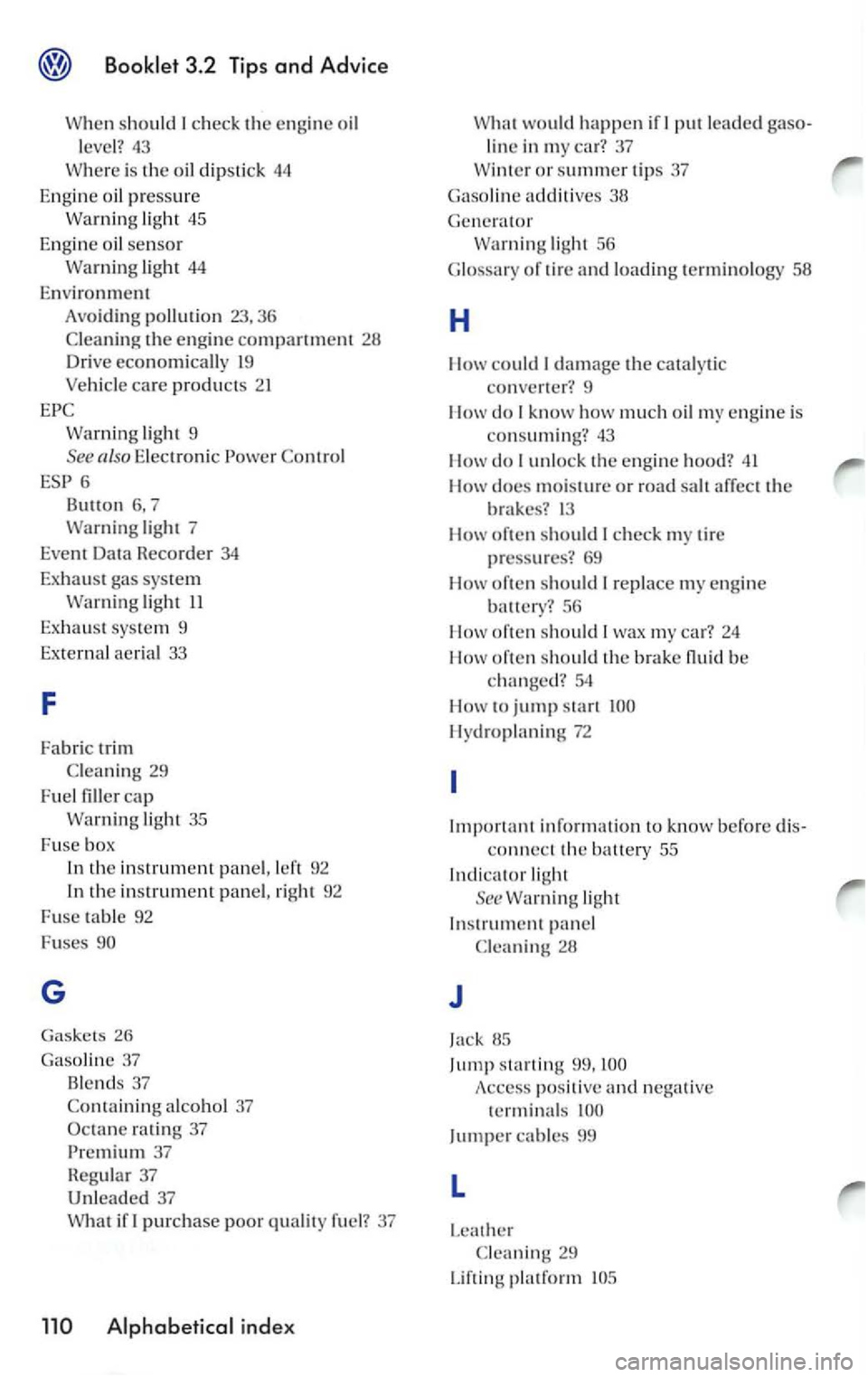
sh o uld I check the engine oil
level? 43
ligh t 45
Engine oil sensor li g h t 44
Environment Avoiding pollution 23, 36
the eng in e compartment 28 Drive economically 19
light 9
also E lectron ic
light 7
Even t Data Hecorder
34
Exhaus t system
light II
Exhau st system 9
Externa l
aeria l 33
F
Fabric trim
light 35
Fuse b ox
I n the in strument p anel , left 92
In the in strum ent pan el, rig h t 92
table 92
Fuses
G
Gaskets
Gasoline 37
Blends 37 alcohol 37
rating 37
37
Hegular 37 Unleaded 37 ifl purchase poor qua lity fu el? 37
woul d happen if I put leaded gaso
l
ine in my ca r? 37
or summer tips 37
Gasoline addi tives
Generator light 56
G lossary oft ire and loading terminology 58
H
I low co uld I damage the cata lytic
conve rter? 9
I low do I know how much oil en gi ne is
consuming'? 43
How do I unlock the en gine hood? 41
How doe s moisture or road salt affec t the brakes? 13
How ofte n should I check my tire
pressures? 69
How often should I replace my engine
battery?
56
How oft e n should I wax my 24
I low ofte n should th e brak e nuid be
c h anged?
54
I low to jump start
light
I n st
rument pane l 28
J
Jack
Jump starti n g
Access positive and negative
terminals
Jumper cables
L
Leather
Page 387 of 444
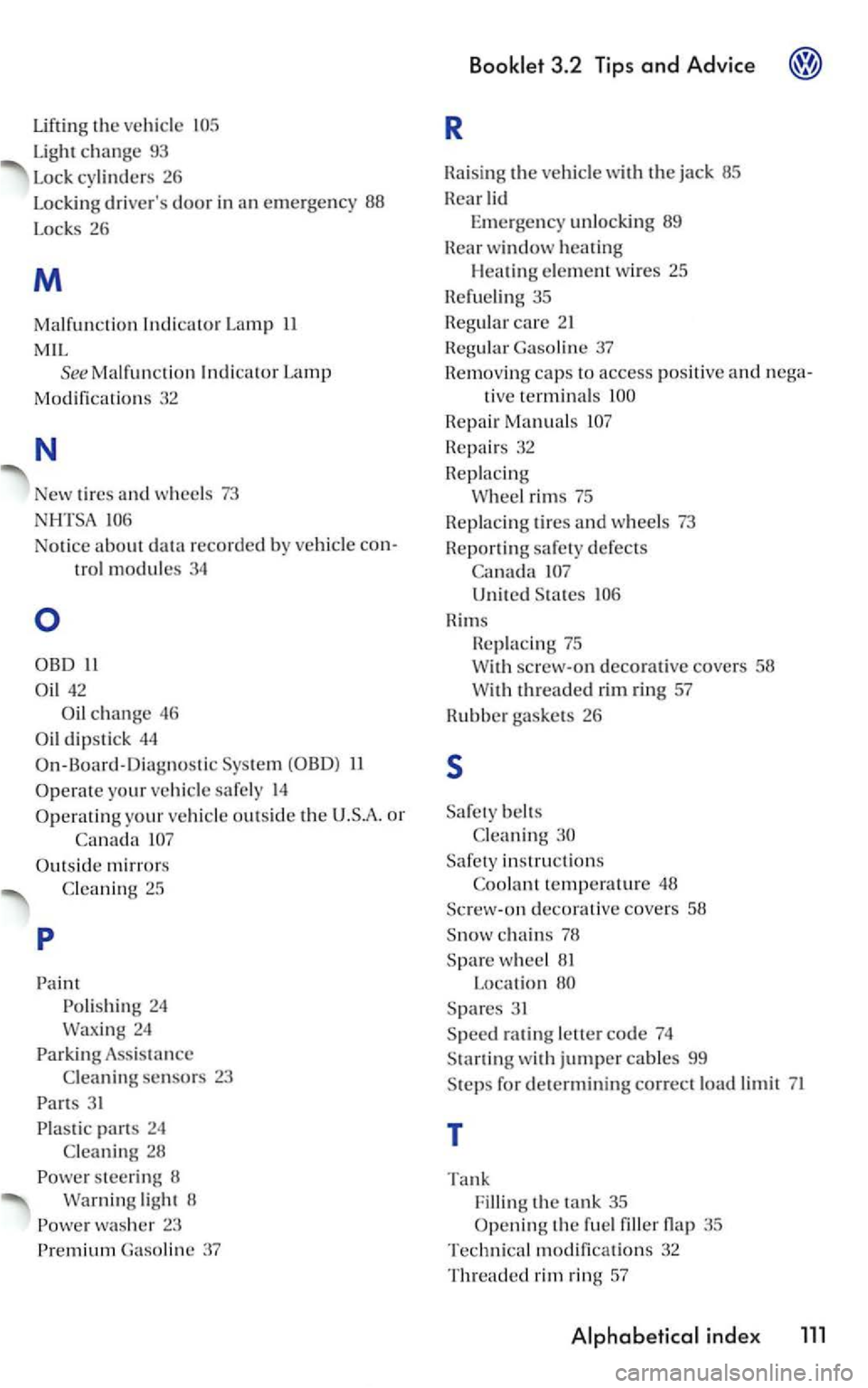
Lifting the ve hicl e
Light change 93
Lo ck cy linders 26
L o ckin g driver's door in emergency 88
Locks
26
M
Malfunction Lamp
M IL See Malfun ction Indicator Lamp
Modific ations 32
N
New tires wheels 73
NHTSA
otice about
trol modules 34
II
yo ur vehicle safely 1 4
mirro rs
C leaning 25
p
31
parts 24 C leaning 28
w asher 23
G asolin e 37
Booklet Tips and Advice
care 2 1
Regular Gasoline 37
Hemoving caps to access p osi tive and nega-
tive terminals
Repai rs 32
R ep l
acing
Wheel rim s 75
Replac
ing tires and w heels 73
Reporting safety defec ts
Ca
nada United States
Him s
Heplacing 75
With screw-on decora tive covers 58
With threade d rim ring 57
R
ubbe r gaskets 26
s
b ells
C
leanin g
Safety instructio ns
C
oolant temperature
Snow c h ain s 78
wheel 81
Location
Spares 31
Speed rating letter code 74
Startin g w ith jumper cables 99
Steps for determining correct load limit 71
T
Tan k
F illin g the ta nk 35
O
pening th e fuel filler 35
T
echnical modific ations 32
Threa ded rim ring 57
Alphabetical index lll
Page 388 of 444
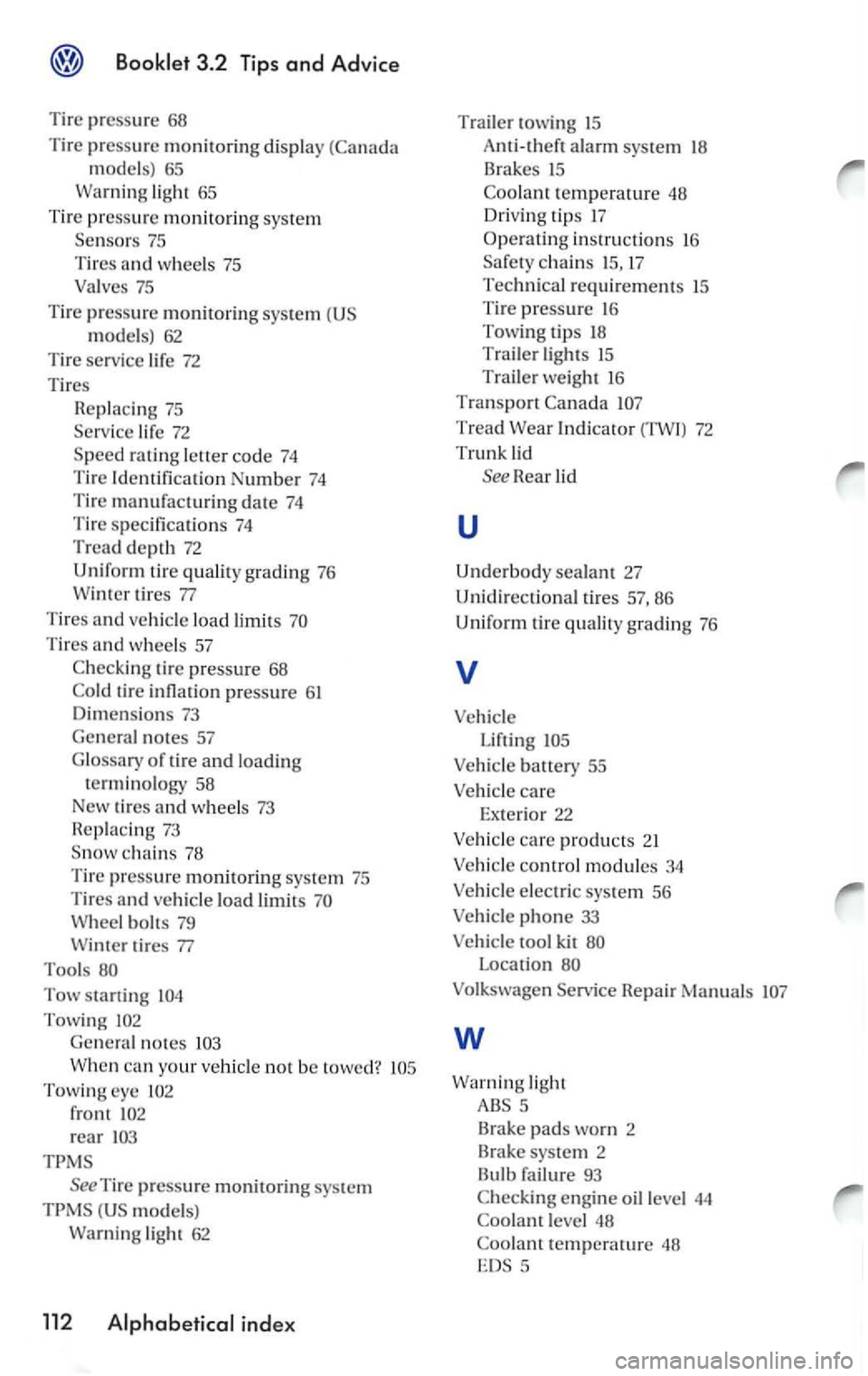
75
Tire pressure monitoring syste m models) 62
Tire service life 7 2
Tir
es
H epl ac ing 75
Service life 72
ratin g letter code 74
Tire Identification Number 74
Tire manufacturing date 74
T ire specification s 74
Tread depth 72
Uniform tire quality grading 76
Winter tires 77
Tires and vehicl e load limits
Tires and w heels 57
Checking tir e pressure 68
Co ld tir e infl ation
pressure 6 1
Dimensio n s 73
Ge n
eral notes 57
Glossary
of tire and loading terminolo gy 58
New tir
es and wheels 73 Heplacing 73
Towing
front
r ear
T ire pressure monitoring sys te m
models)
Warni ng light
62
112 index
Traile r towing 15
A
nti-theft a larm system Bra kes
chains 17
Technical requirement s
Ti re pressure 16
Towing tips Traile r lights
Transport Canada
Tread W ear Indicator 72
Trunk lid
Hear lid
u
Underbody seala nt 27
Unidire ct
ional tires 57, 86
U niforrn tire
quality grading 76
v
Vehicl e
Lifting
Location
w
Warnin g light
5