Page 132 of 485
1222007 SEQUOIA from Aug. ’07 Prod. (OM34462U)
u13092
To remove the booster seat:
Press the buckle release button and allow
the belt to retract.
u13146
Follow the procedure below for a child
restraint system that requires the use
of a top strap.
u13147
Anchor brackets
Use one anchor bracket on the rear of
second seats and two anchor brackets on
the floor as shown above to attach the top
strap.
Anchor bracket is installed for each sec-
ond seating position.
— U sin g a to p st rap
(for bench type second seats)
Page 136 of 485
1262007 SEQUOIA from Aug. ’07 Prod. (OM34462U)
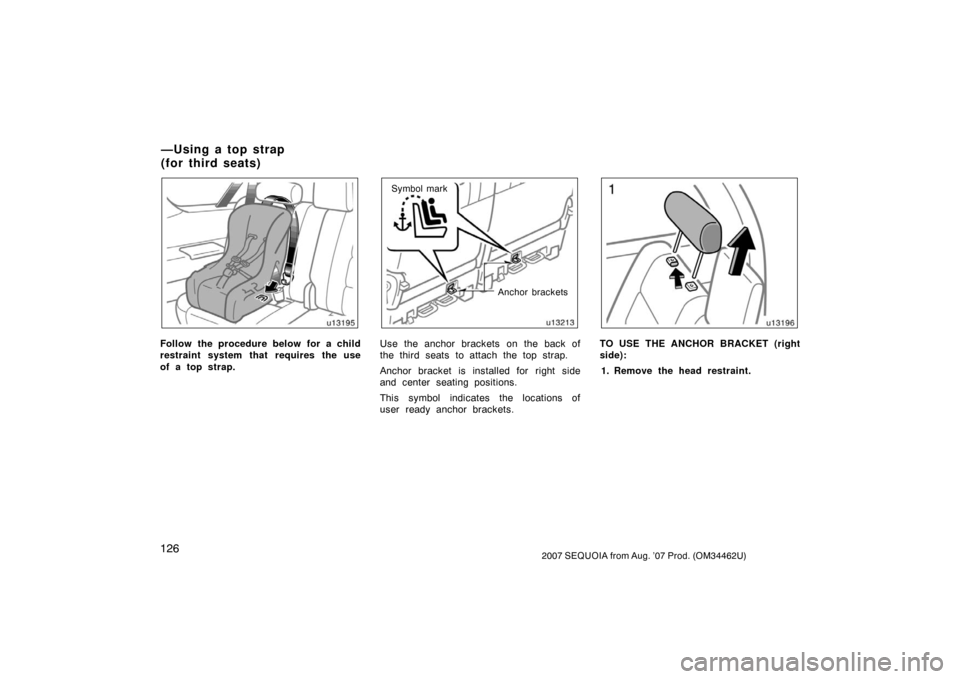
u13195
Follow the procedure below for a child
restraint system that requires the use
of a top strap.
u13213
Anchor brackets
Symbol mark
Use the anchor brackets on the back of
the third seats to attach the top strap.
Anchor bracket is installed for right side
and center seating positions.
This symbol indicates the locations of
user ready anchor brackets.
u13196
TO USE THE ANCHOR BRACKET (right
side):
1. Remove the head restraint.
— U sin g a to p st rap
(for third seats)
Page 141 of 485

1312007 SEQUOIA from Aug. ’07 Prod. (OM34462U)
2. Left side: Turn up the cover for thelower anchorages. Confirm the posi-
tion of the lower anchorages below
the button on the cover.
Center: Turn up the cover for the left
lower anchorage and remove the cap
for the right lower anchorage. Con-
firm the position of the lower an-
chorages below the button on the
cover.
3. Type A—Latch the hooks of lower straps onto the anchorages and
tighten the lower straps.
Type B—Latch the buckles onto the
anchorages.
For owners in Canada— The symbol on
a child restraint system indicates the pres-
ence of a lower connector system.
If your child restraint system has a top
strap, it should be anchored. (For the
installation of the top strap, see “—Using
a top strap (for bench type second seats)”
on page 122 in this Section.)
For installation details, refer to the instruc-
tion manual equipped with each product.CAUTION
�When using the lower anchorages
for the child restraint system, be
sure that there are no irregular ob-
jects around the anchorages or that
the seat belt is not caught.
�Push and pull the child restraint
system in different directions to be
sure it is secure. Follow all the
installation instructions provided by
its manufacturer.
�After securing the child restraint
system, never recline the seat.
�Do not install a child restraint sys-
tem on the second seat if it inter-
feres with the lock mechanism of
the front seats. Otherwise, the child
or front seat occupant(s) may be
killed or seriously injured in case
of sudden braking or a collision.
u13215
Lower anchorages for the child restraint
systems complying with the FMVSS225
or CMVSS210.2 specifications are
installed in the second seat.
The anchorages are installed in the seat
cushion of each second seat.
Child restraint systems complying with the
FMVSS213 or CMVSS213 specification
can be fixed to these anchorages. In this
case, it is not necessary to fix the child
restraint system with a seat belt on the
vehicle.
—Installation with child
restraint lower anchorages
(for
separate type second seats)
Page 375 of 485

3662007 SEQUOIA from Aug. ’07 Prod. (OM34462U)
CAUTION
Even if the total load of occu-
pant’s weight and the cargo load
is less than the total load capac-
ity, do not apply the load uneven-
ly. That may cause not only dam-
age to the tire but also deteriora-
tion to the steering ability due to
unbalance of the vehicle, causing
an accident.
u20014
Cargo
capacityWeight of the
r e m o v e d th i r d se a t
SEATING CONFIGURATION
VARIATION
In case of removing the rear seats,
it is possible to load as much cargo
as the weight of the removed seats.
(Cargo capacity) = (Total load capac-
ity)
− (Total weight of occupants) +
(Weight of the removed rear seats)
Rear seats weights:
Right side 24 kg (53 lb.)
Left side 24 kg (53 lb.) Determine what kind of tires your
vehicle is originally equipped with.
1. Summer tires
Summer tires are high −speed capabil-
ity tires best suited to highway driving
under dry conditions.
Since summer tires do not have the
same traction performance as snow
tires, summer tires are inadequate for
driving on snow −covered or icy roads.
For driving on snow −covered or icy
roads, we recommend using snow
tires. If installing snow tires, be sure
to replace all four tires.
2. All season tires
All season tires are designed to pro-
vide better traction in snow and to be
adequate for driving in most winter
conditions, as well as for use all year
round.
Types of tires
Page 405 of 485

3962007 SEQUOIA from Aug. ’07 Prod. (OM34462U)
�Make sure to set the jack prop-
erly in the jack point. Raising
the vehicle with jack improper-
ly positioned will damage the
vehicle or may allow the ve-
hicle to fall off the jack and
cause personal injury.
� Never get under the vehicle
when the vehicle is supported
by the jack alone.
� Use the jack only for lifting
your vehicle during wheel
changing.
� Do not raise the vehicle with
someone in the vehicle.
� When raising the vehicle, do
not place any objects on top
of or underneath the jack.
� Raise the vehicle only high
enough to remove and change
the tire.NOTICE
� Do not continue driving with
a deflated tire. Driving even a
short distance can damage a
tire and wheel beyond repair.
� Vehicles with rear height con-
trol air suspension system:
When jacking up or insta lling
tire chains, be sure to set
manual control mode by
pushing the height control
mode select switch and stop
the engine. Otherwise, the
vehicle height may change
because of the automatic lev-
eling function, resulting in an
accident.
u40004
1. Get the required tools under the
right side second seat and
spare tire.
1. Tool bag
2. Jack
To get the tools, you need to fold up
the right side second seat. As for the
operation of folding up the seat, see
“—Tumbling second seats for luggage
space” on page 53 in Section 1 −3.
To prepare yourself for an emergency,
you should familiarize yourself with
the use of the jack, each of the tools
and their storage locations.
— R eq u ired to o ls an d sp are
tire