Page 338 of 458
338
30p227a
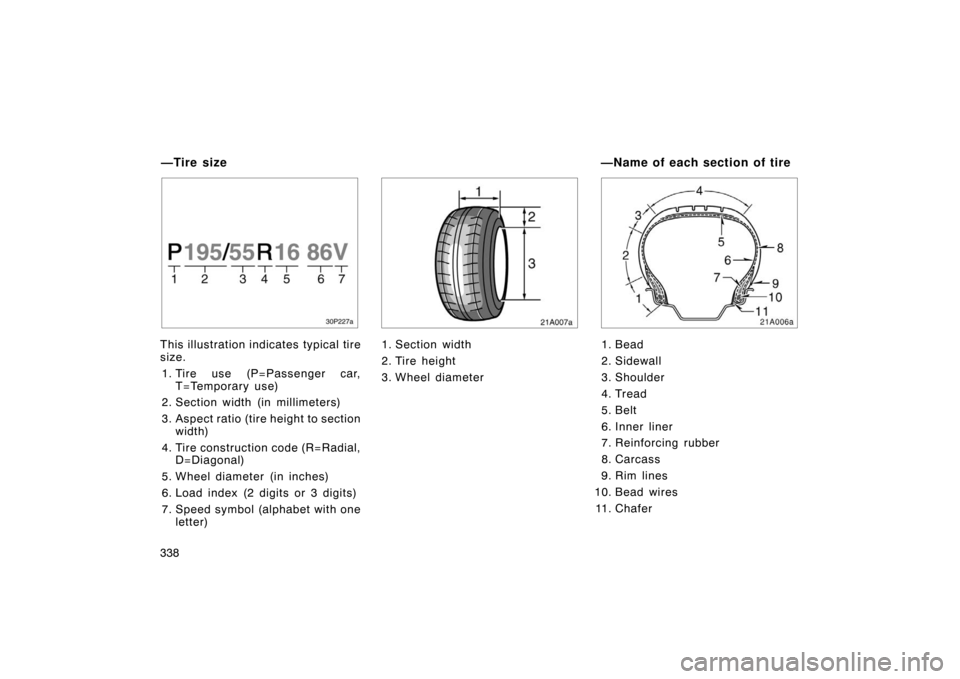
This illustration indicates typical tire
size.1. Tire use (P=Passenger car, T=Temporary use)
2. Section width (in millimeters)
3. Aspect ratio (tire height to section width)
4. Tire construction code (R=Radial, D=Diagonal)
5. Wheel diameter (in inches)
6. Load index (2 digits or 3 digits)
7. Speed symbol (alphabet with one letter)
21A007a
1. Section width
2. Tire height
3. Wheel diameter
21A006a
1. Bead
2. Sidewall
3. Shoulder
4. Tread
5. Belt
6. Inner liner
7. Reinforcing rubber
8. Carcass
9. Rim lines
10. Bead wires 11. Chafer
—Tire size —Name of each section of tire
Page 339 of 458

339
—Uniform tire quality grading
This information has been prepared
in accordance with regulations issued
by the National Highway Traffic Safe-
ty Administration of the U.S. Depart-
ment of Transportation. It provides
the purchasers and/or prospective
purchasers of Toyota vehicles with in-
formation on uniform tire quality grad-
ing.
Your Toyota dealer will help answer
any questions you may have as you
read this information.
DOT quality grades—All passenger
car tires must conform to Federal
Safety Requirements in addition to
these grades. Quality grades can
be found where applicable on the
tire sidewall between tread shoul-
der and maximum section width.
For example: Treadwear 200 Trac-
tion AA Temperature A.Tread wear—
The tread wear grade
is a comparative rating based on the
wear rate of the tire when tested un-
der controlled conditions on a speci-
fied government test course. For ex-
ample, a tire graded 150 would wear
one and a half (1 −1/2) times as well
on the government course as a tire
graded 100. The relative performance
of tires depends upon the actual
conditions of their use, however, and
may depart significantly from the
norm due to variations in driving hab-
its, service practices and differences
in road characteristics and climate. Traction AA, A, B, C—
The traction
grades, from highest to lowest, are
AA, A, B, and C, and they represent
the tire’s ability to stop on wet pave-
ment as measured under controlled
conditions on specified government
test surfaces of asphalt and concrete.
A tire marked C may have poor trac-
tion performance.
Warning: The traction grade assigned
to this tire is based on braking
(straight ahead) traction tests and
does not include cornering (turning)
traction.
Page 340 of 458
340 Temperature A, B, C—T he tem per a-
ture grades are A (the highest), B,
and C, representing the tire’s resis-
tance to the generation of heat and
its ability to dissipate heat when
tested under controlled conditions on
a specified indoor laboratory test
wheel. Sustained high temperature
can cause the material of the tire to
degenerate and reduce tire life, and
excessive temperature can lead to
sudden tire failure. The grade C cor-
responds to a level of performance
which all passenger car tires must
meet under the Federal Motor Vehicle
Safety Standard No. 109. Grades B
and A represent higher levels of per-
formance on the laboratory test wheel
than the minimum required by law.
Warning: The temperature grades for
this tire are established for a tire that
is properly inflated and not over-
loaded. Excessive speed, underinfla-
tion, or excessive loading, either sep-
arately or in combination, can cause
heat buildup and possible tire failure.
Page 341 of 458

341
Ti r e relat ed ter m
Meaning
Cold tire inflation pressure
tire inflation pressure when the vehicl
e has been parked for at leas t 3 hour s
or more, or it has not been driven more than 1.5 km or 1 mile under that
condition
Maximum inflation pressurethe maximum cold inflation pressure to which a tire may be inflated and it is
shown on the sidewall of the tire
Recommended inflation pressurecold tire inflation pressure recommended by a manufacturer
Accessory weight
the combined weight (in excess of those standard items which may be replaced)
of automatic transmission, power steering, power brakes, power windows, pow-
er seats, radio, and heater, to the extent that these items are available as
factory −installed equipment (whether installed or not)
Curb weight
the weight of a motor vehicle with standard equipment including the maximum
capacity of fuel, oil, and coolant, and, if so equipped, air conditioning and addi-
tional weight optional engine
Maximum loaded vehicle weight
t he sum of —
(a) curb weight;
(b) accessory weight;
(c) vehicle capacity weight; and
(d) production options weight
Normal occupant weight68 kg (150 lb.) times the number of occupants specified in the second column
of Table 1 that follows
—Glossary of tire terminology
Page 342 of 458

342Ti r e relat ed ter m
Meaning
Production options weight
the combined weight of those installed regular production options weighing over
2.3 kg (5 lb.) in excess of those standard items which they replace, not pre-
viously considered in curb weight or accessory weight, including heavy duty
brakes, ride levelers, roof rack, heavy duty battery, and special trim
Vehicle capacity weight
(Total load capacity)the rated cargo and luggage load plus 68 kg (150 lb.) times the vehicle’s desig-
nated seating capacity
Intended outboard sidewall
(A) the sidewall that contains a whitewall, bears white lettering or bears
manufacturer, brand, and/or model name molding that is higher or deeper
than the same molding on the other sidewall of the tire, or
(B) the outward facing sidewall of an asymmetrical tire that has a particular side that must always face outward when mounted on a vehicle
Occupant distributiondistribution of occupants in a vehicle as specified in the third column of Table
1 that follows
Rima metal support for a tire or a tire and tube assembly upon which the tire beads
are seated
Rim diameter (Wheel diameter)nominal diameter of the bead seat
Rim size designationrim diameter and width
Rim type designationthe industry of manufacturer ’s designation for a rim by style or code
Rim widt hnominal distance between rim flanges
Vehicle maximum load on the tirethe load on an individual tire that is determined by distributing to each axle
its share of the maximum loaded vehicle weight and dividing by two
Page 343 of 458
343
Ti r e relat ed ter m
Meaning
Vehicle normal load on the tire
the load on an individual tire that is determined by distributing to each axle
its share of the curb weight, accesso
ry weight, and normal occupant weight
(distributed in accordance with Table 1 that follows) and dividing by two
Weather sidethe surface area of the rim no t covered by the inflated tire
Table 1– Occupant loading and distribution for vehicle normal load for various designated seating capacities
Designated seating capacity, number
of occupants
Vehicle normal load, number of occu-
pantsOccupant distribution in a normally
loaded vehicle
2 through 422 in front
5 through 1032 in front, 1 in second seat
Page 344 of 458
344 Vehicle load limits include total load
capacity, seating capacity, towing ca-
pacity and cargo capacity. Follow the
load limits shown below. Total load ca-
pacity and seating capacity are also
described on the tire and loading in-
formation label. For location of the tire
and loading information label, see
“Checking tire inflat ion pr es s ur e” on
page 409.
Total load capacity:
365 kg (810 lb.)
Total load capacity means combined
weight of occupants, cargo and lug-
gage.
Seating capacity: Total 5 (Front 2, Rear 3)
Seating capacity means the maximum
number of occupants whose esti-
mated average weight is 68 kg (150
lb.) per person. Depending on the
weight of each person, the seating ca-
pacity given may exceed the total
load capacity.
NOTICE
Even if the number of occupants are
within the seating capacity, do not ex-
ceed the total load capacity.
Towing capacity
Toyota does not recommend towing
a trailer with your vehicle. Your ve-
hicle is not designed for trailer towing.
Cargo capacity
Cargo capacity may increase or de-
crease depending on the size (weight)
and the number of occupants. For de-
tails, see “Capacity and distribution”
that follows.
CAUTION
Do not apply the load more than
each load limit. That may cause
not only damage to the tires, but
also deterioration to the steering
ability and braking ability, which
may cause an accident.
When stowing cargo and luggage in
the vehicle, observe the following:
� Put cargo and luggage in the lug-
gage compartment when at all
possible. Be sure all items are se-
cured in place.
� Be careful to keep the vehicle bal-
anced. Locating the weight as far
forward as possible helps maintain
balance.
� For better fuel economy, do not
carry unneeded weight.
CAUTION
�To prevent cargo and l uggage
from sliding forward during
braking, do not stack anything
in the luggage compartment.
Keep cargo and luggage low,
as close to the floor as pos-
sible.
Vehicle load limits Cargo and luggage—
—Stowage precautions
Page 347 of 458
347
199 kg – 176 kg = 23 kg.
( 444 lb. – 388 lb. = 56 lb. )
As shown in the above example, if the
number of occupants increases, the
cargo and luggage load equaling the
combined weight of occupants who
got on later must be reduced. In other
words, if the incr
ease in the number
of occupants causes the excess of
the total load capacity (combined
weight of occupants plus cargo and
luggage load), you have to reduce the
cargo and luggage on your vehicle.
For details about total load capacity,
see “Vehicle load limits” on page 344.
CAUTION
Even if the total load of occu-
pant’s weight and the cargo load
is less than the total load capac-
ity, do not apply the load uneven-
ly. That may cause not only dam-
age to the tire but also deteriora-
tion to the steering ability due to
unbalance of the vehicle, causing
an accident.
Types of tires
Determine what kind of tires your
vehicle is originally equipped with.
1. All season tires
All season tires are designed to pro-
vide better traction in snow and to be
adequate for driving in most winter
conditions, as well as for use all year
round.
All season tires, however, do not have
adequate traction performance
compared with snow tires in heavy or
loose snow. Also, all season tires fall
short in acceleration and handling
performance compared with summer
tires in highway driving.