Page 374 of 458
374
50p088
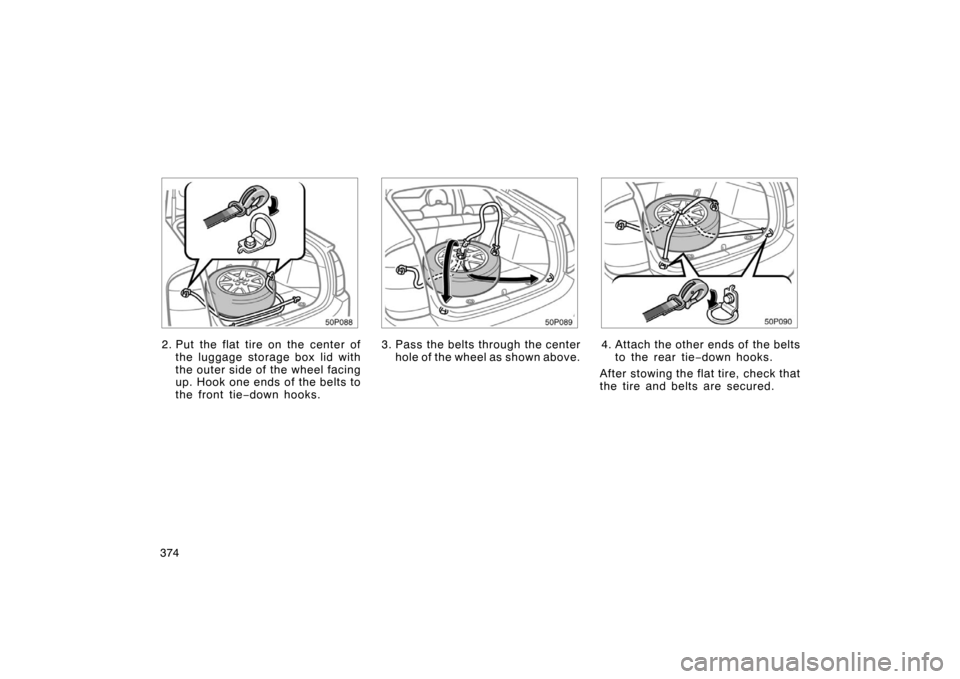
2. Put the flat tire on the center ofthe luggage storage box lid with
the outer side of the wheel facing
up. Hook one ends of the belts to
the front tie −down hooks.
50p089
3. Pass the belts through the center
hole of the wheel as shown above.
50p090
4. Attach the other ends of the beltsto the rear tie −down hooks.
After stowing the flat tire, check that
the tire and belts are secured.
Page 376 of 458
376
50p021b
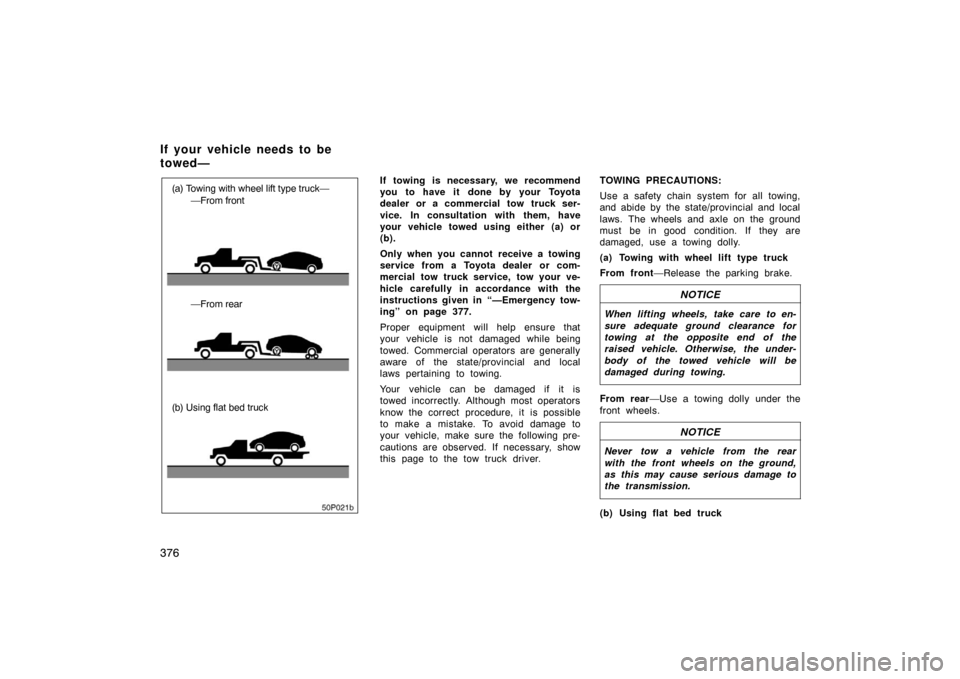
(a) Towing with wheel lift type truck——From front
—From rear
(b) Using flat bed truck If towing is necessary, we recommend
you to have it done by your Toyota
dealer or a commercial tow truck ser-
vice. In consultation with them, have
your vehicle towed using either (a) or
(b).
Only when you cannot receive a towing
service from a Toyota dealer or com-
mercial tow truck service, tow your ve-
hicle carefully in accordance with the
instructions given in “—Emergency tow-
ing” on page 377.
Proper equipment will help ensure that
your vehicle is not damaged while being
towed. Commercial operators are generally
aware of the state/provincial and local
laws pertaining to towing.
Your vehicle can be damaged if it is
towed incorrectly. Although most operators
know the correct procedure, it is possible
to make a mistake. To avoid damage to
your vehicle, make sure the following pre-
cautions are observed. If necessary, show
this page to the tow truck driver. TOWING PRECAUTIONS:
Use a safety chain system for all towing,
and abide by the state/provincial and local
laws. The wheels and axle on the ground
must be in good condition. If they are
damaged, use a towing dolly.
(a) Towing with wheel lift type truck
From front
—Release the parking brake.
NOTICE
When lifting wheels, take care to en-
sure adequate ground clearance for
towing at the opposite end of the
raised vehicle. Otherwise, the under-
body of the towed vehicle will be
damaged during towing.
From rear—Use a towing dolly under the
front wheels.
NOTICE
Never tow a vehicle from the rear
with the front wheels on the ground,
as this may cause serious damage to
the transmission.
(b) Using flat bed truck
If your vehicle needs to be
towed—
Page 377 of 458
377
50p022b
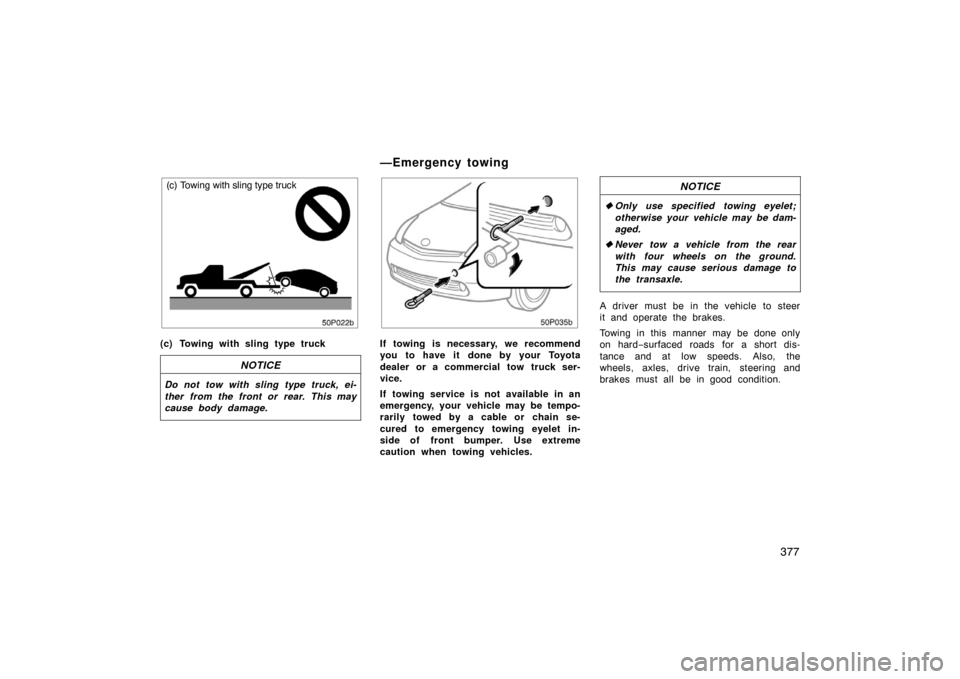
(c) Towing with sling type truck
(c) Towing with sling type truck
NOTICE
Do not tow with sling type truck, ei-
ther from the front or rear. This may
cause body damage.
50p035b
If towing is necessary, we recommend
you to have it done by your Toyota
dealer or a commercial tow truck ser-
vice.
If towing service is not available in an
emergency, your vehicle may be tempo-
rarily towed by a cable or chain se-
cured to emergency towing eyelet in-
side of front bumper. Use extreme
caution when towing vehicles.
NOTICE
� Only use specified towing eyelet;
otherwise your vehicle may be dam-
aged.
� Never tow a vehicle from the rear
with four wheels on the ground.
This may cause serious damage to
the transaxle.
A driver must be in the vehicle to steer
it and operate the brakes.
Towing in this manner may be done only
on hard− surfaced roads for a short dis-
tance and at low speeds. Also, the
wheels, axles, drive train, steering and
brakes must all be in good condition.
—Emergency towing
Page 378 of 458
378
CAUTION
Use extreme caution when towing ve-
hicles. Avoid sudden starts or erratic
driving maneuvers which would place
excessive stress on the emergency
towing eyelet and towing cable or
chain. The eyelet and towing cable or
chain may break and cause serious
injury or damage.
NOTICE
Use only a cable or chain specifically
intended for use in towing vehicles.
Securely fasten the cable or chain to
the towing eyelet provided.
Before towing, release the parking brake
and put the hybrid transaxle in “N”. The
hybrid system must be in the “IG−ON”
mode.
In the following cases, as the front wheels
might be locked by means of the parking
lock mechanism, your vehicle cannot be
towed by another vehicle using a rope.
Have your vehicle carried with the front
wheels or all the wheels raised.
�If the parking mechanism fails.
�If the 12 volt battery is discharged.
CAUTION
If the hybrid system is not running,
the power assist for the brakes and
steering will not work so steering and
braking will be much harder than usu-
al.
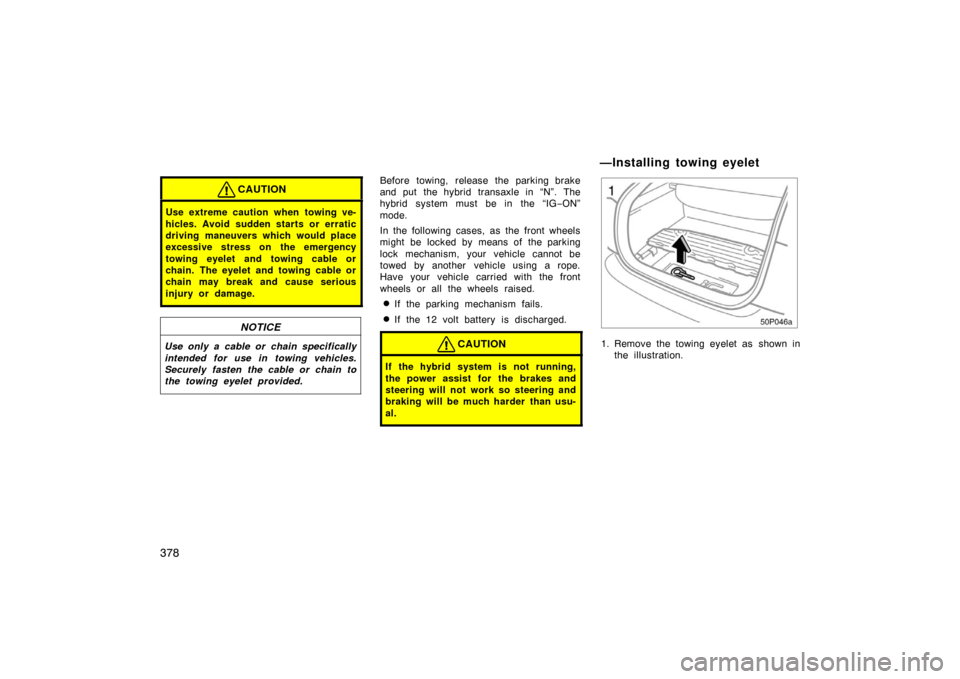
50p046a
1. Remove the towing eyelet as shown in the illustration.
—Installing towing eyelet
Page 379 of 458
379
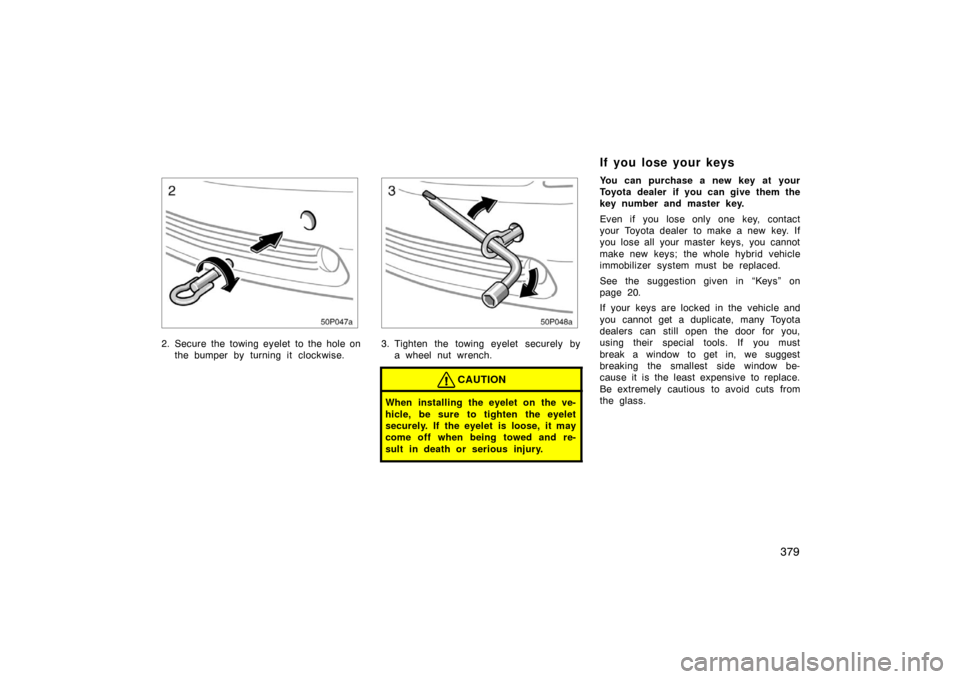
50p047a
2. Secure the towing eyelet to the hole onthe bumper by turning it clockwise.
50p048a
3. Tighten the towing eyelet securely bya wheel nut wrench.
CAUTION
When installing the eyelet on the ve-
hicle, be sure to tighten the eyelet
securely. If the eyelet is loose, it may
come off when being towed and re-
sult in death or serious injury.
You can purchase a new key at your
Toyota dealer if you can give them the
key number and master key.
Even if you lose only one key, contact
your Toyota dealer to make a new key. If
you lose all your master keys, you cannot
make new keys; the whole hybrid vehicle
immobilizer system must be replaced.
See the suggestion given in “Keys” on
page 20.
If your keys are locked in the vehicle and
you cannot get a duplicate, many Toyota
dealers can still open the door for you,
using their special tools. If you must
break a window to get in, we suggest
breaking the smallest side window be-
cause it is the least expensive to replace.
Be extremely cautious to avoid cuts from
the glass.
If you lose your keys
Page 384 of 458

384
1. Rinse off loose dirt with a hose. Re-move any mud or road salt from the
underside of the vehicle or the wheel
wells.
2. Wash with a mild car −wash soap,
mixed according to the manufacturer ’s
instructions. Use a soft cotton mitt and
keep it wet by dipping it frequently into
the wash water. Do not rub hard—let
the soap and water remove the dirt.
Plastic wheel ornaments: The plastic
wheel ornaments are damaged easily by
organic substances. If any organic sub-
stances splash an ornament, be sure to
wash them off with water and check if the
ornament is damaged.
Aluminum wheels: Use only a mild soap
or neutral detergent.
Plastic bumpers: Wash carefully. Do not
scrub with abrasive cleaners. The bumper
faces are soft.
Exterior lights: Wash carefully. Do not
use organic substances or scrub them
with a hard brush. This may damage the
surfaces of the lights.
Road tar: Remove with turpentine or
cleaners that are marked safe for painted
surfaces. 3. Rinse thoroughly—dried soap can
cause streaking. In hot weather you
may need to rinse each section right
after you wash it.
4. To prevent water spots, dry the vehicle using a clean soft cotton towel. Do not
rub or press hard—you might scratch
the paint.
NOTICE
�Do not use organic substances
(gasoline kerosene, benzine or
strong solvents) which may be toxic
or cause damage.
� Do not scrub any part of the ve-
hicle with a hard brush, which may
cause damage.
Automatic car wash
Your vehicle may be washed in an auto-
matic car wash, but remember that the
paint can be scratched by some types of
brushes, unfiltered washing water, or the
washing process itself. Scratching reduces
paint durability and gloss, especially on
darker colors. The manager of the car
wash should be able to advise you wheth-
er the process is safe for the paint on
your vehicle.
NOTICE
To prevent damage to the antenna,
make sure to remove it before driving
through an automatic car wash.
Waxing your Toyota
Polishing and waxing is recommended
to maintain the original beauty of your
Toyota’s finish.
Apply wax once a month or if the vehicle
surface does not repel water well.
1. Always wash and dry the vehicle be- fore you begin waxing, even if you are
using a combined cleaner and wax.
2. Use a good quality polish and wax. If the finish has become extremely weath-
ered, use a car −cleaning polish, fol-
lowed by a separate wax. Carefully fol-
low the manufacturer ’s instructions and
precautions. Be sure to polish and wax
the chrome trim as well as the paint.
Exterior lights: Do not apply wax on the
surfaces of the lights. Wax may cause
damage to the lenses. If you accidentally
put wax on the light surfaces, wipe or
wash it off.
Page 401 of 458

401
Parts and tools
Here is a list of parts and tools you will
need to perform do−it−yourself mainte-
nance. Remember all Toyota parts are de-
signed in metric sizes, so your tools must
be metric.
CHECKING THE ENGINE OIL LEVEL
Parts (if level is low):
�Engine oil ILSAC multigrade having vis-
cosity proper for your climate
Tools:
�Rag or paper towel
�Funnel (only for adding oil)
CHECKING THE COOLANT LEVEL
Parts (if level is low):
�“Toyota Super Long Life Coolant” or
similar high quality ethylene glycol
based non− silicate, non −amine, non− ni-
trite, and non −borate coolant with long −
life hybrid organic acid technology.
“Toyota Super Long Life Coolant” is a
mixture of 50% coolant and 50% deion-
ized water (for the U.S.A.) or 55%
coolant and 45% deionized water (for
Canada).
Tools:
�Funnel (only for adding coolant) CHECKING BRAKE FLUID
Parts (if level is low):
�SAE J1703 or FMVSS No.116 DOT 3
brake fluid
Tools:
�Rag or paper towel
�Funnel (only for adding fluid)
CHECKING 12 VOLT BATTERY CON-
DITION
Tools:
�Warm water
�Baking soda
�Grease
�Conventional wrench (for terminal
clamp bolts)
CHECKING AND REPLACING FUSES
Parts (if replacement is necessary):
�Fuse with same amperage rating as
original
ADDING WASHER FLUID
Parts:
�Water
�Washer fluid containing antifreeze (for
winter use) Tools:
�Funnel
REPLACING LIGHT BULBS
Parts:
�Bulb with same number and wattage
rating as original (See charts in “Re-
placing light bulbs–” on page 422.)
Tools:
�Screwdriver
Page 455 of 458
455
�If your vehicle needs to be
towed, do it with the front
wheels raised. For details on
towing, see “If your vehicle
needs to be towed” on page
376.