Page 104 of 318

94
TURN SIGNALS
To signal a turn, push the headlight/
turn signal lever up or down to position
1.
The key must be in the “ON” position.
The lever automatically returns after you
make a turn, but you may have to return
it by hand after you change lanes.
To signal a lane change, move the lever
up or down to the pressure point (position
2) and hold it.
If the turn signal indicator lights (green
lights) on the instrument panel flash faster
than normal, a front or rear turn signal
bulb is burned out. See “Replacing light
bulbs” on page 286 in Section 7−3.To turn on the emergency flashers,
push the switch.
All the turn signal lights will flash. To turn
them off, push the switch once again.
Turn on the emergency flashers to warn
other drivers if your vehicle must be
stopped where it might be a traffic hazard.
Always pull as far off the road as pos-
sible.
The turn signal light switch will not work
when the emergency flashers are operat-
ing.
NOTICE
To prevent the battery from being dis-
charged, do not leave the switch on
longer than necessary when the en-
gine is not running.
Emergency flashers
Page 105 of 318

95
To turn on the front fog lights, twist
the band of the headlight and turn sig-
nal switch lever. They will come on
only when the headlights are on low
beam.
Full intensity
position
To adjust the brightness of the instru-
ment panel lights, turn the dial.
Full intensity position: This position always
keeps the brightness of the instrument
panel lights at full intensity even when the
tail lights/headlights are turned on.
If you have to turn on the tail lights/head-
lights in daytime, or if the daytime running
light control sensor activates in circum-
stances such as shade, the brightness of
instrument cluster will be reduced. In this
case, set the dial to the full intensity posi-
tion.To turn on the interior light, slide the
switch.
The interior light has the following posi-
tions:
“OFF”—Turns the light off.
“ON”—Keeps the light on all the time.
“DOOR”—Turns the light on when any of
the side doors, back door or glass hatch
is opened. The light goes off when all the
side doors, back door and glass hatch are
closed.
Front fog lightsInstrument panel light control Interior lights
Page 140 of 318

130
When parking, firmly apply the parking
brake to avoid inadvertent creeping.
To set: Pull up the lever. For better hold-
ing power, first depress the brake pedal
and hold it while setting the parking
brake.
To release: Pull up the lever slightly (1),
press the lock release button (2), and low-
er (3).
To remind you that the parking brake is
set, the parking brake reminder light in
the instrument panel remains on until you
release the parking brake.
CAUTION
Before driving, be sure the parking
brake is fully released and the park-
ing brake reminder light is off.
The cruise control is designed to main-
tain a set cruising speed without requir-
ing the driver to operate the accelera-
tor. Cruising speed can be set to any
speed above 40 km/h (25 mph).
Within the limits of the engine’s capabili-
ties, cruising speed can be maintained up
or down grades. However, changes in ve-
hicle speed may occur on steeper grades.
CAUTION
�To help maintain maximum control
of your vehicle, do not use the
cruise control when driving in
heavy or varying traffic, or on slip-
pery (rainy, icy or snowcovered) or
winding roads.
�Avoid vehicle speed increases when
driving downhill. If the vehicle
speed is too fast in relation to the
cruise control set speed, cancel the
cruise control then downshift the
transmission to use engine braking
to slow down.
TURNING THE SYSTEM ON AND OFF
To turn the cruise control on, press the
“ON−OFF” button. The “CRUISE” indicator
light on the instrument panel will come on
to indicate that the cruise control is opera-
tional. Pressing the “ON −OFF” button
again turns the system off.
When the system is turned off, cruising
speed must be reset when the cruise con-
trol is turned on again.
Cruise control
Page 161 of 318
151
OPERATION OF INSTRUMENTS AND
CONTROLS
Air conditioning system
Controls152
. . . . . . . . . . . . . . . . . . . . . . . . . . . . . . . . . . . . .\
. . . . . . . . . . . . . .
Air flow selector settings 155
. . . . . . . . . . . . . . . . . . . . . . . . . . . . . . . . . . . . \
.
Operating tips 155
. . . . . . . . . . . . . . . . . . . . . . . . . . . . . . . . . . . . \
. . . . . . . . . .
Instrument panel vents 157
. . . . . . . . . . . . . . . . . . . . . . . . . . . . . . . . . . . . \
. .
Air conditioning filter 158
. . . . . . . . . . . . . . . . . . . . . . . . . . . . . . . . . . . . \
. . . .
SECTION 1 9
Page 163 of 318

153
Fan speed selector
Turn the knob to adjust the fan speed—to
the right to increase, to the left to de-
crease.
Temperature selector
Turn the knob to adjust the temperatu-
re—to the right to warm, to the left to
cool.
Air flow selector
Turn the knob to select the vents used for
air flow.1. Panel— Air flows mainly from the
instrument panel vents.
2. Bilevel— Air flows from both the floor
vents and the instrument panel vents.
3. Floor— Air flows mainly from the floor
vents.
4. Floor/Windshield— Air flows mainly
from the floor vents and windshield
vents.
Turning the air flow selector to the
floor/windshield position turns on the
defogging function with the purpose of
clearing the front view. In this position, air intake selector
mode changes to FRESH automatically
to clean up the front view quickly. It is
not possible to return to RECIRCULATE
in this position.
Vehicles with “A/C” button—Press the
“A/C” button for dehumidified heating or
cooling. This setting clears the front
view more quickly.
5. Windshield— Air flows mainly from the
windshield vents.
Turning the air flow selector to the
windshield position turns on the defog-
ging function with the purpose of clear-
ing the front view.
In this position, air intake selector
mode changes to FRESH automatically
to clean up the front view quickly. It is
not possible to return to RECIRCULATE
in this position.
Vehicles with “A/C” button—Press the
“A/C” button for dehumidified heating or
cooling. This setting clears the front
view more quickly.
For details about air flow selector settings,
see “Air flow selector settings” described
below.
Page 167 of 318
157
Defogging
The inside of the windshield
For best results, set controls to:Fan speed— Any setting except “OFF”
Temperature— To w a r d s WARM
(red zone) to heat;
COLD (blue zone) to
cool
Air intake—FRESH (outside air)
Air flow—WINDSHIELD
Turning the air flow selector to the wind-
shield or floor/windshield position turns on
the defogging function with the purpose of
clearing the front view.
When turning the air flow selector to wind-
shield or floor/windshield position, air in-
take selector mode changes to FRESH
automatically to clean up the front view
quickly. It is not possible to return to
RECIRCULATE in this position.
Vehicles with “A/C” button—Press the
“A/C” button for dehumidified heating or
cooling. This setting clears the front view
more quickly.
�On humid days, do not blow cold air
on the windshield—the difference be-
tween the outside and inside tempera-
tures could make the fogging worse. Defrosting
The outside of the windshield
For best results, set controls to:
Fan speed— Any setting except “OFF”
Temperature— To w a r d s WARM
(red zone)
Air intake—FRESH (outside air)
Air flow—WINDSHIELD
Turning the air flow selector to the wind-
shield or floor/windshield position turns on
the defrosting function with the purpose of
clearing the front view.
When turning the air flow selector to wind-
shield or floor/windshield position, air in-
take selector mode changes to FRESH
automatically to clean up the front view
quickly. It is not possible to return to
RECIRCULATE in this position.
Vehicles with “A/C” button—Press the
“A/C” button for dehumidified heating or
cooling. This setting clears the front view
more quickly.
�To heat the vehicle interior while de-
frosting the windshield, choose
floor/windshield air flow.
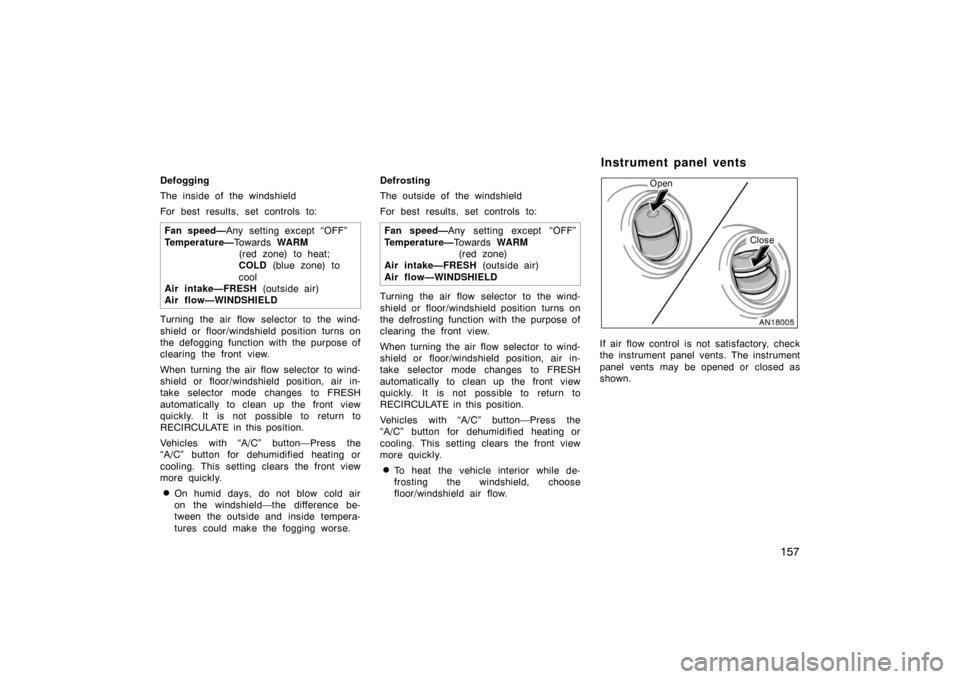
Open
Close
If air flow control is not satisfactory, check
the instrument panel vents. The instrument
panel vents may be opened or closed as
shown.
Instrument panel vents
Page 168 of 318
158
You can change air flow direction by turn-
ing the instrument panel vents.The air conditioning filter information
label is placed inside of the glove box
as shown and indicates that a filter has
been installed.
The air conditioning filter prevents dust
from entering the vehicle through the air
conditioning vent.The air conditioning filter is behind the
glove box.
Air conditioning filter
(on some models)—
Page 172 of 318

162
To reset the hour: Push the “H” button.
To reset the minutes: Push the “M” button.
The key must be in the “ACC” or “ON”
position.
If the electrical power source has been
disconnected from the clock, the time dis-
play will automatically be set to 1:00.
When the instrument panel lights are
turned on, the brightness of the time indi-
cator will be reduced.CIGARETTE LIGHTER
To use the cigarette lighter, press it in.
After it finishes heating up, it automati-
cally pops out ready for use.
If the engine is not running, the key must
be in the “ACC” position.
Do not hold the cigarette lighter pressed
in.
Use a Toyota genuine cigarette lighter or
equivalent for replacement.PORTABLE ASHTRAY
The ashtray can be removed and used
outside the vehicle. To use the ashtray,
open the lid.
When finished with your cigarette, thor-
oughly extinguish it in the ashtray to pre-
vent other cigarette butts from catching
fire. After using the ashtray, close the lid
completely.
To remove the ashtray, pull it out from the
front cup holder.
ClockCigarette lighter and portable
ashtray

