2007 SUZUKI ALTO Ignition system
[x] Cancel search: Ignition systemPage 42 of 139

Downloaded from www.Manualslib.com manuals search engine 4376G-74E
INSTRUMENT PANEL
5-6
Immobilizer System Light
When the ignition switch is turned to the
“ON” position, this light comes on to let you
know the light is working. If this light blinks
with the ignition switch turned to “ON”, there
may be something wrong with the immobi-
lizer system. Contact your MARUTI SUZUKI
dealer to have the system inspected.
76G-05-010
Electric Power Steering Light
(if equipped)
This light comes on when the ignition switch
is turned to the “ON” position, and goes out
when the engine is started.
If this light comes on while driving, the
power steering system may not work prop-
erly. Have the system inspected by your
MARUTI SUZUKI Authorized workshop.NOTE:
If the power steering system does not work
properly, you will feel heavier to steer but
you still will be able to steer.
76G-05-009A
“Malfunction Indicator” Light
Your vehicle has a computer-controlled
emission control system. A “Malfunction
Indicator” light is provided on the instrument
panel to indicate when it is necessary to
have the emission control system serviced.
The “Malfunction Indicator” light comes on
when the ignition switch is turned to “ON”
and goes out when the engine is started.
If the “Malfunction Indicator” light comes on
when the engine is running, there is a
problem with the emission control system.
Take the vehicle to your MARUTI SUZUKI
dealer to have the problem corrected.
Continuing to drive the vehicle when
the “Malfunction Indicator” light is on
can cause permanent damage to the
vehicle’s emission control system, and
can affect fuel economy and
driveability.
CAUTION
76G-05-009
Page 70 of 139

Downloaded from www.Manualslib.com manuals search engine 7176G-74E
Before starting the engine:
1) Make sure the parking brake is applied
fully.
2) Manual Transmission - Shift into “N”
(neutral) and depress the clutch pedal all
the way to the floor. Hold it while starting
the engine.
Make sure that the parking brake is
applied fully and the transmission is
in Neutral before attempting to start
the engine.
Stop turning the starter immediately
after the engine has started or the
starter system can be damaged.
Do not crank the engine for more
than 15 seconds at a time. If the
engine doesn’t start on the first try,
wait about 15 seconds before trying
again.
7-2
STARTING THE ENGINE
w ww w
w WARNING
OPERATING YOUR VEHICLE
Once a week, or each time you fill your fuel
tank, perform the following under-bonnet
checks:
1) Engine oil level.
2) Coolant level.
3) Brake fluid level.
4) Windscreen washer fluid level.
5) Battery solution level.
6) Bonnet latch operation.
Pull the bonnet release handle inside the
vehicle. Make sure that you can not
open the hood all the way without
releasing the secondary latch. Be sure
to close the hood securely after checking
for proper operation. See "All Latches,
Hinges & Locks" of "PERIODIC
MAINTENANCE SCHEDULE" in the
"INSPECTION AND MAINTENANCE"
section for lubrication schedule.
Make sure the bonnet is fully closed
and latched before driving. If it is not,
it can fly up unexpectedly during
driving, obstructing your view and
resulting in an accident.
w ww w
w WARNING
Starting a Cold Engine
Engine which is started after 6 hours should
be treated as cold engine.
For Electronic fuel injection models
With your foot off the accelerator pedal,
crank the engine by turning the ignition
key to “START”. Release the key when
the engine starts.
If the engine does not start after 15
seconds of cranking, wait about 15
seconds, then press down the
accelerator pedal to 1/3 of its travel and
try cranking the engine again. Release
the key and accelerator pedal when the
engine starts.
If the engine still does not start, try
holding the accelerator pedal all the way
to the floor while cranking. This should
clear the engine if it is flooded.
Starting a Warm Engine
For Electronic fuel injection models:
Use the same procedure as for “Starting a
Cold Engine”.
CAUTION
Page 74 of 139

Downloaded from www.Manualslib.com manuals search engine 7576G-74E
7-6
OPERATING YOUR VEHICLE
Be careful where you park and drive;
the catalytic converter and other
exhaust components can get very hot.
As with any vehicle, do not park or
operate this vehicle in areas where
combustible materials such as dry
grass or leaves can come in contact
with a hot exhaust system.
w ww w
w WARNING
To minimize the possibility of catalyst
or other vehicle damage:
Maintain the engine in the proper
operating condition.
In the event of an engine
malfunction, particularly one
involving engine misfire or other
apparent loss of performance, have
the vehicle serviced promptly.
Do not turn off the engine or
interrupt the ignition when the
transmission is in gear and the
vehicle is in motion.
Do not try to start the engine by
pushing or towing the vehicle, or
coasting down a hill.
Do not idle the engine with any
spark plug wires disconnected or
removed, such as during diagnostic
testing.
Do not idle the vehicle for
prolonged periods if idling seems
rough or there are other
malfunctions.
Do not allow the fuel tank to get
near the empty level.
CAUTION
IMPROVING FUEL ECONOMYThe following instructions will help you
improve fuel economy.
Avoid excessive idling:
If you are to wait for more than a minute
while you are parked, stop the engine and
start it again later. When warming up a cold
engine, allow the engine to idle for some
time.
Avoid “fast” starts:
Fast starts away from lights or stop signs
will consume fuel unnecessarily and shorten
engine life. Start off slowly.
Avoid unnecessary stops:
Avoid unnecessary deceleration and
stopping. Try to maintain a slow, steady
speed whenever possible. Slowing down
and then accelerating again uses more fuel.
Keep a steady cruising speed:
Keep as constant a speed as road and
traffic conditions will permit.
76G-07-006
Page 77 of 139

Downloaded from www.Manualslib.com manuals search engine 78
76G-74E
Wear Your Seat Belts at All Times.
The driver and passengers should
be properly restrained at all times,
using the seatbelts provided. Refer
to the “SEATBELTS” section for
instructions on proper use of the
seat belts.
Never drive while under the
influence of alcohol or other drugs.
Alcohol and drugs can seriously
impair your ability to drive safely,
greatly increasing the risk of injury
to yourself and others. You should
also avoid driving when you are
tired, sick, irritated, or under stress.
HIGH-SPEED DRIVING
When driving down a hill, the engine
should be used for braking by shifting to
next lower gear.
Try not to hold the brake pedal down
too long or too often while going
down a steep or long hill. This could
cause the brakes to overheat,
resulting in reduced braking efficiency.
Failure to take this precaution could
result in loss of vehicle control.
When descending a down hill, NEVER
turn the ignition key to the “OFF”
position. Emission control system
damage may result.DRIVING ON SLIPPERY ROADSUnder wet road conditions you should drive
at a lower speed than on dry roads due to
possible slippage of tyres during braking.
When driving on icy, snowcovered, or
muddy roads, reduce your speed and avoid
sudden acceleration, abrupt braking, or
sharp steering movements. When driving at a high-speed, pay attention
to the following:
Stopping distance progressively increases
with vehicle speed. Apply the brakes far
enough ahead of the stopping point to
allow for the extra stopping distance.
On rainy days, “Aquaplaning” can occur.
“Aquaplaning” is the loss of direct
contact between the road surface and
the vehicle’s tyres due to a water film
forming between them. Steering or
braking the vehicle while “Aquaplaning”
can be very difficult, and loss of control
can occur. Keep speed down when the
road surface is wet.
At high speeds, the vehicle may be
affected by side winds. Therefore, reduce
speed and be prepared for unexpected
buffeting, which can occur at the exits
of tunnels, when passing by a cut of a
hill, or when being overtaken by large
vehicles, etc.
DRIVING ON HILLS When climbing steep hills, the vehicle
may begin to slow down and show a
lack of power. If this happens, you
should change to a lower gear so that
the engine will again be operating in its
normal power range. Change rapidly to
prevent the vehicle from losing
momentum.
w ww w
w WARNING
w ww w
w WARNINGCAUTION
8-1DRIVING TIPS AND SAFE DRIVING
76G-08-001
Page 83 of 139

Downloaded from www.Manualslib.com manuals search engine 84
76G-74E
You should take extreme care when
working on your vehicle to prevent
accidental injury. Here are a few
precautions that you should be
especially careful to observe:
Do not leave the engine running in
garages or other confined areas.
When the engine is running, keep
hands, clothing, tools, and other
objects away from the fan and water
pump belt. Even though the fan may
not be moving, it can automatically
turn on without warning. When it is necessary to do service
work with the engine running, make
sure that the parking brake is
applied fully and the transmission is
in Neutral.
Do not touch ignition wires or other
ignition system parts when starting
the engine or when the engine is
running, or you could receive an
electric shock.
Be careful not to touch a hot
engine, exhaust manifold and pipes,
muffler, radiator and water hoses.
Do not allow smoking, sparks, or
flames around gasoline or the
battery. Flammable fumes are
present.
Do not get under your vehicle if it
is supported only with the portable
jack provided in your vehicle.
Be careful not to cause accidental
short circuits between the positive
and negative battery terminals.
Keep used oil, coolant, and other
fluids away from children and pets.
Dispose of used fluids properly;
never pour them on the ground, into
sewers, etc.INSPECTION AND MAINTENANCE9-1
w ww w
w WARNING
w ww w
w WARNING
V VV V
V
V VV V
V
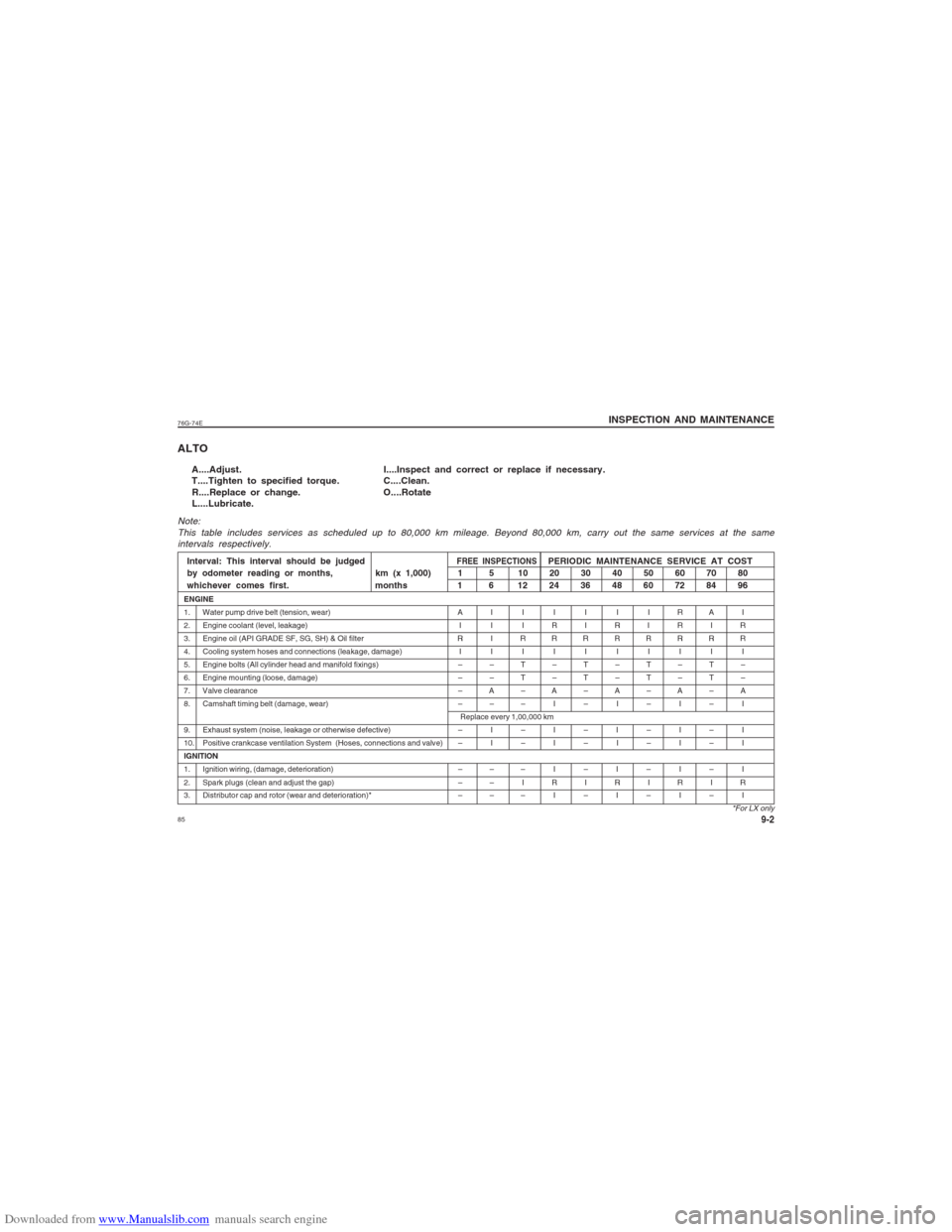
PERIODIC MAINTENANCE SCHEDULEThe following table shows when regular
maintenance on your vehicle is required.
This table shows in kilometres and months
when inspections, adjustments, lubrication
and other services should be performed.
MARUTI SUZUKI recommends that
maintenance on your MARUTI SUZUKI
vehicle be performed by MARUTI
SUZUKI Authorised Dealer/Service
Station.
Whenever it becomes necessary to
replace parts on your vehicle, it is
recommended that you use MARUTI
GENUINE PARTS (MGP).
w ww w
w WARNINGCAUTION
76G-09-001
Page 84 of 139
Downloaded from www.Manualslib.com manuals search engine 8576G-74E
INSPECTION AND MAINTENANCE
9-2
A....Adjust. I....Inspect and correct or replace if necessary.
T....Tighten to specified torque. C....Clean.
R....Replace or change. O....Rotate
L....Lubricate.
Note:
This table includes services as scheduled up to 80,000 km mileage. Beyond 80,000 km, carry out the same services at the same
intervals respectively.Interval: This interval should be judged
FREE INSPECTIONS
PERIODIC MAINTENANCE SERVICE AT COST
by odometer reading or months, km (x 1,000) 1 5 10 20 30 40 50 60 70 80
whichever comes first. months 1 6 12 24 36 48 60 72 84 96
ENGINE
1. Water pump drive belt (tension, wear) A I I I I I I R A I
2. Engine coolant (level, leakage) I I I R I R I R I R
3. Engine oil (API GRADE SF, SG, SH) & Oil filter R I R R R R R R R R
4. Cooling system hoses and connections (leakage, damage) I I I I I I I I I I
5. Engine bolts (All cylinder head and manifold fixings) – – T – T – T – T –
6. Engine mounting (loose, damage) – – T – T – T – T –
7. Valve clearance – A – A – A – A – A
8. Camshaft timing belt (damage, wear) – – – I – I – I – I
Replace every 1,00,000 km
9. Exhaust system (noise, leakage or otherwise defective) – I – I – I – I – I
10. Positive crankcase ventilation System (Hoses, connections and valve) – I – I – I – I – I
IGNITION
1. Ignition wiring, (damage, deterioration) – – – I – I – I – I
2. Spark plugs (clean and adjust the gap) – – I R I R I R I R
3. Distributor cap and rotor (wear and deterioration)* – – – I – I – I – I
*For LX only
ALTO
Page 103 of 139

Downloaded from www.Manualslib.com manuals search engine 104
76G-74E
INSPECTION AND MAINTENANCE9-21NOTE:
If you experience some firing problem of
spark plugs, such as, hard engine-starting,
misfire etc., the cause may be located not
only on spark plugs but also on deteriorated
ignition wiring (generally, used for more than
80,000 km or five years). If spark plug
replacement does not solve the problem,
have the ignition wiring and other ignition
system inspected by your MARUTI SUZUKI
dealer.
76G-09-022
BRAKESBrake Fluid
Check the brake fluid level by looking at the
reservoir in the engine compartment. Check
that the fluid level is between the “MAX”
and “MIN” lines. If the brake fluid level is
near the “MIN” line, fill it up to the “MAX”
line with MARUTI GENUINE brake fluid.
Failure to follow the guidelines below
can result in personal injury or
serious damage to the brake system.
If the brake fluid in the reservoir
drops below a certain level, the
brake warning light on the
instrument panel will come on (the
w ww w
w WARNING
V VV V
V
76G-09-023
EXAMPLEEXAMPLE
FUEL FILTER REPLACEMEMTTrust this replacement job to your MARUTI
SUZUKI authorised workshop.
Page 104 of 139

Downloaded from www.Manualslib.com manuals search engine 10576G-74E
parking brake must be fully
disengaged with ignition switch in
"ON" position). Should the light
come on, immediately ask your
MARUTI SUZUKI dealer to inspect
the brake system.
A rapid fluid loss indicates a leak in
the brake system which should be
inspected by your MARUTI SUZUKI
dealer immediately.
Brake fluid can harm your eyes and
damage painted surfaces. Use
caution when refilling the reservoir.
w ww w
w WARNING
V VV V
V
76G-09-024
INSPECTION AND MAINTENANCE
9-22
Do not use any fluid other than
MARUTI GENUINE brake fluid. Do
not use reclaimed fluid or fluid that
has been stored in old or open
containers. It is essential that
foreign particles and other liquids
are kept out of the brake fluid
reservoir.
The brake fluid should be replaced
every two years or 20,000 km.NOTE:
With disc brakes, the fluid level can be
expected to gradually fall as the brake pads
wear.
w ww w
w WARNINGCAUTION
76G-09-025
Brake Pedal
Check if the brake pedal stops at the
regular height without "spongy" feeling when
you depress it. If not, have the brake
system inspected by your MARUTI SUZUKI
dealer. If you doubt the brake pedal for the
regular height, check it as follows:With the engine running, measure the
distance between the brake pedal and floor
silencer mat when the pedal is depressed
with approximately 30 kg (66 lbs) of force.
The minimum distance required is 110 mm
(4.3 in). Since your vehicle’s brake system
is self-adjusting, there is no need for pedal
adjustment. If the pedal to floor wall distance
as measured above is less than the minimum
distance required, have your vehicle inspected
by your MARUTI SUZUKI dealer.
76G-09-026