2007 SUZUKI AERIO oil temperature
[x] Cancel search: oil temperaturePage 87 of 232
Downloaded from www.Manualslib.com manuals search engine 4-22 INSTRUMENT PANEL
54G27-03E
54G571
NOTE:
If you need maximum defrosting:
set the air flow selector to “DEFROST”
(the air conditioning system will come on
and the “FRESH AIR” mode will be
selected automatically),
set the blower speed selector to HIGH,
adjust the temperature selector to the
HOT end, and
adjust the side outlets so the air blows
on the side windows.
MaintenanceIf you do not use the air conditioner for a
long period, such as during winter, it may
not give the best performance when you
start using it again. To help maintain opti-
mum performance and durability of your air
conditioner, it needs to be run periodically.
Operate the air conditioner at least once a
month for one minute with the engine
idling. This circulates the refrigerant and oil
and helps protect the internal components.
NOTE:
Your vehicle uses the air conditioning
refrigerant HFC-134a, commonly called
“R-134a”. R-134a replaced R-12 around
1993 for automotive applications. Other
refrigerants are available, including recy-
cled R-12, but only R-134a should be used
in your vehicle.
Automatic Heating and Air
Conditioning System
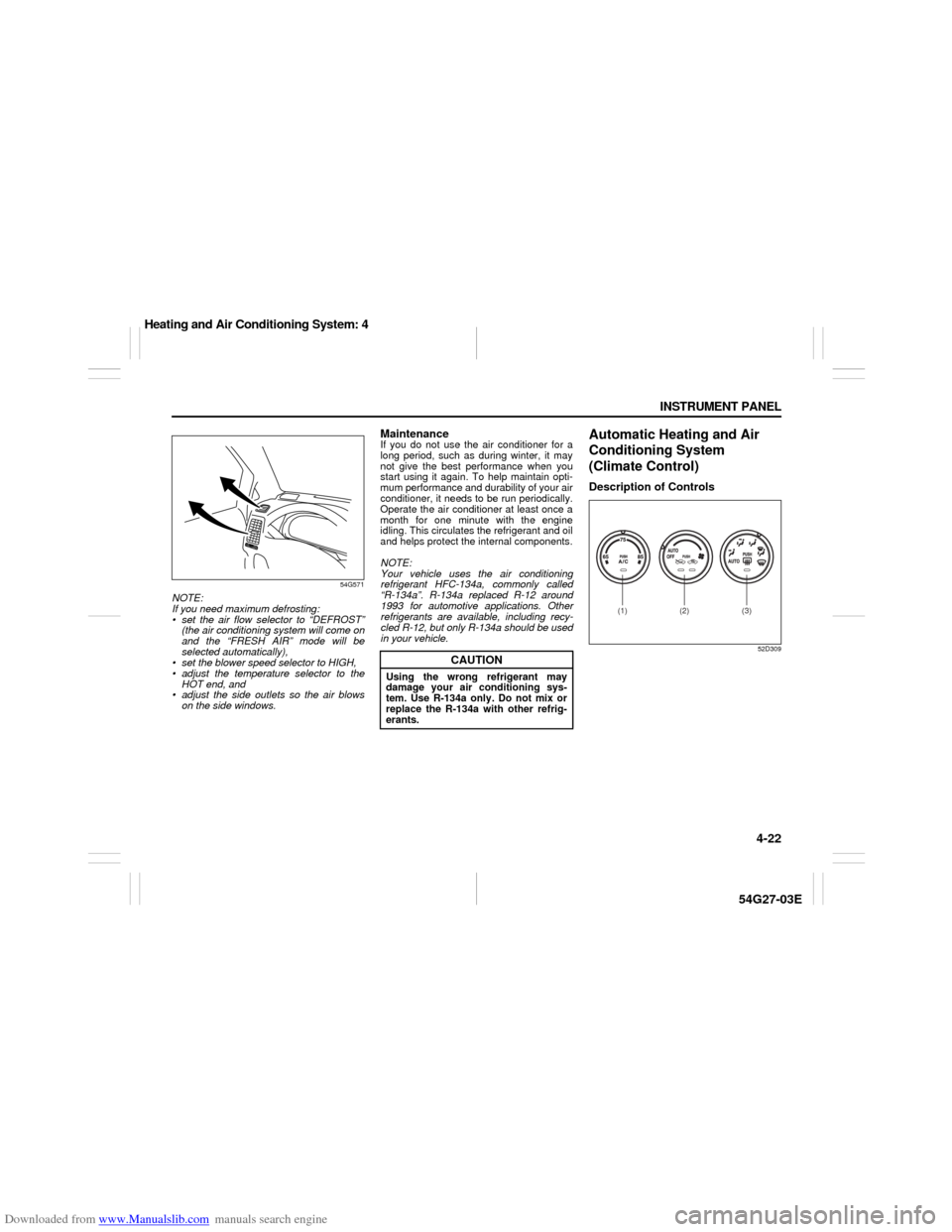
(Climate Control)Description of Controls
52D309
CAUTION
Using the wrong refrigerant may
damage your air conditioning sys-
tem. Use R-134a only. Do not mix or
replace the R-134a with other refrig-
erants.
(1) (2) (3)
Heating and Air Conditioning System: 4
Page 91 of 232
Downloaded from www.Manualslib.com manuals search engine 4-26 INSTRUMENT PANEL
54G27-03E
54G571
NOTE:
If you need maximum defrosting:
set the air flow selector to “DEFROST”
(the air conditioning system will come on
and the “FRESH AIR” mode will be
selected automatically),
set the blower speed selector to HIGH,
adjust the temperature selector to the
HOT end, and
adjust the side outlets so the air blows
on the side windows.
MaintenanceIf you do not use the air conditioner for a
long period, such as during winter, it may
not give the best performance when you
start using it again. To help maintain opti-
mum performance and durability of your air
conditioner, it needs to be run periodically.
Operate the air conditioner at least once a
month for one minute with the engine
idling. This circulates the refrigerant and oil
and helps protect the internal components.
NOTE:
Your vehicle uses the air conditioning
refrigerant HFC-134a, commonly called
“R-134a”. R-134a replaced R-12 around
1993 for automotive applications. Other
refrigerants are available, including recy-
cled R-12, but only R-134a should be used
in your vehicle.
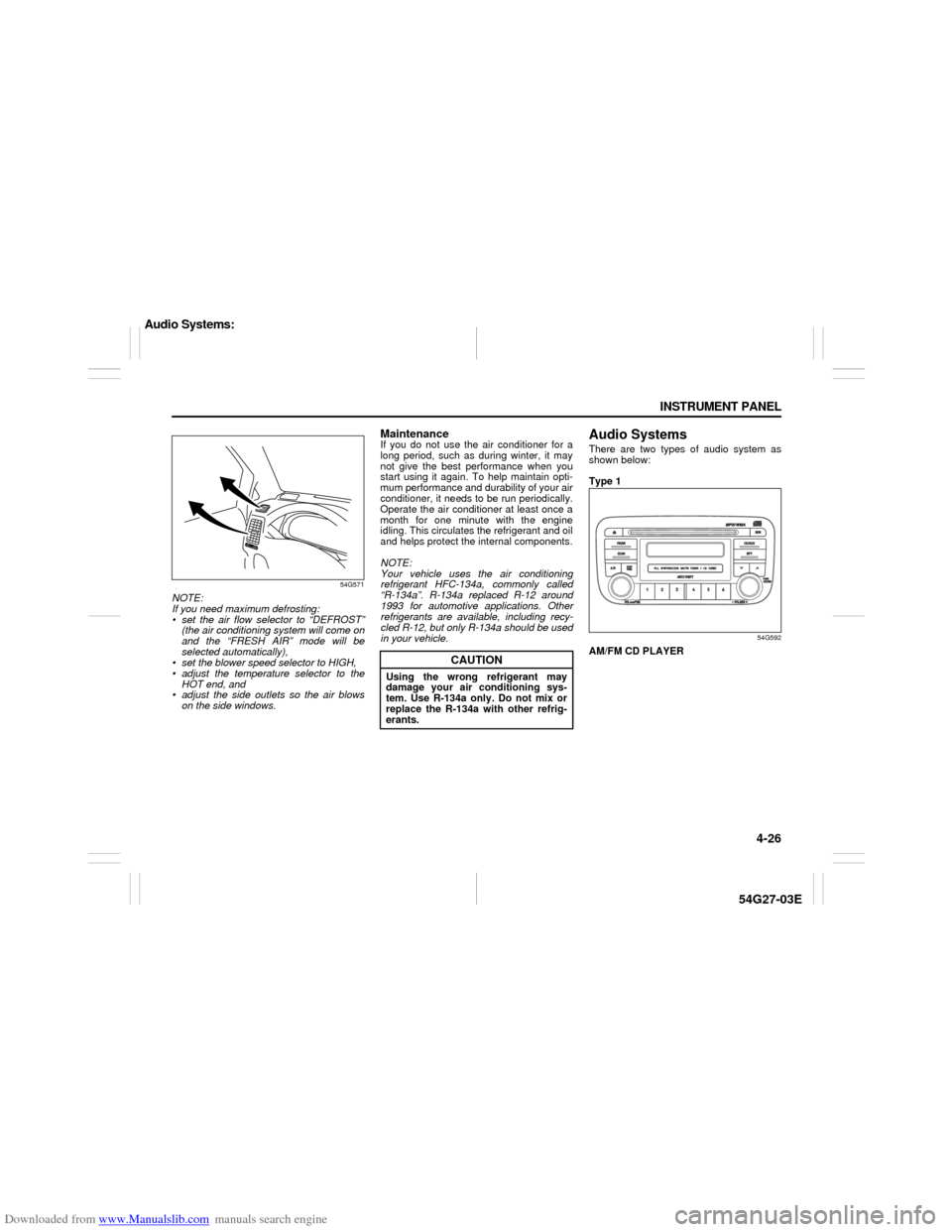
Audio SystemsThere are two types of audio system as
shown below:
Type 1
54G592
AM/FM CD PLAYER
CAUTION
Using the wrong refrigerant may
damage your air conditioning sys-
tem. Use R-134a only. Do not mix or
replace the R-134a with other refrig-
erants.
Audio Systems:
Page 160 of 232

Downloaded from www.Manualslib.com manuals search engine 9-7 INSPECTION AND MAINTENANCE
54G27-03E
Maintenance Recommended under Severe Driving ConditionsFollow this schedule if your car is mainly operated under one or more of the following conditions:
When most trips are less than 6 kilometers (4 miles)
When most trips are less than 16 kilometers (10 miles) and outside temperature remain below freezing.
Idling and/or low-speed operation in stop-and-go traffic.
Operating in dusty areas.
Schedule should also be followed if the car is used for delivery service, police, taxi or other commercial applications.
R: Replace or change
I : Inspect and correct, replace or lubricate if necessaryInterval: This interval should be judged by odometer
reading or months, whichever comes first.miles (x 1000) 3 6 9 12 15 18 21 24 27 30 33 36 39
km (x 1000) 5 101520253035404550556065
months 3 6 9 12 15 18 21 24 27 30 33 36 39ENGINE & EMISSION CONTROL
1. Drive belt
*Tension check, *adjustment, *replacement
–
–
–
–
–
–
–
–
–
I
–
–
–
2.Engine oil and oil filter RRRRRRRRRRRRR
*3.
Cooling system hoses and connections
–
–
–
–
I
–
–
–
–
I
–
–
–
4.Engine coolant –––––––––R–––
*5.
Exhaust pipes and mountings
–
–
–
–
I
–
–
–
–
I
–
–
–
*6. EVAP canister Replace every 250000 km (150000 miles) or 180 months
*7.
Emission-related hoses & tubes
–
–
–
–
–
–
–
–
–
–
–
–
–
8.Spark plugs –––––––––––––
*9.
Ignition coil (plug cap)
–
–
–
–
–
–
–
–
–
I
–
–
–
*10.Fuel tank & cap –––– I –––– I –––
11.
Air cleaner filter element (paved road)
I
I
I
I
I
I
I
I
I
R
I
I
I
*12. Fuel filter Replace every 250000 km (150000 miles) or 150 months
*13.
Fuel lines and connections
–
–
–
–
I
–
–
–
–
I
–
–
–
*14.Canister air suction filter –––––––––––––
Engine Oil and Filter: 1, 2
Page 164 of 232

Downloaded from www.Manualslib.com manuals search engine 9-11 INSPECTION AND MAINTENANCE
54G27-03E
Engine Oil and FilterSpecified Oil
52D083
(1) Preferred
Use engine oil with the American Petro-
leum Institute Certified For Gasoline
Engines “Starburst” symbol.
Select the appropriate oil viscosity accord-
ing to the above chart.
We highly recommend you use SAE 5W-
30 oil.
Oil Level CheckEngine oil dipstick
80G064
It is important to keep the engine oil at the
correct level for proper lubrication of your
vehicle’s engine. Check the oil level with
the vehicle on a level surface. The oil level
indication may be inaccurate if the vehicle
is on a slope. The oil level should be
checked either before starting the engine
or at least 5 minutes after stopping the
engine.
52D084
The handle of the engine oil dipstick is col-
ored yellow for easy identification.
Pull out the oil dipstick, wipe oil off with a
clean cloth, insert the dipstick all the way
into the engine, then remove it again. The
oil on the stick should be between the
upper and lower limits shown on the stick.
If the oil level indication is near the lower
limit, add enough oil to raise the level to
the upper limit.
CAUTION
Failure to use the recommended oil
can result in engine damage.C
Fo o-30
-22-20
-4-10
14 32 50 68 86 104010203040
10W-30
(1)
5W-30
Temperature
EXAMPLE
“Starburst”
EXAMPLE
FULL
ADD
Gear Oil: 6, 10
Page 165 of 232

Downloaded from www.Manualslib.com manuals search engine 9-12 INSPECTION AND MAINTENANCE
54G27-03E
Refilling
81A147
Remove the oil filler cap and pour oil
slowly through the filler hole to bring the oil
level to the upper limit on the dipstick. Be
careful not to overfill. Too much oil is
almost as bad as too little oil. After refilling,
start the engine and allow it to idle for
about a minute. Stop the engine, wait
about 5 minutes and check the oil level
again.
Changing Engine Oil and Filter
60G306
Drain the engine oil while the engine is still
warm.
1) Remove the oil filler cap.
2) Place a drain pan under the drain plug.
3) Using a wrench, remove the drain plug
and drain out the engine oil.4) Reinstall the drain plug and gasket.
Tighten the plug with a wrench to the
specified torque.
EXAMPLEOpen Close
WARNING
The engine oil temperature may be
high enough to burn your fingers
when the drain plug is loosened. Wait
until the drain plug is cool enough to
touch with your bare hands.EXAMPLE
WARNING
New and used oil and solvent can be
hazardous. Children and pets may be
harmed by swallowing new or used
oil or solvent. Repeated, prolonged
contact with used engine oil may
cause [skin] cancer. Brief contact
with used oil or solvent may irritate
skin.
Keep new and used oil and solvent
away from children and pets.
Wear a long-sleeve shirt and water-
proof gloves.
Wash with soap if oil or solvent
contacts your skin.
Tightening torque specification
50 Nm (36.2 lb-ft, 5.0 kg-m)
Automatic Transaxle Fluid: 10
Page 204 of 232

Downloaded from www.Manualslib.com manuals search engine 10-7 EMERGENCY SERVICE
54G27-03E
If the temperature indication does not
return to the normal condition:
1) Turn off the engine and check that the
water pump belt and pulleys are not
damaged or slipping. If any abnormality
is found, correct it.
2) Check the coolant level in the reservoir.
If it is found to be lower than the “LOW”
line, look for leaks at the radiator, water
pump and radiator and heater hoses. If
you locate any leaks that may have
caused the overheating, do not run the
engine until these problems have been
corrected.
3) If you do not find a leak, carefully add
coolant to the reservoir and then the
radiator, if necessary. (Refer to “Engine
Coolant” in the “INSPECTION AND
MAINTENANCE” section.)
65D614
WARNING
If you see or hear escaping steam,
stop the vehicle in a safe place and
immediately turn off the engine to let
it cool. Do not open the hood when
steam is present. When the steam
can no longer be seen or heard, open
the hood to see if the coolant is still
boiling. If it is, you must wait until it
stops boiling before you proceed.
Also, be careful not to touch hot
engine parts (radiator, water hoses,
engine etc.).
WARNING
It is hazardous to remove the radia-
tor cap when the water temperature
is high, because scalding fluid and
steam may be blown out under
pressure. The cap should only be
taken off when the coolant temper-
ature has lowered.
To prevent personal injury, keep
hands, tools and clothing away
from the engine cooling fan and air-
conditioner fan (if equipped). These
electric fans can automatically turn
on without warning.
If the Engine Overheats: 2, 9
Page 208 of 232
Downloaded from www.Manualslib.com manuals search engine 11-1 APPEARANCE CARE
54G27-03E
Corrosion PreventionIt is important to take good care of your
vehicle to protect it from corrosion.
Listed below are instructions for how to
maintain your vehicle to prevent corrosion.
Please read and follow these instructions
carefully.Important Information About
CorrosionCommon causes of corrosion
1) Accumulation of road salt, dirt, moisture
or chemicals in hard to reach areas of
the vehicle underbody or frame.
2) Chipping, scratches and any damage to
treated or painted metal surfaces
resulting from minor accidents or
impact from stones and gravel.
Environmental conditions which accel-
erate corrosion
1) Road salt, dust control chemicals, sea
air or industrial pollution will all acceler-
ate the corrosion of metal.
2) High humidity will increase the rate of
corrosion particularly when the temper-
ature range is just above the freezing
point.
3) Moisture in certain areas of a vehicle
for an extended period of time may pro-
mote corrosion even though other body
sections may be completely dry.
4) High temperatures will cause an accel-
erated rate of corrosion to parts of thevehicle which are not well ventilated to
permit quick drying.
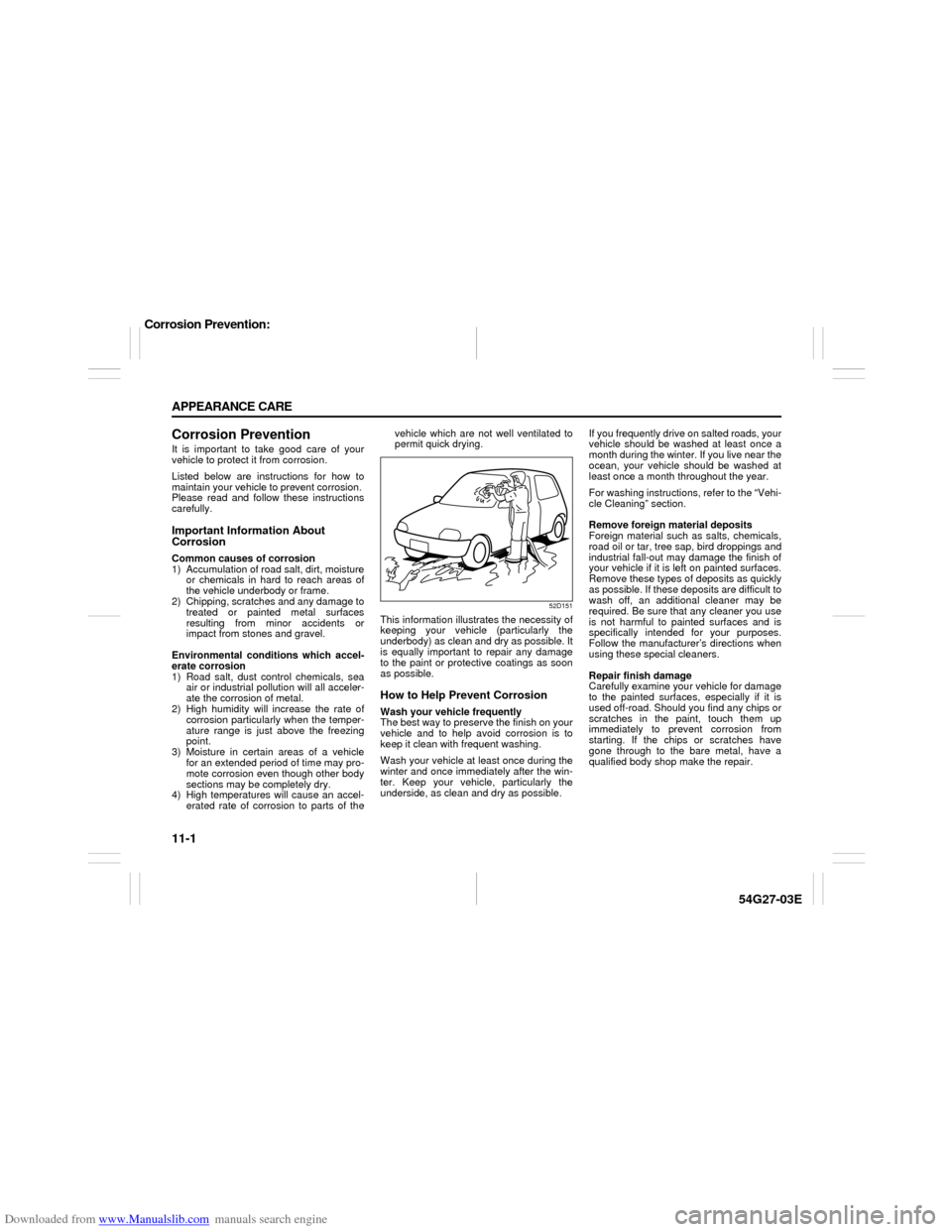
52D151
This information illustrates the necessity of
keeping your vehicle (particularly the
underbody) as clean and dry as possible. It
is equally important to repair any damage
to the paint or protective coatings as soon
as possible.How to Help Prevent CorrosionWash your vehicle frequently
The best way to preserve the finish on your
vehicle and to help avoid corrosion is to
keep it clean with frequent washing.
Wash your vehicle at least once during the
winter and once immediately after the win-
ter. Keep your vehicle, particularly the
underside, as clean and dry as possible.If you frequently drive on salted roads, your
vehicle should be washed at least once a
month during the winter. If you live near the
ocean, your vehicle should be washed at
least once a month throughout the year.
For washing instructions, refer to the “Vehi-
cle Cleaning” section.
Remove foreign material deposits
Foreign material such as salts, chemicals,
road oil or tar, tree sap, bird droppings and
industrial fall-out may damage the finish of
your vehicle if it is left on painted surfaces.
Remove these types of deposits as quickly
as possible. If these deposits are difficult to
wash off, an additional cleaner may be
required. Be sure that any cleaner you use
is not harmful to painted surfaces and is
specifically intended for your purposes.
Follow the manufacturer’s directions when
using these special cleaners.
Repair finish damage
Carefully examine your vehicle for damage
to the painted surfaces, especially if it is
used off-road. Should you find any chips or
scratches in the paint, touch them up
immediately to prevent corrosion from
starting. If the chips or scratches have
gone through to the bare metal, have a
qualified body shop make the repair.
Corrosion Prevention:
Page 230 of 232

Downloaded from www.Manualslib.com manuals search engine 15-4 INDEX
54G27-03E
Rear Window Defroster Switch
..........................................4-10
Rear Window Wiper/Washer Switch
..................................3-5
Refill with Oil and Check for Leaks ....................................9-13
Refilling
................................................................................9-12
Remote Audio Controls
.............................................. 3-8
, 4-43
Replace the Oil Filter
...........................................................9-13
Replacement of the transmitter battery
.............................2-4
Reporting Safety Defects
....................................................12-4
SSafety Certification Label
...................................................12-2
Seat Adjustment
..................................................................2-11
Seat Belt Extender ...............................................................2-30
Seat Belt Hanger
..................................................................2-21
Seat Belt Inspection
............................................................2-22
Seat Belt Pretensioner System
..........................................2-31
Seat Belt Reminder
..............................................................2-19
Seat Belts and Child Restraint Systems
...........................2-13
Selection of Coolant
............................................................9-17
Shoulder Anchor Height Adjuster
......................................2-21
Side Door Locks
..................................................................2-1
Snow Tires
...........................................................................9-31
Spark Plugs ..........................................................................9-21
SPECIFICATIONS
................................................................14-1
Specified Fluid
.....................................................................9-16
Specified Gear Oil ................................................................9-14
Specified Oil
.........................................................................9-11
Speedometer ........................................................................4-7
Spot Light
.............................................................................5-7
Starting the Engine
..............................................................6-2
Steering Wheel
.....................................................................9-24
Stowing Rear Center Lap-Shoulder Belt
...........................2-19Sun Visor
............................................................................. 5-6
Supplemental Restraint System (air bags)
....................... 2-32
TTachometer
.......................................................................... 4-9
Temperature Gauge
............................................................ 4-10
Thermometer
....................................................................... 4-13
Tilt Steering Lock Lever
..................................................... 3-6
Tire Chains
.......................................................................... 7-3
Tire Changing Tools
........................................................... 5-12
Tire Inflation Pressure ........................................................ 9-26
Tire Inspection
.................................................................... 9-27
Tire Rotation
........................................................................ 9-29
Tire Sidewall Labeling
........................................................ 9-25
Tire Size
............................................................................... 9-26
Tires
..................................................................................... 9-25
Towing a Disabled Vehicle
................................................. 10-5
Towing Your Vehicle (recreational towing)
...................... 8-2
Trailer Towing
..................................................................... 8-2
Trip meter
............................................................................ 4-7
Troubleshooting
.................................................................. 4-47
Trunk Lid
.............................................................................. 2-7
Trunk Light .......................................................................... 5-13
Turn Signal Indicators
........................................................ 4-6
Turn Signal Operation ........................................................ 3-4
UUniform Tire Quality Grading
............................................. 9-29
Unlatching and Latching Detachable Connector
............. 2-18
Using the Transaxle
............................................................ 6-4
VVehicle Cleaning
................................................................. 11-3
Vehicle Identification Number
........................................... 12-1