2007 SUZUKI AERIO fuel
[x] Cancel search: fuelPage 131 of 232

Downloaded from www.Manualslib.com manuals search engine 6-2 OPERATING YOUR VEHICLE
54G27-03E
12)Check all gauges.
13)Make sure that the BRAKE light turns
off when the parking brake is released.
Once a week, or each time you fill your fuel
tank, perform the following under-hood
checks:
1) Engine oil level
2) Coolant level
3) Brake fluid level
4) Power steering (if equipped) fluid level
5) Windshield washer fluid level
6) Hood latch operation
Pull the hood release handle inside the
vehicle. Make sure that you cannot
open the hood all the way without
releasing the secondary latch. Be sure
to close the hood securely after check-
ing for proper latch operation. See the
item “All latches, hinges and locks” of
“CHASSIS AND BODY” in the “Periodic
Maintenance Schedule” section in the
“INSPECTION AND MAINTENANCE”
section for lubrication schedule.
Starting the EngineBefore Starting the Engine1) Make sure the parking brake is set fully.
2) Manual Transaxle – Shift into “N” (Neu-
tral) and depress the clutch pedal all
the way to the floor.
Hold it while starting the engine.
Automatic Transaxle – If the gearshift
lever is not in “P” (Park) position, shift
into “P”. (If you need to re-start the
engine while the vehicle is moving, shift
into “N”.)
NOTE:
The engine of manual transaxle vehicle will
not start unless the clutch pedal is
depressed.
NOTE:
Automatic transaxle vehicles have a starter
interlock device which is designed to keep
the starter from operating if the transaxle is
in any of the drive positions.
Starting a Cold EngineWith your foot off the accelerator pedal,
crank the engine by turning the ignition key
to “START”. Release the key when the
engine starts.
If the engine does not start after 15 sec-
onds of cranking, wait about 15 seconds,
then press down the accelerator pedal to
1/3 of its travel and try cranking the engine
again. Release the key and accelerator
pedal when the engine starts.
If the engine still does not start, try holding
the accelerator pedal all the way to the
floor while cranking. This should clear the
engine if it is flooded.
If you are unable to start the engine using
this procedure, consult your SUZUKI
dealer.Starting a Warm EngineUse the same procedure as for “Starting a
Cold Engine”.
WARNING
Make sure the hood is fully closed
and latched before driving. If it is not,
it can fly up unexpectedly during
driving, obstructing your view and
resulting in an accident.
WARNING
Make sure that the parking brake is
set fully and the transaxle is in Neu-
tral (or Park for vehicles with an auto-
matic transaxle) before attempting to
start the engine.
CAUTION
Stop turning the starter immedi-
ately after the engine has started or
the starter system can be dam-
aged.
Do not crank the engine for more
than 15 seconds at a time. If the
engine doesn’t start on the first try,
wait about 15 seconds before try-
ing again.
Daily Inspection Checklist: NO
Starting the Engine: 1
Page 138 of 232

Downloaded from www.Manualslib.com manuals search engine 6-9 OPERATING YOUR VEHICLE
54G27-03E
How the ABS WorksA computer continuously monitors wheel
speed. The computer compares the
changes in wheel speed when braking. If
the wheels slow suddenly, indicating a
skidding situation, the computer will
change braking pressure several times
each second to prevent the wheels from
locking. When you start your vehicle or
when you accelerate after a hard stop, you
may hear a momentary motor or clicking
noise as the system resets or checks itself.
Break-In Catalytic Converter
54G236
The purpose of the catalytic converter is to
minimize the amount of harmful pollutants
in your vehicle’s exhaust. Use of leaded
fuel in vehicles equipped with catalytic
converters is prohibited by federal law,
because lead deactivates the pollutant-
reducing components of the catalyst sys-
tem.
The converter is designed to last the life of
the vehicle under normal usage and when
unleaded fuel is used. No special mainte-
nance is required on the converter. How-
ever, it is very important to keep the engine
properly tuned. Engine misfiring, which
can result from an improperly tuned
engine, may cause overheating of the cat-
alyst. This may result in permanent heat
damage to the catalyst and other vehicle
components.
WARNING
The ABS may not work properly if
tires or wheels other than those
specified in the owner’s manual are
used. This is because the ABS works
by comparing changes in wheel
speed. When replacing tires or
wheels, use only the size and type
specified in this owner’s manual.
CAUTION
The future performance and reliabil-
ity of the engine depends on the care
and restraint exercised during its
early life. It is especially important to
observe the following precautions
during the initial 960 km (600 miles)
of vehicle operation.
After starting, do not race the
engine. Warm it up gradually.
Avoid prolonged vehicle operation
at a constant speed. Moving parts
will break in better if you vary your
speed.
Start off from a stop slowly. Avoid
full throttle starts.
Avoid hard stopping, especially
during the first 320 km (200 miles)
of driving.
Do not drive slowly with the tran-
saxle in a high gear.
Drive the vehicle at moderate
engine speeds.
Braking: 6
Break-In: 6
Catalytic Converter: NO
Page 139 of 232

Downloaded from www.Manualslib.com manuals search engine 6-10 OPERATING YOUR VEHICLE
54G27-03E
54G584S
Improving Fuel EconomyThe following instructions will help you
improve fuel economy.
Avoid excessive idling
If you are to wait for more than a minute
while you are parked, stop the engine and
start it again later. When warming up a
cold engine, allow the engine to idle until
the temperature gauge pointer comes up
to the “C” position. In this position, the
engine is sufficiently warm for starting off.
Avoid “jackrabbit” starts
Fast starts away from lights or stop signs
will consume fuel unnecessarily and
shorten engine life. Start off slowly.
Avoid unnecessary stops
Avoid unnecessary deceleration and stop-
ping. Try to maintain a slow, steady speed
whenever possible. Slowing down and then
accelerating again uses more fuel.
Keep a steady cruising speed
Keep as constant a speed as road and traf-
fic conditions will permit.
CAUTION
To minimize the possibility of catalyst
or other vehicle damage:
Maintain the engine in the proper
operating condition.
In the event of an engine malfunc-
tion, particularly one involving
engine misfire or other apparent
loss of performance, have the vehi-
cle serviced promptly.
Do not shut off the engine or inter-
rupt the ignition when the transaxle
is in gear and the vehicle is in
motion.
Do not try to start the engine by
pushing or towing the vehicle or
coasting down a hill.
Do not idle the engine with any
spark plug wires disconnected or
removed, such as during diagnos-
tic testing.
Do not idle the vehicle for pro-
longed periods if idling seems
rough or there are other malfunc-
tions.
Do not allow the fuel tank to get
near the empty level.
WARNING
Be careful where you park and drive;
the catalytic converter and other
exhaust components can get very
hot. As with any vehicle, do not park
or operate this vehicle in areas where
combustible materials such as dry
grass or leaves can come in contact
with a hot exhaust system.
Catalytic Converter: NO
Improving Fuel Economy: NO
Page 140 of 232
Downloaded from www.Manualslib.com manuals search engine 6-11 OPERATING YOUR VEHICLE
54G27-03E
60A183S
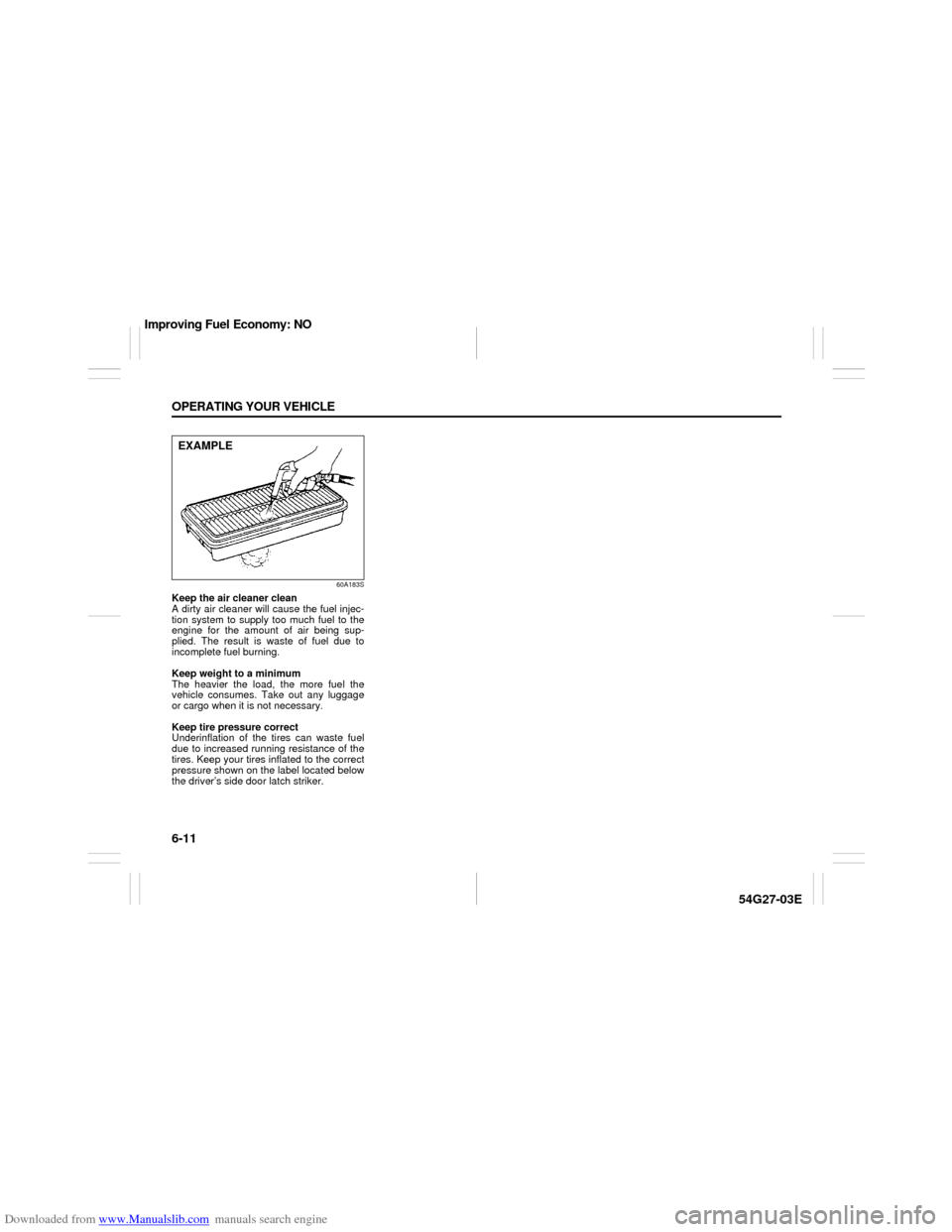
Keep the air cleaner clean
A dirty air cleaner will cause the fuel injec-
tion system to supply too much fuel to the
engine for the amount of air being sup-
plied. The result is waste of fuel due to
incomplete fuel burning.
Keep weight to a minimum
The heavier the load, the more fuel the
vehicle consumes. Take out any luggage
or cargo when it is not necessary.
Keep tire pressure correct
Underinflation of the tires can waste fuel
due to increased running resistance of the
tires. Keep your tires inflated to the correct
pressure shown on the label located below
the driver’s side door latch striker.EXAMPLE
Improving Fuel Economy: NO
Page 149 of 232
Downloaded from www.Manualslib.com manuals search engine 8-2 VEHICLE LOADING AND TOWING
54G27-03E
Trailer Towing
54G639
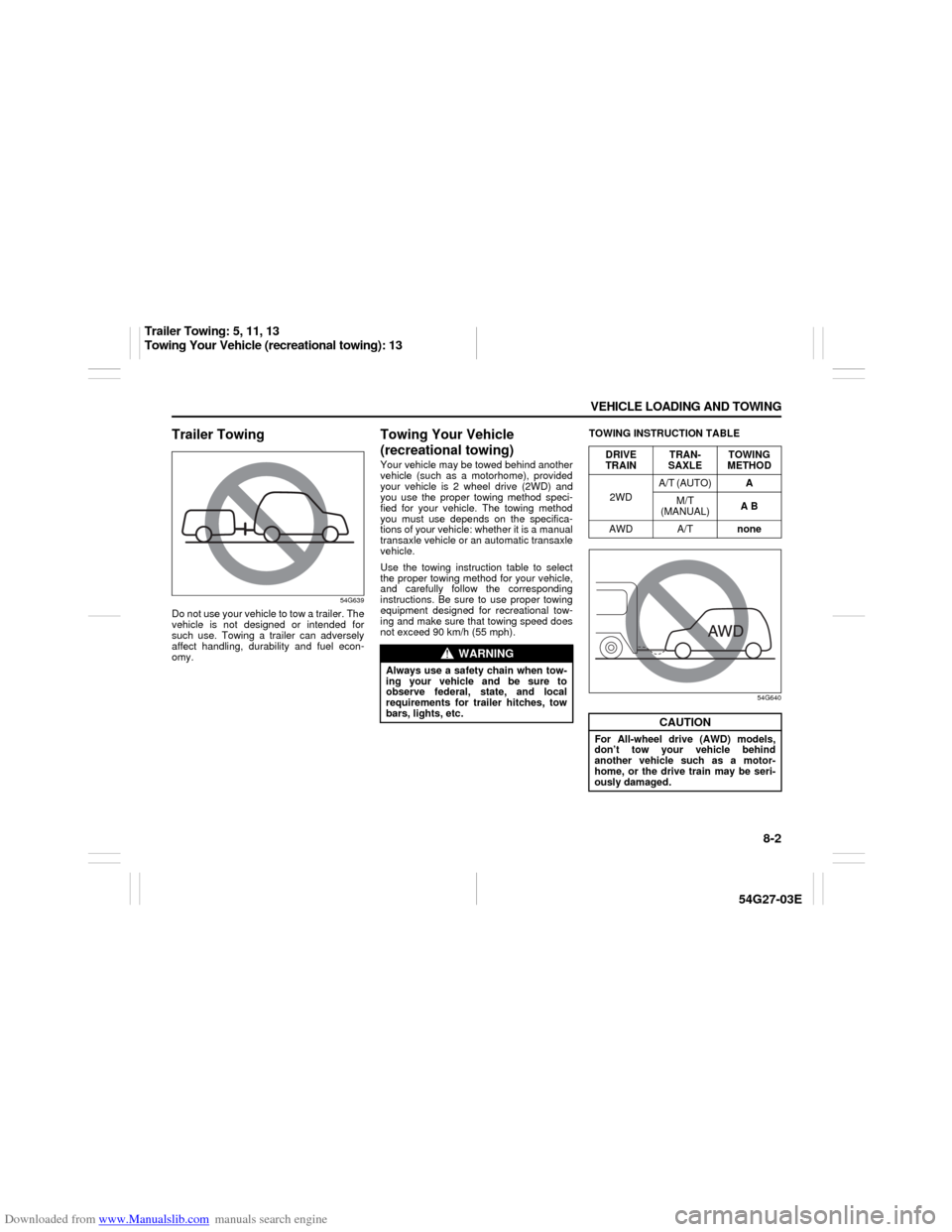
Do not use your vehicle to tow a trailer. The
vehicle is not designed or intended for
such use. Towing a trailer can adversely
affect handling, durability and fuel econ-
omy.
Towing Your Vehicle
(recreational towing)Your vehicle may be towed behind another
vehicle (such as a motorhome), provided
your vehicle is 2 wheel drive (2WD) and
you use the proper towing method speci-
fied for your vehicle. The towing method
you must use depends on the specifica-
tions of your vehicle: whether it is a manual
transaxle vehicle or an automatic transaxle
vehicle.
Use the towing instruction table to select
the proper towing method for your vehicle,
and carefully follow the corresponding
instructions. Be sure to use proper towing
equipment designed for recreational tow-
ing and make sure that towing speed does
not exceed 90 km/h (55 mph).TOWING INSTRUCTION TABLE
54G640
WARNING
Always use a safety chain when tow-
ing your vehicle and be sure to
observe federal, state, and local
requirements for trailer hitches, tow
bars, lights, etc.
DRIVE
TRAINTRAN-
SAXLETOWING
METHOD
2WDA/T (AUTO)A
M/T
(MANUAL)A B
AWD A/Tnone
CAUTION
For All-wheel drive (AWD) models,
don’t tow your vehicle behind
another vehicle such as a motor-
home, or the drive train may be seri-
ously damaged.
Trailer Towing: 5, 11, 13
Towing Your Vehicle (recreational towing): 13
Page 156 of 232

Downloaded from www.Manualslib.com manuals search engine 9-3 INSPECTION AND MAINTENANCE
54G27-03E
Periodic Maintenance ScheduleR: Replace or change
I : Inspect and correct, replace or lubricate if necessaryInterval: This interval should be judged by odometer
reading or months, whichever comes first.miles (x 1000) 7.5 15 22.5 30 37.5 45 52.5 60 67.5 75
km (x 1000) 12.5 25 37.5 50 62.5 75 87.5 100 112.5 125
months 7.5 1522.53037.54552.56067.575ENGINE & EMISSION CONTROL
1. Drive belt
*Tension check, *adjustment, *replacement
–
–
–
I
–
–
–
I
–
–
2. Engine oil and oil filter R R R R R R R R R R*3.
Cooling system hoses and connections
–
–
–
I
–
–
–
I
–
–
4. Engine coolant – – – R – – – R – –*5.
Exhaust pipes and mountings
–
–
–
I
–
–
–
I
–
–
*6. EVAP canister Replace every 250000 km (150000 miles) or 180 months*7.
Emission-related hoses & tubes
–
–
–
–
–
–
–
I
–
–
8. Spark plugs – – – – – – – R – –*9.
Ignition coil (plug cap)
–
–
–
I
–
–
–
I
–
–
*10.Fuel tank & cap –I–I–I–I–I11.
Air cleaner filter element (paved road)
–
–
–
R
–
–
–
R
–
–
*12.Fuel filter ––––––––––*13.
Fuel lines and connections
–
–
–
I
–
–
–
I
–
–
*14. Canister air suction filter Replace every 250000 km (150000 miles) or 180 months
Periodic Maintenance Schedule: 1, 2, 3, 4, 5, 6, 9, 10
Page 157 of 232

Downloaded from www.Manualslib.com manuals search engine 9-4 INSPECTION AND MAINTENANCE
54G27-03E
R: Replace or change
I : Inspect and correct, replace or lubricate if necessary
#1: Inspect at 250000 km (150000 miles) or 180 months.
NOTE:
The maintenance services enclosed with rectangle are recommended maintenance items.Interval: This interval should be judged by odometer
reading or months, whichever comes first.miles (x 1000) 82.5 90 97.5 105 112.5 120 127.5 135 142.5 150
km (x 1000) 137.5 150 162.5 175 187.5 200 212.5 225 237.5 250
months 82.5 90 97.5 105 112.5 120 127.5 135 142.5 150ENGINE & EMISSION CONTROL
1. Drive belt
*Tension check, *adjustment, *replacement
–
I
–
–
–
I
–
–
–
I
2. Engine oil and oil filter R R R R R R R R R R*3.
Cooling system hoses and connections
–
I
–
–
–
I
–
–
–
I
4. Engine coolant – R – – – R – – – R*5.
Exhaust pipes and mountings
–
I
–
–
–
I
–
–
–
I
*6. EVAP canister Replace every 250000 km (150000 miles) or 180 months*7.
Emission-related hoses & tubes
–
–
–
–
–
I
–
–
–
I
8. Spark plugs – – – – – R – – – –*9.
Ignition coil (plug cap)
–
I
–
–
–
I
–
–
–
I
*10.Fuel tank & cap –I–I–I–I–I (#1)11.
Air cleaner filter element (paved road)
–
R
–
–
–
R
–
–
–
R
*12.Fuel filter –––––––––R*13.
Fuel lines and connections
–
I
–
–
–
I
–
–
–
I (#1)
*14. Canister air suction filter Replace every 250000 km (150000 miles) or 180 monthsThe U.S. Environmental Protection Agency or the California Air Resources Board has determined that the failure to perform recom-
mended maintenance items enclosed with a rectangle will not nullify the emission warranty or limit recall liability prior to the completion
of the vehicle’s useful life. SUZUKI, however, urges that all recommended maintenance services be performed at the indicated inter-
vals and the maintenance recorded.
Periodic Maintenance Schedule: 1, 2, 3, 4, 5, 6, 9, 10
Page 160 of 232

Downloaded from www.Manualslib.com manuals search engine 9-7 INSPECTION AND MAINTENANCE
54G27-03E
Maintenance Recommended under Severe Driving ConditionsFollow this schedule if your car is mainly operated under one or more of the following conditions:
When most trips are less than 6 kilometers (4 miles)
When most trips are less than 16 kilometers (10 miles) and outside temperature remain below freezing.
Idling and/or low-speed operation in stop-and-go traffic.
Operating in dusty areas.
Schedule should also be followed if the car is used for delivery service, police, taxi or other commercial applications.
R: Replace or change
I : Inspect and correct, replace or lubricate if necessaryInterval: This interval should be judged by odometer
reading or months, whichever comes first.miles (x 1000) 3 6 9 12 15 18 21 24 27 30 33 36 39
km (x 1000) 5 101520253035404550556065
months 3 6 9 12 15 18 21 24 27 30 33 36 39ENGINE & EMISSION CONTROL
1. Drive belt
*Tension check, *adjustment, *replacement
–
–
–
–
–
–
–
–
–
I
–
–
–
2.Engine oil and oil filter RRRRRRRRRRRRR
*3.
Cooling system hoses and connections
–
–
–
–
I
–
–
–
–
I
–
–
–
4.Engine coolant –––––––––R–––
*5.
Exhaust pipes and mountings
–
–
–
–
I
–
–
–
–
I
–
–
–
*6. EVAP canister Replace every 250000 km (150000 miles) or 180 months
*7.
Emission-related hoses & tubes
–
–
–
–
–
–
–
–
–
–
–
–
–
8.Spark plugs –––––––––––––
*9.
Ignition coil (plug cap)
–
–
–
–
–
–
–
–
–
I
–
–
–
*10.Fuel tank & cap –––– I –––– I –––
11.
Air cleaner filter element (paved road)
I
I
I
I
I
I
I
I
I
R
I
I
I
*12. Fuel filter Replace every 250000 km (150000 miles) or 150 months
*13.
Fuel lines and connections
–
–
–
–
I
–
–
–
–
I
–
–
–
*14.Canister air suction filter –––––––––––––
Engine Oil and Filter: 1, 2