2007 SUBARU TRIBECA spare tire
[x] Cancel search: spare tirePage 279 of 377
9-8 In case of emergency
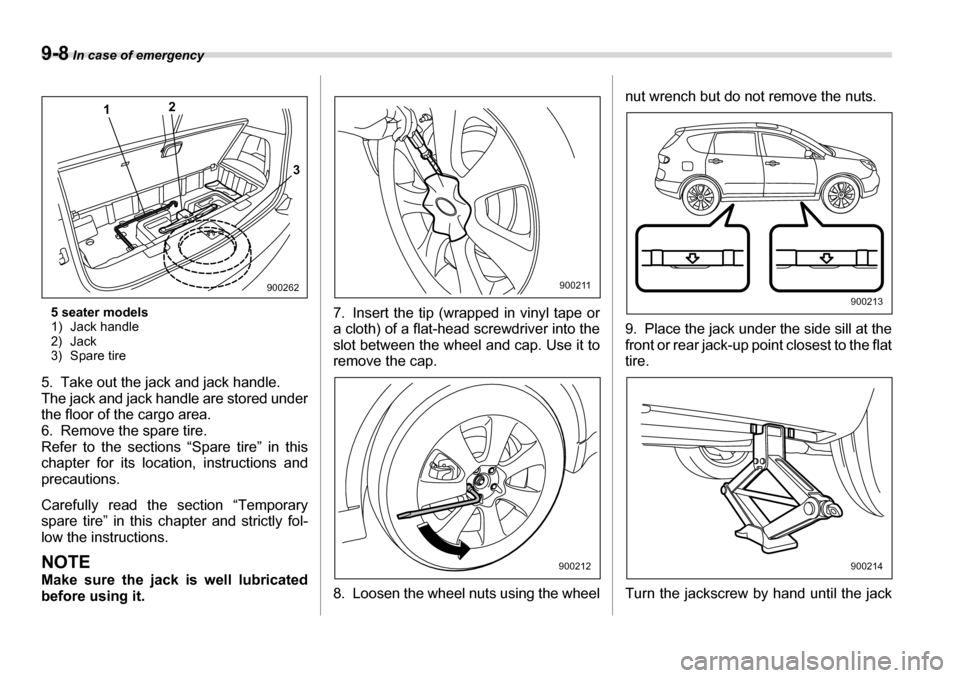
5 seater models
1) Jack handle
2) Jack
3) Spare tire
5. Take out the jack and jack handle.
The jack and jack handle are stored under
the floor of the cargo area.
6. Remove the spare tire.
Refer to the sections “Spare tire” in this
chapter for its location, instructions and
precautions.
Carefully read the section “Temporary
spare tire” in this chapter and strictly fol-
low the instructions.
NOTE
Make sure the jack is well lubricated
before using it. 7. Insert the tip (wrapped in vinyl tape or
a cloth) of a flat-head screwdriver into the
slot between the wheel and cap. Use it to remove the cap.
8. Loosen the wheel nuts using the wheel nut wrench but do not remove the nuts.
9. Place the jack under the side sill at the
front or rear jack-up point closest to the flat
tire.
Turn the jackscrew by hand until the jack
1
3
2
900262900211
900212
900213
900214
Page 280 of 377
In case of emergency 9-9
– CONTINUED –
head engages firmly into the jack-up point.
10.Insert the jack handle into the jack-
screw, and turn the handle until the tire
clears the ground. Do not raise the vehicle
higher than necessary.
11.Remove the wheel nuts and the flattire.
12.Before putting the spare tire on, clean
the mounting surface of the wheel and
hub with a cloth.
13.Put on the spare tire. Replace the
wheel nuts. Tighten them by hand.
14.Turn the jack handle counterclockwise
to lower the vehicle.
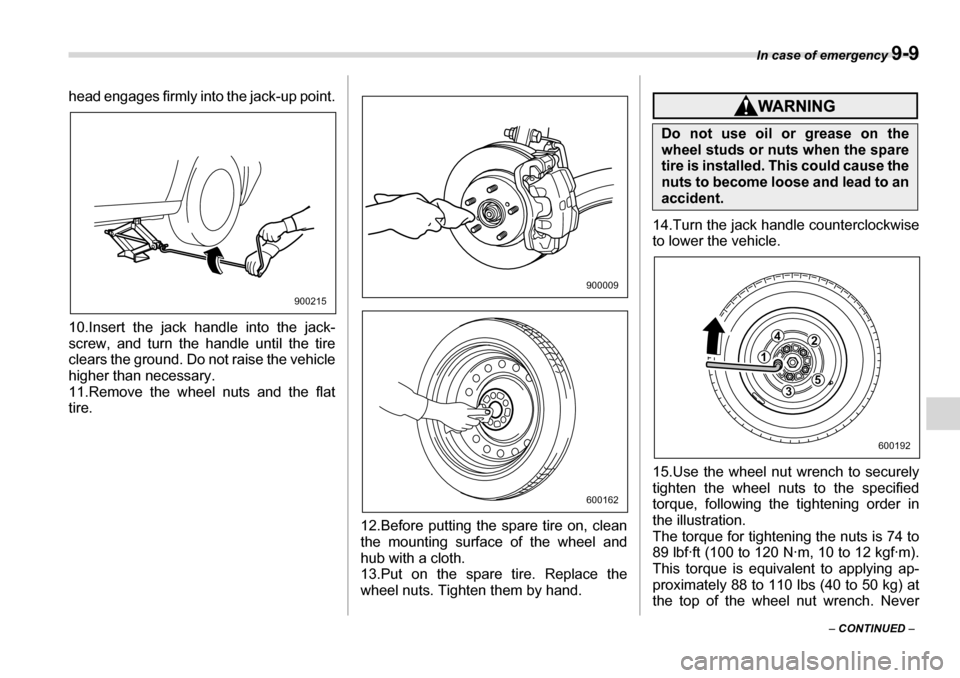
15.Use the wheel nut wrench to securely
tighten the wheel nuts to the specified
torque, following the tightening order in
the illustration.
The torque for tightening the nuts is 74 to
89 lbf·ft (100 to 120 N·m, 10 to 12 kgf·m).
This torque is equivalent to applying ap-
proximately 88 to 110 lbs (40 to 50 kg) at
the top of the wheel nut wrench. Never
900215
900009
600162
Do not use oil or grease on the
wheel studs or nuts when the spare
tire is installed. This could cause the
nuts to become loose and lead to an
accident.
1
42
53
600192
Page 281 of 377
9-10 In case of emergency
use your foot on the wheel nut wrench or
a pipe extension on the wrench because
you may exceed the specified torque.
Have the wheel nut torque checked at the
nearest automotive service facility.
16.Store the flat tire in the spare tire hold- er.
Refer to the sections “Spare tire” in this
chapter for its location, instructions and
precautions.
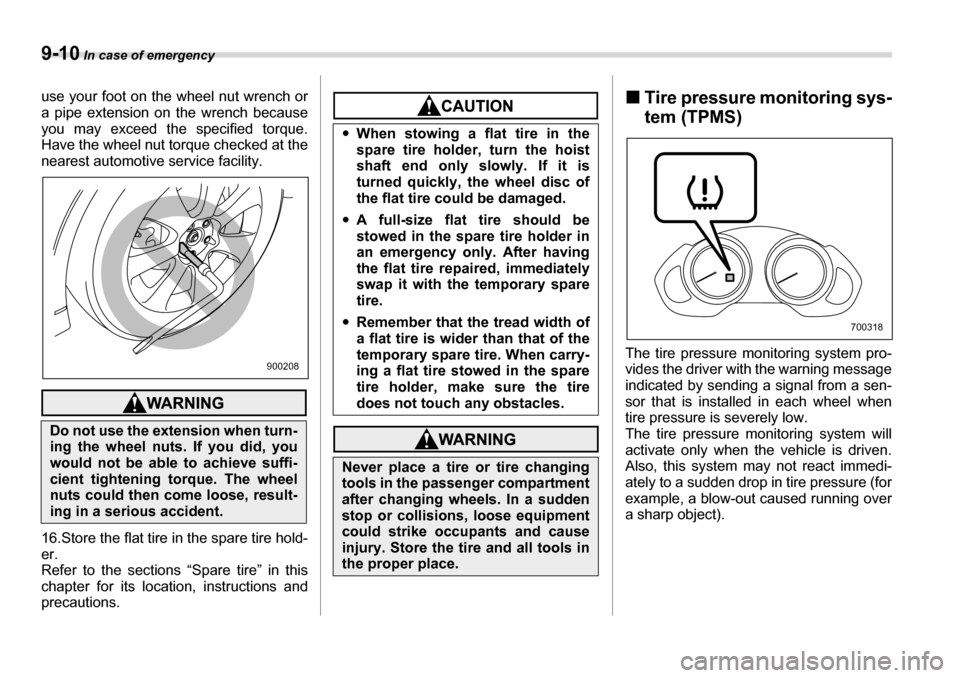
„Tire pressure monitoring sys- tem (TPMS)
The tire pressure monitoring system pro-
vides the driver with the warning message
indicated by sending a signal from a sen-
sor that is installed in each wheel when
tire pressure is severely low.
The tire pressure monitoring system will
activate only when the vehicle is driven.
Also, this system may not react immedi-
ately to a sudden drop in tire pressure (for
example, a blow-out caused running over
a sharp object).
Do not use the extension when turn-
ing the wheel nuts. If you did, you
would not be able to achieve suffi-
cient tightening torque. The wheel
nuts could then come loose, result-
ing in a serious accident.
900208
y When stowing a flat tire in the
spare tire holder, turn the hoist
shaft end only slowly. If it is
turned quickly, the wheel disc of
the flat tire could be damaged.
y A full-size flat tire should be
stowed in the spare tire holder in
an emergency only. After havingthe flat tire repaired, immediately
swap it with the temporary spare tire.
y Remember that the tread width of
a flat tire is wider than that of the
temporary spare tire. When carry-
ing a flat tire stowed in the spare
tire holder, make sure the tire
does not touch any obstacles.
Never place a tire or tire changing
tools in the passenger compartment
after changing wheels. In a sudden
stop or collisions, loose equipment
could strike occupants and cause
injury. Store the tire and all tools in
the proper place.
700318
Page 282 of 377
In case of emergency 9-11
– CONTINUED –
Jump starting
If the low tire pressure warning light
comes on while driving, never brake
suddenly and keep driving straight
ahead while gradually reducing
speed. Then slowly pull off the road
to a safe place. Otherwise an acci-
dent involving serious vehicle dam-
age and serious personal injury
could occur.
Check the pressure for all four tires
and adjust the pressure to the COLD
tire pressure shown on the vehicle
placard on the door pillar on the
driver’s side. If this light still comes
on while driving after adjusting the
tire pressure, a tire may have signif-
icant damage and a fast leak that
causes the tire to lose air rapidly. If
you have a flat tire, replace it with a
spare tire as soon as possible.
When a spare tire is mounted or a
wheel rim is replaced without the
original pressure sensor/transmitter
being transferred, the low tire pres-
sure warning light will flash. This in-
dicates the TPMS is unable to moni-
tor all four road wheels. Contact
your SUBARU dealer as soon as
possible for tire and sensor replace-
ment and/or system resetting.
Do not inject any tire liquid or aero-
sol tire sealant into the tires, as this
may cause a malfunction of the tire
pressure sensors.
If the light flashes, promptly contact
a SUBARU dealer to have the sys-
tem inspected.
yBattery fluid is SULFURIC ACID.
Do not let it come in contact with
the eyes, skin, clothing or the ve- hicle.
If battery fluid gets on you, thor-
oughly flush the exposed area
with water immediately. Get medi-
cal help if the fluid has entered
your eyes.
If battery fluid is accidentally
swallowed, immediately drink a
large amount of milk or water, and
obtain immediate medical help.
Keep everyone including children
away from the battery.
yThe gas generated by a battery ex-
plodes if a flame or spark is
brought near it. Do not smoke or
light a match while jump starting.
yNever attempt jump starting if the
discharged battery is frozen. It
could cause the battery to burst or
explode.
Page 322 of 377
Maintenance and service 11 - 2 5
– CONTINUED –
„
Tire inspection
Check on a daily basis that the tires are
free from serious damage, nails, and
stones. At the same time, check the tires
for abnormal wear.
Contact your SUBARU dealer immediate-
ly if you find any problem.
NOTE y When the wheels and tires strike curbs or are subjected to harsh treat-
ment as when the vehicle is driven on a
rough surface, they can suffer damage
that cannot be seen with the naked eye.
This type of damage does not become
evident until time has passed. Try not
to drive over curbs, potholes or on oth-
er rough surfaces. If doing so is un-
avoidable, keep the vehicle’s speed
down to a walking pace or less, and ap-
proach the curbs as squarely as possi-
ble. Also, make sure the tires are not
pressed against the curb when you
park the vehicle. y
If you feel unusual vibration while
driving or find it difficult to steer the ve-
hicle in a straight line, one of the tires
and/or wheels may be damaged. Drive
slowly to the nearest authorized
SUBARU dealer and have the vehicle
inspected. „ Tire pressures and wear
Maintaining the correct tire pressures
helps to maximize the tires’ service lives
and is essential for good running perfor-
mance. Check and, if necessary, adjust
the pressure of each tire (including the
spare) at least once a month (for example,
during a fuel stop) and before any long
journey. Check the tire pressures when the tires
are cold. Use a pressure gauge to adjust
the tire pressures to the values shown on
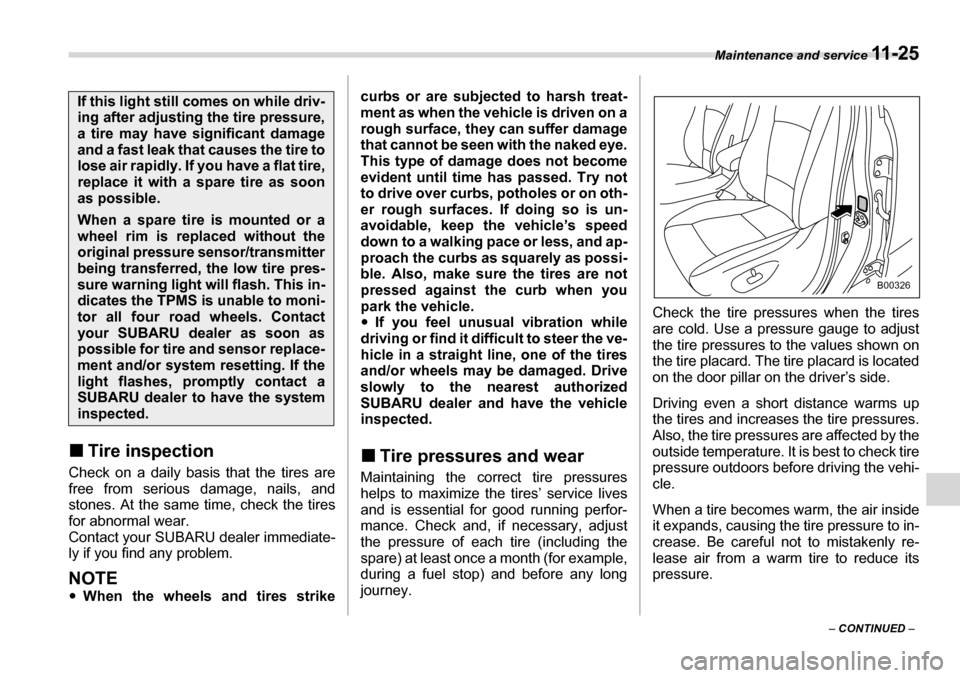
the tire placard. The tire placard is located
on the door pillar on the driver’s side.
Driving even a short distance warms up
the tires and increases the tire pressures. Also, the tire pressures are affected by the
outside temperature. It is best to check tire
pressure outdoors before driving the vehi- cle.
When a tire becomes warm, the air inside
it expands, causing the tire pressure to in-
crease. Be careful not to mistakenly re-
lease air from a warm tire to reduce its
pressure.
If this light still comes on while driv-
ing after adjusting the tire pressure,
a tire may have significant damage
and a fast leak that causes the tire to
lose air rapidly. If you have a flat tire,
replace it with a spare tire as soon
as possible.
When a spare tire is mounted or a
wheel rim is replaced without the
original pressure sensor/transmitter
being transferred, the low tire pres-
sure warning light will flash. This in-
dicates the TPMS is unable to moni-
tor all four road wheels. Contact
your SUBARU dealer as soon as
possible for tire and sensor replace-
ment and/or system resetting. If the
light flashes, promptly contact a
SUBARU dealer to have the system
inspected.
B00326
Page 346 of 377
Specifications 12-3
– CONTINUED –
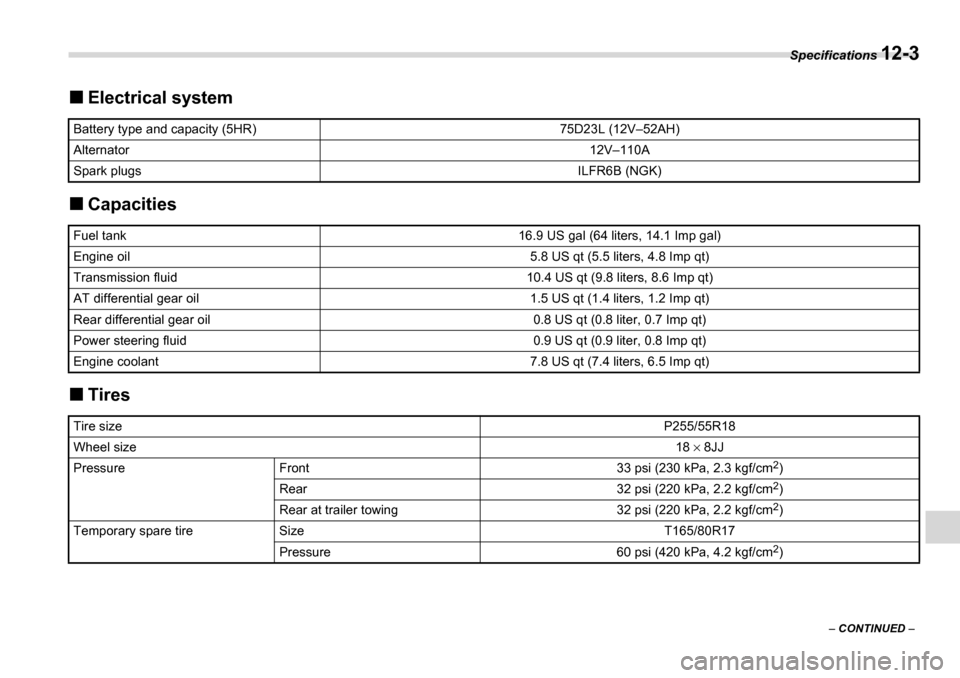
„Electrical system
„ Capacities
„ Tires
Battery type and capacity (5HR)75D23L (12V–52AH)
Alternator12V–110A
Spark plugsILFR6B (NGK)
Fuel tank16.9 US gal (64 liters, 14.1 Imp gal)
Engine oil5.8 US qt (5.5 liters, 4.8 Imp qt)
Transmission fluid10.4 US qt (9.8 liters, 8.6 Imp qt)
AT differential gear oil1.5 US qt (1.4 liters, 1.2 Imp qt)
Rear differential gear oil0.8 US qt (0.8 liter, 0.7 Imp qt)
Power steering fluid0.9 US qt (0.9 liter, 0.8 Imp qt)
Engine coolant7.8 US qt (7.4 liters, 6.5 Imp qt)
Tire sizeP255/55R18
Wheel size18 × 8JJ
PressureFront33 psi (230 kPa, 2.3 kgf/cm 2
)
Rear32 psi (220 kPa, 2.2 kgf/cm 2
)
Rear at trailer towing32 psi (220 kPa, 2.2 kgf/cm 2
)
Temporary spare tireSizeT165/80R17
Pressure60 psi (420 kPa, 4.2 kgf/cm 2
)
Page 358 of 377
Consumer information and Reporting safety defects 13-5
– CONTINUED –
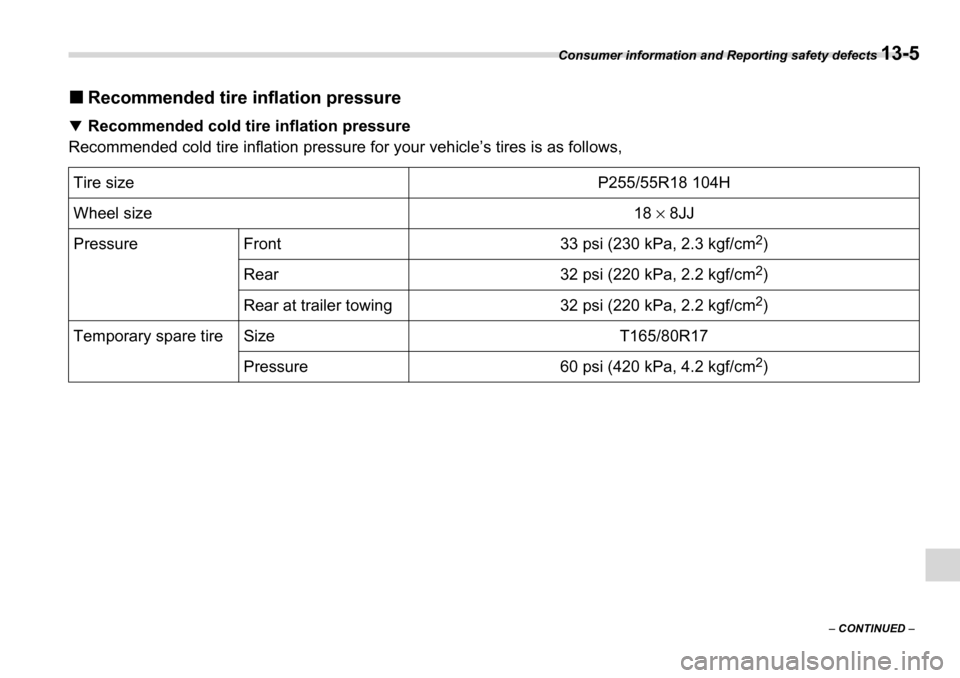
„Recommended tire inflation pressure
T Recommended cold tire inflation pressure
Recommended cold tire inflation pressure for your vehicle’s tires is as follows,
Tire sizeP255/55R18 104H
Wheel size18 × 8JJ
PressureFront33 psi (230 kPa, 2.3 kgf/cm 2
)
Rear32 psi (220 kPa, 2.2 kgf/cm 2
)
Rear at trailer towing32 psi (220 kPa, 2.2 kgf/cm 2
)
Temporary spare tireSizeT165/80R17
Pressure60 psi (420 kPa, 4.2 kgf/cm 2
)
Page 359 of 377
13-6 Consumer information and Reporting safety defects
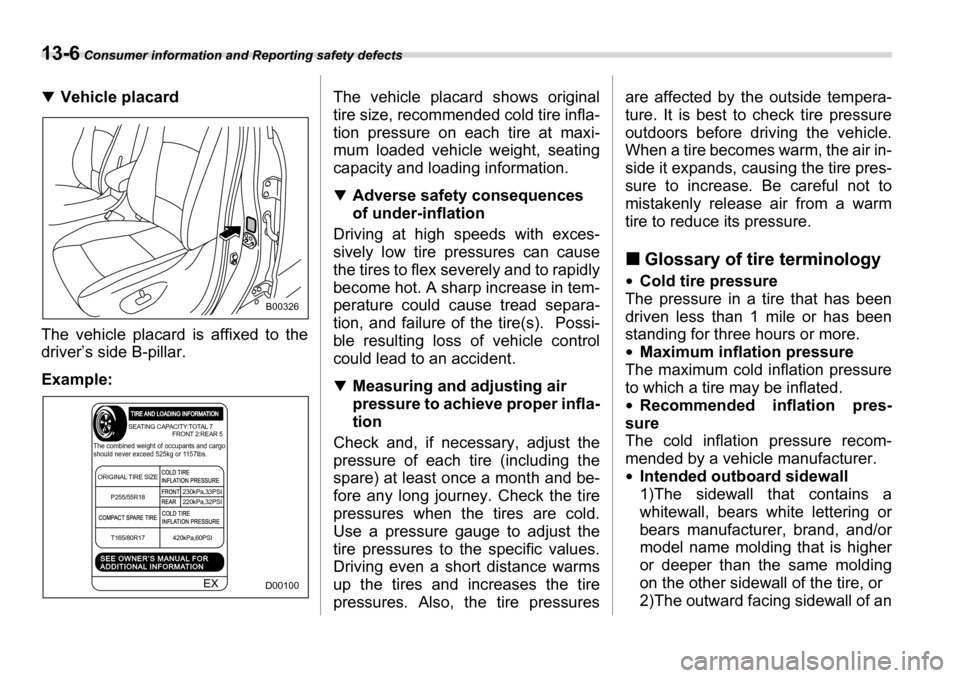
TVehicle placard
The vehicle placard is affixed to the
driver’s side B-pillar. Example: The vehicle placard shows original
tire size, recommended cold tire infla-
tion pressure on each tire at maxi-
mum loaded vehicle weight, seating
capacity and loading information. T
Adverse safety consequences
of under-inflation
Driving at high speeds with exces-
sively low tire pressures can cause
the tires to flex severely and to rapidly
become hot. A sharp increase in tem-
perature could cause tread separa-
tion, and failure of the tire(s). Possi-
ble resulting loss of vehicle control
could lead to an accident. T Measuring and adjusting air
pressure to achieve proper infla-
tion
Check and, if necessary, adjust the
pressure of each tire (including the
spare) at least once a month and be-
fore any long journey. Check the tire
pressures when the tires are cold.
Use a pressure gauge to adjust the
tire pressures to the specific values.
Driving even a short distance warms
up the tires and increases the tire
pressures. Also, the tire pressures are affected by the outside tempera-
ture. It is best to check tire pressure
outdoors before driving the vehicle.
When a tire becomes warm, the air in-
side it expands, causing the tire pres-
sure to increase. Be careful not to
mistakenly release air from a warm
tire to reduce its pressure. „
Glossary of tire terminology
y Cold tire pressure
The pressure in a tire that has been
driven less than 1 mile or has been
standing for three hours or more. y Maximum inflation pressure
The maximum cold inflation pressure
to which a tire may be inflated. y Recommended inflation pres-
sure
The cold inflation pressure recom-
mended by a vehicle manufacturer. y Intended outboard sidewall
1)The sidewall that contains a
whitewall, bears white lettering or
bears manufacturer, brand, and/or
model name molding that is higher
or deeper than the same molding
on the other sidewall of the tire, or
2)The outward facing sidewall of an
B00326
TIREAND LOADING INFORMAANDLOADINGINFORMATIONSEATING CAPACITY:TOTAL 7
ORIGINAL TIRE SIZE COLD TIRE
INFLATION PRESSURE
COLD TIRE
INFLATION PRESSURE
FRONT
230kPa,33PSI
REAR 220kPa,32PSI
P255/55R18
T165/80R17 420kPa,60PSI
COMPACT SPARE TIRE FRONT 2:REAR 5
The combined weight of occupants and cargo
should never exceed 525kg or 1157lbs.
SEE OWNER’S MANUALSEE OWNER’S MANUAL FOR FORADDITIONALADDITIONAL INFORMA INFORMATIONTION
EXD00100